4iB Records | For intrinsic Beliefs
Record Label dealing in Industrial, Power Electronics, Harsh Noise, Experimental, Death Industrial, Drone, Ambient, Japanese Noise, Field Recording, Abstract, Musique Concrete and other related genres.

> ASMUS TIETCHENS Interview by Nuno Loureiro – Chain D.L.K. (2007)

Asmus Tietchens is a name that requires no introduction for those who have been following the evolution of the most experimental spectrum of electronic music for the last three decades. More than an interview, the following conversation is a brief voyage through the career of one the most important German sound artists.

Chain D.L.K.: What can you tell about your latest work, Zeta-Menge?
Asmus Tietchens: Zeta-Menge is the sixth album in an ongoing MENGEN series. On this CD I tried to create spatial structures without being “spacy.” There is an acoustic foreground and an acoustic background. My main interest is in the room between foreground and background.
Chain D.L.K.: You developed the Kontact der Jünglinge project with Thomas Köner (www.koener.de). What was the concept behind it? Was it an homage to Karlheinz Stockhausen, or did it go beyond that?
Asmus Tietchens: In a way the name Kontakt der Jünglinge is an homage to the Big Karlheinz. But musically, it absolutely is not. We never aimed to make electronic music like Stockhausen. Thomas and I enjoy improvising live with preformed materials; we like to surprise each other in a live situation. So the majority of our performances does not sound like typical Köner or Tietchens. Much more we try to step beyond our own stylistical borders. By the way, we just began to record our first studio album.
Chain D.L.K.: Going back into the past, you started working during very prolific periods in contemporary German musical history. Although having always a very strong identity, did you ever feel, in any way, affiliated with any movement or aesthetic, like — for instance — the “industrial” one?
Asmus Tietchens: Yes, in the early ’80s, after my “Sky Period,” I felt connected with the industrial movement. Remember, my first post-”Sky” records have been released on industrial labels like United Diaries and Esplendor Geométrico. But soon I found my own path, which differed more and more from the typical industrial attitude. Industrial was a very important and thrilling starting point for further developments in the direction of musique concrète and advanced electronic music.
Chain D.L.K.: On the other hand, you also were in contact with the Krautrock generation, isn’t that right? Did you have any kind of relationship with it?
Asmus Tietchens: Not really. I never prefered that acid stuff à la Klaus Schulze, Throbbing Gristle, etc. But there is one exception: In 1976 I was part of the group Liliental with Dieter Moebius (Cluster + Harmonia) and others. We recorded one album at Conny Planck’s studio; that album was released in 1978 on the Brain label as Liliental.
Chain D.L.K.: With such a long career, how do you see the current production, regarding electronic and experimental music? Has hedonism replaced conceptual thought? Does the avant garde still exist?
Asmus Tietchens: The avant garde still exists, but luckily it is not the old avant garde. A lot of new composers/musicians developed the genre of experimental electronic music very carefully. I do not think that hedonism has replaced conceptual thinking. Of course there is a lot banal electronic stuff around, but in the same way serious approaches increased. The ratio of both is the same as it was in the early ’80s, but nowadays we have more from both of them. These immense quantities make it difficult to separate the chaff from the wheat.

Chain D.L.K.: Electronics have passed from the “laboratories” (including at universities) to mass production. Do you find any significant changes in composition, from the technical point of view?
Asmus Tietchens: Of course digital tools changed the compositional approaches of many musicians. As it did in the ’80s when cheap synthesizers and cheap multi-track recorders became available. Now everyone can buy good computers and useful software for a handful of Euros. That’s really democratic. And still you and I (the listeners) decide what we want to listen to. Maybe this answers the question of quality.
Chain D.L.K.: What are your projects for the near future, concerning artistic and/or academic work?
Asmus Tietchens: Besides the above mentioned studio album with Thomas Köner, I am preparing the next MENGEN album, Eta-Menge, to be released by Line this fall. And after a 12-year break I started again to experiment with the sounds of dripping water. So far I already recorded three new “Hydrophonien.” Early next year Seuchengebiete 4 will be released on Die Stadt.
Chain D.L.K.: You were a professor of Sound Installations at the Hamburg Arts School, right? Do you still teach?
Asmus Tietchens: I am not a professor, but a lecturer. I taught sound design and audio technology at the Hamburg University of Applied Sciences. I still do so.
Chain D.L.K.: In an interview once given to a Portuguese publication (Monitor,issue #1, June 1993), you stated that the Marches Funébres album was”total kitsch,” which is a rather curious thought. Is that still your opinion?
Asmus Tietchens: The whole album isn’t kitschy, oh no! Just “Grünschattiger Nachmittag.” Yes, this piece is still big-time kitsch, it should have been a joke. The concept was to let Django dance the Bolero with schmaltzy strings and pathetic drums. Didn’t it work?
Visit Asmus Tietchens on the web at:
[interviewed by Nuno Loureiro] [proofreading by Benjamin Pike]
(Source: http://www.chaindlk.com/interviews/Asmus-Tietchens/)
> THE NEW BLOCKADERS Profile and Reviews

The New Blockaders (abbreviated TNB) began in 1982. The founder-members, R. and P.D. Rupenus, having previously been involved in several music/art projects since the late ’70s. The New Blockaders play what they refer to as “anti-music” as opposed to industrial music. Over their career The New Blockaders have recorded with Coil, Merzbow, Jim O’Rourke and Thurston Moore among others.
Some reviews:
TNB’s debut is full of chaotic Dada referentialism putting in the bag cryptic Max Ernst collages on the inserts, Hegel or nihilistic Situationism on a declamatory manifesto, and disturbed tumult on their sound, to bring the corpse of art into the crematory again. And you will expect to hear overcharged electricity or deranged machinery, which is as far from that as it makes this edition an intelligent turn in retrospect. You will be tempted to think first of Erik Satie’s Musique D’ameublement (Furniture Music) in a perverse manner. TNB reversed the logics that would generate muzak, ‘a music which was urging you to take no notice of it and to behave (during the intervals) as if it did not exist,’ according to Satie. The noises here are intrusive and sound as if the furniture is what produces them. A squawk symphony filled with rusty wheels and creaking wood floor. There’s even a dog disturbed or a trombone that sings along the crawled households; so that in difference to the angst of their Industrial contemporaries (Throbbing Gristle, Whitehouse) it was in Changez Les Blockeurs’ case a syntax destruction, an anti-narrative in the form of a happening that would draw a sort of acoustic noise art continuity with the assemblages and environments, early sixties pre-Fluxus, of Allan Kaprow, Jim Dine, Robert Whitman or Claes Oldenburg, or in case you permit me the license to align them to something academic, John Cage’s 1940 score Living Room Music which reads: ‘To be played on household objects such as magazines, a table, books, the floor or using architectural objects like window frames,’ will allow it. Predating the Guds Soner, TNB refurnish. e/i



Metalworkers unionised along the line of Anarchist-Surrealist poetics. A warehouse symphony, workers pile scrap metal in honour of Beethoven’s Ode to Joy. Invisible commandos parachuting back in time on tyreless bicycles in the Paris commune, BMX stunts on the barricades, railroad hand-carts creep through loops in the alleys and anchor-chains of Kronstodt. Timeless, historical and recommended. ND
(Source: http://mutant-sounds.blogspot.sg/2007/03/new-blockaders-changez-les-blockeurs.html)
More Info At: http://www.thenewblockaders.org.uk/
> Shadows of the Mind by VARG VIKERNES (2013)
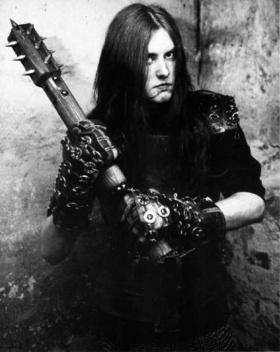
Once upon a time I was a fan of classical music who became an Iron Maiden fan, a thrash metal fan, a death metal fan and musician and eventually a black metal musician. What drove me down that path was the melancholic atmosphere, aggression and energy of the music. I still like classical music and Iron Maiden too, in particlar their «Somewhere in Time» album, but thrash and death metal lost it’s charm the moment I found something better – in 1991.
This something better was called «black metal» by Euronymous, a name he had from a Venom album, and it was something brand new at the time; it was not originally a music style, but a revolt against the commercial nature of and the lack of originality in death metal. The so-called black metal bands were supposed to all be original; they were all supposed to bring something unique and special to the scene. If they didn’t they were not «true»; i. e. not worthy of the black metal label.
Darkthrone had their Satanic image; Burzum had the dark fantasy image. Mayhem had nothing to boast of at the time, they had yet to release their first proper album («Deathcrush» was absolute shit) but they had Euronymous, so they too were naturally considered to be «true». Immortal were not «true», and therefore called their music «holocaust metal» instead, out of fear of Euronymous and his reaction if they started to use the black metal label.
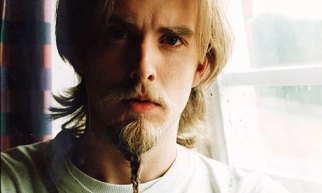
Darkthrone and Burzum – the only bands with an album out in early 1992 – were too successful for this to last though. As could be expected when some bands have success other bands too wanted to play this at the time new style of music – and yes, they saw this as a music style. So it became a music style, and we saw a horde of copy-cat bands coming; Emperor, Enslaved, Gorgoroth and others too began to play music very similar to the music of Darkthrone andBurzum. At first Euronymous tried to stop this, and even visited and threatened a few bands to make them stop, but naturally this was hopeless.
The scene was in turmoil, and with the success of Burzum – signed to Euronymous’ label – Euronymous all of a sudden saw the opportunity to turn his poorly run business into something profitable, and he started to sign the copy-cat bands. As he saw it he secured allies in his «war» against the trendy death metal bands.
Personally I didn’t like it when other bands ripped off my music style, but rather than go around and be angry over this I simply did soemthing new – again. I recorded the «Filosofem» album in early 1993 and made what was supposed to be an «anti-black metal album». I wanted to show the copy-cats that you don’t all have to sound the same; you can do your own thing. Like I did.

«Naturally» this failed miserably, and all of a sudden the bands started to make music sounding just like the music on «Filosofem», and I gave up….
Ah, but naturally I was a fool; bands don’t actually rip off the music of others unless they copy it; the bands who followed us were not copy-cat bands. They were just creative kids who were inspired by the music of others and who changed and even improved the music they were inspired by. Rather than feel insulted I should be proud of having inspired others to make music. Most of it very good music, I am sure. I don’t really know though; I have been to foolish to ever try to listen to any of it. My mind was closed. My heart was closed.
One of the reasons for that was also that with time I saw that Burzum was not only inspiring others to make good music, it was also used or rather mis-used by the same forces who turned death metal into nihilistic shit. Black metal as a movement turned into nihilistic shit as well; all the wrong things were promoted – heavily.
Being a European at heart I naturally didn’t want any part of that, so I repeatedly expressed my contempt for it all. The idea that my creative efforts and name would be used to promote a nihilistic movement was very offensive to me. And naturally I was right to feel that way.
Some times I do good things, and occasionally a string of words that makes sense might come from my lips, but most of the time I am of course the same old fool who was insulted when others liked my music back in 1992, so when I have tried to express my contempt for the twisting and perverting of black metal over the years I have failed to make it clear that I don’t actually think badly of individuals who like the so-called black metal music. Why would I? We are all lost souls in a dying world, so to speak, stripped of all sprititual life and energy by the societies we live in, and left to find new spiritual life and energy on our own. We stumble, we fall and we get up again, as we progress, and black metal, although empty and hollow like most other things in this world, is actually a good gateway to the Divine Light. If nothing else black metal has been a way to find true meaning, a positive direction and new life for many.

As I see it those enthralled by the aggression, melancholy and/or harmonic atmosphere of black metal are on the way to become better, and are thus already better than the rest, and I don’t want you to feel that I think badly of you when I speak badly of black metal as it is today. I don’t like the black metal (or any metal) life style, but that doesn’t mean I have anything against those caught in this lifestyle.
I no longer play metal music, so naturally I don’t say this for commercial reasons. I just think that we get enough shit from the world we live in as it is. There is no reason to add to that load.
HailaR WôðanaR! HailaR BalduR!
(Source: http://thuleanperspective.com/2013/04/30/shadows-of-the-mind/)
> THE LEMON KITTENS Profile By Piero Scaruffi & Andy Kellman
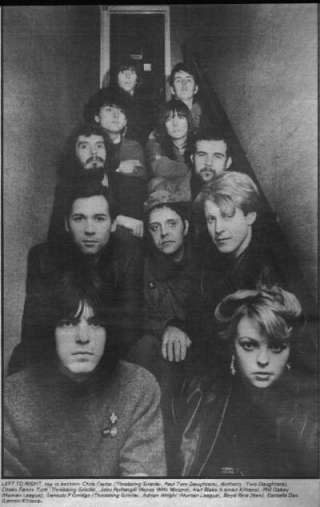
The Lemon Kittens were two young multi-instrumentalists involved in multimedia art-performance/theater: Danielle Dax, a fan of electronic music, biblical mysticism and middle-eastern vocal music, and Karl Blake, a veteran jazz musician. Their music harked back to Canterbury’s jazz-rock, to Brian Eno’s avantgarde rock, and to the nonsense quality of much British rock.

The EP Spoonfed And Writhing and the album We Buy A Hammer For Daddy are cacophonous and chaotic, although the melodies are often charming and pastoral. With the EP Cake Beast (1980) the tracks began to expand and assume complex structures. The band’s style matures on the full-length album Big Dentist (1982). The eleven-minute piece They Are Both Dirty is a dissonant circus of grotesque Dadaistic gestures. For three minutes Blake indulges in all sorts of acoustic and electronic sounds. Then Dax begins to hum accompanied by a piano. As the music returns to a clownish fanfare, she intones an operatic litany. Guitar noises and tribal drums take over, but the end is solemnly-performed funeral music. Blake’s and Dax’s collage art is still naive, but certainly full of surprises. Blake displays his penchant for absurd, neurotic jazz in Mylmus, and then weds it with lunar synth-pop in No Night Not Shared.
By Piero Scaruffi, 1999
(Source: http://www.scaruffi.com/vol4/lemonkit.html)

Lemon Kittens were founded in Reading, UK, in the late 1970s by Karl Blake. By placing an ad in the Sept 1979 issue of Industrial News, he met Danielle Dax, who would initially provide artwork and then later become a full partner in the band.
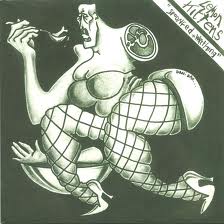
With no “proper” musical skills upon their formation in Surrey, England, the Lemon Kittens epitomized the “anything goes” spirit of late-’70s post-punk in the U.K. Karl Blake, who cut his teeth in numerous outfits prior to the Lemon Kittens, started the band with Gary Thatcher and a revolving cast of others (which at one point included future Alternative TV leader Mark Perry), but at the time of the release of their first EP in 1979, the seven-song Spoonfed + Writhing 7″, the group’s lineup featured Blake, Thatcher, N. Mercer, Mylmus, and Danielle Dax. The group was whittled down to a duo of Blake and Dax by February of 1980; the other three members had fled, making for the group’s 16th different lineup change since initialization in April 1978. Blake and Dax then decided to operate primarily as a duo, with help coming from whoever whenever they needed the assistance to perform. Later in 1980, Blake and Dax released We Buy a Hammer for Daddy on the United Dairies label (their labelmates included fellow oddballs and noise-mongers Whitehouse and Nurse With Wound), an album that featured the duo swapping a wide variety of instruments.
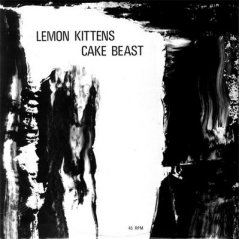
The Cake Beast EP came out in February of 1981; Dax left after its release to begin a successful solo career, which Blake took part in sporadically throughout the ’90s. In late 1982, the Illuminated LP Those That Bite the Hand That Feeds Them Must Sooner or Later Meet…the Big Dentist (best referred to as The Big Dentist) became the group’s second full-length. Blake rounded up a new group of cronies, laid the Lemon Kittens to rest, and began the Shock Headed Peters.
By Andy Kellman
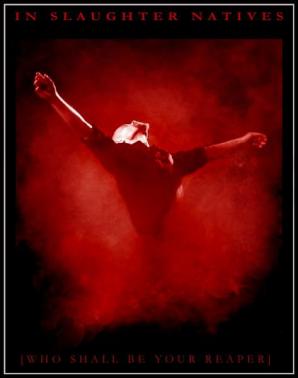
> IN SLAUGHTER NATIVES Interview By Filip Van Muylem (2013)
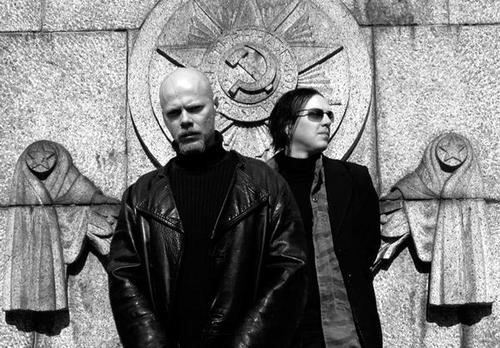
In Slaughter Natives played at the Porta Nigra festival (30, 31/5 & 1/6/2013). A good opportunity to ask a few questions to Jouni Havukainen. Peter Verreycken and Nicolas (Empusae) joined with questions and it turned to be a pretty nice interview!
FVM: Thank you for this interview! As a lot of people had expected, Nicolas (Empusae) joined you stage. Can you say something about this great cooperation?
ISN: Nicolas did not only join me; he also joined other bands, like Triarii and he played with his own band, Empusae. I’ve known him for several years and we already joined forces whenever we were touring together and when we were able to. I think the first time we did something together was during Summer of Darkness in 2010. It’s not always possible to do things together, sometimes travelling costs too much…
FVM: And Nicolas has his day job too, just like you…
ISN: I’m kinda a lucky as I work partime and I am able to do almost what I want. I had a nice deal. I know it’s not always easy for everybody.
FVM: I know you’ve been making music since 1988, which is really already a long time and you joined the famous Cold Meat Industry label…
ISN: In fact, it was even earlier, I think in 1987 or yes, maybe indeed 1988. I had known Roger Karmanik for many years before that. I knew his wife since 1982 or something like that. He was working in the music industry and he asked me: you’ve got to release something. I thought: yeah I can do that and he said: you need to be ready. So I had to quickly finalize everything. That’s how the first casette came out.
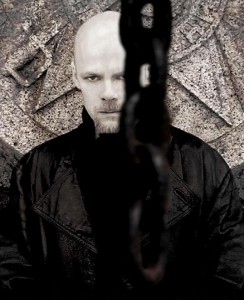
FVM: Now it’s really a legendary label…
ISN: Well, you know there was a connection between all the bands back then. In the beginning, everything was based in a small place called Linköping in Sweden; only 50.000 people lived there. It was only 2 hours of driving from Stockholm where I used to live. Most of the bands where friends, we knew each other very well. As it was a small town it was very easy to do things together.
FVM: I suppose the cold weather helped a bit to get together and work?
ISN: Not really, it can be very cold but also pretty decent. Between minus 27 degrees and plus 10. The winters are not so dramatic. And if yo go to Stockholm, that’s only 800 km away from a city like Berlin.
FVM: But I think you can feel a bit the weather conditions and the raw nature in your music?
ISN: Maybe sometimes, but I will not tell that you can feel that, to tell you the truth.
FVM: Why did you choose to make the kind of music you are making and how did you choose the name?
ISN: Well, I had the feeling i had to come up with something. I had a master tape and was wondering what I should do with it, stick to it or do something else. I had done other styles and music before. I tried other things, but I slowly came back to the thing I had made. Somehow I kept coming back to the same thing and decided to simply go for it. It was in me and it was like it was meant to be. It just happened. When I make music it’s not that I have a plan. I just make music as it comes, I don’t think about selling or about record deals. And about the name, well, you can’t say the name ‘In Slaughter Natives’ is proper English, but nobody cares. I just loved it and it felt good to do things the way i did them. I wasn’t thinking about the name, it just came later. I just liked the combination of the words.
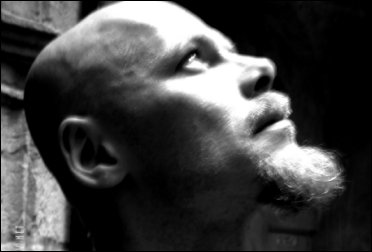
FVM: Do you have your own record studio where you can just do whatever you want, whenever you want?
ISN: Yes, I’m totally independent and can do whatever I want. This is very important for me. In the early days, it was very expensive and you needed much more material than now. Now it’s so much easier, and the technology doesn’t cost that much anymore. Now I have the feeling that i have too much gear to work with. Before you couldn’t do much, because you needed so much equipment and it was very expensive. You had to work with the little equipment you had. I must say that saving things is much easier than before. You can just record something and leave it for a longer time and come back on it when you feel ready for it. Before, you really had to save everything and it took some time before it was all done in a proper way. Now it’s so easy. I love the current back-up system.
FVM: I understand: this way, you can ask another artist to play the drums while someone else is doing the synths and then you can put it all together, from your own place…
ISN: Totally right.
FVM: Something we noticed on your Facebook page is that you use a lot of black and white pictures. Where do they come from?
ISN: I ran into them by mistake. I’m always interested in pictures and sometimes I’m intrigued by pictures, as if they were catching me. Sometimes I change them into black and white to make them more dramatic.
FVM: Are you a fan of Hieronymus Bosch, the famous painter with his strange paintings?
ISN: I’m not a big fan, but i like it.
FVM: If you look at the paintings while playing your music, it sounds like the perfect soundtrack, a bit like what Empusea did in the past with a strip album. What do you think of that?
ISN: I don’t know, when I make music, I need to get a certain feeling. Usually I don’t give up until I have this certain feeling. My feeling and inside touch has nothing to do with what the others feel about my music. It’s very personal and everybody has his own idea about it. It’s very important that the people get their own imagination and feeling about it. That’s my aim. I have never been to one of Bosch’ exhibitions, so maybe I should give it a try. Now I’m tempted to do it.

FVM: Are there other painters or artists who influence you?
ISN: Maybe one: August Strindberg. He’s a writer who lived around 1800 and wrote strange books. He was also a painter, but no one knew that. The books were really special, but the paintings were fantastic. I can’t say more about it, you really have to see them. You have to check it out.
FVM: Can you tell us something about the 3cd ‘Insanity & Treatment’? How did you come up with the idea of the 3cd box? It captivates the atmosphere very well. Can you tell more about it?
ISN: Honestly, it was not my idea to do it. Nick, the guy from the Russian label, Infinite Fog Productions, wrote to me and asked for it. I like him, he’s a nice guy.
FVM: I saw you on stage in the 90’s in Waregem and I still recall the torches and the hot and steamy atmosphere. Still after all those years you can make me feel the same way with the new material, but you don’t do that fireworks anymore…
ISN: Well, the problem with fire is that it’s dangerous and there are more and more restrictions on it. The insurance doesn’t like it either if something happens, so concert promotors are not happy with it. It’s not so popular anymore, they don’t like it when you talk about fire and stuff.
FVM: No Festival Of Light was playing there too; do you still have contacts with one of them?
ISN: Not for the moment. Frederik Bergström and I talk a lot about paintings and stuff. But maybe in August.
FVM: At the beginning of this interview, I mentioned that you worked with Nicolas (Empusae). Are there other artists with whom you want to work?
ISN: Well, Thomas Pettersson. Just as with the concerts, everytime we can we do things together.
FVM: You only recorded together once? Are you considering doing more together?
ISN: Well, yes, we only did the 7 inch and who knows? When I was making a song I thought maybe i should ask him to work on it. I asked him and it really worked. It was nice working together. We all did our part and I did some cutting and mixing. It worked fine. It felt good, but it was unintended, it just happened and it worked really well.
FVM: I can imagine that after the Porta Nigra where you played 3 gigs in a row and worked with 2 other artists that you can think like: why not go further and record something together?
ISN: Well I’m a bit difficult to work with, because I need time to do things. It can be that I work one day with this and then one week with this. Sometimes I need 2 years to finish something. It’s not always easy to work like this. I love to take my time and hate to be pushed. I was working together with Andréa Nebel on a new project called Aghast Manor. She asked me: I want to record a new album, I have some idea’s, we could work together. I said yes, you can come to my place. She stayed a couple of weeks. We were working in a total different way from what I am used to. We used to wake up in the morning, started working and made one song a day and ended in the evening. We did the vocals and everything like this and then we used to take the next song… I aslo wrote one song for the ‘Penetrate’ album. But I was mostly helping Andréa out with the recordings and other stuff.
FVM: What is the song ‘Blood Testural’ about?
ISN: I don’t want to talk about it. But honestly I still like that song and I think I will never get tired of that song. I don’t know why, but it still works fine. It’s an old song and I am not saying that it is a bad thing, but I have so much new material and sometimes old stuff is a bit boring.
FVM: You don’t play that much concerts: is there a reason for this?
ISN: Well, it’s the same as with my recordings: I love to take my time and it has to come by itself. Sometimes it works if you force me to do things, but sometimes I really hate it. It’s not always like this.
FVM: Can you say something about one of my favorites ‘The Silence Shed A Tear’? I love the title.
ISN: I love the title too but I can’t remember when i played it for the last time on stage.
FVM: ‘Still Only Death’ is almost a classic. Is that your most popular one?
ISN: I can’t say whether it’s the most popular, but for sure it is popular. There will be a completely new version, it will be on the new album. Maybe I’ll make even one additional new version. I’m still working on the new release. I hope to find more time, once my moving to Germany is over.
FVM: So we can expect something new in a year or so?
ISN: If everything goes well it will be released in September. It will be with 4 new songs and older reworked stuff. I decided to prepare the new release to perform it live and I really want to use them for concerts. This is what you can expect from the new material. and after that there will be another release.
FVM: Will you do a large tour after the release then?
ISN: Not really. I need more time for the main release. This one is only half done and i really want to take my time to do it properly. A lot depends on how much time i can concentrate on it and for the moment I nearly have no time at all. I think I will have a lot of time in summer and really hope to do nothing else but being busy with music. I hope it’s going to work.
FVM: Well I will leave you now and really hope you can focus on the new releases: the fans are waiting… The gig at Porta Nigra was great and with this we have high expectations…
(Interviewed By Filip Van Muylem, 17 June 2013)
(Source: http://www.peek-a-boo-magazine.be/en/interviews/in-slaughter-natives/)
More Info At: http://www.inslaughternatives.com/
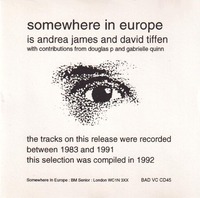
> SOMEWHERE IN EUROPE Interview By Brian Duguid (1992)

Whatever else they may be, Somewhere In Europe aren’t a “clone” band. Formed from the ashes of a band called Basic Essentials in 1983, they have released four cassettes on their own These Silences label, each progressing through a moody, surreal succession of soundscapes, drawing on collage, post-industrial atmospherics and highly personal songforms to create some very individual music. Take the ominous windy drone and scared squeakings of Butterfly in a Vice (from Liturgy of Anguish); or the church bells, tinny drum machine, hesitant glockenspiel and flamenco of Under the Sun (from Dark Days); or the gloomy guitar strumming and buried vocals of Never Go Back (from Know Your Enemy). Random selections that both illustrate their diversity of content and more cohesive styling: it wouldn’t be unfair to suggest that Somewhere In Europe’s recordings share a certain angst, a fondness for the minor key that inevitably creates a disquieting feeling. There is a definite musical kinship with Death In June (with whom they have collaborated), although Somewhere In Europe’s use of collage and juxtaposition sets them well apart. Perhaps it’s as well to let the group speak for themselves. A few questions seem in order …
 BD: Could you describe your musical histories? How did you get into music and develop to the point where you are today?
SIE: In the mid-seventies, we lost interest in rock music and we started going to lots of gigs of improvised music in obscure clubs in London. The freedom and spontaneity of the performances inspired us and we began making improvised music ourselves which we recorded on an old reel to reel tape recorder. Punk got us interested in rock again. We became involved with a band called The Sleep. David managed them and did publicity and organised gigs. Andrea then formed a band called Basic Essentials. David managed them, did their publicity etc and he also wrote lyrics for some of their songs. Two cassette ‘singles’ were issued and they generated record company interest. The band started recording a new cassette but they split up before it was finished. Somewhere in Europe emerged gradually after we bought a four track recorder and started experimenting with different musical formats.
BD: How has your music changed since you started Somewhere in Europe? What were you initially trying to do that differed from the more conventional music you made before?
SIE: None of the music we have been involved in has ever been really conventional. Basic Essentials was quite an experimental group despite having the familiar drums, bass, guitar and vocal line-up.
BD: What are your methods of working? Composition?
SIE: Our music is composed or created in a variety of ways. We might start with a piece of “found” sound or a voice taken from TV, and then add other elements, or we might start composing and building up layers of sound on the synth to which we add noise or “found” sound. Occasionally, we take an existing song and strip it down and reassemble it.
BD: What sorts of things are you trying to do on the latest cassette, Liturgy of Anguish? A lot of your music seems to combine melodic/conventionally harmonic sounds with more dissonant textures, to provide an unsettling, slightly disturbing effect. How important is this tension, both in your music and in your lives?
SIE: Our music often does mix melodic and dissonant sequences – usually quite deliberately to create uncertainty or even disquiet. The resultant tension is important as it helps to keep the listener alert. We do not think of our work as being cathartic but it probably does allow us to release some of our feelings regarding society and human relationships.
BD: On one track you quoted some of Aleister Crowley’s favourite slogans. Is he an influence on your lives?
SIE: The track you are thinking of is Blood Of Martyrs. This is our version of Death In June’s Rule Again, which was written by Douglas P and David Tibet, both of whom were, at that time, interested in Aleister Crowley and his beliefs.
BD: How personal do you feel your music is? For me, it sometimes sounds distant and detached, cold maybe. To what extent is it a direct expression of yourselves?
SIE: Our music is very personal; we do not feel we are cold and distant as individuals, but that is for other people to decide.

BD: It also doesn’t sound particularly “uplifting” to me. Does this reflect any particular view of people/the world?
SIE: Our music is not intended to deliberately uplift or depress. We are primarily interested in producing music which reflects or evokes a mood or atmosphere. It is not meant to reflect a particular political or social consciousness; it is intended to be more universal than that. It is up to the individual listener how he/she responds to it. Having said that, though, we do have a largely pessimistic view of humanity. As individuals, however, we are largely optimistic.
BD: It seems to me that the earlier SiE releases had more humour and irony than the last two. Is this fair? Any reasons for the gradual change?
SIE: We are not aware of a deliberate move away from humour and irony although we have become more distressed about certain aspects of our lives in the last few years, and that may have affected our work. Also, one can’t always predict what another person will find humorous. Occasionally, we have felt something was serious or even grim, and someone else has found it amusing!
BD: Are there any particular emotions you aim to evoke? What sort of response are you trying to get? What sort of reaction/feedback have you had?
SIE: As we’ve already said, we don’t deliberately set out to provoke any particular emotions. Also, we do not desire any particular response to our work. The reaction to our music has been largely positive, which we find very encouraging. Sometimes, we have come to dislike a track and then someone has written to us or reviewed the cassette and responded to it in a fresh way and that has made us reassess it. We find this interaction very interesting.
BD: How have other artists, writers, filmmakers or musicians influenced you? Do you feel part of any musical or artistic movements? You have said that you were influenced by people like the Dadaists or the S.I. In what ways?
SIE: We have been influenced and stimulated by many people over the years. It would be impossible to list them all – we have attempted to do so in other interviews and always found the lists are too arbitrary. All those listed take on equal importance whereas their significance to us is variable – one person may have remained an influence over years, another’s power may have evaporated swiftly but been potent for a short time. Musically, we have listened to a wide variety, from sixties rock to industrial, from electric folk to techno, from disco to punk! Similarly, the writers, film makers, painters who have influenced and stimulated us are many and varied. We identify with the European avant garde tradition. Like the Dadaists, Surrealists and the Situationists, we would like to see the collapse of the distinction between art and the rest of life.
BD: It’s a very unusual sound for a British group: do you feel isolated in this country? Part of any particular network/community?
SIE: No, we don’t feel isolated. We are in contact with a large number of individuals all over the world with whom we exchange letters, mail art, cassettes and publications.
BD: How did you come to be involved with members of Death in June? What have you done together? How do you feel their European/romantic visions relate to your own?
SIE: We first met Douglas at Rough Trade records when RT was distributing the Basic Essentials cassettes. Later, when a friend wrote an article on Death in June, we took some photos of the band to accompany the article. Douglas liked the photos and used several of them as publicity pictures. He then began inviting us to DIJ gigs and the friendship has grown from there. Andrea contributed bass and backing vocals to many of the tracks on The World That Summer LP, and she contributed a vocal to one track on The Wall of Sacrifice LP. Douglas has contributed to three out of the four SIE cassettes. Despite these collaborations, DIJ and SIE remain individual units with their own unique visions of the world.

BD: So far, your own releases have been on cassettes. Is this just convenience or do you have any particular attachment to the medium?
SIE: We use cassette and not vinyl for a number of reasons. It is very economical; it is reusable; it is easy to send through the post. Although some shops do take copies to sell, we like distributing them through the world wide network of people involved in producing cassettes, zines, mail art etc. We feel that independently produced cassettes present a real alternative to the record industry, just as publications like EST offer an alternative to the mainstream magazines.
BD: What plans do you have for the future?
SIE: We have lots of plans, but whether they will come to anything remains to be seen. We may produce a video which would match images to our music and there is a strong possibility of a CD release containing a selection of tracks from the four cassettes.
This CD has now been released on N.E.R., distributed through World Serpent.
(Interview carried out by post in April 1992 and © by Brian Duguid.)
(Source: http://media.hyperreal.org/zines/est/intervs/sie.html)
> GERECHTIGKEITS LIGA Interview by Simon V.
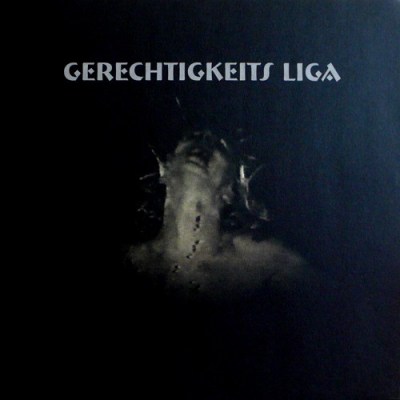
SV: Gerechtigkeits Liga was one of the very first industrial bands in Germany. What were (and possibly still are) your motivations at the time? Was Western Germany in 1981 swept by a creative wind just like most of Europe?
GL: GL evolved from having played in several punk bands and then continued with a different style of sound & music, which I would call electro-acoustic music due to the equipment we were working with when we launched Gerechtigkeits Liga. It was basically first and foremost a noise band and less of an “industrial” or post-industrial group, at least for the first year or one and a half years of GL’s existence. I had very little contact with other musicians in the noise and industrial field at the beginning of the 80s—even though by 1983 I had started working with a second colleague of mine, and we had gotten to know Uli Rehberg who lived in Hamburg and owned a record shop as well as running a label called Walter Ulbricht Schallfolien. Uli organized a concert in 1983 with Whitehouse and GL in Hamburg. In fact before I got to know him in Hamburg, we were offered to play live with Nocturnal Emissions, that was also in ’83. During this time I had also founded our own label ‘Zyklus’ records, in order to release our own audio, as well as video material. We received a lot of correspondence and mail art from West & some Eastern European countries, as well as the USA.
The inspiration behind having founded the group for me was the fact that I had been growing up during the Cold War period, which made me feel quite paranoid at the time, I wasn’t very pleased about the lack of cultural independence, the cultural trashy overflow from the US that had been taking place for a rather long time by then of course. And also the fact that I had a strong feeling that the Germans at the time were almost consciously trying to reject remembering Germany’s history in the 30s, the Third Reich and what happened in the concentration camps, the deportation of Jews and gay people and so-called political enemies, etc. I also felt the urgent need to break with conventional methods of writing and performing music and to explore new ways to work with sound and film, as well as video. We became a group towards the end of ’81, when i started working with a third friend. We started the first recording period as an electro-acoustic set, more or less due to the more conventional equipment we had still left over from our punk bands, including guitar, bass, violine (as I had been partly a bad singer and rather bad guitarist in two or three punk bands, and my colleague a bassist) and everything else was based on recordings that we did record in junkyards and in a WW2 bunker, until 1982, when we started working with our first drum machine and an analogue synthesizers. We did collect bits and pieces of metal and plastic, anything you could imagine, little children’s toys. We worked a lot with tape loops and manipulated sounds on tapes. Out of all these sounds we created our first album, which sounded more like a noisy soundtrack. It was partly dark ambient but mostly aggressive noise, pure noise only. This first album was released on tape in 1982.
SV: The name you chose means “Justice League” in German. Has it a specific background or does it reflect a sarcastic and cynical approach to the abused word “justice” in modern Western society? It is not very likely to have anything to do with the American comics series, is it?
GL: The truth is that as I was only 17, a friend of mine had the German translation of the American comic lying around, and we were looking for a name for the project. It looked really amusing and at the same time it seemed to be a truly fitting idea to use such an ambiguous name. But I had no idea how popular this comic was—it was so bizarre as it played no role, just a so called pure coincidence that we were sitting there going through hell knows how many names. But it seemed to be so fitting at the same time. The artwork for the first cassette was a literal piss take: in the booklet we used the actual logo from the Gerechtigkeits Liga comic, other elements from the comic and from adverts, with concentration camp photos and we used this layout as a cover page for a booklet, as well as a ‘promo’ poster for a new tape release with the title: ‘Scenes we’d like to see’. We plastered them around the old city center of Bremen in Germany and part of a local shopping zone at the time. They couldn’t have been up for longer than a few days maximum, at the time concert posters would go up on a nightly basis and a lot of graffiti as well in certain areas. But it was completely misunderstood, which makes me feel sad, but also amuses me in retrospect. It was meant to be thought provoking, but it’s always up to the interpretation of the viewer. In this case we were mistaken for neo-nazis and a manhunt was started by a bunch of angry and punch happy anarchist punks, which was an irony in itself as we drank in the same bars, shared some of the same ideas but always remained anonymous with all GL activities in the earlier days.
SV: Was the concept of “industrial music” important for you at the time? Is it still now? Thinking of early German industrial, one usually thinks of Einstürzende Neubauten, Die Krupps, early D.A.F., Cranioclast. Do you feel Gerechtigkeits Liga has anything to do with them?
GL: I felt that most of the things of significance were mainly happening in West Berlin. Compared to Berlin, I felt I was living in the provinces even though I lived in a city of maybe 600,000 inhabitants. Nevertheless, to West Berliners that would have been a provincial place. Especially Einstürzende Neubauten, who were from West Berlin and seemed to be overshadowing the majority of the Industrial and experimental music scene at the time. Throbbing Gristle in the UK were already by then a major cult project. And SPK, who by then were also living in London although they were from Australia. I was proven wrong though—there was actually a lot happening in Northern Germany, Asmus Tietchen had already been active for a long time. We got to know him in 1983 through Uli Rehberg. The concept of industrial music was important to a certain degree, of course. Nevertheless I never associated groups like Einstürzende Neubauten with the term at all, which may seem odd. I always found it strange that they were associated with industrial music, especially in the earlier days. Neither did I at the time associate D.A.F. or Cranioclast with industrial music, even though I did like Einstürzende Neubauten a lot in the 80s. Die Krupps I wasn’t too greatly impressed by, I thought they were trying to mix pop tunes with sort of industrial elements, such as steel samples and percussion.
In the early days, throughout the first one and half years of GL’s existence, we probably ironically had quite a bit in common with Einsturzende Neubaten, as we went out onto junkyards and started recording metal and acoustic instruments in a Second World War bunker which we were using as a rehearsal space. The way we processed and used the sound was in many ways fairly similar to the way Einsturzende Neubaten were working at the time. We were approached by Cranioclast and they sent us one of their tape releases, that was how I first listened to them. As far as I can remember it was more like minimalist electronic music. I never met the main person behind it as far as I remember, but we exchanged correspondence. Between 1981 and the beginning of 1984 we released all records, tapes and videos on our own label, which was called Zyklus Records.
SV: You eventually moved to London. Why did you choose to go there? Was the interest for experimental and noisy music higher in the UK than in Western Germany?
GL: I definitely thought that interest in the experimental and noise scene was far bigger over there, and that the scene was obviously much larger, as I had been there on numerous visits before and had also gotten to know the members of SPK and many other musicians who were active in the so-called industrial or what Graeme Revell later called the post-industrial scene.
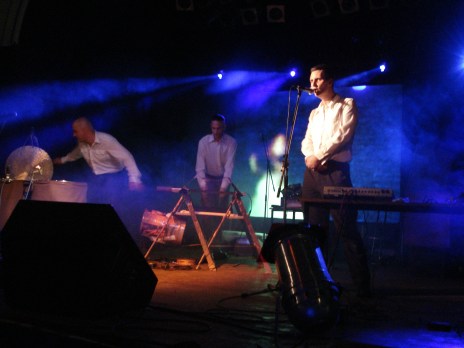
SV: Many tapes were published by your own label Zyklus Records, as well as your debut vinyl “The Games Must Go On.” Is any of that tape material meant for a future reissue? Did you have contact with many other tape labels/networks across Europe at the time?
GL: A lot of the stuff that was released on our own label Zyklus Records—which by the way I relaunched recently with my new colleague Ragnar in March 2011 in order to release a new GL album called Dystopia—has been re-released. An old friend of mine by the name of John Murphy helped us with some of the percussion and drum recordings on the new album, for which I’m very greatful. The debut vinyl “The Games Must Go On” and the LP Hypnotisches Existenzialismus, which was originally released in 1985 by Side Effects in London and re-released in 1986 by Thermidor in San Francisco, was re-released in 2005 as a digipack by Isegrimm Records in Germany. Another seven tracks which were recorded in 1984 at the Limbo Lounge in New York City were also released as bonus tracks on the same digipack. Three years later I released a retrospective on the German label Vinyl-on-Demand called Per Ignem ad Lucem, and included two 12-inch vinyl LPs plus a 7-inch vinyl single as well as a video DVD. The tracks that were released on this compilation covered an array of unreleased live material from the 80s as well as studio outtakes and a few rare studio recordings from the 80s. The DVD includes early video clips from the 80s as well as some bonus live material which was shot at Columbia University in New York City in 1984 or 1985. We had a lot of contact with labels, mainly in Western Europe but we were also in touch with many tape and record labels in the States, in Canada and the rest of the world. We didn’t trade many tapes due to the limited editions we released.
SV: Your debut LP “Hypnotisches Existenzialismus” shows a deep attraction for tribal percussions and ritual atmospheres. Could you tell us about your interest into trance-inducing and hypnotic rhythms?
GL: When we recorded the album between ‘83 and ‘84 we had been experimenting with trance-inducing rhythms and tribal chants. On a theoretical level I had become interested in and started studying the techniques of hypnotism as well as animal magnetism. I had also started reading literature by Mircea Eliade about shamanism, he had written a fascinating book about shamanism, shamans and their rituals, the rough English translation of the title would be Shamanism and Archaic Ecstatic Techniques.
SV: Could you comment on the title “Hypnotisches Existenzialismus” itself?
GL: It was a chance title because of my old colleague Thomas. I was very interested in the things I just talked about and in existentialism, but he was even more interested in existentialism and obsessed with the writer and philosopher E.M. Cioran. We couldn’t make up our minds about the title, and considered our interests and the ideals that had flowed into the record. We were living together and spending a lot of time together, and while he was out one day I thought, “we have to come up with a title because we have a deadline coming up”—so I just mixed both subject matters and turned it into “hypnotic existentialism.” In a way it was anything but a conceptual record, even though it should have been one and ironically enough may sound like one, which I don’t consider to be a coincidence.
SV: In my review I suggested that the music of the LP calls to my mind the idea of a futuristic dystopia, in which cold technology blends with primitive and savage instincts. What do you think of this interpretation?
GL: I totally agree with you that the record represents a futuristic dystopia… Your question is stating almost the exact point we were trying to make at the time. It’s ironic, as our new album released in March 2011 actually has the title of Dystopia.
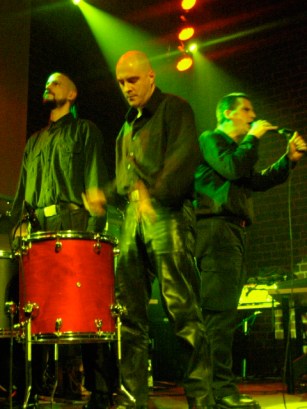
SV: Do you have any interest for the dystopia genre in literature, such as Orwell’s “1984” or Huxley’s “Brave New World”? The quote of Emil Cioran on the innersleeve of the CD reissue seems to suggest that utopias are not for Gerechtigkeits Liga.
GL: Yes, I certainly used to have a great interest in the just-mentioned literature, especially in my younger years I was a great fan of Orwell’s dystopian novel 1984 and also Huxley’s Brave New World. Amongst other authors, I was a huge fan of some of the novels of J.G. Ballard, who seemed to reflect a future vision with such an accurate view that I’m still extremely impressed. Obviously I should also mention William Burroughs, who played a great part in my cultural development. While we were on tour in the States in the mid-80s I had a chance to meet the man himself in the Midwestern town of Lawrence, Kansas. It seemed like a pure coincidence and irony at the time, as we were visiting an American guy whose name was also Bill, and who was running a punk record and video label on which he had previously released the American version of SPK’s Despair video, and who later released the Final Academy video on his label, Fresh Sounds. He was a good friend of Burroughs at the time and introduced us to him during our short stay in Lawrence. The reason we made a stopover there was to sign a video deal for a video that hadn’t yet been made, and was meant to be filmed on our return to New York at Columbia University at a cable TV station.
SV: The song “Media Distortion” has, to my ears, the same rhythm as Laibach’s “Dekret”. Both songs were released the same year, I think. Is it a coincidence or is there a story behind this?
GL: I’m sure as soon as I hear that song again I will remember it, but I can’t at the moment. There’s certainly no relationship between the two songs and no significant story behind “Media Distortion”, except for the fact, that it deals with mass media, muzak, escapism and depression.
SV: Judging from the list of your tape releases, looks like you did perform live quite often back in the days. What was a Gerechtigkeits Liga live concert like?
GL: All our shows used to be multimedia events, as back in the 80s I had problems writing words and vocals for the tracks we recorded and performed live. Therefore I expressed my ideas via films and slide projections, which we used as background material. I’ve always had a strong interest in experimental film, especially at that time, and I thought it was a good and unconventional idea to express one’s ideas through background projections. Then it was more unusual, people were not doing it a lot. The rest of the performance at the beginning was based on pure live music during the first couple of years. As we started doing low-budget tours and played many tours and single gigs abroad, it soon became apparent that we had to start reducing the amount of equipment in order to travel lighter. Therefore unfortunately we were forced to use a certain amount of sounds from backing tapes and just mainly used percussion and an array of conventional instruments such as brass instruments, violins, a broken guitar, pedal effects and tape fade-ins, as well as synth keyboard. Even though I didn’t have conventional vocals at the time, I usually improvised a lot and just made words up on the go, which I just shouted into the microphone.
SV: Worth mentioning is your participation to the historical Side Effekts anthology Vhutemas Archetypi in 1985, alongside SPK, Laibach, Hunting Lodge and Lustmord. Has that record any special meaning to you? Is the topic of the “Wodan Archetype” of any interest to you?
GL: Of course the record did have and still has a very private special meaning to me. On the other side, I must admit that at the time of recording the two tracks for the compilation were certainly not related to the “Wodan Archtype,” even though I was interested in the occult and Northern or Germanic mythology to a certain degree. I think the interest has increased slightly over the years. What still fascinates me in retrospect when listening to the compilation is that every band or project who participated and worked on their tracks independently and without having had any communications with the other participating musicians, but if you closely listen to it someone may get the feeling all tracks were recorded within the presence of all contributors. It certainly seems to give a strong impression that all of us had a common denominator, as each track seems to fit together, almost like pieces of a puzzle.
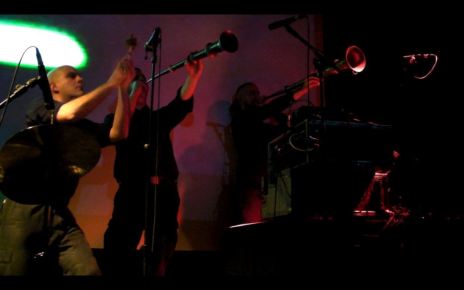
SV: Let’s get to the present now. Towards the end of the 1980s your traces were lost, only to reappear in 2005 with the CD reissue of Hypnotischer Existenzialismus. What led to this release after so many years? How did you come in contacts with Isegrimm Records?
GL: Shortly after the beginning of the Millennium I noticed that the so-called industrial or post-industrial music scene with all its sub-genres wasn’t dead, as I had presumed for so long during most of the ‘90s. In 2001 I was approached by a Berlin festival organiser called Stefan Schwanke, who kindly asked me if I would be interested in recording a track for one of his upcoming vinyl compilations by the title of Statement 1961. The theme of the compilation was meant to be the building of the East Berlin Wall, which had been started by the GDR in 1961. The compilation was meant to be dedicated to all East German residents who tried to escape from the East and were executed in the process of doing it. I did like the idea a great deal and was surprised that someone still showed an interest in Gerechtigkeits Liga after such a long period of absence. The compilation was finally released on the 26th of June 2004 within the framework of a festival. Stefan had previously asked me if I would be interested to perform at the launch festival of the compilation and I had agreed to do so. After a rather disappointing performance due to the fact that I encountered problems with some of my equipment on stage, I was later that evening approached by a gentleman called Lerry who mentioned a great interest in the history of Gerechtigkeits Liga and who asked me if I would be interested in a re-release of some of the older vinyl releases from the 80s. We exchanged email addresses and telephone numbers, and eventually the planned material was released as a digipack in 2005. By 2004 I had already decided to pursue the project again, and had made the acquaintance of a new friend and now collaborator, Ragnar. At that time he was visiting London on a very regular basis, and we continued working as GL where I had left off at the beginning of the 90s.
SV: Let’s talk about the latest Gerechtigkeits Liga releases. How has your perspective of music changed? What do you have in mind, musically speaking, these days?
GL: Since 2004, we’ve recorded and released plenty of material on different vinyl and CD compilations, as well as two 7-inch vinyl records (one a split release with the German noise project Gehirn Implosion) and the new album Dystopia, not to mention the Vinyl-on-Demand retrospective that I mentioned earlier in the interview. Obviously my perspective of music has changed over the past decades. In many ways my ideas have somehow stayed the same but I have become much more open-minded towards almost all genres of music that are out there, which was an impossibility for me when I was in my late teens. I can now listen to almost all genres of music and view them far more objectively. I’m also able to spend longer periods of time without listening to music at all, especially when I work on my own sound projects. I’ve been able to work with a much larger array of instruments, be it conventional instruments like Tibetan dungchen (horns), or high-tech instruments and recording gear. We did do some similar things in the 80s as well though. At one time in the late 80s we used more electronic instruments than we use now, but analog of course rather than digital. At present I am really wondering how to continue. I have a more ambient noisy project that has been mostly recorded and has been sitting in the corner, which needs to be worked on: a Shining Vril vs. Gerechtigkeits Liga album. If a release will finally be available is as yet unknown. We’re currently planning to put out a follow up release to the new album “Dystopia”, which will come out in form of a limited cassette with additional live studio recordings. This release will be called “Dystopia” – ‘Ritus’. A number of other releases is planned for the year 2012: One of them will be a special Gerechtigkeits Liga live release on Klanggalerie in Vienna and a special dark ambient project, possibly to be released on GL’s Zyklus Records.

SV: Are you planning to do any live performances too, and, if yes, how do you see an industrial live performance these days?
GL: Yes, we’ve done a number of live concerts in the past few years, the majority of which took place at small or larger festivals, such as the 8th Wroclaw Industrial Festival in 2009 in Poland, as well as the Wave Gothik Treffen in 2008 in Leipzig, Germany. Generally the live performances we’ve done over the last few years are quiet different compared to what I used to do with one of my ex-colleagues in the 80s. We used to put more emphasis on backing tapes but now we are much more of a band set-up. Whenever we play at larger venues we have a third man on board who has been playing metal percussion as well as drums. Even though we are still using video projections for all of our concerts I am concentrating more on vocals and brass instruments, as well as limited samples nowadays, and my main colleague is responsible for synthesised as well as organic sounds and drum percussion.
SV: Thank you very much for your time and the answers. One last word at your disposal.
GL: Many thanks for your never ending patience and for having waited such a long time for my answers dear Simon!
– Interviewed By Simon V.
(Source: http://www.filthforge.org/interviews/interview-gl.htm)
More Info At:
http://www.gerechtigkeitsliga.com/
> WIRE, TEST DEPT:REDUX, IN THE NURSERY, CONTRASTATE, CONSUMER ELECTRONICS, RAMLEH, IRM & Others Live in Wroclaw, Poland on 7-9 November 2013

XII WROCLAW INDUSTRIAL FESTIVAL PRESENTS:
– WIRE (UK)
– TEST DEPT: REDUX (UK)
– IN THE NURSERY (UK) (Full Line-up Set)
– CONTRASTATE (UK)
– CONSUMER ELECTRONICS (UK)
– RAMLEH (UK)
– UNDERVIEWER (B) (Pre-FRONT 242)
– NOTHING BUT NOISE (B) (FRONT 242 Side Project)
– AGENT SIDE GRINDER (S)
– IRM (S)
– OPPENHEIMER Mk II (UK/A)
– ALUK TODOLO (F)
– C.H. DISTRICT (POL)
– SZELEST SPADAJĄCYCH PAPIERKÓW (PL)
– COLLAPSING NEW PEOPLE (A)
– MERCYDESIGN (D)
– SPHERICAL DISRUPTED (D)
– MIRT (PL)
– KOMORA A (PL)
– DEAD FACTORY (PL)
– MONOPIUM (PL)
– DJ BORG vs DJ SKULLSCRAPER (aka DIRK IVENS)
DATE: 7 – 9 November (Thursday – Saturday)
VENUE: Gothic Hall, 1 Purkyniego, Wroclaw, POLAND
More Info At:
http://industrialart.eu/festival/
https://www.facebook.com/WroclawIndustrialFestival
WIRE
TEST DEPT: REDUX
IN THE NURSERY
CONTRASTATE
CONSUMER ELECTRONICS
RAMLEH
IRM
> LUSTMORD & PIANOHOOLIGAN Live in London, 27 September 2013
BARBICAN & UNSOUND PRESENT:
– LUSTMORD
– PIANOHOOLIGAN
DATE: 27 September (Friday)
TICKETING: £20
http://www.barbican.org.uk/music/event-detail.asp?ID=15105
VENUE: LSO St Luke’s, Old Street, London EC1, UNITED KINGDOM
More Info At:
http://www.lustmord.com/live-in-london/
http://www.barbican.org.uk/music/event-detail.asp?ID=15105
https://www.facebook.com/events/332886573508156/
LUSTMORD
PIANOHOOLIGAN

> COLD CAVE shows cancelled due to BOYD RICE’s alleged Nazi affiliations

COLD CAVE’s shows in Toronto and Montreal scheduled for this week have been cancelled amidst controversy surrounding the New York dark wave band’s tour-mate BOYD RICE (a.k.a. NON). Rice, a pioneer of noise music, has come under fire due to alleged past affiliations with Nazi imagery and ideology. Rice has often attempted to distance himself from the accusations, claiming his associations to be deliberate provocation and “pranks,” but as with other musicians who have flirted with Fascist signifiers, it carries too much baggage to shake off with a “just kidding.”
Cold Cave and Boyd Rice were scheduled to play at The Shop @ Parts & Labour tonight (Wednesday, June 26) in Toronto, but the promoter, Embrace, pulled the plug. The show was then rebooked for the same night at Izakaya Sushi House, but that too has now been cancelled.
Here’s the full explanation Jason Whitney, booker of the Izakaya show, posted on Tumblr:
I regret to inform you that tonight’s Cold Cave show is cancelled. I’m sorry to do this on such short notice but I have just now come to realize the severity of the situation. I was the only person behind this show and I realized that the consequences of doing it were not worth it to me.
Realize that I was doing this show as a Cold Cave show, not a Boyd Rice show. Cold Cave is one of my favourite bands so I jumped at the opportunity to book them when Embrace pulled the show. I knew Boyd was the reason that the show had been pulled in the first place and that people held strong opinions about him. I have never met him so I can’t speak for his character, and am in no way defending him, but he seems as someone who has done all the things he’s done for shock value. As someone who identifies as Jewish, I would not be doing the show if I believed he was a nazi or was going to push some sort of agenda or hate speech.
People have every right to believe what they want and every right to express it, but the pressure that has been placed on me because of this is not worth the stress that I’ve endured. I tried to keep my cool but it has all caught up to me.
My sincere apologies to anyone who was offended by my picking up the show, know that I had no ill intent. To me, Boyd was merely someone who was going to perform for 40 minutes before Cold Cave played. I was excited at the opportunity to book Cold Cave and didn’t think about the people that felt so strongly about Boyd, and didn’t realize what would happen by booking him along with Cold Cave.
As for the people who were looking forward to the show, I thank you for all the support I received, I’m sorry I couldn’t follow through but I was made aware that I would be alienating myself and putting myself at risk but doing this show, and decided that it was not worth that. I’m sure Wes will be back, and I thank him as well for his understanding with this.
Know that in the end I was the only person involved in booking this show. Thank you to the one person who contacted me directly about the situation. If you would like to discuss things further you can reach me at xjasonwhitney@gmail.com
Thank you,
Jason Whitney
COLD CAVE and BOYD RICE were also scheduled to play a show tomorrow (Thursday, June 26) at Montreal venue Il Motore, but Meyer Billurcu, owner of both the venue and its promotion company, Blue Skies Turn Black, cancelled the show last month. He offered the following statement on the concert’s Facebook event page:
As the owner of both Il Motore and Blue Skies Turn Black, I want to extend a formal and very sincere apology to those of you who were disheartened by Boyd Rice’s impending performance at my venue. When I initially booked Cold Cave, I was not aware of whom they were bringing on tour as support.
Both BSTB and Il Motore have a strict zero-tolerance policy towards any and all forms of prejudice, misogyny, racism, homophobia, transphobia and violence.
For these reasons, we have decided to cancel the Cold Cave show on June 27th altogether.
I am truly grateful for your understanding and continued support,
Meyer.
> MAUTHAUSEN ORCHESTRA – Retrospection by Pure Stench
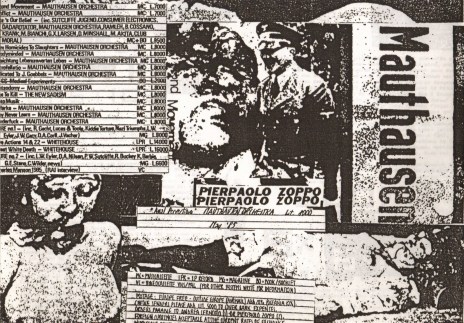
A misanthropic appeal, the converse to quiet, a pull away from the simmering shit of mainstream music. The deafening structure of Noise is more than art to many. Not even the catch term “acquired taste” will fit each and every time down here. Sound documentation that comes in many forms – sometimes loose and chaotic, sometimes structured and tense, other times playful and settled, always unmitigated evidence that pleasure is in the ear of the beholder. Industrial has been around awhile and, because I become bored easily, I thought that I would take a stab at showing some of the best from the past. A retrospection of sorts starting with my favorite “old-school” act.

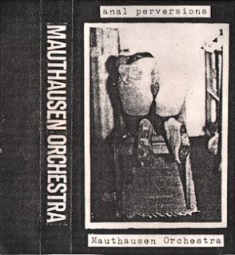
1982, Italy. Pierpaolo Zoppo starts releasing his own tapes of his project Mauthausen Orchestra under the label “Aquilifer Sodality”. Combing through topics such as sexual violence, perversion, torture and murder and picking them apart with the right maneuver as to not come off as cheap and careless is not an easy task. Where the people of one decade find their horrific scenery another decade finds its jokes. Mauthausen Orchestra’s atmosphere, one of true debauchery and calculated sickness, coalescing with the sobering awe of his industrial racket blanketed by the 80’s true lo-fidelity, raw recording procedures has yet to truly be matched. His early sound traversed a good deal of ground from the sharp and violent piles of feedback and synth work forcefully fed to you, to long chapters of grinding precision and tape manipulation pulling pieces out of itself and building upon it. Maurizio Bianchi was such an obvious influence on most of his work, especially up until “Bloodyminded”, that it would be impossible to write anything on Mauthausen Orchestra without mentioning his name at least once. In all of these early recordings one thing can be agreed upon, it was always dirty. My introduction to this project was “Anal Perversions” and it displays Zoppo’s range perfectly in two lengthy and harsh tracks. Some may prefer more variation of material such as “Murderfuck”, or the damaging assaults of “Uneasiness”, so I also recommend that everyone go out and find “5 Year of Slaughter”, or even better, “Gravitational Arch of Sex”. Both of which collect the assortment of material from his 3 greatest sound periods (check the link at the bottom of this article to download material from 1982-1986).

The project took a rest in 1986 and besides re-releases of the 1982-1986 collection, M.O. didn’t wake back up until 1997 with the creation of “Raising Vapors” co-released by Body and Blood and Bloodlust! records. The sound of “Raising Vapors” took a lot from the old Italian sound they helped create and added variation to it. The violence was not as heavy and brutal as it was before, instead it was more minimalistic, the discipline was more exacting. “Lost Boys In Town” displayed a lot of the same characteristics as the previous works but, to me, it seemed even more relaxed. The reason for the change in name, from Manthausen Orchestra to M.O., is unknown to me but the change in sound is very apparent and it is often argued whether or not these two releases should even be considered “Power Electronics”. In 1999 M.O. released one of their most talked about LP’s, “Kiss The Carpet”,an extremely violent and heavy look at human dysfunction. Wherever the last two releases lacked virility and sheer brutality, “Kiss the Carpet” displayed it in spades. From this point on I lost interest in M.O.’s material. Later material such as “Smooth Hate” and “Where Are We Going?” plays on minimalistic Noise with a deep and, in my opinion, boring ambiance.
A good number of acts followed including his country-mate Atrax Morgue who re-releases many of M.O.’s tapes during the 90’s. Later on, groups such as Taint, Liver Mortis and Pleasure Fluids, some of my current favorites, took note and began to dust off the old niche.
Luckily for me, I don’t have to do the work. You can download the early M.O. discography here:
http://industrialintroduction.blogspot.com/search/label/Mauthausen%20Orchestra
(Source: http://purestench.blogspot.sg/2010/11/retrospection-mauthausen-orchestra.html?zx=86a89cae95c01fbc)
> KAPOTTE MUZIEK Interview by Dmitry “Dim” Kolesnik (1998)
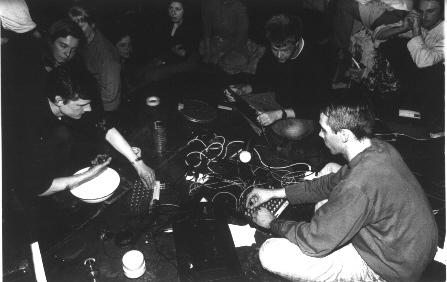
This interview was obtained somewhen at the beginning of September, 1998. Frans de Waard was so kind to answer my questions via e-mail. I wish to thank him as well as Geert-Jan for support and assistance.
1.Who are KAPOTTE MUZIEK now? Can you indicate yourself as a leader?
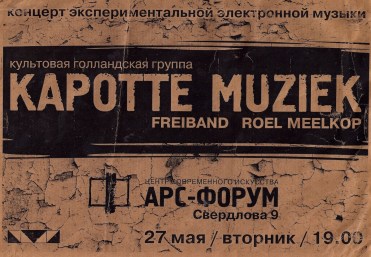
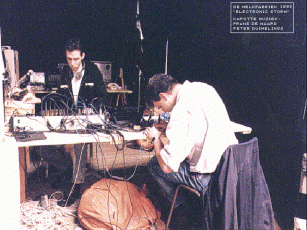
At the moment KM is myself in all the studio work, and for live concerts also Peter Duimelinks (since 1993) and Roel Meelkop (since 1995). Jokingely they refer to me as the leader, but it’s not like that. When we play live, each has an equal saying in what we do. We know eachother for more then 10 years now, so it’s not natural that anyone is the leader.
2. How would you define other members of KM, what are their attitude towards the band, how do you think?
We all three have an open mind toward sound – and just sound, anything else is not important. Everybody is very critical to what the other does, but everybody appreciates the opinion of the other.
3. Birthplace of the band, present location.
KM started in 1984 in Nijmegen, together with a guy named Christian Nijs, who left 4 years later. In the meantime I lived in Den Haag, Roel and Peter in Rotterdam, but now I am back in Nijmegen (since july 1998).
4. Short story of your musical career. Why did you started creating music and KM as well?
From a very early age on I was interested in doing music myself, so tried various things, like writing notes on score paper, which looked good, but having a clue how it would sound. Punk music in 1977 was for me trigger to do some of my own, but quickly I realised that the three chord guitar music involved training too. In 1980 I got a copy of Steve Reich’s Drumming and I was fascinated by the minimal, rhythmical approach. I learned more how Reich worked, and thought “wow if it’s that simple, I can do it myself”, so I started making tapeloops of anything I could lay my hands upon. In 1984 I was asked to compile a tape with Dutch industrial music, so I invited everybody I knew, and of course I needed to make a track myself. Then KM was born…
5. What was your education and had it any influence on you musical drive?
My father wanted me to learn and play the piano, so I had lessons for a few months. But I didn’t like to practice. Then he gave me a guitar (acoustic), but again I was more interested in doing just noise with it (recording on a reel-to-reel tapedeck and then slowing it down). So I had no formal training and thus it had no influence.
6. What is the history of your relations with Staalplaat?
Before I started working for Staalplaat I had my own label, Korm Plastics, and I released cassettes and vinyl. In 1992 I finished university where I studied History, and I thought, maybe I can make Korm Plastics into a real business. So I asked around and then Geert-Jan of Staalplaat (they were always selling my products) called and said: if you’re looking for job, I have one. So since then I worked with Staalplaat.
7. What function do you play in Staalplaat?
I do a bit of everything: buying new products, selling, writing texts, a bit of accounting and generally speak to everybody who calls.
8. Does Korm Plastics still exists and what is going on with it now?
It still exists, as part of Staalplaat. I release mostly vinyl, just music I like myself and mainly from people I like. Also we’re doing the Korm Plastics Introductionairy Paperback series, where we introduce new artists (because that’s what interested me most, working with young and unknown artists).
9. What way will you introduce KM to those who never listened to its music but have desire?
To explain what I do people who are not really open minded is useless… usually I just tell a lot of the way things work for us when making music, making references to things they might know. Nowadays it seems easier, because popmusic is more radical, in terms of production, so it’s possible to refer to that.
10. What kind of music (groups, singers) had the most influence on your development? Other words o where can we find your musical roots?
Most definitely not in singers, as I don’t like vocal music at all. My main inspiration goes back to the early eighties, bands like Throbbing Gristle, Hafler Trio, Asmus Tietchens, and from there back to the history of electro-acoustic music, Pierre Schaeffer. John Cage has been a great influence on my thinking of music, rather then his own music.
11. What music do you listen most often now? Can you name any band or artist which you keep your eyes on all the time?
I have a wide taste, from music with guitars (post-rock), to techno and industrial music. There is however very few people I want to hear everything of, or even collect. Asmus Tietchens is one.
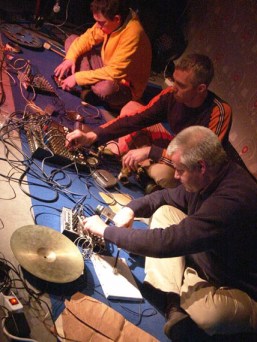
12. Do you try too pay much attention for the modern music? Does it inspire you?
What do you call ‘modern music’? I like techno, but don’t like drum & bass, which is digital jazz rock. Techno music is a great inspiration for some of work, as I like the minimal changes in there.
13. If you had to stay on an desert island for ever, what one CD will you take with you?
No CD at all. I hope to enjoy the sound of the island itself.
14. Do you feel yourselves apart from your listeners, or your way of thinking is the same as people who stand on another side of stage? You denied existence of any messages in your works, so do you feel any connection with your invisible listeners? Did you have any response ever?
No, I think the musician and listener have the same kind of thinking (nor do I think this is favourable). People often tell us afterwards what they think or feel, which is a nice thing, since one likes to get some response. But it’s not a necessity for us.
15. Do you think you are popular? What is popularity for you?
Humm… I don’t think I am very popular… in the sense that I sell a lot of CD’s (most of my work doesn’t sell very well). But many people know me, either from my music, or my work. And I know a lot of people have an opinion on what I do or so. It’s because I do a lot of work, music, Staalplaat, Vital Weekly. So many people talk like: ‘oh but Frans de Waard likes this, hates that etc.’.
16. Does it help or confuse you? Where do you think you are popular mostly?
There is no country where I am particular popular…
17. What stuff do you use for recording and mixing? If it is possible, please describe on the example of you track ‘Tweede Russelsheim’ on Sonderangebot compilation (CD – July 1996), Staalplaat, ( with all that vinyl scratching – do you remember?) how did you make it o every sound from the very beginning, whole technology, all used equipment, whole process etc.
I use very simple analogue techniques: 4 track, 14 track mixing board, 2 different etc, DAT machine, guitar and Korg synth. The track you refer to, uses a lot of found sound material, as with KM, for each concert we go out and search of waste, junk to produce sound.
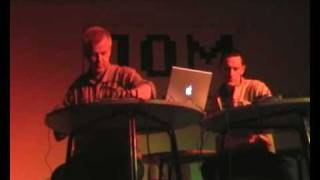
18. Have you ever tried to make totally conceptual album, with counterpoints and any common idea? Name if it exists. Tell about recycling principle you mentioned once.
In some way, I would regard KM as a total concept, entirely bout recycling. In the studio re-using sound material, and on stage re-using trash and junk. Together with Roel Meelkop I will release a 10″ of music entirely made with the sound of glass. However I wouldn’t refer to this as a ‘conceptual’ album (which is more like an outdated term for mid seventies symphonic rock albums!)
19. What is you attitude to computer, as an unlimited source for developing and creating sounds? Don’t you deny computer at all as MUSLIMGAUZE does for example?
I don’t deny any technique, as its not the technique that makes the difference, it’s the result. Results should matter, not how the were generated. I use no computer in my own studio, but I sometimes work with that, for instance with Roel Meelkop. It’s just a different technique, not better or worse. What I don’t like are people buying a lot of computer hardiest stuff and then think the work is done. The result is the work.
20. Who is the author of the covers’ concepts of your CDs? Can you say it is important for you to create cover relative to the content of music?
It’s different. Sometimes I deliver the idea for the design, sometimes the label. Ultimately I would prefer an album with no cover, just bandname and nothing else (this makes me jealous of Francisco Lopez who does this). As just the music counts, nothing else is important.
21. Can you say you have visionable image? If yes , how can you define it?
Not really. My image is to have none.
22. Are you interested in policy? Have you ever got any influence or pressure by policy on you?
I am not so much interested in politics as I used to be, and even then it was of real importance on what I did. Over the years I started to believe that music can’t hold anything political message – album covers can, lyrics can, but music itself: no.
23. What tastes do you have behind music o what literature, cinema etc. are of your interest?
I am very boring person here, but I never read literature, never go the cinema. I have one interest in life, and that’s music. Music for me is the only free arts, the total abstractness. Other forms of art are usually filled with meaning, metaphors, and I am usually not very much interested in those.
24. Please, name all your side-projects, and give a short definition to every of them, if possible. What is your favourite one and why?
Beequeen, which I am doing with Freek Kinkelaar. This is a sort of mixture between ambient, industrial and electro-acoustic music. Shifts, my solo project of ambient guitar music. Goem, techno minimalista, with Peter Duimelinks and Roel Meelkop Quest, another solo project of synthesizer based music. Captain Black, who just does remixes. And sometimes I work under my own name. There is no particular reason for doing work under my own name…
At the moment I like doing Shifts and Goem a lot, Quest is laid to rest. And now that I am in Nijmegen again, I may work more with Beequeen (since Freek lives here too).
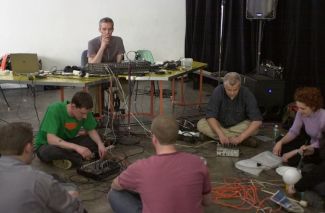
25. What’s the ideal place for concert for you, ideal public?
The place is not really important. But the people should be able to sit on chair, and there should be a good sound system. The audience should be listening and not talking.
26. What collaboration work is most memorable for you?
So many are important. I liked having a CD with Asmus Tietchens and Achim Wollscheid, I liked playing with zoviet*france a few months back, and I liked doing music with Merzbow, and these are just three of the many I did.
27. Whom would you like to work with in the future?
Not with anybody in particular. I take things as they come.
28. What artists from STAALPLAAT label can you recommend to your listeners?
My favourite Staalplaat CD”s include: Jim O’Rourke, Gregory Whitehead, Henri Chopin, Illusion Of Safety, Roel Meelkop, Tape-beatles…
29. What is the best achievement of KM and your solo work? What was the disappointment and what would you prefer to forget forever?
I do very much like ‘Verder by KM, ‘Add’ by KM, the shifts work (all), the Goem work (all) and the last works by Beequeen. I don’t think I have particular dissatisfaction with any work. They had a meaning when they were made. Luckily I did so much, that I can’t play it all. Appreciation changes also over the years.
30. What could be the reason for your split or stopping musical career for you?
I don’t know, and maybe I don’t want to know.
31. What is the best group in the world , by your opinion?
The Beatles, no doubt. Good songs, good in their studio, very creative people.
32. How do you see your future? Your nearest plans and directions.
Make more music. Release more music. CD R will be the medium of the future, a return of the small editions, like cassettes used to be, but sounding much better.
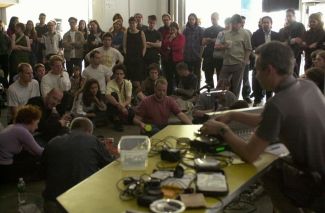
33. How do you finally explain the name of KM?
It means ‘defective music’, and it was given by my father, who one day came and said: “I don’t know how you call this, punk, disco, funk, for me it’s all defective music”, and when I wanted to release some music, I thought it would be a good name.
34. Can you say that you finally turned to CD format releases and forgot cassettes? Are cassettes still available for retailing now? I suppose you can mention all KM CD- releases.
KM still releases cassettes, because it’s a nice medium. I use to present very rough stages of ongoing cassettes. And people still buy them. I can mention all KM releases, but not here and not now. It is a book of 25 pages with releases from everything I have done. I am thinking of getting a webpage at Staalplaat and publicise this there.
(Frans De Waard & Geert-Jan)
by Dmitry “Dim” Kolesnik (email: parazyt@usa.net)
Republic of Belarus (Specially for Achtung Baby!) (November 1998)
(Source: http://drugie.here.ru/achtung/kmengl.htm)
> MASTER/SLAVE RELATIONSHIP (MSR) – Deborah Jaffe

I created Master/Slave Relationship (MSR) in Autumn of 1984 as a one-person industrial noise music and photographic project to explore my own interests in elements of emotional domination and submission, sex, and fetish obsessions. For more than twenty years I have self-produced a unique brand of industrial music and art. In that time I’ve released more than ten cassettes, one vinyl LP, five CDs and one CD-ROM. MSR has never performed live and has no intention of ever doing so. MSR was conceived primarily to express and explore my interests in extreme behaviour and thought.
From 1984 to 1988 I created music as Viscera with Hal McGee and together we created Cause And Effect which was a cassette-only music mailorder outlet in the Midwest. During that time we sold over 10,000 cassettes via mailorder before the days of the internet (yeah you had to write for a catalog through the postal mail and wait a week or two to receive it then send a check in the mail to place your order, no internet, imagine that). Learn more about this formative period of my life here (new window opens).
Prior to my Viscera days, as a teenager, I spent a lot of lonely days and nights in solitude in my room creating countless novels, stream of consciousness writings, lyrics, music, and artwork. My voracious appetite for reading books on all sorts of subjects insatiably began during this time, thus laying the foundation of my self-taught do-it-yourself philosophy.
Speaking of being totally self-taught, I am an artist, musician, photographer, and graphic designer – self-taught in all these areas of endeavor. I am proficient in Photoshop, Macromedia Director, hand-coding html in BBEdit, Dreamweaver, print pre-press process (Quark) and web design and development. The computer – specifically the internet and Apple – changed my life. I’ve been online since 1993 when I got my first computer, a Mac Quadra 900 which at the time was top of the line and cost a small fortune with an incredible processor speed of 25 Mhz with a whopping 50MB of ram – those were the days. I love doing web design and everything you see on this site was created by me.

I currently work at the company I founded, Cybertzara, out of the 1,700 square foot studio that adjoins my house in Arizona. I started Cybertzara as a way to explore my love of technology and computers; blending it with my love of music, art, film, and creativity. I work on a 24″ iMac and a G5 – though I also have two PCs which get minimal use. The server that hosts all Cybertzara sites is run on Unix FreeBSD and is colocated in California (with gratitude to Nicole my Systems Admin).
I am dedicated to releasing music and art that fights the banal and mediocre in today’s watered-down mass media, and I’m dedicated to giving the music listener and art collector some things to think about instead of anesthetizing them into complacency. How I hate to spoonfeed.

My interests are more varied and wide-ranging than anyone could imagine and include a keen interest in mid century modern art and style, Dada, Tristan Tzara, Hans Arp, Man Ray, abstract expressionism, the infinite power of the subconscious mind, all forms of music, all things Apple including iPod iPhone iMac and iYouNameIt. I’m always learning, exploring, reading about new things and ideas. As if all that isn’t enough, oh, yeah, I also own and operate a heavy metal music mailorder and record label which I started in 1996 called blackmetal.com.
2008 UPDATE: I have been concentrating on visual art for the past few years and I have new abstract expressionist artwork and in 2008 I am working on new music and films. My art is available as high quality Limited Edition signed giclee fine art prints, with an emphasis right now on abstract expressionism.

As much as I am interested in so-called peak performance and perfection, I am intrigued by doing just the opposite. I’m intrigued by fucking things up. Yet I’m obsessed with making things perfect. Maybe it’s because I’m obsessed with perfection that fucking things up seems so attractive to me. This site is about my art and the stories of my life and the outrageousness of thought that always seems to work it’s way into my mind.
 4iB Records | For intrinsic Beliefs