4iB Records | For intrinsic Beliefs
Record Label dealing in Industrial, Power Electronics, Harsh Noise, Experimental, Death Industrial, Drone, Ambient, Japanese Noise, Field Recording, Abstract, Musique Concrete and other related genres.

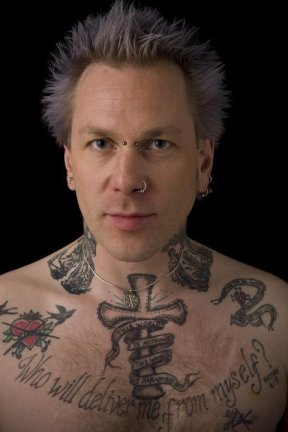
> INTERVIEW WITH SKITLIV FRONTMAN SVEN ERIK “MANIAC” KRISTIANSEN By Bruce Moore (Pure Grain Audio)

Skitliv is the brainchild of Maniac, the infamous frontman of the influential groundbreaking Norwegian Black Metal Band Mayhem. His latest offering comes to us via Seasons Of Mist Recordings and was released in stores in the US back in November. As one would expect from a veteran of the genre, Skandinavisk Misantropi has everything the extreme Metal fan could possibly want. It serves as a testament to Maniac’s staying power in the industry; he can still grind out serious Black Metal that is noteworthy. Sven Erik “Maniac” Kristiansen took some time out of his busy schedule to answer a few questions about Skitliv and the new disc, Skandinavisk Misantropi.
Bruce Moore: Where did the name Skitliv originate from and is there a special meaning to it?
Maniac: I took the name because it was very appropriate at the time. I think this word says a lot about life in general. To observe, that is.
Bruce Moore: Your brand new CD titled, Skandinavisk Misantropi, was released in November here in the States. Now that it is complete, how do you feel about it? Are you satisfied with the outcome?
Maniac: I am satisfied with it. It turned out the way I wanted it to. It is an image of what I was going through in the last years. I could not release the same album again; therefore I am very content with it.
Bruce Moore: Give us some insight into Skandinavisk Misantropi and the meaning behind its title?
Maniac: It’s both a title that for me holds contempt towards other people’s lives and how they waste them, but it also depicts parts of my own life and certain stages I just had to go through. It was hard to write and record this album. Human life is so often just a waste of time and a waste of space.
Bruce Moore: Give us some insight into the album lyrically?
Maniac: I do not like to explain my lyrics. People will have to read them and find their own meaning or mine in them. These lyrics are highly personal on certain levels and highly fictional on other levels.
Bruce Moore: Different groups have unique ways of writing their songs. How do you guys go about writing your music? Is it a collective effort or is it more the efforts of one particular member of the band?
Maniac: It is mainly me who writes the main riffs then Kvarforth and Ingvar develops them. In the end, I decide whether it will be used or not. I write all the lyrics.
Bruce Moore: Every band has its musical influences. What are some of the other bands and artists that have greatly influenced you guys and your music?
Maniac: Personally the bands that have inspired me most are: Black Sabbath (forever and ever), Velvet Underground, Burzum, Kraftwerk, Current 93, Universe Zero, Hellhammer/Celtic Frost and loads of others of course.
Bruce Moore: Skandinavisk Misantropi comes to us by way of Season Of Mist. Are you happy the way they handled the record, regarding distribution, marketing and promotion? How has the label been accommodating the band’s needs?
Maniac: It’s a bit early to say I guess, but I am in general satisfied with the way Seasons Of Mist has treated me. I guess it is not the labels job to accommodate any particular needs of my band. SoM is a good label.
Bruce Moore: Many of your songs are so intense that I am sure they translate well into a live setting taking on a whole new life in front of an audience. How does it make you feel when the emotion and power that you envisioned in the recording studio, comes to life while playing in front of a crowd?
Maniac: It is a relentless rush of energy and a total feeling of being alive. It’s a most rewarding feeling, most of the time.

Bruce Moore: When you are on the road for a while I am sure you see and experience many different things you might not even have known existed. Are there any stories that stand out in your mind as being exceptionally strange or odd?
Maniac: Too many maybe. People never stop to surprise me. Like the Navajo Indians who walked for miles on end to see Mayhem in Albuquerque.
Bruce Moore: Are there any European gigs already lined up in support of Skandinavisk Misantropi?
Maniac: Unfortunately not yet. But there will be soon I hope.
Bruce Moore: How much roadwork do you expect to be doing this 2010?
Maniac: As of today, I do not know. I have a lot on my schedule for this year. Like getting married and writing more albums.

Bruce Moore: Any plans to hit North America?
Maniac: I would love to. It has been way too long since I was in the States. I enjoy driving long hauls and playing loads of shows in the USA.
Bruce Moore: What is next for Skitliv?
Maniac: I am writing new material and hopefully we will play live soon.
(Source: http://puregrainaudio.com/interviews/interview-with-skitliv-frontman-sven-erik-maniac-kristiansen)
> LUFTWAFFE INTERVIEW; The Scent of the Vanquished By Malahki Thorn (Heathen Harvest)

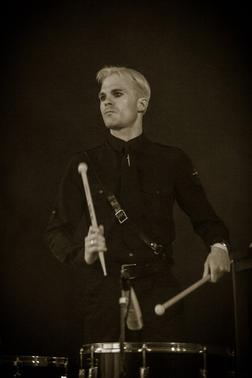
Heathen Harvest (HH): Please begin by explaining how Luftwaffe began as a band and who were the founding members?
B9 InVID: We began in 1997 as a one time musical venture for an art show called “Disassembly 1.” I had met J1 earlier in the year and as we both had an affinity for similar music we decided to do a very root-industrial performance with me utilizing found-percussion and my Moog Liberation and J1 reading from Crowley. It was so well received that we resolved to write some structured songs and become a formal music group.
HH: The band is stationed in Chicago. Are the members American?
B9: Yes, we are Americans and although we collaborate with some international artists, our core is fully yank.
HH: Do the members of Luftwaffe have previous musical experience or formal musical training?
B9: I had been raised in a musical household, as my father plays guitar/dulcimer and is a luthier specializing in crafting American folk instruments. I’d also played 1st trumpet in my High School’s marching/concert band (although I wanted to play bassoon!) I believe it would be hard to march with a bassoon, however.
HH: What other musical activities are Luftwaffe’s members involved in?
B9: I have done some music for film and also have done some guest instrumentation on some Panicsville releases, mostly playing drums and trumpet. I supplied some samples for the latest Ostara release as well.
HH: Has the band stayed true to the vision of its inception? And if not what has changed and what has motivated this change?
N2: There are key OSS documents to which Luftwaffe has deferred during the continuance of its manifestation. The vision, which is unique to Luftwaffe, and is not owing to the OSS doctrine, has continued to evolve, but not in such a manner as to betray either its original form nor compromise its service to the OSS.
HH: Luftwaffe is a duo. Do you intentionally keep the bands core membership static?
B9: We are very fond of collaborative efforts and in live performance we employ the aid of N2 Itiniti (who is aiding us in this interview and is the author of the majority of our philosophical works) and Sasha Feline of Valence (our sister band). For a while we had a very skilled live percussionist who, very sadly, has since moved away from Chicago. Fortunately he does appear on the CD in full form!
HH: What role does each core member play in research, song writing, playing / singing, recording, and production?
B9: The lion’s share of our lyrical content is taken from our philosophical writings pertaining to Solipsism and time as a sentient manifestation. Many songs also expound on John Constance works (and his trepanation) as well as the Event Nihility. I personally maintain our studio and do most of the physical engineering on my PC. Inspiration comes on at odd times and I am all too often far from my instruments. Often inebriating substances are involved and although I would never maintain that intoxication is a good crutch for art, it is very often. I am certain that sobriety has its place, but with a near 75% success rate I cannot help but endorse the latter! Don’t do drugs. Stay in school.
HH: How do you go about composing and creating the songs for Luftwaffe? Do they begin with a solid idea that you want to communicate or do they come into being through improvised playing?
N2: Extemporizing from my experience of listening to Luftwaffe Recordings which I have had little and more often no direct involvement with, I Would parallel the impact of a typical Luftwaffe song to that of a missile. Allegorizing thus, the music is the casing, and the lyrics the warhead. Both components serve the primacy of their utility.
B9: Many of my drum and guitar parts come, in part, from dreams. However, simply in applied composition, I always devise guitar parts of which I am almost unable to play repeatedly due to their difficulty. But I force my hands to play them until they become second nature. This pushes me to be a better technical musician. I find playing instruments to be a near-sexual experience and almost a purely psycho-automatic medium for ones most base energies. Performing our music fulfills, for me, a primal desire that nothing else can fill. The music is literally the sky, armed.
HH: Can you discuss the philosophical doctrine of Solipsism and how this philosophy inspires or influences Luftwaffe?
N2: Solipsism can be succinctly characterized as a belief in the primacy of an idiocentric universum. Luftwaffe, however, belongs to an artistic polity, and so the basic precepts of solipsism have been modified so as to accommodate such diversity as exists in our community. For this reason we subscribe to a form of oligarchical solipsism which grants us a unique respite from the Plurarch. Vide: “The Proclamation of a Solitary Order,” “The Political Ideoscape in Pluroform,” as well as the essay entitled “Solipsistica Nihilisti.”

HH: Luftwaffe published a book titled Et Nihil 1 along with a past release. Et Nihil 1 contained writings by Luftwaffe and Douglas P. amongst other musicians. Can you discuss the theme of the book and some of the contributors and articles?
B9: Et Nihil 1 was a tome for which we asked several artists, of whom we are fond, to contribute essays on the themes of Solipsism, Nihilism, Sentience of Time or Trepanation. It was released with the CD The Trepan of the Clock, and although limited to 100 copies only about 50 made it out (as I made them all by hand and botched a great deal of the cutting and folding of the CD jackets.) The writings that we submitted defined not only, in part, the need for nihilistic parlance in our art. We also laid the foundation for Solipsist thought as well as tactics of subversion. We were delighted to have Douglas P. as well as State Research Bureau, Panicsville and Nookleptia contribute. I hope to do an Et Nihil 2.
HH: Are there other specific philosophies, political or spiritual influences that inspire Luftwaffe?
N2: The philosophical writings of N1 Xian have been very influential to us. He endeavored to demonstrate the existence of two worlds, one that is losing, and one that is lost. He also prophesied the end of history, which, according to the tradition he founded, occurred on February 2nd, 1966. Also indispensable to our formulation of oligarchical solipsism has been the discovery of an obscure Midrashim generically named the Lamed Vav. A later revision of this document was circulated amongst the Ebionites which was entitled, The 36 Faces of Adam Qadmon. This document proposes that there exist, and always have, 36 persons who are the invisible pillars of the Universe. They do not, however, know the nature of their commission, and self-discovery results in the person¹s death. It is believed that a day will come when the 36 awaken, and through them God will pass judgment against humanity. But just as the merit of any story cannot be judged before the last page is read, so also must history end before God’s judgment is known. We have imagined 39 years of spurious history since 1966–it is now time for us to open our eyes.
B9: Suffering sans gain. Art as the plague, as characterized by Artaud.
HH: Apart from writing and music what other arts are you involved in?
B9: I am involved in Theatre.
HH: Are you agnostic, Gnostic, atheist, heathen or all of the above or none?
N2: We engage in ceremony and communion that is not without a spiritual component; however, its formulation is self derived, and therefore cannot be easily classified.
B9: I personally view death as the end and attempt to live accordingly.
HH: Through out the lyrics of Luftwaffe a message is reiterated that man, his spirit, and culture are in decline. How do you see the current state of events in our world and how does this influence your writing and music?
J1: The spirit of man is in swift decline. Human culture begins its decline at the moment of that culture’s advent. That we are witnessing the terminal stages of a culture’s decline merely serves to delineate the Xstorical terrain we traverse. Through our art, Luftwaffe endeavors to open a window, that people might be aware of this decline and of our own spiritual and cultural bankruptcy. At this stage, things happen swiftly. What you read today in the newspapers, you may see outside your home tomorrow.
HH: The lyrics also reflect a very distinct spiritual self-awareness that vaguely describes the struggle towards personal spiritual evolution. Can you discuss these spiritual themes of spiritual self-evolution?
J1: The first stage in spiritual evolution is awareness. Without awareness there is no spirit. Awareness entails seeing one’s environment for what it is and seeing one’s own place within that environment. It is this awareness we endeavor to impart. “The Proclamation of a Solitary Order” is the first manifestation of such awareness.

HH: Do your beliefs and message entail redemption through cultural and societal destruction or do you see this as the inevitable direction of man?
J1: Rather we foresee redemption through the ultimate dissolution of the human species. The light will not be released until the occlusive veil of flesh is torn asunder and exorcised from the Earth. What will remain is our divinity — Our redemption.
HH: The music of Luftwaffe is very heavily steeped in references to revolt, revolution, and political and spiritual revolution. Can you discuss your feelings towards revolutions? Do you see revolution and uprising as a cleansing force?
N2: In every generation a person or marginal polity has come forward and declared that the condition of man is fallen and that the present generation must be the last; that history must be censured for a new enterprise to commence. Our proclamation is that this has already happened and that this dream of the shadow of man must also be annulled so that we may commence the enterprise of a new heaven and earth.
HH: Some of Luftwaffe’s songs speak of a “new dawn” or “new frontiers” that are yet to be discovered. Are these ideas inspired by spiritual or physical conquest or imperialism?
N2: Violence of a genocidal nature can be conveyed by any polity against any other polity. This truth offers testament to the sameness and separation endemic to the Plurarch. The identity of the oppressed, revolutionary, or otherwise, continuously changes such that even the roles of oppressed and oppressor often alternate–sometimes within the same generation. This is the natural outcome of Plurarchial dominion, and it is repulsive. We do not, as some may assume, positively identify with the multitudinous and often changing faces of tyranny and oppression. Our enterprise is the establishment of truth, and the obliteration of lies.
HH: You also discuss the consequences of political revolution and political oppression in such songs as “The Dead Do Not Revolt” which speaks of corruption, murder, burning corpses and firing lines. Are these feelings and reflections inspired by relating to the politically and military oppressed and fellow revolutionaries?
B9: “The Dead Do Not Revolt” is a song specifically about artistic censorship. It was written the day following one of our performances which was threatened with violence by a local group (via facsimile), who is ill informed about the meanings our music (they don’t care.) They showed up, but did not attack us as their fax to the club had promised. “The Dead Do Not Revolt” was written the next day as a result of my disgust over the incident, censorship based on ignorance and juvenile testosterone unregulated by any semblance of intelligence. Free speech and free assembly should certainly be upheld–otherwise art ends. Art and politics are oil and water. These people are not artists, they’re animals… We’re using Musik as Magick!
J1: “The Dead Do Not Revolt” was written by B9 as a polemic against censorship. It continues to strike me as a vivid and graphic description of what censorship, essentially, is. The methodology for silencing an individual or group of individuals has remained the same throughout history and it is the same today. The modern day censor typically likes to begin a sentence with denial, “Well, it’s not censorship when….” Know such persons for what they are. Censorship often begins with shutting down venues. It frequently proceeds to bricks being thrown through windows. It always ends in tongues being cut out and mass graves being dug. Consider the Spanish Inquisition, Nazi Germany and the Soviet Empire behind us. Consider the Patriot Act, the Christian Coalition, the ADL, and the ARA before us. If we let them, they’ll gladly do it again.
HH: How do you feel about the American occupation of Iraq and will you have a creative response to these current events?
N2: The US occupation of Iraq resulted from an illegal invasion. This is not my opinion; it is a statement of fact. The reasons for conquest and Invasion have forever remained the same. What makes this invasion distinctive is that no convincing attempt was ever made to disguise the true reason for its occurrence. We live in such a place and time that no justification is required of atrocity. It is not merely the regrettable case that such atrocity is tolerated; it is actually celebrated by the majority of US citizens.
B9: The war in Iraq simply proves that money is more important than culture and human life. Ours has become non-culture based on a mediocrity that will not stop until the entire world is McBled McWhite. Musically, “Nebuchadnezzar Division,” “A Terror Campaign Without Higher Authority” as well as “Correcting The Human Model” addresses this.
J1: We do address these issues both as Luftwaffe and through our individual endeavors. I wrote “Ascension of Indignation” (from “Trephanus Uhr”) with this in mind.
HH: Can you discuss the martial tone of such songs as “Kronostory” that describe intolerance for the “slathering animals to be put down”?
N2: Such is the cost of willful ignorance. Except in the case of a man, when an animal dies it does not ask why. The price of life is its own vindication, and how we accomplish this will determine our fate. Life will not allow its innate value to be eternally mocked. We do not glorify suffering or murder, despite our comportment. Our voices are raised in condemnation, and the martial tone is that of indignation.
HH: There is strong sense of antiauthoritarianism and anti-state sentiment that comes through the music of Luftwaffe. Does the band see itself as being in active opposition to authoritarian and political forces?
N2: Sometimes I wonder if this recurrent and lucidly conveyed sentiment Is purposefully overlooked by our detractors who continuously cast us as proponents of that which we most vehemently condemn. And although the Ideoscape in Pluroform has been convincingly interpreted as opposing communism, it should not be assumed that our condemnation extends no further than the oppressive paradigms endemic to the left.
HH: The music of Luftwaffe is an original and unique blend of manipulated electronics and acoustic instruments. Can you discuss some of the instruments you have used during recording? Can you discuss how you produce the electronic elements of Luftwaffe? Do you have preferred methods of processing and creating sounds, samples, voice etc.?
B9: I record to Cubase SX on my PC in the studio and we use a variety of electronic instruments: Roland Juno-106, Moog Liberation, Yamaha SY-77, Cibes CPB-2 Bass Pedals. The majority is pre-amped and processed initially through a Boss-BR8 and I have an enormous library of effect plug-ins in Cubase and Wavelab, which we use for mastering. The majority of our newest recordings use organic instrumentation, especially on the percussion, which is usually from some marching basses (24/28”) and a couple of floor toms. I play a 1975 Alvarez 5054 12 String Dreadnought primarily and an Ibanez 6 String Dreadnought and J1 plays a Washburn bass. We have tried to master (or at least plod through) on a variety of instruments: Melodica, bugle, dulcimer, recorder, 6 string bass, Psaltery and I even play my high school trumpet on some tracks on the most recent recordings (Some day I’ll have a hurdy gurdy.) J1 and N2: have discovered a delightful (and very simple) stringed instrument called a strum stick, which is essentially a mountain dulcimer in guitar-type form. Sasha Feline also does some groovy guest flute for us live on Kronostory and we hope to add flute some of our newest songs in live performances.
HH: The music of Luftwaffe feels to me to be a new hybrid of ritual / tribal and martial-industrial music. Was it ever your intention to bring a militant philosophical / spiritual influence to industrial music?
J1: Most definitely. When you attain the means and ability to make music and find yourself amidst like-minded colleagues, you can say whatever you want. We feel no compunction to abide by any genre-based etiquette! Luftwaffe’s music has a strong element reminiscent of the power electronics / noise music genre. You have also collaborated with noise artists in the past. What kinds of music do your interest and inspiration encompass?
B9: I have had two profound experiences at noise shows that have made me consider my own music in a new light. The first was in 1997 when I first saw NON. I was the only one who was at the stage, as the wall of force that Boyd Rice’s noise was generating had physically driven everyone back. It was as if great-electrified hooks had been affixed beneath my ribs, which were lifting me off the ground. A full body electric orgasm produced from a larger than life spectacle-one I had always dreamed of seeing. That evening really changed my life. The second instance actually drove me from the venue. It was at the Extreme Women in Music show and William Bennett of Whitehouse was DJ-in noise. After a couple of mostly-alcohol screwdrivers and some grass I tried to continue to watch the show. The sound waves that he was generating not only made me feel violently ill but actually made me feel extremely angry. Certainly the drugs augmented my feelings, but it was a profoundly cruel experience (in the Artaudian sense) and forced me to leave. Although I felt a misery, it was a great experience, which taught me much about punishing the audience.
HH: Do you find you find that you have an audience in the American noise scene?
B9: Absolutely. In fact, they are becoming our largest.
HH: The music of Luftwaffe is also quite original and has few comparisons in the current post-industrial music scene. How is the music of Luftwaffe being received in the US and abroad? Where are you receiving the most interest?
B9: The majority of interest has been in Europe and I have received many very thoughtful email praises of our art. We do have a fairly extensive American following as well as some fans in Japan and Greece.
HH: I have read descriptions of your music by other reviewers online that label the music of Luftwaffe as “Right Wing” which implies a conservative or fascist rightist political affiliation. Is the band comfortable with these labels? Do you welcome such labels on your music and ideology or reject such labels?
N2: Because we oppose oppression in the forms of imperialism, militarism, and exploitative capitalism, we have marked the vanguards of the new right as the adversary. Because our moral fulcrum is Sovran, we can neither ally ourselves with the left, though certain of its struggles we deem worthwhile.
B9: Often those who review our album simply do not understand what they are listening to and in their seeming confused embarrassment, they label it as something grossly inaccurate—without ever even giving a hint of a description of the actual philosophical content. They claim to disagree with the content, albeit they are not sure what it is. The term “wing” is not applicable to our music. We don’t support any form of politics and we circumvent that plane entirely. As N2 said earlier, all of the cosmology is there in the music and writings. We encourage questions.
J1: When we record a song and play it for friends who know us and are able to intelligently discuss our ideas, we are able to enjoy the illusion of being “understood.” When we release a CD and it is distributed internationally; it must, necessarily, take on a life and meaning outside ourselves. Jorge Luis Borges wrote, “I sometimes think good readers are poets as singular, and as awesome, as great authors themselves.” Borges’s optimism aside, I fear for better or for worse, within the vagaries of art, people tend to find what they wish to find.
HH: Has the band come up against any attempts by radical “leftist” political groups to censor your music or stop you from playing live as often happen to artists across Europe?
B9: We have on more than one occasion. I could go on to laundry list for an hour about all of the inconsistent and violent, heinous actions of these uneducated fools, but I won’t. I will say that it really all stems from the spite of one single person and has ultimately no greater extent than that. It does not aid matters that he and I both dated the same girl. Testosterone fueled jealousy issues create harebrained volatility. He has refused to listen to our music and also to speak with us in a neutral, chaperoned environment, to which opportunity we wholeheartedly agreed. Without their cowardly masked-faces and weapons they cannot hold their own in an intellectual discussion. I best describe them as children who want really to eat at the grown-up’s table for Christmas. They truly rape the name of Pierre Proudhon. I wish he were alive to see what they’re doing!
J1: We have on a local level. Evidence seems to indicate that this is a result of one individual’s personal grudge being brought to bear on the local “activist” community. I don’t believe this is indicative of any larger political indignation. Nevertheless we are not immune to that which we are invoking — no one is.
HH: Can you name some musicians or artists that have been influential for Luftwaffe?
B9: Other than the apparent I have recently been influenced by the guitar technique of John Renbourn of Pentangle. He does an excellent solo album called The Lady and the Unicorn, which has some fantastic guitar work. I am also a fan of E. Power Biggs, the legendary pipe organist and I collect his vinyl. Skinny Puppy, NON and Throbbing Gristle were my biggest influences early on.
HH: You recently worked with Richard Leviathan of Ostara as a guest musician. How was it working with Richard and how did your musical partnership come about?
B9: I heard Strength Through Joy for the first time in 1997 when I saw them live with NON and Death in June in Chicago. It was my first exposure to Apocalyptic Folk music and it was a magickal experience. I realized that the same feelings that Skinny Puppy had instilled in me over the past 10 years could be duplicated merely with an acoustic guitar. I wore Salute to Light out on my CD player and I eventually contacted Richard suggesting that they play with us here in the USA. I sent him some of our music and some naughty goodies in the post and after much correspondence we finally met in London in 2002 for a show. He and his wife were extremely gracious and had us all over after the show for dinner and fellowship. Richard has become a good friend and I am currently writing some music for his vox, which we plan to put on our next CD, now in the works. Our Fields cover and The 10th Avatar have yielded us some high praises! I’m sad he does not live closer-quite a swim across the pond!
HH: Can you discuss the forthcoming Ostara/Luftwaffe split picture disc from Were Di?
B9: Well, unfortunately it seems Were Di is no longer in business. We learned about this second hand from another group who was to also be released on that now defunct label. We will be working toward a DVD release in the coming year and perhaps a picture disc on another label.
HH: Are there other artists in the post-industrial music scene that you would also like to work with in the future?
B9: As our latest CD features some excellent collaboration, I would like to be able to perform them in a live performance. A Death in June/Luftwaffe/Ostara show would allow for that. We will however get to do some of our Valence and Gnomonclast collaborations from the CD and LP in our upcoming April show. Its locale is under wrap for now, but will be on our website as soon as we can announce it.
HH: Luftwaffe has played live in the United States in Chicago. How is playing live? Who turns out for shows? Do you have a solid local fan base?
B9: We have a very diverse fan base, which is not entirely made up of gothic and industrial fans. Although we have not played in a long while, our last headlining show at The Empty Bottle drew about 80 people. I really enjoy playing live; it can be a brilliant experience—or a disaster! Especially when the PA is shorting out and there ain’t nothin’ you can do to stop it.
HH: You played live with NON and Death in June in Chicago. Are NON and Death In June bands that Luftwaffe feel connected to and if so what is the connection?
B9: I have loved their music for many years and they have become good friends. They are absolutely brilliant people.
HH: How was it to play with musicians that are so highly regarded in the post-industrial music scene? I read that you felt indebted to NON and Aleister Crowley?
B9: The world is indebted to them!
HH: Does Luftwaffe have any plans for an extensive American or European tour?
B9: We do have a confirmed international date for this spring, but the promoter has asked us to wait on announcing it; but, the information will be up on our website soon. We hope to play at least one domestic show beforehand, which is looking to be sometime in March. There has been discussion of a show in Europe in 2005, but that is tentative. I personally would like to play in Denver and maybe on the west coast sometime soon as well. Boyd Rice is from Denver and he’s promised to take us to a groovy and very theatrical Mexican restaurant located there some time. Maybe we could persuade him to do a live cameo as well.
HH: Luftwaffe is located in Chicago. Have you found support and an audience for your music in America? How has the European audience embraced Luftwaffe as opposed to America?
B9: Our shows have been well attended in the past domestically and we hope to play more internationally in the near future. Our albums have been extremely well received in Europe and I have had some of the most pleasant and flattering emails come from new fans all over the continent, most inquiring if we would be playing there at any point. I’d be very interested in playing some of the European festivals, as I would love to meet some of the other artists. They always seem to be held in a castle or some ancient ruinous building or theatre in the countryside. We have little of that in the USA!
HH: You have a history of releasing albums on Lupine Arts label. Who are Lupine Arts and how did you come about working with them?
B9: Lupine Arts was a label I devised at 16 for my very first industrial musical endeavor. It has been a moniker I have used for several artistic projects since 1991, yet it has now evolved into Kalki’s Army, which is more specific and appropriate. I think Kalki’s Army will probably replace Lupine on future albums and releases.
HH: Punch Records of Italy issued your most recent vinyl release. What was involved in deciding to issue a release through Punch Records in Europe?
B9: Yes, my hat is off to Punch for producing such a beautiful album, which is receiving high acclaim! I think it is our finest release to date. Punch contacted us about the possibility of a release, which was initially to be a picture disk, but as maximal sound quality is paramount we decided on heavy blue vinyl (we also had the now defunct Were Di picture disc on the way—we thought.) The LP also comes with a color poster of N2 Itiniti’s linoleum cut artwork, which is absolutely breathtaking.
HH: I would like to thank you on behalf of all the readers that visit Heathen Harvest. We wish you as much success as you welcome! Lastly, do you have any last words?
B9: Kalki Avahana! Kalki Avatara!
(Source: http://hh.heathenhideout.com/article.php?story=20050126104015305&genre=13&sort=alpha&page=3)
> COIL: AN INTERVIEW WITH (The Late) JOHN BALANCE by Compulsion Online

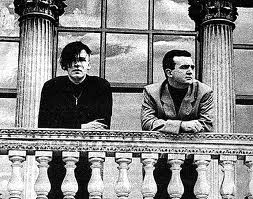
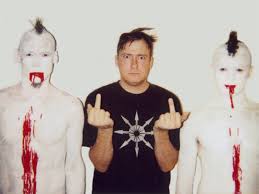
Coil, archangels of chaos, fronted by John Balance and Peter Christopherson have been around a while now producing some of the finest and most exquisite recordings you’re ever likely to hear. From their debut album “Scatology” to the dark record that is “Horse Rotorvator” it is clear that very few bands have their aims and ideas as well thought out as Coil. Rather than hold onto the past, Coil have never remained static and in some respects “Loves Secret Domain” and the ensuing EP, “The Snow”, was the nearest to contemporary styles they got, though remaining distinctly Coil in its inherent ability to appeal to the listener on different levels. Having managed to obtain an interview with John Balance just after the release of “Stolen and Contaminated Songs”, John believed “Scatology” was `too long ago’ to be still answering questions relating to it; the majority of this interview is based around their most recent releases. Hopefully it will dispel some of the myths surrounding this enigmatic duo, in addition to providing some information on their current and future projects – which seems to be shaping up to be their most fruitful period since their formation in 1984.
Regarding Clive Barker’s Hellraiser what actually happened? Did Coil pull out or did the financial backers think the music was too weird?
Well, we pulled out about 10 minutes before they said we were going to pull out, anyway. The thing is we were in right at the very beginning of the project. Clive Barker was writing a screenplay and he came to our house and took away a load of piercing magazines and things – which is where they got all the Pinhead stuff from.
Apparently, it was quite S&M orientated . . .
Yeah, we saw some original footage which we unfortunately didn’t keep but it was really heavy and good, like a sort of twisted English horror film. And then when the Americans saw this footage they thought it was too extreme and they also gave Clive ten times the original money.
It completely changed then…
Yeah, so then Clive sort of felt, because it was his first film and with Hollywood being involved it was his gateway to the stars. So they changed the location to America, dubbed all the actors over and took out a lot of the explicit sex.
Did you feel let down about this? It could have been your gateway as well?
Yeah it would have been brilliant but we wouldn’t have carried on, because they were changing everything and they weren’t being very nice to us, the actual film people. They were keeping us in the dark a lot. We said we’d had enough just at the same time they decided they wanted to use Howard Shore. They just wanted normal film music. They didn’t want anything too scary which is sad and ridiculous for a horror film.
Are Coil still doing music for commercials?
We haven’t done any for a while.
When you did do them, were they used to finance Coil projects or were they an integral part of Coil?
Well, Peter does adverts and videos as almost his main job really and if he didn’t do those we couldn’t do Coil, but we don’t do it to finance Coil we do that anyway but it helps.
Peter does a lot of video work as well?
He’s done loads of videos.
You made a video for Windowpane. Did you enjoy that?
It was really good; best video I think we’ve done. We’ve done about six in all.

I understand you made one for Loves Secret Domain in Thailand; it’s supposed to be quite sensual…
We made Windowpane in Thailand as well. Yeah, they both are. The Windowpane one we filmed in the Golden Triangle, actually in the water of the Mecon River. It means Laos and Burma means Thailand. The original opium dealing areas. There was an area where the sun dipped down into the hill just at sunset, and we filmed it at sunset on this island.
It was on (the music TV show) Snub, the visuals were really good…
Yeah, really trippy.
What else have you made videos for?
Tainted Love (see Mick Gafney’s Coil magazine for more about this), The Wheel, and a couple of others I can’t remember which ones.
What about The Snow video?
It’s a sort of, not a collage, but a barrage of images. A couple of people threatening to dance, but it’s done sort of mandala, the images go in and out, there’s four of them basically. An image repeated that makes patterns; there’s lots of stuff in it; actual snow flurries. It all looks like it was filmed in a snow shaker.
Have you any plans to issue these commercially?
Yeah, we keep waiting. When we do the next album we’ll do a couple of videos from that album and we’ll pt them all out together.
Do you think video is a good medium to get your ideas across?
I do think so. Yeah, but they’re not useful you see. We have to spend a lot of money on them; a lot of our money and unless they can use them on commercial TV it’s almost stupid for us to make them, but we still do. In Thailand we were actually filming somebody else and because we were there with cameras and stuff we managed to get two videos out of those. For next to nothing, it’s just juggling it all.
In the MFTEQ interview you spoke of Coil making a film, is this true?
We keep talking about this project Live at Bar Maldoror.
What’s it going to be?
I don’t know. (laughs) We haven’t started it yet. We’ve got lots of other stuff. I would like to make a 45 minute film or something. It will take a year to do it. Steven Stapleton (of Nurse With Wound) is doing one as well.
What’s that?
Lumb’s Sister.
Right, some of the soundtrack’s already been released…
Yeah in little bits. The film is about two hours long.
What is it based on?
Nature and magic around his house in Ireland. The whole area is about to be made National Heritage which means fuck all. It means a lot of trouble for him; they’re widening the roads so tourists can come up it.
Moving on, Coil seem to have a low profile, little press attention, tracks on obscure compilations and the mail order releases won’t exactly gain much press attention. Do you think you should keep a higher profile?
Yeah, probably. We sort of have to but we haven’t got the set-up, really. We have a much better profile in Europe. It’s because we don’t follow album releases with a single and keep up the pressure.
You have a promotion company though…
No, not any longer.
But you had one for Loves Secret Domain…
Yeah we did, but we won’t use them again. It’s difficult because you give a lot of control over and we thought it might work and it sort of worked but it also backfired a lot.
Is this why Stolen and Contaminated songs was mail order?
Yeah, to get money. We can double the money we get which isn’t much but we need it all.
It’s coming out on album as well, isn’t it?
How do you know all of this?
It’s on the leaflet…
We’re going to do a thousand as lot of our friends don’t have CDs and have missed out.
In Tape Delay you stated “we’re making a conscious effort to be isolationists”. Do you still feel this way?
Yeah, I compromise I watch TV and stuff and it drives you mad you have to spend 90% of your time getting rid of everything.

Coil use a lot of symbolism both aurally and visually. How important to you is this?
Just the way we think. The Black Sun is a weird one, it’s what I call the “Millennial Emblem”. I’ve noticed it in a lot of other people’s stuff. All About Eve’s video ended with a black sun and the Shamen have been using it in weird ways. It’s like this strange shape is appearing and I don’t know why.
Where did you take it from?
Well, the one we used is taken from Aleister Crowley, originally. He drew it as a cipher for something. Then we used the chaos symbol which sort of dovetailed to the use of that in Chaos magic. We are going to do a book on expanding it all to see how many we can come up with. I’m going to get as many people in; just everything I can find on it. I’ve got a file on it but I know if I ask as many people as possible it could go on forever. It will be out by the autumn or something.
How To Destroy Angels was designed specifically “for the accumulation of male sexual energy”, yet so was Loves Secret Domain. In what way was this?
This is like one of those weird press releases that was going around. It was part of this misleading thing. We never said that.
How To Destroy Angels was an actual ritual piece, though…
Yeah, it was. It was designed, if you break it down there was like five gongs we used and the piece was 17 minutes which was associated with Mars. There was lots of things with that we couldn’t do, on the original one as it had to fit in. When we did the CD, the new version, we’ve expanded it out a bit.
Why did you decide to rework it?
Because I thought we could do more with it.
It’s based on magical structures and specific timing, how did you work it out?
For Mars there’s load of numbers associated with it, and the metals and the colours and we used male orientated instruments, like gongs that was the metal part of the iron, bullroarers which are used in male initiation rites, which we covered in blood and symbols and stuff and we didn’t let anybody see them. The way you’re supposed to use them.
Do you think people actually listened to it in its required context?
Well that’s beyond us. One of the best things is that people said it relaxed them in the bath. That’s fair enough you didn’t have to keep women out of the room when you are listening to it, that certainly wasn’t the intention.The idea was music with a function; once we’ve done that people can use it for anything.
Derek Jarman designed the cover for the reissue, didn’t he?
Yeah, it’s a painting of his, sort of 2 foot by 2 1/2 foot of gold on gold with smashed glass on a black background. He’s doing a lot of art now. He does his painting in Kensington, in a friend’s sort of room. He’s doing massive canvasses now.
The 12 inch was to be the first in a series…
Well, we are going to do another one, another ritual one, on Mercury, which we’ll be starting just before Christmas.
Loves Secret Domain like previous Coil releases seems fragmented and disoriented. Is this the way you like to work?
It’s the way we are. (laughs) It’s partly to do with the fact we like a two year gap between each one; as we do other things in between to pay the rent. From now on, we’ve decided to do things quicker and make each one more of a whole. Instead we’ll do different projects each one taking an idea and expanding it.
What’s the best conditions for listening to Coil?
Whatever you feel.
Drugs?
It helps perhaps. It’ll bring certain things out, though, I’m not advocating it.
With Scatology you spoke of using “alchemy in sound”. What did you mean by this?
Literally, some of the sounds – shitting and toilets – were all raw noises. We were making good things from what is perceived as being basically, bad things; dealing with subjects other people wouldn’t touch such as rotting and death. That wasn’t the total picture, we were touching on things and it seemed easy to say that to people. There was much more to it.
It wasn’t shit you were celebrating, then?
It wasn’t shit we were celebrating at all but the undergrowth, the rotting vegetation type thing.
What were you trying to convey?
Back then, too long ago. (laughs)
With Loves Secret Domain you seem to have dropped the references, leaving the music on it’s own. Any specific reason?
Deliberately, because if you look at all our album covers before they had loads of references, as you said, and I kept seeing other people’s albums doing that. So I wanted to take away every pointer or reference people could have including vocals. I took a lot of the vocals out of the mixes and just left sounds and fragments and stuff – that make sense but not on the surface. We took away the sense and just left sensation, is what we said.

What were the ideas behind Loves Secret Domain?
Electricity and drugs. It’s about sound sensations, physical sensations and frequencies.
Is that why you chose the sample from Donald Cammell’s film “Performance”?
Yeah, partly.
“Pulsating energies…”
Yeah, right, and they were on mushrooms in that part of the film.
The vocals were via Tesla’s wireless, going back so was Metal In The Head. Do you like using recurring themes?
Absolutely. Sort of the same thing. We don’t look back as much as other groups do. I’ve toyed with the idea of re-recording some of our older songs to see how it would be.
Loves Secret Domain saw a slight change in Coil. Horse Rotorvator was such a dark record, right down to the apocalypse quote, a death album maybe, while Loves Secret Domain was more up-lifting a life album, maybe. What changed you?
Well, you can’t go much lower than that. It’s like the wake after the funeral, basically. We’re seriously exploring pleasure (now).

Did people think you were getting too doomy and gloomy then?
It didn’t bother me. Lots of people criticised Loves Secret Domain for being too uppy and clubby. It isn’t really that at all.
Going back to that press release it said “deranged techno house compatriots”. Even though it’s been overstated do you feel comfortable doing dance music?
We don’t do dance music.
What about The Snow?
You can’t dance to it. It’s physical music but not dance music, I mean, we know how to do it, but we don’t want to, basically. We do dance music for the head. This is what “deep listening” is about. We used the rhythms and the sounds of dance music to some extent but it had meaning behind it, in a sense it’s like ritual music again.
What did you mean by “trance as dance”?
That was that press release again. (laughs) It’s giving me grief.
Last time we spoke you mentioned the possibility of releasing some dance records under a different name. Any more on this?
No, not yet. (laughs) Still thinking about it.
It would be Coil under a different name?
Yeah, I think so.
Considering people had said Coil had gone dancey, how did the Coil audience react?
Confused them a bit. We never get enough feedback though some did say “Why are you doing this?” or “I hated this”, specific tracks they didn’t like. This was from people in Norway and it doesn’t really mean the same to them.
The Snow contained a line of Crowley’s poetry, why?
I just liked the quote. Annie Anxiety says it at the end. You can’t really hear it.
How did the Jack Dangers (of Meat Beat Manifesto) remixes come about?
We wanted to do different mixes and we knew him vaguely so we phoned him up and he was into it. He’s a really nice guy and we wanted to work with someone we liked. We could have given it to someone else who could have come up with something we didn’t like. Something commercial, God forbid.
What did you make of them? They were quite heavy…
I liked it. I said make it as relentless as possible and he did.
Tim Simenon was to remix Windowpane…
He was I’m not sure if he’s going to anymore. We’ve done a track with him for the new album which is called “Damage From A Diamond”. In fact we worked on the track together and he’s releasing the track as Bomb The Bass and we’re releasing it as Coil, as well. We’re setting up a whole bunch of collaborations for the new album.
You’ve been remixing Nine Inch Nails. How did this come about?
He’s a Coil fan. We got in touch with him to do a video and he said of course you can and by the way “Tainted Love” by Coil is my favourite video ever. So I said do you want to work with us on some music and he said, yeah. So he said do you want to do a remix and he sent the tape and we chose one it’s “Gave Up” off the new album “Broken”. It’s to come out in a couple of months, I think. We cut all his vocals up completely, it’s really good, actually, I mean that’s commercial because the original thing is. It’s got choruses and that and we tried to take those away.

You cut-up a lot of Loves Secret Domain, didn’t you?
All over.
You didn’t mind that people thought this was an old technique?
No, we wanted people to think it was old hat. We went back to actually cutting up quarter inch tape into one inch pieces and taping it together. It took about three days to do it. We had two 40 foot loops across the room.
What were the tapes of?
A prison documentary, male rape and Chinese girls banging percussion and stuff. Almost random it wasn’t chosen for any meaning.
Do you do a lot of videos for other groups?
Recently we’ve done Ministry, two videos one with William Burroughs, Bjorn Again and Gavin Friday, which is a really good video, though I haven’t seen it on anywhere. Pete’s done his last three as well.
You seem quite inside the music industry, for Coil to be so far outside it. If you know what I mean?
Yeah absolutely. We haven’t made a conscious attempt to get inside. Even to be perceived as being inside you really have to make an effort; go to places and meet journalists and I’m just not up for that.
How do you feel about still being labelled industrial, as you were in Indiecator magazine’s industrial article?
Doesn’t bother me. It’s quite good as people who like industrial might buy it anyway. It means nothing to us. It doesn’t influence what we do in any way, whatsoever. They can call us anything.
Do you think you’ve still got a deviant viewpoint?
Yes, (laughs) always will have.
Do you enjoy collaborating with other people?
Yeah, we enjoy it more than doing it purely off our own back. It’s just another person’s energy. As we work as a threesome, including our engineer (Danny Hyde), once you’ve done that and done all your ideas, all the music and done the work on the mixing desk and then listened to it over and over, then the test pressings, you’re just sick of it from over exposure and if you’ve got someone else sitting in there making a triangle of energies, it’s really good.
How did the Annie Anxiety collaboration come about?
She’s been on the fringe of our social circle thing for ages, ever since we knew CRASS in 1978.
Marc Almond is from your Psychic TV days. Does he enjoy working with Coil?
He likes to work with us. I sort of ask him once we’ve finished a track “What did you think of it?” and he says great. That’s all you ever get from him. I think he enjoys it because it’s sort of different for him.
What about Boyd Rice, from Throbbing Gristle times, then?
Yeah, we’re going to do some more. He’s coming over at Christmas as he’s playing with Death In June live and hopefully he’ll record with us, doing something similar to what we’ve done before.
What’s new in the collaboration front then?
We’re going to work with Diamanda Galas on the next album. She’ll be doing vocals and piano and ideas. It will be an angry song. She wants to do our press release in America as well.
It sounds as if you need someone new after what you said earlier.
Yeah, right. (laughs)

What was this about a Ministry video with William Burroughs?
A track called “Just One Fix” where they had used some Burroughs’ samples and their record company made them take them off as they were scared of copyright infringement and William heard about it and he said “Oh no, put them back on”. So we went over and filmed them all, William shooting and stuff and while we were there we also did some recording with him for Coil.
What is this going to be?
Another track on the album.
Spoken vocals?
Well, I’m fed up of hearing him speak over other people’s work so we got him to say a load of words, from which we’ll do an original cut-up from.
That will be interesting as he along with Brion Gysin were the first to do cut-ups…
Yeah, that’s right. We’re going to try and recapture what they were trying to do.
You’ve met him before?
Yeah, Peter worked with him on the “Nothing Here Now But The Recordings” (Industrial Records) album and we’ve been in touch with him and his secretary and right hand man, James Grauerholtz, by post. We’ve been doing secret dealings and stuff but we’re going public with them now.
Melody Maker reported that Coil were to be involved in the soundtrack to David Cronenberg’s film version of the Naked Lunch. Was there any truth in this?
Almost. (laughs) We were sort of up for it at some point and in some way. There’s things in the pipeline which we’re far more in control with; Burroughs’ texts and books, but that’s like three years ahead, but we’re sort of developing ideas and we’ve got full permission from Grauerholtz and Burroughs.
Burroughs was working recently with the Disposable Heroes Of Hiphoprisy . . .
I don’t know how much he did.
Did he mention how he feels about working with them?
Yeah, he did. He obviously gets so many requests and James says “look, do you want to work with these people?” and they’ve got good sense. If they meet the people and like them, they’ll do it. At the moment he’s doing loads of paintings not just gunshot art but automatic drawings, some of which are brilliant. He goes for pure art and at the moment that is painting.
What did you think of the film the Naked Lunch?
I didn’t like it. I thought it was homophobic which was one of the weirdest things I thought about it. If it had been more caricature it would have been much better. I didn’t enjoy it full stop. However good it was.
Coil provided the soundtrack for “The Gay Man’s Guide To Safer Sex”, how did that come about?
The people who produced it, were friends of ours.
From the Terrence Higgins Trust? What did you do for the film?
Yeah. It’s like 45 minutes of new music. It suits the tone of it which is slightly new agey, a slightly progressive house type thing. I wouldn’t want to release it as Coil particularly.
And the other one is “Sarah Dale’s Sensuous Massage”?
Same again, same production company and that’s even more ambienty.
What’s that all about?
How to please your partner using kitchen utensils, oils and stuff. (laughs)
Do you enjoy writing music for films?
Yeah, I do. I’d like ideally to do brilliant films, a good project. These projects are interesting and we do get amusement from them.
Is it a different process to writing actual songs?
Yeah, absolutely as you have to fit it into their timing and to their briefs. You obviously can’t go mad, you have to tone it down usually.
More disciplined then. Ideas from them and you?
Well, there are no ideas. You have the pictures and there’s almost the music that is obviously for it. You can easily ruin everything by using inappropriate music.
How do you approach song writing, as unlike guitar bands, you can’t exactly jam in the studio?
No we’re not. It’s difficult we just find sounds we like I mean we do jam, we jam onto tape. If it doesn’t work you take that part away. It appears but it probably isn’t as spontaneous as a guitar based band. Ultimately it’s the same sort of thing.
What about playing live. You’ve been talking about it for years?
(laughs) Probably will talk about it for years. Not as Coil, I would imagine. If we do a different sort of thing with other members, like I’ve got this other project the Black Light District I couldn’t imagine us setting up equipment to enable us to play live as you couldn’t cart all our equipment onto a stage.
What is the Black Light District, I saw t-shirts a few years ago?
It’s sort of techno, but weirder. No releases yet but there will be through Threshold House.

If you did play live, how would you tackle it?
It wouldn’t be a normal rock club, not a church either we need technology it’s what we are about. A good high tech club or something.
You played before using smell as well . . .
Yeah, we would do that and all sorts of things. Performances going on in the audience as well.
John Mcrobbie of Mute’s Grey Area approached you to perform live with some films possibly the Derek Jarman ones, will you?
I doubt it. Depends how much they offer us. It would be at the Scala cinema so I doubt it.
You seem to be spending increasing amounts of time in Thailand. What’s the fascination with the country?
Over the last six years we’ve gone every year. It’s spiritual. It really is spiritual. England is completely fucked-up; it’s all to do with the church where everything is based on guilt here. You’re fucked unless the church or society says you’re not. In Thailand it is the opposite you’re free and if you fuck-up it’s your own fault. It’s a completely reversed system over there; the whole thing is about having enjoyment in life.
Is Bee (ex-Into A Circle) still living there?
Yeah, right, and also Bee lives there and we go and stay with him. He’s thinking of starting a studio in Bangkok. He was back over here recently.

Is Stolen and Contaminated Songs more of a stop gap release than anything else?
Yes, we said originally it was more ambient but . . . the tracks are longer.
How much of it was reworked?
There’s only a couple, there’s a different version of Loves Secret Domain; a rougher mix and much of the rest is new or unheard anyway.
The track based around the suicide, Is Suicide A Solution; was this taken from your answering machine?
Yeah.
It’s really powerful and emotive . . .
We edited a few clicks out and that. We actually had second thoughts about putting it on or not. It is good. It was a friend of ours. We came back and it was on the answering machine, devastated me a bit. I couldn’t believe it.
Devastating that’s probably the right word for it.
Do you have a lot of problems in releasing records such as The Sound Of Music?
No, it’s our own fault for putting the titles out before we’ve even got the project. The next album should be out in March.
This will be “International Dark Skies”I take it? It features those we’ve already mentioned, who else?
Trent Reznor. When he comes over we’re filming a video for him. He’ll be doing lead guitar and vocals.
Do you like Nine Inch Nails?
I like the idea of Nine Inch Nails, that’s my stock answer. I respect what he does. We listened to his backing tapes and it’s all really well done.
What about NIN namechecking Throbbing Gristle and calling themselves industrial?
Well, in a sense, Throbbing Gristle don’t own their history. I think it’s good in a sense as it can only reflect well on the original industrial groups. I mean these people are stadium bands in America and they are genuinely into these bands.
Would you not like to think you have moved on since then?
Oh yeah, we’re doing something completely different and they’re doing something different. It is college rock’n’roll that they’re doing.
What’s happened with the Coil / Nurse With Wound project?
It’s still happening. It will be an album. We tried to record some up in Yorkshire but it didn’t happen so we packed up our bags and headed back to London.
Are you writing together or covering each other’s songs?
Well, there was (supposed to be) a Clawfist single which I don’t think will happen now. I mean it might eventually come off the album.
Aren’t Coil doing music to accompany a graphic novel?
Yeah with Dark Horse Publishing. They do major league comics and we’re involved with a couple of projects. We’re helping them with a Tattoo comic and the main one which is called “Underground” which is a very adult novel; a graphic novel as they call them and we’re doing the soundtrack that you play while you’re reading.
Sounds interesting . . .
It is very violent and very good.
Have you seen the storyline yet, what is it about?
It’s about tunnels under a futurist city where people play games.

Tunnels under cities, that’s you back to sewers again . . .
Yeah, it is very much our thing. In the games they play people collect ears, they play like computer games but with people.
How did this come about?
Through our Wax Trax contacts. We’ve been corresponding with the people at Dark Horse on magic and all sorts. They’re very up on it, the writers.
Who are they?
Andrew Vachss. He’s a major comic writer.
It will reach a whole new audience as well . . .
Absolutely, and it will sell a lot, but the clever thing is we can incorporate Black Light District into the comic. So we would actually appear in the strip, not as Coil as a group, but as a theme running throughout it. I’m going to get Black Suns put in it, too.
When should we expect Underground?
It’s due out July next year.
What else project wise?
The Black Sun book which will have a single in it. That’s the main thing I want to concentrate upon. I want to get some good people to write articles and stuff.
On a lighter note, this is from Melody Maker’s True Stories column :
“…This allows us to neatly sidestep into a story concerning how Peter & John got laid up for several hours with blood poisoning after traversing through the sewers of Brighton on a gay activist tour. Seems they survived that okay, only to be laid low when they started cleaning out their goldfish pool and got severe cuts”.
What’s the story?
It’s these fucking people again. (laughs) We went down the sewers in Brighton as you can do on tours and then it’s completely something else; I cut my hand on rosebushes and then went into our pond. We’ve got a big pond round the back with frogs and stuff and I got really bad poisoning. The scars went septic, though, they’ve completely gone now.
It’s not as bad as it sounds, then?
There was no gay activism in that thing. I got arrested for gay activism with Derek Jarman on a march though. (laughs)
Did you? Was that an Act-Up thing?
Yeah, we got arrested, taken to the station and cautioned.
No further action?
I don’t think so. We’re probably on their list; I was probably on it before. (laughs)
Do you get hassle from the authorities at all?
Secretly, nothing hands on-touch wood. As far as they know, we don’t break the law.
Is there anything that’s interested you lately?
Well, Terence McKenna. I did a course with him recently in a couple of days and it was pretty inspiring. We’re going to work with him. Evolution, the label, are doing an EP with four or five tracks; each with different groups and I think we’re on that with Terence.
What are the aims of Coil now?
To do all the things we’ve said we would and keep us going. I want to do some more higher profile stuff. I would like to do a really good film soundtrack and as I said that’s three years on down the line. Then I think the Burroughs’ influenced thing will appear.
What about financial backing for the film?
There are ways. You just get professional film backers. We don’t have to put our money up for it.
You don’t want to compromise your ideas though?
That’s the trouble, finding the backers who will allow you. These French TV people, Canal +, finance pretty weird things. Maybe they will.
This would be under your own names, not Coil?
Yeah, it will be a more complex set up.
Filming, directing and writing?
No just about it, that’s the hardest bit. I want to do everything.
You’ve never helped on the Derek Jarman films?
No, I haven’t actually. We did the Angelic Conversation soundtrack. But helping out, no, I don’t know why. Haven’t even been in one; everyone else I know has. (laughs)
Did you enjoy the Angelic Conversation?
Yeah, it’s Derek’s favourite film as well. People have said why don’t you put the soundtracks out on their own, but it doesn’t work. It is more that the usual soundtrack is meant to go with the video. This is what The Sound of Music will be eventually.
Will that ever see the light of day?
Yeah, probably. It’ll be soundtrack stuff, slightly reworked to make it a bit more interesting on record.
What about the Side Effects of Life?
That became Loves Secret Domain.
And I remember another (provisional title) called Funeral Music for Princess Diana. . .
(laughs) Ever since the current scandal I thought maybe we should cash in and release that.
(Source: http://www.compulsiononline.com/interview_coil.htm)
> BURIED IN SOUND – An Interview With VOMIR by Roger Batty (Musique Machine)

Vomir (Frenchman Romain ‘Roro’ Perrot) is one of the most un-compromising & respected artists with in the Harsh Noise Wall scene. Since the projects started in 2006 he has released near to forty releases (with some of these being on multiple tape or CDR sets). Romain kindly agreed to give me an email interview.
m[m]: What was your first introduction to the noise scene & when/ why did you decided to form Vomir?
Romain: My first introduction to the noise scene was Keiji Haino and Merzbow around 1994. It was a visceral shock, deeper than any Hardcore or Industrial records I’d ever listened to. I have been hooked since then to Harsh Noise. I started to play noise guitar solo and in different improv/free noise formations and then switched onto analogue gear & electronics to produce static harsh sounds. That would have being in 2003.
m[m]: I believe your early work Vomir is less HNW based- what made you decide to start going for a more wall like sound? & can you tell what your early work was like?
Romain: My early work was guitar based free noise, solo, and with the following: Freyja w/ Fred Nipi (a great French Harsh Noiser), in Mahayoni Mudra w/ Fred Nipi and Franq de Quengo (Bimbo Tower headmaster), in Arschgeil w/ Strom_Varx and Penthotal.
Romain: As for why I went for a more ‘Wall’ like sound basically I wanted to focus deeper & deeper in on pure harsh noise, but the results with the guitar were not totally convincing. So I got myself analogue noise generators and built my sound from that up. The early Vomir material was outbursts of noise and distorted vocals, and then completely static noise. I got more & more white noise generators to make different layers of harsh noise to create a thick wall of sound.
m[m]: A lot of HNW artists are influenced by Giallo or horror movies, but your work seems a lot more focused in Nihilistic & a world hating feel would you agree with this & what else influences the project?
Romain: Well, I think it would be more about world ignorance than hatred – I have no hate – and more precisely about social refusal & not wanting to interact with Society as a whole. I really feel better alone or with my close family or friends. Nevertheless I try to be the most polite and gentle when I meet people.
m[m]: How do you go about creating your Wall’s of noise & what source material do you use to make them? And have you any favourites?
Romain: Ok, I answered this more or less in a previous answer, so I will detail my gear (which is basically the one that any harsh nosier use…): Sirkut WNG, SNB & Carpet Burn, Trauma Tone WNG & shaker box, Benfox WNG & modified electric tanpura, Roland Space echo, Big Muff (US & Russian), DOD meatbox, deathmetal, corrosion & thrashmaster, Audible Disease Rupture & Convulsion, Hughes & Heffner Warp disto, BOSS Harmonist & RGE-10 graphic eq, IBANEZ blacknoise, a cheap mixer, FOSTEX FR2-LE for recording.
From this gear, I set up particular ‘chains’ and mix them. Trauma Tone WNG is my preference.
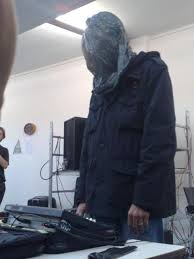
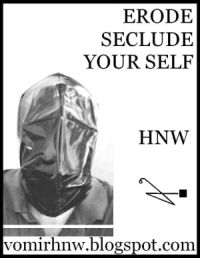
m[m]: Were did the whole idea of you wearing a bag on your head & standing complete still or lying on the ground come from?
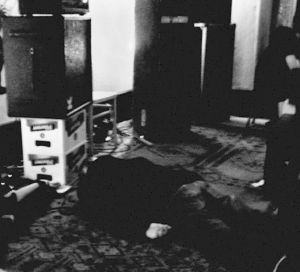
Romain: I think I was always interested in anonymity in noise, from the New Blockaders to the Haters etc… and another influence would be Franciso Lopez, giving the audience blindfolds so they can focus on the listening to his set & not what he’s doing on stage. Plastic bin bags are cheap, easy to find and fit well my ideas of sensory deprivation, loss of identity, seclusion from others, focus in on the noise, the noise which is the only important thing. If I stand still or lay on the ground is like being totally transparent.
m[m]: A practical question how do you manage to breathe inside the bag?
Romain: Well, the bag is not closed around my neck ! So with a slow breathing, there is no problem.
m[m]: When you play live are you always doing new pieces or do you ever take elements from older material?
Romain: Yes, it’s a new piece for every set.
m[m]: You mentioned you enjoy doing the longer & multiple release sets- have you ever considered playing a really long noise set say several hours?
Romain: I really like to be able to at some point to play for several hours in one go. The LaMonte Young & Marian Zazeela’s dream house would be the perfect live event for this.
m[m]: A lot of your tracks and work is untitled- why is this?
Romain: I don’t give much importance to track titles, that’s all. It’s the same for the covers: I always let the label take care of it.
m[m]: One of your more intriguing titled release is Au Duc De Reschwig (Homage To the Duke De Reschwig)- who is Duke De Reschwig & why is this piece a homage to him?
Romain: I was reading a book by great French author Jean-Pierre Martinet, in which an old man is named that way.
m[m]: Can you tell us a bit more about the Jean-Pierre Martinet book that features the character Duke De Reschwig & why you decided to use the name for the piece?
Romain: Jean-Pierre Martinet was a cursed French writer, who was always treated as worthless by editors during his life. He was an alcoholic, worked at a news stand, and died in 1993. His best works are Jérôme and L’Ombre des forêts. His books have now been re-edited in France. His writings were very pessimist. The duc de Reschwig is a character from ‘l’ombre des forêts’, an enigmatic blind homeless, who wants to make an impossible length movie of 73 years (!) about the life – in real time – of Holderlin.
m[m]: Is there any concept behind your first official proper album Proanomie? And how did it come about you decided to put it out as a proper cd instead of a CDR?
Romain: Well the title comes from Anomie which means: in common parlance it is thought to mean something like “at loose ends.” The Oxford English Dictionary lists a range of definitions, beginning with a disregard of divine law, through the 19th and 20th century sociological terms meaning an absence of accepted social standards or values. Most sociologists associate the term with Durkheim, who used the concept to speak of the ways in which an individual’s actions are matched, or integrated, with a system of social norms and practices … Durkheim also formally posited anomie as a mismatch, not simply as the absence of norms. Thus, a society with too much rigidity and little individual discretion could also produce a kind of anomie, a mismatch between individual circumstances and larger social mores. Thus, fatalistic suicide arises when a person is too rule-governed, when there is … no free horizon of expectation. so proanomie is pro-anomie, volunteer anomie… I did’nt decide put it out as a proper CD- It was the UK label AT WAR WITH FALSE NOISE that decided to take the risk ! Fortunately the CD had good response and reviews and it is almost sold out now. Thanks to the label, having a proper CD helped me to do some live sets.
m[m]: You say you leave much of the artwork & imagery to the labels- do you have any input on the albums look?
Romain: No. Labels send me their final design for a final ‘ok’, and that’s it. I just change a detail or two if needed. Sometimes, like for the Indecente cdr cover, I sent a pic, but that’s all.
m[m]: Like many noise artist you seem fairly prolific- how often do you record pieces & work? And how much unreleased stuff do you have?
Romain: I listen to my own HNW work every day, even if it is for 10 minutes. If I need to record for a release, I’ll adjust more precisely the details, and of course I’ll take care of the track length needed. I have some recorded work unreleased but not much, because of the fact that I precisely record when needed. My set up is always plugged; I just have to switch on to be in my noise.
m[m]: You seem to imply you only record when asked or approached by labels to make work is this correct & how long does it usually take for you to prefect the feeling you want in a track?
Romain: Yes, that’s correct. I make HNW everyday, but I only press record when a track for a release is needed. During recording the most important thing is that there is no technical problem, good sound during each session. I adjust the parameters of the set-up (with a little indeterminacy), then settle the eq, which is a very important thing. My feeling would be to balance between deep rumble and medium crunch, and I would adjust these two parameters to fit the mood I’m in during the particular time of recording.
m[m]: Can you tell us a bit more about the concept around your longer muilt disc or tape release like Claustration, Deliverance – The Living Dead Noise Box, No Content. How these came about & have you any more planed?
Romain: I just really like multiple discs/tapes sets. In the 90’s there were lots of those sets, by American or Japanese Harsh Noise artists and it was so good to get so much massive noise in one place. Also I think HNW fits very well for a longer length, so when a label said ok for a multiset, I always went for it! Split multiple sets are on their way, and also a Vomir multi tape, in 2010.
m[m]: Name your top ten noise records & why they are?
Romain: I am sorry, I won’t answer this question as I hate this kind of list… I will name you just one: AMM “The Crypt, the complete session” Matchless recordings.
m[m]: Do you have a piece or track you particular pleased with?
Romain: No.
m[m]: Do you listen to anything other than noise & if so do you think this has any influence on your sound? For example do like ambient, drone or American minimalistic music? Which it sometimes follows a similar unchanged sonic path as HNW.
Romain: I’m listening to a lot of music. EAI/onkyo, free noise, minimalist… Sometimes ambient/drone is too gentle, beautiful, but some works – Phil Niblocks’ for example – are mandatory. I like the sound with textures.
m[m]: What are your thoughts about the HNW genre becoming quite popular of late?
Romain: I don’t think it is becoming popular, except maybe for few topics on noise boards… But of course I’m pleased when records by HNW acts are being released, and the more good noise, the better. Actually I do think that the noise phenomenon born after Wolf Eyes fame has now gone and that a lot of people doing noise to have fun or local glory has stopped. Labels also have troubles selling their records these days , when a couple of years ago, there were LPs & CDs released every month, the production has become quite scarce except for renditions maybe… Those who do noise as a part of their life will remain, even if nobody’s releasing the sound.
m[m]: What will be the focus of new & upcoming Vomir work?
Romain: HNW HNW HNW HNW. no ideas, no change, no development, no entertainment, no remorse.
m[m]: What next in the pipeline & any more plans to tour? And any thoughts of playing stateside?
Romain: I’m Always planned stuff with DIY labels, and more official releases from At War With False Noise to be released. I try to update frequently this page: vomirhnw.blogspot.com.
Romain: As I have a family, playing is sometimes uneasy, but I always try to say Yes when someone wants to organize a set. Touring would be great, with plenty of boring time, but nothing’s planned. Once again, thank you for your support and for this interview.
Thanks to Romain for his time & efforts to find about more about the project & get up dates drop into his Blog spot here.
Interview by Roger Batty
(Source: http://www.musiquemachine.com/articles/articles_template.php?id=160)
> CHANGES/ANDREW KING – Untitled Split Review (Compulsion Online)
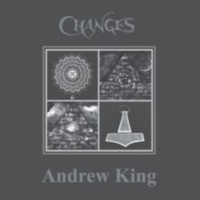
CHANGES
Changes was formed in 1969 by cousins Robert Nicholas Taylor and Nicholas Tesluk yet it wasn’t until the mid-nineties that their first material was released. At the behest of Michael Moynihan (of Blood Axis) the vintage tapes were dusted down and digitized unearthing folk music whose themes and sentiments predated “apocalyptic folk” by over two decades. Following the release of Fire of Life, the duo returned to the studio resulting in the albums Legends and Orphan In The Storm, and a couple of singles, numerous compilaton tracks and a live recording Hero Takes His Stand, featuring members of Waldteufel and In Gowan Ring.
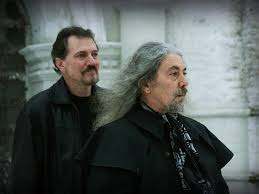
And while they’ve sought influence from the British folk groups their output is characterised by a darker strain – their first shows were at coffeehouses operated by the notorious British cult The Process Church of the Final Judgement. Changes alternate between gentle ballads and songs championing the heroic and chronicling the impending apocalypse, often involving legendary and mythical figures. A key track is ‘Twilight of the West’ which echoed Spengler in its fatalistic vision and proved prophetic and more apt to todays cultural and spiritual malaise than to when it was orignally penned in 1969-70.
On this Terra Fria release the elder statesmen of the “apocalyptic folk” genre deliver two fine examples of the heroic and the apocalyptic. Over ringing acoustic guitars, the cousins melodic voices entwine to deliver ‘Mahabharata of the Soul’ using Hindu imagery to convey the conflict within the soul of Western man. ‘Anthem To Freedom’ is a simple but effective rendering of a heroic ballad. Military snare and poised acoustic guitars combine with beautiful vocal melodies in this tribute to the warriors of the world who have fought and died for freedom. The other two tracks are gentle ballads. ‘Flame’ is an evocative love song with Taylor’s deep voice over 12-string acoustic guitar. ‘Shenandoah’, meanwhile, swaps the acoustic for electric guitar with Taylor, once again, providing a rich melody for the poetic lyrics. The final track is a reading of R.N. Taylors poem ‘…And Finally’, that tells of ragnarok. I’ve longed to hear a verbal rendering of this poem ever since Taylor gifted me an inscribed printed edition. And it does not disappoint. There’s a subtle interplay between ice cold drones and spartan drumbeats as Taylor delivers this passionate reading of this polemical poem in parody, whose narrative draws upon T.S. Eliot (and particularly The Wasteland), Spengler before finishing on the cryptic whispering of Odin delivered to his son Balder as he lay dead on a funeral pyre. It’s an effective reading of this evocative poem that will appeal to those with a penchant for the mythic and the experimental.
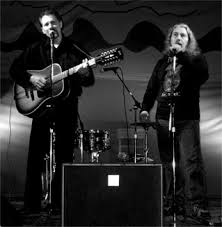
ANDREW KING
The music of Andrew King is fiercely traditional, partly due to his (former) role at the British Library where he was solely responsible for preserving vernacular culture in the form of folk song. His contributions to the Terra Fria release are drawn from these scholarly pursuits.
On ‘Two Brothers’ King delivers an impassioned performance concerning the accidental death of one of the siblings as a result of a playful tussle. As the song progresses from the almost unaccompanied first verse through harmonium drone to ponderous death beats the music becomes richly evocative to the point where the verse relating the child’s death to the parents, family and loved ones is set to an angelic accompaniment. The use of vocal performances from a live performance ensure a natural and captivating delivery of this fatal tale.
‘Dives and Lazarus’ has more minimal backing with just a lilting keyboard ensuring King’s voice remains the focal point, as he delivers this 19th Century song about Diverus’s feast who denies the (fateful) starving Lazurus. On ‘Kommer I snart, I Husmænd’ King delivers this folk song – a battlecry for smallholders everywhere – in its original Danish tongue. Timpani drums and piano set the scene to which King lends an earnest and valiant vocal. King’s assured tones actually remind of Lord Summerisle’s contribution to The Wicker Man soundtrack.
The standout track of King’s contributions is ‘What Is The Life of a Man’ his largely unaccompanied vocal relating the impermanence of life and man’s place in the natural order. The massed accompaniment by his “chorus of farmers and fatalists” is moving in its simplicity. A fine example of traditional song, direct and emotive which effortlessly pulls on the heart strings. ‘The Farmer’s Toast’ adopts a similar approach with the massed backing of the farmers and fatalists, gentle organ drone and violin score. The congregation of voices is effective. There’s a roughness here, a sense of humanity that is strangely affecting as they drink to the health of the farmer.
Although Andrew King is a regular at folk clubs, he’s closely affiliated to post-industrial and experimental circles. KnifeLadder the London based polyrhythmic industrialists are responsible for the musical setting of King’s interpretations of these traditional folk songs, while Andrew Liles collaborated with King on The Harbinger of the Decaying Mind, a 10-inch on the Old Europa Cafe label. And while I’ve yet to hear that record this collection compares favourably with his Athanor release, The Amfortas Wound. Andrew King, along with the Scottish singer Alasdair Roberts, are currently taking traditional song to contemporary music audiences.
The Changes / Andrew King release is deleted at source but you’d be a fool not to track this down via the varied online retailers as this is a great CD from both acts. Changes have copies for sale from www.highfiber.com/~thermite/ Fantastic stuff, and probably the finest release from Terra Fria yet. For more information go towww.terra-fria.com
(Source: http://www.compulsiononline.com/Changes%20-%20Untiltled%20split.htm)
CHANGES
ANDREW KING
> MASONNA (Yamazaki Maso) – God of Noise
Yamazaki “Maso” Takushi (山崎 “マゾ” 卓志?) is the birthname of Japanese noise musician and performer known most widely for his solo project Masonna.
Born in Kyōto, 1966. He operates the Coquette Records label and is also a member of the group Christine 23 Onna (now titled Acid Eater, with Toda Fusao from Angel’in Heavy Syrup), Maso is also the manager of Jojo Hiroshige’s Alchemy Records store. He has an analog synthesizer project called Space Machine, with other projects which include Triple Yama’s, Kinkakuji, Gokurakuji, South Saturn Delta & Andromelos.
He was a member of the noise group Flying Testicle with Merzbow, as well as the Japanoise supergroup Bustmonster which included Akita Masami from Merzbow on drums.
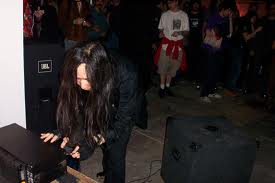
Maso has said that he became interested in making noise music when he heard the sounds of destruction on television as a child, but that his first exposure to the Japanese noise genre was Hanatarash’s debut LP, which at the time did not impress Maso. It was however later, upon happening on an LP entitled LSD by a Tokyo noise band named Nord, and mistakenly thinking it was an album by the band LSD, that these experiences had possibly kindled his future interest. A year thereafter Maso sought many different types of noise releases in the underground music stores in and around Osaka Japan. Two years would pass until Maso would start to develop his own style of noise and begin producing, at which time he quit listening to the noise albums of others and focused in on his own unique style. Previous to his interest in noise Maso played guitar in several bands, one of which he states in interviews was a Led Zeppelin cover band, playing the occasional Deep Purple song.
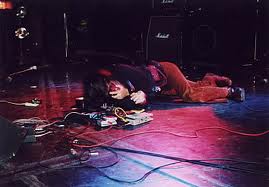
All of Maso’s projects draw heavily from the psychedelic music scene in outward style, but sonically most of them resemble very few of the traits of late 1960s and 1970s psychedelic music. Maso has an interest in avant-garde films, having stated in interviews that his two favorite movies are the Alexandro Jodorowsky films The Holy Mountainand El Topo. He also claims to admire and wish to work with American musician Captain Beefheart.
==========
Masonna (マゾンナ), started in 1987 in Osaka, Japan, is the noise music project of Yamazaki Maso. Sometimes rendered as an acronym M.A.S.O.N.N.A., standing for either Mademoiselle Anne Sanglante Ou Notre Nymphomanie Auréolé (French for “Miss Bloody Anne, Or Our Aureoled Nymphomania”; the proper spelling is Auréolée. In kana: 血まみれのアンヌ嬢・若しくは・我等がニンフォマニアが・後光に包まれる) or more rarely Mystic Another Selection Of Nurses Naked Anthology. Maso has said before that the name is a pun on pop singer Madonna, though the name is also a composite of Maso (Japanese for “Masochist”) and Onna (Japanese for “Woman”) alluding again to the fetishistic “bloody Anne” reference in the French acronym. Along with Merzbow, Masonna is one of the best-known Japanese noise projects.
The Masonna project has been the opening act for several well-known artists on their Japanese concert dates, including Sonic Youth, Beck and Slipknot. Masonna also caught the attention of John Peel and was featured on his program, having even done a limited Masonna ‘John Peel Sessions’ CD.
Yamazaki Maso currently works at Alchemy Records in Osaka.
Masonna is most known for Yamazaki’s wild live performances which usually consist of damaging his equipment, jumping around madly, and at times getting injured. He has given entire concerts which last only a few seconds. In 1996 Masonna toured the United States on the “American Mystique Tour” named after his only album to be released on two formats, Inner Mind Mystique.
More Info At: http://masonna.main.jp/
> ELECTRO SUPLEX – An Interview With (the late) Koji Tano aka MSBR

MSBR is a noise project of Japan’s Koji Tano. MSBR’s crushing wall of noise, like Merzbow’s, manages to tap into a post-human territory of pure absolute volume that seems to have more in common with the unstoppable forces of nature than any form of music. Witness the MSBR “Collapseland” CD on the German Heelstone label, directly inspired by the catastrophic Kobe earthquake. It doesn’t take much of an imagination to connect Koji’s claustrophobic dense noise constructions with the obliterating movement of massive tectonic plates. You know the drill: Japanoise – blah blah blah. In addition to his noise activities, Koji’s MSBR web page is an essential nexus of information for the international noise set.

1. How old are you?
KT: 37
2. Can you describe your music in words?
KT: Grappling Electro Noise. But I’m making less electronic sounds using field recordings recently.
3. Can you tell me more about the field recordings?
KT: Yes. My recent concept is to re-make new natural/usual form by exchange of natural/usual sounds. Materials are from several things. Sounds in my room, in town, in field. I recorded those and dub/cut up and exchange by some effect.
4. Do you record everything in a home studio? Do you use computer for sounds or editing?
KT: I record some materials in a home studio and some live. I’m using DAT. My equipments are mainly a KORG guitar synthesizer and some effects. And I use feedback to be out by connect with these equipments as source material. I won’t use computer for making sounds. Because I don’t like digital sounds. I prefer analog one.
5. What is the first record you ever owned?
KT: 1st LP of KING CRIMSON
6. What is the record you listen to when you fall asleep?
KT: HAWKWIND “SPACE RITUAL”
7. What is the record you play the loudest?
KT: HAWKWIND “SPACE RITUAL”
8. What is the last book you read?
KT: “DENSHI ZATSUON” This is magazine for noise music I’m doing. 1st was issued last summer. I’m making 2nd now.
9. Can you tell me more about “DENSHI ZATSUON”?
KT: “Denshi Zatsuon” means electro noise. 1st issue out July ’97. 2nd issue out Apr. ’98. 1st was 600 copies and a few copies left. Notes are all in Japanese and total is 66 pages. 2nd issue will be more pages.
Notes are mainly about noise-interview, review, others. But artists in several are are introduced. Daniel Menche, Destroy All Monsters, Macronympha, Stabat Mors, trente oiseuax, Ash International are introduced.
There will be many interviews on 2nd issue. RLW, B. Günter, R&G, PBK, Toy Bizarre, Steve Roden, Brandon Labelle, Kiyoshi Mizutani, Paolo Bandera (Sigillum S and SRS), TAINT…..
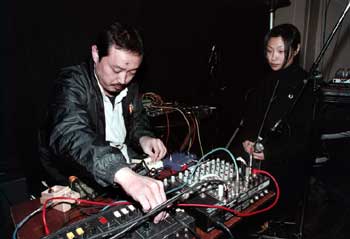
10. You mentioned B. Gunter in your contents for DENSHI ZATSUON #2. Did you interview him? What do you think of his music?
KT: I’m not familiar with B.Günter. This interview with him is one by other members of magazine. I think his work is very interesting but it’s art. So his work is not sometimes enjoyable. Maybe this is his concept.
He said it need not violent one in art and I can understand some. But there’re much violent one in our society now. I think it’s important to tell this social factor in artistic work. I want to tell detail about this but it’s difficult for me in English.
11. Can you tell me of any new MSBR releases? Compact Discs especially?
KT: 2 CDs are released. One is collaboration with Daniel Menche, Crawl Unit, Basic Noise. Release is from Isomorphic Records in USA. Another one is collaboration & split work with Blazen Y Sharp. Release is from Gender-Less Kibbutz in Italy.
Except these, LP and CD are ready to be released from my new label – FLENIX this spring. LP is a live split with Spastic Colon. CD is collaboration with DSM and ERG. ERG is another project of MNORTHAM.
12. Your old Manga in Ongaku Otaku #2 was very good – Do you still draw Manga? Have they been published in Japan?
KT: I finished new MANGA for Ongaku Otaku #3. It’s new work of mine. My MANGA hasn’t been ever published until now. A work in Ongaku Otaku #2 was one I draw about 15 years ago. And I haven’t done MANGA by new work this time.
But I will keep doing MANGA again. So if someone who read this interview has interest to publish my MANGA, please contact to me.
13. I know you like wrestling and Japanese grappling – Do you know Mexican wrestling? Do you know El Santo?
KT: Yes, I know. But I don’t like Mexican Style. I prefer more stronger style by Suplex and Submission wrestling. Especially, Suplex is the best technique in wrestling, I think. My thought is that the best wrestler is Antonio Inoki. Except him, I like Bruzer Blody, Giant Baba, Stan Hansen, Jack Brisco…. Except wrestler, I like Masutatsu “GOD HAND” Ohyama. He’s a god of Karate.
14. What is your favorite piece of equipment for making noise?
KT: Guitar Synthesizer by KORG. I always use for recording and performing.
15. Do you have any contacts with the Japanese techno scene?
KT: I don’t have any contact to Japanese techno scene. I have interest in techno techniques for making sounds but I don’t like the music itself. Because most of those are too dance and groovy for me. I dislike dance music.
16. I’m writing an article about Richard Pinhas and Heldon – Do you know their music?
KT: Yes!! I love their sound. Especially, “Interface” is one of my favorite 70’s record. Its style – electronics sequence and drumming, I think it’s real techno music. This means mixture of human and machine. And very groovy for human in Rock generation like me. Some artists in Japan get influence from their sounds.
17. I notice you and some other Japanese noise musicians listen to a lot of seventies progressive and psychedelic music more than new noise/electronic – do you agree? Why do you think this is? Do you listen to any new noise/non-noise musicians?
KT: First of all, Noise artists I mentioned are first/second generation like Hijokaidan, Merzbow, Incapacitants, AUBE, K2, Pain Jerk, others. They are all over than 30 years old. They have kept to listening music from early 70’s when they were youths. And progressive and psychedelic are minor music from 70’s, and that spirit is the same from noise after 80’s. Especially, 70’s German Rock – CAN, NEU, AMON DUUL, CLUSTER, GURU GURU, others – had destroyed style of Rock Music by that time, and I think it has the same concept from noise. Japanese noise artists in first/second generation got a big influence in starting their music career from 70’s German Rock. I myself listen to this music and like it very much.
Next, third generation like Kazumoto Endo, Government Alpha, and others are all less than 30 years old. When they are youth, first generation of noise are already doing and “noise” had been out as musical category. Third generation got a big influence from “noise” and started doing “noise”.
I listen to new noise of course. There are some interesting artists if I tell as noise artist-MSBR. STABAT MORS, DANIEL MENCHE, SPECULUM FIGHT, TOY BIZARRE, SMALL CRUEL PARTY, others. In non-noise music, there are less interesting artists for me. Especially, alternative is the same from 80’s real alternative. It’s not new music.
18. Merzbow likes Heldon too – you said some Japanese musicians are influenced by them – can you tell me which ones?
KT: I think they are first Rock band did mixture electronic sequence and human beat. Guitar by Pinhas is not important (but I like it). But his concept in this mixture was very new at that time. In techno age now, this is still important. I can say HELDON style is next techno music to 21st century.
I think MERZBOW has the same concept in their recent noise. It’s mixture destroyed electro sequence and destroyed human beat….I myself do another unit “MAGMAX” using noise manipulation plus TB-303 sequence. That style is nearer to SUICIDE than HELDON but concept is mixture of electro sequence (TB-303) and human beat (noise).
19. Is there any MAGMAX music out on cassette? Is this a solo project or do you work with other musicians?
KT: MAGMAX has no releases now. Only live. But LP with 7″ will be released from HANDS in Germany in the near future. MAGMAX is a project by me and other 2 menbers. My part is noise & rhythm(TB-303). Other 2 menbers are vocalists – MAGMAX#1 and MAGMAX#2. When live and recording, MAGMAX#1 mainly does vocal.
20. As you said, what made Heldon special was the heavy electronics mixed with the live drumming (especially on INTERFACE and UN REVE SANS CONSEQUENCE). Do you have any interest in doing something with real drums and electro noise?
KT: Yes, I have interest to do work with drummer. It will be exciting. I also like INTERFACE and UN REVE SANS CONSEQUENCE. And I like early DAF (2nd LP!) too. They also did mixture of electronics and drumming. It’s more punk style than HELDON. If I found a good drummer, I’d do it.
21. Are you familiar with the Japanese Zero Gravity and Transonic labels? I’ve heard some of their music (Utah Kawasaki and Kazunao Nagata CDs) and they seem to be abstract non-dance electronic with some drumming – sometimes like Suicide/Heldon/DAF (early) or Cluster and Kraftwerk (early) using old synths and effects.
KT: I’m not familiar with them. I have heard some of their works. I can understand your thought but I think their music is not same as HELDON, DAF, Suicide… The reason is that spirit between both is different. I think that HELDON is more free improvisation and DAF is PUNK, like Suicide. Especially, DAF and Suicide had a vocalist. I think their music gets a big influence from Cluster, Kraftwerk and others. But I think there’s no need for doing 70’s style in the 90’s. It’s like many band people play Beatles, Rolling Stones, Led Zeppelin…. There’s no spirit to new vision.
I like HELDON and DAF but I am not going to do the same style. I must add something of new to those styles. And one of those is “Noise”.

Selected discography:
On MSBR Records, Koji’s own label. All are MSBR releases unless noted otherwise:
(MR01) “ULTIMATE AMBIENCE” LP Ltd 400 copies
(MR02) “STEROID” 7″ Ltd 30 copies
(MR03) “STRUCTURED SUICIDE” cassette
(MR04) “AMALGAM” split 7″ with TELEPHERIQUE from Germany Ltd 55 copies
(MR05) “SCOPOTOPHILIA” split 7″ with TAINT from USA Ltd 66 copies
(MR06) “YASHA” collaborative cassette with THIRDORGAN from Osaka
(MR07) “A CAT HAS NINE LIVES” split 7″ with SMELL&QUIM from England Ltd 69 copies
(MR08) “MULTI LAYERING TERMINATION” collaborative 7″ with DANIEL MENCHE from USA Ltd 100 copies
(MR09) “SONIC AGRESSION” collaborative cassette with RICHARD RAMIREZ from USA
(MR10) “INFUSED ELECTRONICS” split 7″ with SSHE RETINA STIMULANTS from Italy Ltd 100 copies
(MR11) collaboration 7″ with SALT from Germany
(MR12) “STULTIFICATION” split 7″ with SPECULUM FIGHT from USA Ltd 120 copies
(MR13) “-” DANIEL MENCHE/SMALL CRUEL PARTY split 7″ Ltd 77 copies
(MR14) “CONTACT #1” split & collaborative LP with TELEPHERIQUE & CONTAGIOUS ORGASM Ltd 500 copies
(MR15) “SCHASCHLIK” TELEPHERIQUE/D.W.M./TESENDALO collaborative 7″ Ltd 100 copies
(MR16) “METABOLIST” TELEPHERIQUE/Cruel Science in Babylon split C-46
(MR17) “SUPPLEMENT” C-60
(MR18) “YAKUZA vs MAFIA” split 8″ with MACRONYMPHA
(MRL01) “-“SPECULUM FIGHT/MSBR/THREE split 7” Ltd 58
Selected releases on other labels:
“SONIC DESTRUCTION” (DEADLINE RECORDS in USA) split LP with BLACK LEATHER JESUS Ltd 300 copies
“DESTRUCTIVE LOCOMOTION” (RRR/PURE in USA) CD Ltd 500 copies
“COLLAPSELAND” (HEELSTONE in GERMANY) CD Ltd 500 copies
“INTENSIFICATION” (PRAXIS DR.BEARMANN in Germany) 10″ Ltd 200 copies
“DESTRUCTIBLE FOUNDATION/DRAIN” (MSNP/SELF ABUSE in USA) split 7″ with MERZBOW Ltd 500 copies
“ELECTROVEGETARIANISM” (PINCH-A-LOAF Productions in USA) 7″
“COLLABODESTRUCTIVISTS” (ISOMORPHIC RECORDS in USA) CD 3 collaboration with Daniel Menche, Crawl Unit, Basic Noise
“MASS FOR DEAD INSECTS” (GENDER-LESS KIBITZ IN Italy) CD
“MENTAL DISSOLUTION” (BLOODLUST in USA) cassette Ltd 50 copies
“METAL STRICKEN TERROR ACTION” (BANNED PRODUCTION in USA) cassette
“-” (EF tapes in USA) split 2 cassettes with COCK E.S.P. Ltd 100 copies
“SUPPLEMENT” (APRAXIA in USA) cassette
“HOLY MOUNTAIN ELECTRONIXX” (CLING-FILM records in Belgium) cassette Ltd 100 copies
Compilation appearances (selected, of course):
“CATACLASTIC FRACTURE” (DEADLINE RECORDS in USA) CD
“EXPLORATION :?” (BODY AND BLOOD in Canada) CD
“THE JAPANESE/AMERICAN NOISE TREATY” (RELAPSE RECORDS in USA) 2 CDs
“SOME WHORES AND A CAMERA ZAIBATSU” (OLD EUROPA CAFE in Italy) CD
“ADVENTURES IN MODERN ELECTRONICS” (PINCH-A-LOAF Productions in USA) CD
“PURE POWER PICNIC” (TIDAL WAVE RECYCLING in Norway) DAT
“FINISH” (DFP in Germany) double 7″s
“CHKIYUU” (Ash International) CD
“THE ARTIFICIAL NERVE” (XERXES Recordings in Japan) 5 cassette set
“DENSITY-100:” (G.R.O.S.S. in Japan) 2 cassettes
“NE SHI” (BANNED PRODUCTION in USA) 2 cassettes
“PRAYER OF MANKIND” (SSSM in Japan) 2 cassettes
“NOISE NET #3” (NOISE in Taiwan) cassette
“EXTREME PLEASURE” (SLAUGHTER PRODUCTION in Italy) cassette
(Source: http://www.angbase.com/interviews/msbr.html)
> STORMTROOPER ELECTRONICS: An Abridged Lesson in the History of WHITEHOUSE by Michael Moynihan
Whitehouse just could be the most extreme form of music ever created. They may be the most repellent as well. Regardless of whether or not you can stomach their brand of aural torture, they’ve maintained a unique form of purity that is unmatched in the world of pop sell-outs and media marketing rock ‘n’ roll whores. In fifteen years, and with that many releases under heir belt, Whitehouse have never even broached the edges of the commercially acceptable music business. Carving out a private niche for themselves, the band refuses to deviate from their trail blazed path of relentless, uncompromising deviant noise.
Beginning in 1980 as a phantasm in the mind of Essential Logic guitarist William Bennett, it wasn’t long before an electronic project called Come mutated into Whitehouse after a few singles. Fed up with New Wave and techno pop, William began to finally reach his goal of a veritable “electronic maelstrom” which would leave audiences either reveling in unbridled power or begging for mercy, depending on one’s predilections. Over the years Whitehouse has peripherally and directly involved an astounding number or underground luminaries, including Daniel Miller (The Normal), Kevin Tomkins (Sutcliffe Jugend, and now Body Choke), Philip Best (Consumer Electronics), Glen Wallis (Konstructivists), Stefan Jaworzyn (Skullflower), Jordi Valls (PTV, Vagina Dentata Organ), David Tibet (PTV, Current 93), Peter Sotos (of Pure magazine infamy, now publishing Parasite), and most recently, Jim Goodall (Medicine). On top of this cast of players, recent Whitehouse efforts have featured the production/engineering input of Steve Albini and the incredible artwork of Trevor Brown.
Since day one, rumors and innuendo have followed William and Whitehouse like the plague, and many of them are still bandied about over a decade later. In an effort to set the record straight, the following interview sheds light both on the band’s history as well as it’s controversies. In spite of an often frightening reputation, William Bennett is in reality a charming and personable fellow. Don’t let that fool you though, as the sheer determination and unswerving dedication of Whitehouse to their violent appetite, which remains unquenched after fifteen years, should warn beyond a doubt that they will not be denied in the end…
Michael Moynihan (MM): Daniel Miller, who founded Mute Records, was on some of your early releases, right?
William Bennett (WB): Yes. On the Come stuff, which was like the crossover, or the bridge between the two sounds [leading to Whitehouse]. He recorded things like The Normal and the Silicon Teens album in a little studio in London called IPS, and he kindly took me down there and did two or three sessions together, and he helped me mix it. I knew nothing about that sort of thing, and he also helped releasing it, as he’d just done The Normal single [“Warm Leatherette”] and he gave me contacts for distribution, where to get the sleeves done, the labels, and so on…
MM: What was the original idea behind Come Organization?
WB: It was essentially a record label for Whitehouse. I can’t really remember how the name came about, but the ‘organization’ part was inspired by a pornography company called “Private Organization”, which ironically is the one that publishes the magazine called Whitehouse. So there’s two things that got together a little bit there.
MM: And why did you choose the name for the band?
WB: It was just the idea that there was a pornographic magazine called Whitehouse, and then of course Mary Whitehouse, who I’m sure you’re familiar with, being the anti-pornography campaigner.
MM: Was that a coincidence that the porno mag had the same name as the censorship activist, or was it a deliberate effort of the publisher’s to rub salt in her wounds?
WB: That’s what I’m not sure of, I don’t know. But it seemed like a classic bit of irony, and I love things with two meanings or three meanings or more…
MM: Does Whitehouse, the magazine, still exist?
WB: I think so, but it’s a crap magazine-I wouldn’t recommend it to anyone!
MM: What fueled the ideas behind the Whitehouse releases at the outset?
WB: Bits and pieces. It didn’t really have much direction at the beginning I suppose. It was only later, with Erector. That was the first time when I thought there was a sense of direction.
MM: How did the obvious interest in the Marquis de Sade come about?
WB: Initially, that went back a long way, from about 1977, when I was at University in Glasgow, Scotland. I was very good friends with a guy called Alan, who’s now the guy from Postcard Records. At the time he wasn’t involved with music directly but he put out a punk fanzine called Chickenshit. The Marquis de Sade books were banned everywhere, but he had access to some special library where he could get a hold of a copy in French. He used to translate a couple of pages of it for each issue of his fanzine. And that’s where I was first familiar with it, and I really loved reading it. It was until a year or two later that I actually managed to get the Grove Press editions, and I’ve just been collecting his stuff ever since.
MM: Have you read it in the original language?
WB: Oh yeah, I do read the stuff in French. In fact, it’s much better in French. With the English, although they’re beautiful translations, there is a lot of embellishment to make it sound of the period [18th Century]. They use a very sort of floral language, whereas in the French it’s much more simplistic, and there’s a lot of humor that doesn’t seem to translate. I think they’re beautiful translations, but reading it in French makes for an entirely different experience. And he uses very simple sentences very effectively; it’s a very interesting style. The books certainly haven’t lost any of the power over the last two centuries. What people forget is how much black humor there is in it. They are serious books, but there’s a lot of black humor in there. Unfortunately they haven’t translated the [Sade] biography by J. J. Pauvert, three huge volumes that have come out in French. I don’t understand why they haven’t been translated into English, because they make all the other biographies totally obsolete, as almost works of fiction. He’s had access to all the letters from the Sade family’s mansion, chateaux, and some of the revelations in there are just extraordinary.
MM: Was there anything else that had impact on you like that of de Sade?
WB: Anything in that genre, things like Krafft-Ebbing, Venus in Furs, and I enjoy reading things like Naked Lunch-other books of that ilk.
MM: So whatever was explicit in one way or another.
WB: Yes. And then in the next year or two, having finished reading all that, I moved across to start reading more non-fiction books. I didn’t like any fiction after reading de Sade, it all seemed really tame. And then it was biographies of murderers and a lot of stuff on the two World Wars.
MM: True crime books must have been a lot harder to come by then, as opposed to the glut of them today.
WB: Yes, that’s right. It’s a big industry now. There was no such thing as a “true crime” section in a bookstore 15 years ago. Certainly not of contemporary true crime. The books about someone like Peter Kurten were very rare, but we just spent lots of time hunting around all the stores in London, hunting for the stuff, and you got lucky.
MM: Your interest in Nazi imagery was growing then as well.
WB: Yes. I read a lot of books about the concentration camps and biographies of people like Himmler, especially. It was an amazing period for that sort of thing, where there was seemingly a license for these guys to do almost what they pleased. And the imagery itself, the fetishistic implications of that as well…

MM: You didn’t hesitate then, to incorporate allusions to all these things in Whitehouse?
WB: No.
MM: You weren’t worried about what kind of reaction it might provoke?
WB: At the time there were already quite a lot of things put out which were pretty risqué, controversial. So I wasn’t frightened, I had the confidence to do just about anything, and I certainly don’t regret it now. But obviously it did cause an incredible amount of controversy. I find that a record like New Britain, for example-there’s no real political content in it at all, if you look at it carefully. It’s all imagery, really. There’s no real content to the imagery. It does appear very sinister, and Whitehouse has been more controversial than a lot of other groups, for the music as much as anything-being very harsh, electronic, and difficult music to listen to. But a lot of other groups have dabbled in that kind of imagery, like TG and Joy Division…
MM: Some the latter’s stuff is incredibly blatant…
WB: Yeah, I mean the very name itself! Death in June as well, but they’re rock bands so it doesn’t really matter so much. We got hammered a lot harder for two reasons: because the music was so harsh, and people didn’t really know where we were coming from-it wasn’t rock music- and secondly, we incorporated a lot of what could be called sexist imagery.
MM: You couldn’t arrive at a more unpopular combination of imagery for the liberal humanist types!
WB: Certainly, yeah, and especially with Rough Trade, who were responsible for a lot of our distribution at the time.
MM: Your distribution problems with Rough Trade were somewhat legendary.
WB: Well, they were being totally hypocritical about it. I still don’t think there’s anything wrong with that sort of imagery at all. But they banned the first Nurse With Wound album, some Stranglers records, and I think Blondie were even banned for awhile! They were very sensitive. The worst thing was, that while they’re in their rights to stop whatever records they want, of course, people would go into their shop in London and ask for Whitehouse records and they’d get a fifteen minute monologue over why they shouldn’t be looking for Whitehouse records! And that’s beyond reason…They should politely say, “No, sorry we don’t have anything.”
MM: Where was it that they drew the line? Was it a specific album that caused it, because originally they didn’t seem to have a problem.
WB: I know they disliked the Leibstandarte SS MB albums, and I don’t they appreciated the Für Ilse Koch compilation, but where they drew the line was actually the Right to Kill album. They literally picked up the box of records and threw it at me when I went down there. The legend is that I was wearing a Nazi uniform, which was totally untrue! The other anecdote with all this is that Doug P. from Death In June was working there at the time, and I wrote a letter to Geoff Travis [who ran Rough Trade], who I’d been good friends with since Essential Logic (who were a Rough Trade band), saying I think this is a bit hypocritical since you’re still distributing all the Death In June stuff. I wasn’t getting at Death In June-I was happy that they did distribute their stuff. I was just pointing out the injustice of it. But then because of that it started a feud with Doug P., as he thought I was trying to get them into trouble.
MM: Did a record like New Britain get any sort of reaction from extreme right wing types, or was it too obscure or bizarre for them to even notice?
WB: No, nothing really at all. Politically, there’s nothing there at all. I’ve no interest really in that sort of politics. And I certainly don’t think they would have any interest in that sort of music.
MM: Were there ever problems with anyone besides Rough Trade?
WB: They were the only problem. The records continued to be distributed, the thing with Rough Trade was more that they had taken a lot of them at that time, but we found other distributors. It didn’t really affect the sales, or the mail-order. I can’t really think of any letters that would come saying “This is wrong”…
MM: Weren’t there some similar difficulties in Germany on a recent tour?
WB: The second show we did was in Nuremberg, and for some obscure reason-I think it had more to do with Pure magazine than with anything else-something went out on the radio or there were some flyers distributed which threatened to cause trouble at the original venue, so they just changed the venue that night, and there was no trouble at all. There were like 150 people there, but it probably would have been a much bigger show at the original venue, ’cause that’s where all the promotion was for.
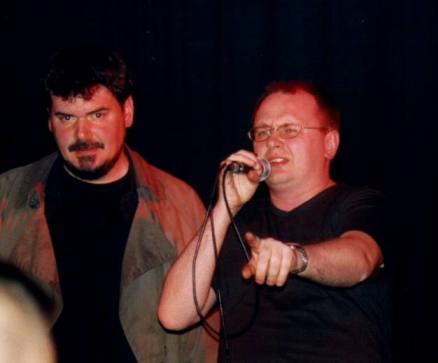
MM: How was the last US tour, which was the first one in many years?
WB: It went really well, from our point of view. Very diverse kinds of places. We tried making the songs sound like they are on record, for a change, and that worked really well.
MM: How does that compare with what you usually do?
WB: The songs used to sound very different live, I think, than they did in the studio-mostly because of the equipment that we used.
MM: Can you describe what’s used to create the live sound of Whitehouse?
WB: Last time we were in the States, which was a long time ago, we had the two Wasps [synthesizers] and the vocals, which were treated a little bit. But this time there was no treatment at all on the vocals and we used one Wasp and one tiny little Yamaha quasi-toy keyboard. And it worked really well, the sound was excellent-I think the best ever.
MM: Is it difficult to duplicate the studio sounds live?
WB: What we do is to put the Whitehouse sounds into the toy keyboard and then the Wasp is pretty easy to program. They are three basic sounds, which are modified occasionally.
MM: What are the songs you choose for performance?
WB: It’s quite a varied sort of set, actually. A couple of songs from the first album, and a new song that hasn’t been released, bits and pieces-all the classics really, a bit of everything. We finished most of the sets with “Shitfun”, which seemed to work very well.
MM: Looking at your tour itinerary here, I can’t help but wonder who would turn out to see Whitehouse in a place like Knoxville, Tennessee…
WB: Some real weirdos! There were about 35-40 people there, in quite a small club, but every one of them, I can guarantee, was 100% eccentric! But I’ve always felt that whether the audience is one or one thousand, it’s always interesting. There’s a different dynamic every time, so I’m not all that concerned about how many people are there.
MM: Did anyone show up who’d seen you on the last tour, ten years ago?
WB: Well, we played some cities where we hadn’t played before, but in the ones we had played two or three people came up afterward and said they’d seen us way back when. But it was weird because they seemed like really young people anyway-so you know, you start calculating… were they twelve when they saw the last show?!?
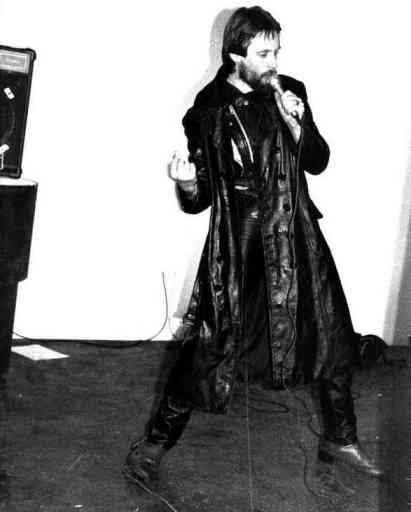
MM: That’s a scary thought.
WB: Yes!
MM: Philip Best, who played in the earlier incarnation of Whitehouse back in 1984, must have only been about fourteen years old then, correct?
WB: Yes. The first Whitehouse show he ever came to, which was, I think, Live Action 3 or 4, really early on, he had to run away from home! From a city about a hundred miles away!
MM: Were the shows fairly violent this time around?
WB: Yeah they were, some of them. In Chicago, for example, we did “Birthdeath Experience” which is a silent song-it’s just silence and us wandering around on the stage, inciting the audience in various ways. I couldn’t see very far out into the audience but I know from speaking to people afterwards, that three or four fights broke out. Exactly the same thing happened in London, when we did “Birthdeath Experience” for the first time. It seems to create a lot of tension in the crowd.
MM: But no one in the audience has tried to attack you on stage?
WB: Only once. It’s surprising with this sort of music, I mean I remember seeing the Birthday Party play live once and Nick Cave just seemed to be asking for trouble and he almost always got it-somebody would start hitting him or kicking him. I don’t know why-maybe the music’s more intimidating-but there’s never actually been direct violence towards us from the crowd, other than throwing objects. Except for once in Newcastle…
MM: Where the girl went berserk?
WB: Yeah, and that was because I severely provoked her anyway!
MM: Whitehouse disappeared for a number of years in the late 80’s-can you explain what caused this?
WB: It was a number of things. Logistically Whitehouse became very difficult. We did Great White Death, which came out really well, much better than I anticipated, but at the same time as that was recorded Kevin [Tomkins], who was a very important member of Whitehouse, moved back to the area where his parents lived. We’d just done a couple of shows in Spain, and I was sick of living in England, in London, at the time. And I thought, this is the place to live, I loved it so much. So I decided, more or less on the spot, to move there. A lot of other people were moving out of London as well, like Kevin, and David Tibet, Steve Stapleton got a house in Ireland. On top of that, after Great White Death, I felt we didn’t have a lot to say anymore, because that album seemed to encompass everything musically and otherwise.
MM: What did Spain have that England was lacking?
WB: It wasn’t a small-minded country, which Britain is. The people are very tolerant, especially because they’d just ten years before then moved from a dictatorship to a democracy. So things like drugs were virtually legal, pornography of every kind was suddenly available, and this is from a country that used to censor Elvis Presley songs. There was a great feeling of libertarianism-anything could be done as long as you didn’t spoil anyone else’s enjoyment-which is not like Britain at all.
MM: And you lived in the city there?
WB: Yes, in Barcelona for about three years. I loved the people, the climate, and lots of things, like drink was very cheap!
MM: Were you doing anything with Whitehouse during this period?
WB: Well I would have, but I just didn’t have any ideas left for songs. I just seemed like Great White Death said it all, and it was pointless doing re-hashes of that record. I would go back to London every six months for a couple of weeks, and meet people, so it wouldn’t have been difficult… But after about a year in Spain I just wound the Come Organisation down completely. And I didn’t think about it at all after that.
MM: And Kevin Tomkins stopped doing anything?
WB: Yeah, he got married apparently. I didn’t even have his phone number or anything, and he just disappeared.
MM: So the entire scene around Whitehouse died at that point.
WB: There was a big scene in London up to then, you know we’d do a show and whole crowds of people would show up. Another person who was involved, John Murphy, went back to Australia around then. There were a lot of people coming around to the shows at the time, like Crystal Belle [Steven Stapleton’s wife], she was called Crystal Clitoris then, and would appear everywhere with her slaves…
MM: Did people like Glen Wallis or Jordi Valls, who were involved with Whitehouse but also played or worked with TG and PTV, receive a lot of flak, since Genesis was always insulting Whitehouse publicly at the time?
WB: No, I don’t think they did personally, I mean Jordi is a very flamboyant character, so Genesis wouldn’t have had any influence on him anyway, although they always continued to be really good friends. But I think in addition to what we’ve already said, there was a lot of petty jealousy. The fact that Jordi and Glen weren’t just working with Psychic TV, I think there was a lot of that involved as well…
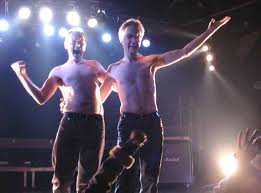
MM: Did you move back to England before going to Thailand?
WB: No, I stayed in Spain for about six years and then went straight to Thailand.
MM: And what drew you there?
WB: It’s a weird place, because something like Playboy magazine is banned there, and yet-
MM: -you can buy six year olds on the corner!
WB: Right, to do anything or to look at anything in real time-you know, I’m referring to live sex shows and things. So you can’t look at it on the printed page, but you can participate in it. It’s a weird sort of inversion of the West, in that respect.
MM: Was this any inspiration to start doing the Whitehouse stuff again?
WB: That had already started about 1988, when I was still in Spain. It was actually after Tibet came for two or three days to stay with me in Barcelona and we went out for paella, the traditional Spanish meal, in a restaurant, and started talking about this idea for “Thank Your Lucky Stars”. Having that song gave me a fresh new outlook on writing. And then luckily Pete [Sotos] managed to arrange a weeks’ recording with Steve Albini. Pete and me had already written a few more things together, but it took a long long time to get the single out. Bit by bit then the other stuff came out.
MM: And what was the next incarnation?
WB: I met up with Stefan [Jaworzyn] again, who’d played live with us a few times back in 1984. We’d known him since ’83 though, he was another one of these people who hung out in London and came to all the shows.
MM: Was he in Skullflower at that time?
WB: More or less around that time I think he actually stopped playing with them. So we did Twice is Not Enough. That was also with Dave Kenny and Glen Michael Wallis. Dave Kenny was the guy from IPS studio, which I mentioned before, and he did Great White Death, but this was a different studio-he works at a posher place now.
MM: What’s going on with the record label now?
WB: As far as Susan Lawly is concerned, I’m pretty much in charge of that. I hate dealing with money, and with CD manufacturers, but it’s no problem, it’s just a bit of extra work.
MM: Will the out of print stuff be re-released?
WB: I don’t like re-issuing stuff, I’ve got a sort of phobia about it. To me it gives the impression that you’re cashing in on stuff. I feel it’s better to use the resources that one has for new projects, rather than spend money on re-releasing old things.
MM: Can you explain the genesis of the name Susan Lawly?
WB: It didn’t come from anywhere, it’s just that name of the record label that I came up with. A lot of people ask if she’s a mass-murderer or something, or a sadist that people don’t know about.
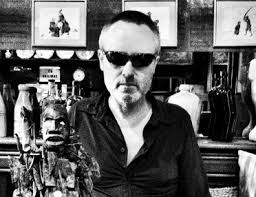
MM: Was it just some perversity on your part to use such a normal name?
WB: No, there’s no perverse reason but that’s all part of the fun of having the name that people assume there is a reason for it.
MM: Some of the songs on Twice is Not Enough seemed to be based on a gambling theme. I heard there was also a particular book that inspired some of that.
WB: The Diceman-it’s like a cult classic amongst people in England, although it’s by an American named Rheinhart. It’s a classic book. The blurb on the back is quite funny because he says, “All my decision making was by the throw of the dice”, and it’s written sort of semi-biographically-you don’t know how much is true or isn’t. So he’ll say, “Am I going to stay home and watch a video or am I going to go down and rape the girl who lives downstairs? If it’s a six I’ll go down and rape but if it’s a three I’ll stay here”… and he throws a six. It’s amazing stuff!
MM: Any other current obsessions?
WB: There are bits to glean from all over the place, as I’ve said it’s nothing in particular. Apart from the three books by Brett Easton Ellis-there’s a rich train of stuff in those. And then bits from films, porno movies-I’m always on the lookout for ideas, since they don’t come up when you want them to generally.
MM: Probably the most common complaint about Whitehouse is that it’s sexist. How do you justify the constant use of sexually violent subject matter?
WB: It’s simply what I’m interested in, and what I like I reading about and watching and participating in, to some extent. I wouldn’t do things that I wasn’t interested in. It’s just personal interest, obsessions, if you like. Really nothing is sacred, as far as I’m concerned. I wouldn’t not do anything. There’s no taboo that I wouldn’t be quite happy to break if I thought it would make for some good music.
MM: And despite all the controversy and disapproval, there has always been an audience for Whitehouse?
WB: Yes, it sells consistently well.
(Article first published in EsoTerra #5, Spring/Summer 1995)
(Source: http://www.esoterra.org/whouse.htm)
> THE HATERS, GX JUPITTER-LARSEN, NEGATIVLAND, STEEL HOOK PROSTHESIS + Others Live at Milwaukee Noise Festival 2013 (22-24 August 2013)

FTAM, RUSHMOR RECORDS, CALLOUS MUSIK AND KOALA BUTTONS PRESENT 2013 MILWAUKEE NOISE FEST
Thursday (22 August 2013)
– The Haters (CA)
– Frank Rosaly (IL)
– Hal Rammel and Jim Schoenecker (WI)
– Lucky Bone (WI)
– Hostage Pageant (OH)
– KrampusØ (WI/MN)
– Blessed Sacrifist (WI)
– Fake Blood Universe (WI)
Friday (23 August 2013)
– The Rita (Victoria, BC)
– Steel Hook Prosthesis (TX)
– Reptile Worship (WI)
– Dan of Earth (WI)
– Startless (IL/MO)
– Wapstan (Montreal)
– Anal Hearse (WI)
– Nummy (WI)
Saturday (24 August 2013)
– Negativland (CA)
– Pedestrian Deposit (CA)
– Peter J Woods (WI)
– Climax Denial (WI)
– Jason Soliday (IL)
– Dr Rhomboid Goatcabin (OH)
– Urth (MN/IL)
– Mildew (WI)
+
SPONSORED NOISE FEST EVENTS:
21 August (Wednesday Night) – Pre-Fest Clusterfuck of a show
https://www.facebook.com/events/166513043526062/
23 August (Friday Afternoon) – Screening of “Milwaukee Noise 2012”
https://www.facebook.com/events/180337808807956
24 August (Saturday Afternoon) – Screening of “A Noisy Delivery” by GX JUPITTER-LARSEN
https://www.facebook.com/events/568056556577797/
DATE: 22-24 August 2013 (Thursday – Saturday)
DOORS OPEN: 1800hrs
TIME START: 1900hrs
TICKETING: $16.00 Per Night/$41.00 3-Day Pass
– Thursday: http://www.themiramartheatre.com/event/274363
– Friday: http://www.themiramartheatre.com/event/274373
– Saturday: http://www.themiramartheatre.com/event/274381
– 3-Day Passes: (Any of the above links)
VENUE: THE MIRAMAR THEATRE, 2844 N Oakland, WI 53211, USA
More Info At:
http://experimentalmilwaukee.com/
https://www.facebook.com/events/641750259184172/
THE HATERS
NEGATIVLAND
STEEL HOOK PROSTHESIS
> DIVE, AUTOGEN, FREAKANGEL, PROTECTORATE, DJ EMANON + Others Live in Estonia, 19 October 2013

BEATS FROM THE VAULT & X-RAY (Radio 2) PRESENT:
Dark Music Festival ‘BODY MACHINE BODY IV’
– DIVE (Belgium)
– AUTOGEN (Latvia) (More Info)
– FREAKANGEL (Estonia)
– PROTECTORATE (Finland)
– DJ EMANON (Finland)
+ Others
DATE: 19 October 2013 (Saturday)
TICKETING:
€ 22 (Pre-Sale Until 30 September 2013)
€ 30 (Normal)
€ 35 (At The Door)
VENUE: VON KRAHL THEATER, Rataskaevu 10, 10123 Tallinn, ESTONIA
More Info At:
http://www.piletilevi.ee/est/piletid/muusika/muu/?concert=130286
https://www.facebook.com/bodymachinebody
https://myspace.com/bodymachinebody
DIVE
AUTOGEN
FREAKANGEL
> ROME, FIRE + ICE, CHANGES + Others Live at MĖNUO JUODARAGIS XVI FESTIVAL, Lithuania from 23-25 Aug 2013

EVENT: MĖNUO JUODARAGIS XVI FESTIVAL
DATE: 23 – 25 August 2013 (Fri-Sun)
TICKETING: 99 Lt (Eur 35, incl. shipping) till July 15. (http://mjr.lt/bilietai/?lang=EN)
VENUE: Zaraso Island, LITHUANIA
More Info At:
http://www.mjr.lt/XVI/en/mjr-en
https://www.facebook.com/MJRfest
ROME
FIRE + ICE
CHANGES
> AUTOGEN (Latvia) Cold Elektro Music

Autogen (LAT)
4iB, Sturm
www.sturmmandat.com/artists/autogen
Autogen is an artist to whom nothing is an excess. They create a cold mixture of post-industrial from tasteful IDM with warped electro and noise. The visual aspect is crucial in their music, and there- nothing is taboo. Strange costumes and all imaginable bodily fluids, that are generated right before your eyes. Lately they returned from their exotic Asian tour and at the moment are working at a sequel to their first album “Mutagen” (4iB Records, Singapore). Kaspars (Rosewater, Narkose-X, Sturm Records, Nakts Maina Festival) and his fiancée Lāsma are accompanied at this BMB by Folki (Rosewater) on percussions.
———————————————————————
Autogen (LAT)
4iB, Sturm
www.sturmmandat.com/artists/autogen
Autogen on artist, kes ei pea midagi paljuks. Luues külma post-industriaalset segu maitsekast IDM’ist, kõverapoolsest electrost ja mürast. Väga oluline moment on nende muusika juures ka visuaalne pool kus miski pole tabu. Veidrad kostüümid ning kõikvõimalikud kehavedelikud, mida genereeritakse otse sinu silme all. Hiljaaegu naaseti eksootiliselt Aasia tuurilt ning hetkel valmistatakse järge oma debüütalbumile „Mutagen” (4iB Records, Singapur). Kaspars’ile (Rosewater, Narkose-X, Sturm Records, Nakts Maina Festival) ja ta veetlevale kihlatule Lāsmale lisaks astub BMB’l nende kooseisus löökpillidel üles Folki (Rosewater).
———————————————————————
AUTOGEN – Mutagen CD (4iB CD/0712/002)
FORMAT: Digipack CD in Slipcase (Limited/Numbered 500 Copies)
PRICE (Incl. Airmail Postage from Singapore): USD20 / €15 / £13
MORE INFO: Click Here
TO PURCHASE: Click Here
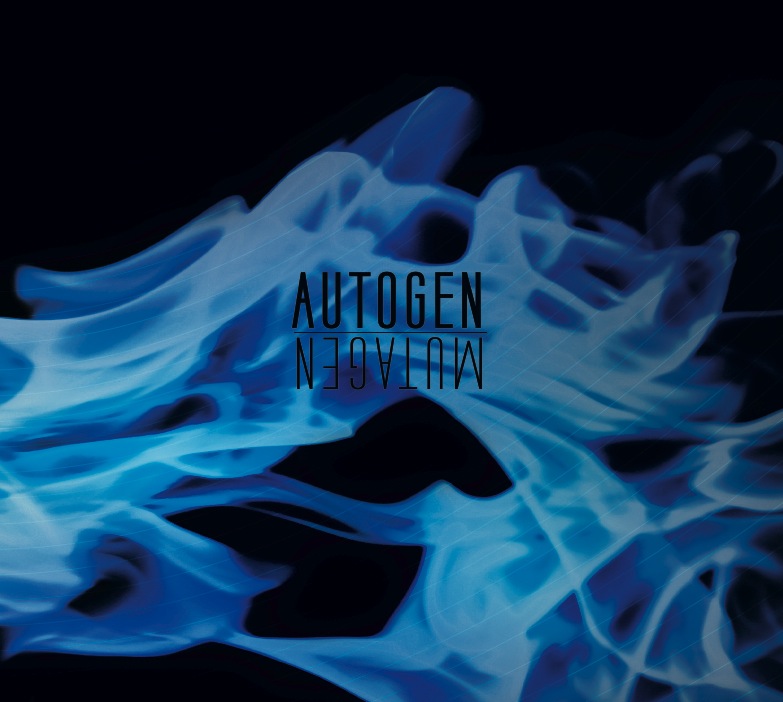
> ALLERSEELEN Interview by Noiseist (2000)
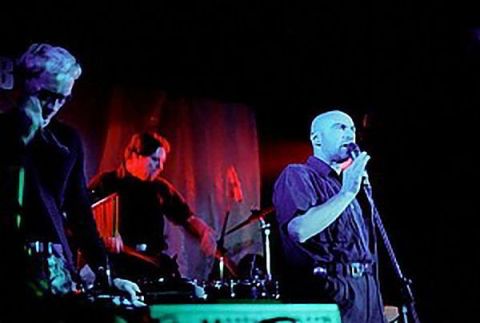
Aorta is an art organisation run by Kadmon, leader of Allerseelen well-known European post-industrial act. He also writes very interesting zines called Aorta and Ahnstern. Each issue is linked to a specific subject. Their publication has now been stopped as Kadmon intended to concentrate much more on his music. Allerseelen last CD is called “Venezia”. This CD seventy minutes long was inspired by various magical mystery tours to the fascinating surrealistic city Venezia. It contains various poems by Rainer Maria Rilke, Ezra Pound, Friedrich Nietzsche and Jean Cocteau. Then some US dates are planned in September. Ajna in the United States should release a CD with early Allerseelen recordings, it will probably be called Heimliche Welt (Stealth World)
Can you tell us why did you choose the photo of Leni Riefenstahl for your EP Alle Lust will Ewigkeit / Traumlied? How do you consider her works? Can you explain both track concepts?
I chose the photo of Leni Riefenstahl. She was and still is a beautiful and powerful woman. She reminds me of the Tarot card Forza – the woman or goddess with the lion. I recently saw her in a documentary – she is still very charming, very active. I sent some copies of this blue vinyl 7″ release to her in Bavaria and got a very friendly answer. She was amazed and surprised by this release. She was a dancer before her career as filmmaker. One of her dances was called Traumblüte – Dream Blossom. I dedicated this 7″ to her because Traumlied means Dream Song and Alle Lust will Ewigkeit (All Lust Wants Eternity) has for me a deep connection to Leni Riefenstahl’s beautiful movie Das blaue Licht (The Blue Light) about a girl living in the mountains, guarding a grotto with blue crystals. This blue light is the reason why I chose the colours silver and blue for the 7″. I also wanted to release something, which is easier to listen to by people who are not that much into the darker, industrial works of Allerseelen. Though I am not really sure whether she really liked the songs. Due to the Allerseelen maxime to collaborate only with the very best artists, I contacted her some days ago again: I invited her to contribute exclusive and unique artwork for a 7″ “Canco de somni/Marques de Pubol” I am preparing with the female Catalonian singer Rosa Solé from the group Circe. I am still waiting for a positive or negative answer.

What about your future releases for ALLERSEELEN?
I am preparing this 7″ release with two songs. Rosa Solé translated my texts into Catalan. One song is a cover version of the old Allerseelen song Traumlied. The other one is a new recording about the strange relationshipbetween Amanda Lear and Salvador Dali, about her last visit in his castle – this song is called Marquès de Púbol. These songs are very beautiful – Leni Riefenstahl might like them too – maybe. The singer of this 7″ “Canco de somni/Marques de Pubol” is Rosa Solé is participating also to the project Circe.
I am already working on the CD Abenteuerliches Herz which is inspired by a surrealist book by the German poet Ernst Jünger about dreams and plants and landscapes. Some songs already have finished. Some of them have a Spanish touch – I spent some time in this country due to various reasons and will go there again very soon. I am also preparing a split 7″ with Allerseelen and Dakshineswar. Dakshineswar is a band from Barcelona, I really love their music. It is sounding like Allerseelen “Traumlied”, DAF “Der Räuber und der Prinz” and little bit like Novy Svet. I am also thinking to produce a CD from Dakshineswar: DAKSHINESWAR@infonegocio.com
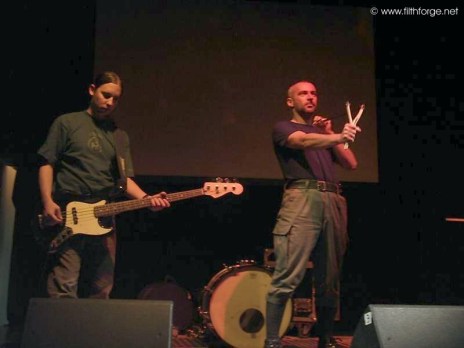
Have you issued new editions of your magazines Aorta and Ahnstern?
No – Aorta was stopped with issue 20. Most issues are still available, some are already sold out and won’t be reprinted. The last Ahnstern issue IX dealt with the German UFO engineer Andreas Epp who died two years ago in Bavaria – he was involved in the construction of flying disks in 1933-1945 and continued his researches after the war. Again: Bavaria – a very beautiful, magical, powerful landscape with lots of artists and researchers. Also the mystical writer Gustav Meyrink and the occult composer Carl Orff lived there, very close to the house of Leni Riefenstahl. I grew up quite close to this region. I have been there again some days ago – good friends of mine are trying to make alive again the fin-de-siècle atmosphere of Munich one hundred years ago.
ALLERSEELEN CD Discography:
- AORCDOl Cruor
- AORCDO2 Gotos=Kalanda
- AORCDO3 Sturmlieder
- AORCDO4 Stirb und Werde
- AORCD05 Neuschwabenland
- AORCD06 Venezia
Compilation:
- “Bluttaufe” on compilation CD Mysteria Mithrae by Athanor
- “Sturmlied” on the 2xCD compilation Riefenstahl by VAWS
- “Gletscherlicht” on compilation CD Cavalcare la Tigre by Sigill
- “Alle Lust will Ewigkeit” & “Traumlied” on compilation CD The Nitha Fields by Ultra
- “Flamme” on compilation CD Lucifer Rising by Athanor
AORTA / ALLERSEELEN
C/O Petak Postfach 778, A-1011 Wien AUSTRIA.
email: allerseelen@hotmail.com
http://www.geocities.com/ahnstern
(Source: http://noiseist.free.fr/interview_ALLERSEELEN.html)
> VON THRONSTAHL INTERVIEW; The Search for Truth (Heathen Harvest)
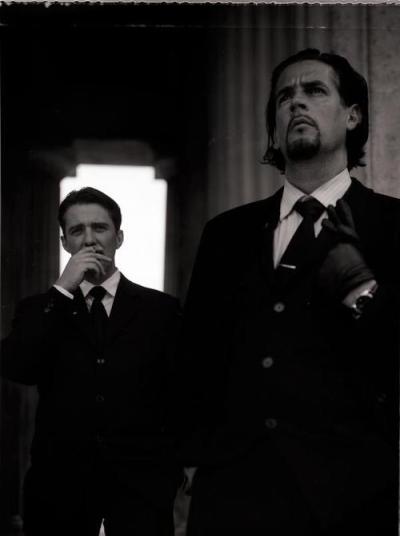
Heathen Harvest (HH): Can you discuss how Von Thronstahl came into being and who the founding members are?
Josef Klumb (JK): The general idea was conceived around 1995 when I was still in Forthcoming Fire, playing Gothic and Darkwave. I was searching for a way to express the European identity in a musical way. That’s how Von Thronstahl came into being.
HH: Can you explain what the name Von Thronstahl means or what significance it has for you?
JK: The prefix “von” indicates aristocratic nobility when put in front of a name. And “Thronstahl” translates “the steel of which the throne is made”. The whole name stands for being untouched or irremovable by the constant change of the world.
HH: What was the initial founding vision of Von Thronstahl?
JK: The idea of the REICH for Europe, or Europa, as I’d prefer to call it. The terminology is stated in the song HEIMATERDE MUTTERBODEN VATERLAND (native soil, mother soil, fatherland). It’s about the general idea of the Reich, of identity more as a feeling, an emotion than something concerned with parliaments or a supposed “democracy“.
HH: Can you explain the previous musical experience of Von Thronstahl’s members prior to joining the band?
JK: Both Raymond and myself used to play Punk, Rock’n’Roll and Gothic. Marcel has played in Rock and Metal bands and worked with various Folk projects (and he still does). René comes from a Metal background. Both of them play a variety of instruments in different bands and projects.
HH: How did the band feel particularly inspired or drawn to the post-industrial music scene and to Martial Orchestral music in general?
JK: I wouldn’t say that the scene itself inspired us, the inspiration came and still comes from life in general and the musical creation happens organically. Our music reflects the longing for the true European identity and soul, as well as a kind of underground thinking, so to speak.
HH: Are there other bands within the post-industrial music scene that have had a direct impact on the formation or sound of Von Thronstahl?
JK: There are a lot of bands and project that we enjoy. As I may be a bit older than some of the others my taste goes more to the origins of the scene. Cabaret Voltaire, Clock DVA, Throbbing Gristle, Thomas Leer, Industrial and Electronic, I’m not a Noise fan, I need structures. Very important in this decade were Allerseelen, which I’d recommend to all the people out there. Plus I enjoy most of the material released by the label Cold Spring Records.
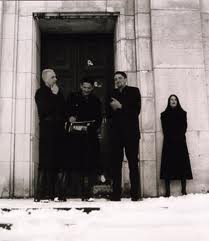
HH: Von Thronstahl debuted the first full length CD title “IMPERIUM INTERNUM” in the year 2000. Looking back how was this CD received by the post-industrial music community?
JK: The debut CD was a big step for the project and it was very well received; in fact the first pressing was sold out some time ago, but it has been re-released by Cold Spring (remastered, plus now it’s a digi-pack instead of a tray) recently. The press reactions, both to the initial release and to the re-release were very positive.
HH: “IMPERIUM INTERNUM” established a particular aesthetic that would continue to define Von Thronstahl for sometime. This aesthetic was founded on a romantic remembrance and exaltation of Europe’s past. Can you discuss what inspired this aesthetic why the band chose to pursue this aesthetic?
JK: The basis for all the aesthetic creation of Von Thronstahl is emotion. Emotion in a sense of really being “moved” from the inside. From heart and soul, so to speak. And emotional longing to reach the shores of our secret home that is Europa.
HH: Can you explain what significance the albums title had for the band?
JK: The title stands for the feeling I’ve just tried to explain. The emotions, thoughts and dreams don’t just need a “vessel”, they also need a name to be written on the flag; a title that implies attributes like “holy” or “sacred”.
HH: “IMPERIUM INTERNUM” contains a recurring theme of medieval Europe and the Arthurian legend of the Holy Grail. What significance does this legend have for the band?
JK: It’s almost too perfect to be used in a symbolic way. The “true belief” that is connected to the legend and the combination of a true kind of Christianity with the old, deep pagan roots.
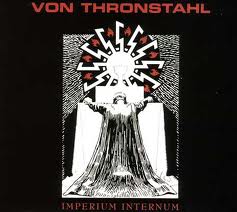
HH: Does Von Thronstahl strive to explore or comment on European history before the Christian Medieval era or does the band see its interest deriving from medieval Christianity to the modern era?
JK: Raymond and myself are deeply inspired by the traditional way of Catholicism. The so-called modern Christianity seems to be on a spiritual level that you’ll likely find at an esoteric fair. If you explore the old Christian tradition you’ll find so many influences dating back to the pagan times, but most of the people who call themselves Christians nowadays aren’t even aware of that.
HH: Does Von Thronstahl express any interest in the pagan or heathen origins of Europe and its peoples?
JK: Raymond and myself are Catholic, but we also are interested in studying the pagan roots, which I’ve mentioned before. Through studying I came across a common theme in both the Old Testament as well as pagan lore (like the Gilgamesh epos) which one could interpret as an insertion of knowledge. “God” or “gods” who came “from the skies” to teach man, inspiring religion and tradition. These passed down stories about god-like beings could be interpreted as records of contact with extraterrestrial beings visiting earth. Although this may sound strange to some folks: Keep the idea in mind and then read the bible (try to picture the Nephilim for example). Marcel and René are both atheists, but both of them are interested in religious tradition in a philosophical way. And after all religion keeps influencing political decisions each and every day all over the world.
HH: “E PLURIBUS UNUM” was Von Thronstahl’s second full length CD and was released in 2001. “E PLURIBUS UNUM” is a collection of rare and unreleased tracks produced by Von Thronstahl. How did the band come to have such a wealth of secondary material so early in your career?
JK: Well, I suppose we’ve had more time back then. And we participated on a lot of compilations which mostly were sold out at that time and we felt that people who were interested should be able to get a hold of that material all together.
HH: “E PLURIBUS UNUM” saw Von Thronstahl beginning to comment on modern politics and current events. In fact the title of the album is taken from the American one dollar currency. Can you explain what shift occurred that directed Von Thronstahl to embrace current affairs as well as the past history of Europe within your music?
JK: The connection of these topics happened organically. There’s something like a spiritual war going on between the traditional and modernistic thoughts, which influences modern politics very much.
HH: Several songs on “E PLURIBUS UNUM” garnished fierce criticism from far left anti fascist groups. Songs such as “Verein(sam)t” contain text from German writer and physicianGottfried Benn who was criticized in his lifetime for his involvement with National Socialism in Germany. How does Von Thronstahl reconcile the artistic and philosophical achievements of such historical figures as Gottfried Benn with their involvement in National Socialism?
JK: Gottfried Benn was enthusiastic about the National Socialist movement during the early years, but soon he recognised that a lot of things simply went wrong with the movements direction. He was taken in by the potential and the power of the movement but disappointed when he saw some of the results. Actually I can relate to that; there are thoughts in between the world of, say, a totalitarian approach from the right and the very same totalitarianism from the left which is slightly disguised as “anti-fascist”. People like Stefan George of Ernst Jünger did never belong to just on side of this conflict that nowadays is mostly being projected as strictly “black and white”. The world needs men who stand for something all by themselves.

HH: “Hail You Captain And Thy Guard” also commissioned outcry from far left activist as the song was created for Daniel Ghettu’s “Totalitarian Archangels Foundation” in Romania and pays homage to “The Iron Guard” and Captain Codreanu. The “Iron Guard” remains notable amidst armed fascist militia groups as they promoted a religious doctrine amidst their ranks. Can you discuss your interest in the “Iron Guard” and the “Totalitarian Archangels Foundation”?
JK: The Codreanu tribute compiled by Dan Ghetu featured a lot of different projects which, Blood Axis aside, I’ve rarely seen blamed as “right wing” or something. That should make one think how the “far left activists” choose their targets. Actually Marcel is even more educated on the subject than I am, but the history of the Iron Guard and mostly the personal struggle of Codreanu, who stood up for his belief and his men to the very minute he was murdered, is very inspiring. To western Europeans the old Romanian tradition may seem a bit “dark”; the musical works of the Iron Guard convey that feeling to many listeners, but it’s also full of “light” with regards to the religious tradition and the tremendous dedication.
HH: What is Von Thronstahl enduring interest in the fascist era of European history?
JK: It is unquestionably a very interesting and diverse field. In terms of what is kind of appealing to me I would say that it is the honesty about it. The European nationalist movements were very frank and open about their beliefs and politics, which by no means can be said about the self-proclaimed “democratic” politicians. Most of them are front-men for a hidden agenda. People should be more educated about the facts that the controlled media won’t report. In a side-note I’d ask the question of “style”: Do you see style in Brussels? I don’t. I see clowns, and the hidden powers behind their masks.
HH: Does the band believe that there is knowledge or guidance to be drawn from this tumultuous era of European history?
JK: I don’t suppose that there is any era from which knowledge shouldn’t be drawn. The human life is a constant learning process, both for the individual and humanity as a whole. The official attempt to black out knowledge and wisdom from sources that do not fit the “Zeitgeist” is one of the most spiteful crimes against humanity.
HH: How does Von Thronstahl feel about the societal and cultural censorship of ideas, art, and philosophy from this era?
JK: That’s what I was getting at. In the western democracies there’s actually more censorship going on today than we are told that there supposedly was during the “forbidden times”. Especially the German political system has its very own “democratic” ways of silencing people.
HH: Is Von Thronstahl’s exploration of fascism inspired at all by the belief in an imperial ruler unifying Europe?
JK: That is, to some extend, a religions question. A leader or ruler in my eyes is someone to work in between, who has to prepare for the true order. For someone “godsend”, which is to be understood literally. There will be now European Imperium without divine order!
HH: Von Thronstahl does not seem interested in Europe’s communist era. What has drawn the band towards the Fascist era and away from an exploration of the cultural and ideological era of communism?
JK: I do perceive both Communism and the freemasonry ideals of western materialism as the exact opposite of what Von Thronstahl stands for. So in a way we have dealt with the topic.
HH: “E PLURIBUS UNUM” showcases some of the first reworking of traditional rock songs by Von Thronstahl as is illustrated in songs such as “Bells” which samples a guitar riff from AC/DC and “This Is Europe Not L.A.” which reworks “Mr. Blue Sky” by the Electric Light Orchestra” What inspired Von Thronstahl to infiltrate and hijack pop music?
JK: We like to work in this manner sometimes; to use (and maybe sometimes abuse?) this great material for our creation. For an upcoming more Folk-oriented release I would like to use the first 20 seconds of The Who’s “Pinball Wizard” from the rock-opera Tommy!
HH: Has Von Thronstahl ever received a backlash or feedback from bands whose material they have reworked?
JK: Not really. I have informed the managements, partly copies of the CDs were sent, but no real feedback.
HH: Von Thronstahl faced a lot of critical press and an attempt was made to keep the band from performing at the Leipzig music festival in 2000. Can you discuss how you overcame this attack and were able to play the event?
JK: Well, we did not actually “play” the event. I was surrounded by all kinds of secret police, even the MAD (Militärischer Abschirmdienst; translates something like „Military shielding force“, a kind of military police / secret service ) was there to prevent me from entering the stage. But all these people weren’t familiar enough with the bands or the people to recognize that the line-up of The Days of the Trumpet Call used to be the basic line-up of VON THRONSTAHL in those days. And I managed to tool the agents, telling some guys of whom I knew that they would report it, that I would enter the stage, so that they were using all their men to “guard” me. Meanwhile, as I had told them before, the line-up formed on stage with the spade bearers left and right and the flag bearer in front of the microphone. Raymond started the E PLURIBUS UNUM CD instead of the backing music, so my voice was coming over the PA which the agents did not recognize, but the crowd did and applauded frenetically. And all the while I was standing very satisfied in the midst of the crowd.
HH: Does Von Thronstahl face opposition everywhere you play?
JK: The only problems were in Germany (where all other concerts, apart from the one mentioned above, did go ahead as planned!) and Austria. We haven’t had any problems like this in the rest of the world. But about ten years ago the opposition used to have a face of some sort. Today it’s either bureaucracy or faceless and cowardly internet threats and accusations.
HH: Has the band ever incurred threats of violence by censors?
JK: As I said: In former times they did show their faces. And, to some extend, their fists, although this was not related to Von Thronstahl. But the one thing that made me crumble in some way is the sharp weapon of bureaucracy.
HH: Do you feel that closing discussion and exploration into the fascist era of European history denies Europeans the opportunity to understand and explore their history?
JK: It seems to be only a question of time until the people realize that the self-proclaimed democrats deny them, among other things, the exploration of the truth. By truth I do not mean something in particular, but merely the right to ask any question you like, as an expression of true freedom. But the truth, the ideals and thoughts are more or less everlasting, whatever the politicians of today decide. So we could be seen as a generation “in between” (times?). We’re the one who can merely proclaim. Others will come later (to reign?).
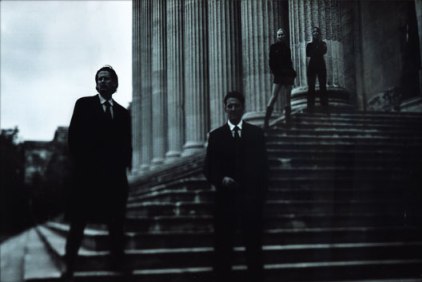
HH: Do you feel as if discussing the fascist past of Europe has the potential of opening old wounds or stirring dormant resentments in Europe’s population?
JK: The only thing that is able to truly heal the wounds of the past is truth. Total truth; although all information always has to be renewed. But without truth, there can be no real understanding among peoples. And regarding the wounds: Some do not heal because the truth hasn’t been spoken (i.e. out loud) while others are being kept open artificially due to certain people’s interest in it.
HH: In America we have a long standing tradition of freedom of speech. Though this freedom often faces challenges we have been able as citizens to maintain our right to explore any subject matter we choose artistically regardless of who it offends. Do you feel as if Europe has a different standard of freedom of speech?
JK: Well, first of all, American civil rights activists have been shouting it from the roof-tops that the USA are rapidly heading towards a police state, so enjoy jour freedom while it lasts! Any American who feels offended by this statement should read the two so-called “Patriot Act” legislations. The basic concept of “freedom of speech” may be right, but even with the police state aside: Is the freedom to say what you like worth something if it doesn’t make a difference? Is the freedom of choice worth something if you can only choose between “Burger King and McDonald’s” (or say, between one of the two political parties in a two-party-system in which both presidential candidates are members of “Skull&Bones” and even belong to the very same family bloodline)? All in all one can say that we’re in the same boat, which is sinking ever faster due to the globalist agenda, or, in freemasonic terms, the “New World Order”.
HH: On “E PLURIBUS UNUM” Von Thronstahl features the song “Fahnentrager” taken from the “Thorak” compilation which paid tribute to the sculpture Josef Thorak? Can you discuss what you enjoy in the artistic expression / aesthetic of Joseph Thorak?
JK: Strength. Glorification of the sun. The victory of beauty. I truly believe in art as an expression of the soul itself. Von Thronstahl has drawn a lot of inspiration from art in its various forms.
HH: To fully understand the music of Von Thronstahl listeners have to conduct their own research in order to fully grasp all the influences and artists that have inspired the band or even a single song. Do you believe this scholastic approach to music creation has helped gain Von Thronstahl an audience?
JK: Yes, indeed and I think this is one aspect of the underground music scene which attracts many people from the “outside”, keeping in mind that music like ours is not played by radio stations and music television.
HH: Do you think most of your audience takes the time to research the references within the music of Von Thronstahl?
JK: We sincerely hope so. Plus we’ve received a lot of feedback indicating just that.
HH: Do you ever receive feedback from your audience concerning new artists or influences that you may have introduced them to through the music of Von Thronstahl?
JK: Yes, we constantly receive such feedback and the relation with our fans, so to say, is very warm and friendly. Recently we played at the COLD SPRING anniversary festival in London and people came there to see us from virtually all over the world! There were people there from England, Ireland, Germany, Austria, Switzerland, Holland, Belgium, France, Spain, Norway, Lithuania, Romania, Hungary, Estonia, Russia, Italy, the USA and many more. We were truly overwhelmed. And this made the fact even worse that we had such a lousy sound-engineer. To be blunt: We were playing “blind”, nothing came out of the monitor system except noises, plus the guy hooked the mini-disc device on the same connection as Raymond’s electronic drums, so the two kept causing interferences in each others signal-flow. That caused the backing music to skip a couple of times and to top it off the guy tried to “solve” the problem by gradually lowering the volume of the drums. Later in the set and after some complaints which didn’t amount to anything, Raymond simply left the stage because nothing came out of his drums pads. That guy truly wrecked the show for us, but somehow we tried to give the audience as much as we could. After the performance we were truly pissed. Marcel, who had put a lot of effort in the preparation, was devastated afterwards and it took quiet a few people who thanked us for the “great performance” to lighten up his mood again. At first none of us believed that the sound for the audience had been better then what we heard on stage (to be honest: during some songs we were surprised that the people weren’t leaving!) but after talking to a lot of them we got convinced of the fact that they actually had a good time. We all agreed that meeting all these nice people (a lot of colleagues from other musical projects were there) was the highpoint of our trip to England. But one thing can be said about this “horror show”: It was closer to my Punk roots than anything we ever did with this line-up!
HH: Cold Spring Records recently re-released “IMPERIUM INTERNUM” and “E PLURIBUS UNUM.” What influenced Von Thronstahl to re-release these albums?
JK: They had been sold-out for some time and people kept asking about them. So you could say (and I even think COLD SPRING advertised them this way) that they were re-released due to public demand. Although there are some limited edition releases by Von Thronstahl I’m not really a friend of limitations with regards to the music, which I like to be spread.
HH: “BELLUM, SACRUM BELLUM” released in 2003 was Von Thronstahl next full length release and it saw the band focusing upon modern politics. Images of American politicians such asGeorge Bush and Defence Minister Donald Rumsfeld appear in collages displayed in the packaging alongside other prominent world leaders like Pope John Paul the II. What inspired Von Thronstahl to engage in modern political commentary?
JK: As I explained earlier the interest in politics has always been there and it is organically connected to the interest in the tradition mentioned above. The modern US-lead wars are a phenomenon you can’t hide from and we took up the challenge to give an artistic comment to what was and still is going on. Some people have compared the album to the LAIBACH release NATO, which was also a “musical statement” about a political and military conflict.
HH: “BELLUM, SACRUM BELLUM” also saw Von Thronstahl take on pop culture with new strength. Samples of songs and appropriated songs from sources as wide as The Clash, The Exploited, Crass, Killing Joke, The Stranglers, Michael Jackson andThe Beatles. Can you discuss this emphasis on adulterating pop music and pop culture?
JK: I think this kind of artistic expression goes back to my punk roots in general. Von Thronstahl took up the punk tradition of, in a way, shoving that so-called “ pop culture ” right back at society in a distorted way; a kind of rebellious approach, if you like. And much of the material that was used is part of my cherished past, like THE CLASH, KILLING JOKE, THE STRANGLERS, CRASS, Conflict. Although I don’t follow the anarchy theme (anymore) I can praise these groups for their energy and creativity and punk in general for the rebellion. By the way: .J.J. Burnel, the bassist of THE STRANGLERS did inspire me a lot with his though about Europa on his album EUROMEN COMETH in 1979. And The Skids from Scotland are recommended. Richard Jobson had a great voice and proclaimed a lot of European thoughts. You should check out the albums DAYS IN EUROPA, JOY THROUGH STRENGTH, CIRCUS GAMES and their debut album. One of the first punk bands that brought “traditional” thoughts across to me was KILLING JOKE. In a way I feel connected to Jaz Colemen whom I admire as a great artist. He has an immense amount of knowledge and wisdom behind his lyrics about society’s problems and the criticism of modern (American) politics.

HH: “BELLUM, SACRUM BELLUM” seems overwhelming inspired by themes of war and resistance even more so than previous releases. Can you discuss the focus on war and conflict and how the band came to settle upon this theme for “BELLUM, SACRUM BELLUM”?
JK: The (first!) war on Iraq and the American politics in the middle east in general inspired the album simply because we saw an agenda (the so-called New World Order) unfolding in front of our eyes that even we (not being scholars, but simple musicians) have been warning people about long before (see, for example, the Forthcoming Fire album “Illumination?”). Plus, after all, “wars and wounds” seem to be true European topics, if you consider our history.
HH: Do you feel as if Von Thronstahl gives equal emphasis to the glory of war and victory as to the darker side which encompasses the human suffering and loss that results from armed conflict?
JK: I don’t believe that the two sides can be separated in any way. Plus I think a form of “transformation” is possible to turn suffering into “light” (speaking in Alchemical terms). The result will be golden; like the golden age.
HH: Von Thronstahl seems to have America in its cross hairs on “BELLUM, SACRUM BELLUM”. Was this album influenced at all by the events now commonly described as 9/11 or the subsequent “War on Terror” launched by America?
JK: Yes. But we were often misunderstood as being simply “anti-American”. We do not have anything against the American people nor have we ever made any statement against them. In fact the American people themselves wake up to the hidden agenda in growing numbers. We’ve received a lot of material from the USA; among it there are some truly revealing documentaries about the 9/11 incident. More and more people are demanding answers. Some of the material was used for the new version of the BELLUM, SACRUM BELLUM title track released on the STURMGEWITTER ZIEHN DURCHS LAND split-CD. There is strong evidence that 9/11 was a planned catastrophe, the so-called “new Pearl Harbour”, which would get the population to back the policy of the elite. Many researchers have put a lot of effort in this. The basic principle is “problem, reaction, solution”: A problem is created, like a terror-attack, to achieve the reaction “something must be done”. After that the politicians can present their solution, which they had planned all along. I’d advise all sceptics of so-called “conspiracy theories” (a term mostly used to slander and ridicule people who found out crucial information in the eyes of the public) to take just a few minutes to check out the information sources on the web. There’s a lot going on behind the scenes which the corporate media does not report.
HH: Can Von Thronstahl offer any personal insight into the mounting war between the Christianized modern West and the Muslim traditionalist East?
JK: At first you’ll have to understand that it is the old game all along: Two sides being played off against each other while a third party sells arms to both of them and gets rich. Even if you only take the official documents under consideration you’ll find out that for example Osama Bin Laden, “the” face of Islamic terror in the world, used to work for the CIA. His whole group was created by the US secret service to have them fight against the Russians. And this story goes on an on. Many people wonder if Bin Laden is still on the CIA pay role. To sum it up: Much of the conflict between the “ Christianized modern West” and the “Muslim traditionalist East ” (a discussion about the accuracy of these terms would be too long I think) is phony. It’s a scam. It’s a lie. Then the questions should be asked “who stands to gain from all of this?”. The cultural aspect is a totally different issue. One should respect other cultures, but there’s a growing problem that could destroy both the Western and the Muslim heritage. The so-called “multi-culturalism“ is another one of these lies; it simply does not work. It only creates a mixed population without any real culture. And such a population, without roots, without identity, is much easier to control. So again: “Who stands to gain from all of this?”. The current discussion about Turkey joining the European Union is a farce. Trade agreements and partnerships maybe possible, but it is simply a different culture and the “clash of cultures” already has caused a lot of damage in big German cities, where you can see and feel the spenglerian “decline of the west” simply by taking a walk through some streets.
HH: “BELLUM, SACRUM BELLUM” also seems to incorporate a commentary on globalization. Can you discuss your thoughts or impressions on globalization?
JK: Globalization is an important part in the “hidden agenda” to which I referred above. It is, if you think it through, an act of crime. It robs countries of their sovereignty and peoples of their identity. In the end you’ll have a “world population” living in the so-called “one world” which can easily be ruled be a supposed “one world government”. In short: We’re against it and we see through the disguise. In fact, one of the first two Von Thronstahl tracks ever was WIDER DIE MASSE (translates “against the mass”, a hymn to individualism), which was re-recorded recently for the STURMGEWITTER ZIEHN DURCHS LAND split-CD. On a personal note I used to say that I favour a good old Whiskey over a *censored*tail with too many ingredients. Globalization and multi-culturalism mix too much together and in the end, nothing has a taste of its own anymore.
HH: Without a doubt the music and artistic vision of Von Thronstahl could be described as Eurocentric. Do you believe that globalization and the new industrialization of culture is eroding the identity and traditions of Europe?
JK: Yes. And I think I explained that I do see a pattern in all of this which should really be hard to ignore. Yet still many people choose to ignore it and even ridicule those who try to explain the connections.
HH: “BELLUM, SACRUM BELLUM” was released on Fasci-nation Recordings. Can you discuss the origin of Fascination Records and who runs the label?
JK: Fasci/Nation is only myself. I started the label for “special” ideas of mine, plus I liked the name. When the album is totally sold out there might be a re-release on COLD SPRING some time, because we’re very happy with their distribution work.
HH: Can you explain the rather derogatory title of the label?
JK: I wouldn’t say that it is derogatory. It has many connotations; after all, art should always be open to interpretation. The inspiration is mostly drawn from the art and style of fascist Italy. It’s my own form of rebellious neo-classicism. It is more “ Rome and style” than “ Berlin and politics”.
HH: In 2004 Von Thronstahl released a split release with Days of the Trumpet Call titled “PESSOA / CIORAN.” Can you discuss the relationship between Days of the Trumpet Call and Von Thronstahl?
JK: THE DAYS OF THE TRUMPEL CALL is Raymond’s solo project, serving as a vessel for his ideas to combine religious ideals with artistic expressions to create neo-classic with a sacral element. Recently the project evolved by adding Carl from MEGALITH and Marcel, who also participates in VON THRONSTAHL. Both the more recent recordings in that line-up plus the live performances were very well received.

HH: What distinguishes these two musical projects from one another?
JK: The topics of THE DAYS OF THE TRUMPEL CALL are more of a spiritual nature. The music has a different mood; it is not as rebellious as Von Thronstahl and where Von Thronstahl has a wide variety of styles, from folk to wave, from neo-classic to electro, from rock to industrial, THE DAYS OF THE TRUMPEL CALL is, a few guitars aside, pure neo-classic.
HH: The “PESSOA / CIORAN” features songs based upon the writings of Fernando Pessoa and Emil Cioran. Can you introduce these writers to the audience and discuss what influenced you to record music around their writings?
JK: The CD was released to accompany our concert with both projects in Portugal and we wanted to do something to honor the country and the Portuguese audience. So we read up on Fernando Pessoa after attending a reading of some of his works in Munich around that time we started the recordings. And to us it seemed that material inspired by Emil Cioran, whose works we knew before, would make a fine addition to the Pessoa material. I really like this CD and it has received very positive reviews.
HH: The songs featured on “PESSOA / CIORAN” between 2002 and 2004. Why did it take so long to compile and record the music for this release?
JK: It didn’t take so long, we just took some material we had recorded earlier and used it for the CD. As I explained above: We thought it would fit, and we still think so. Actually the material for the CD came together really quick, simply because the literature did inspire us so much.
HH: The Von Thronstahl website features a sub section that contains articles on “The Occidental Dandy-Pose.” Can you discuss the bands interest in Dandy fashion?
JK: It is not so much about the fashion in particular, it is about the “taste” or the “style”. Having an eye for the beauty of things or just having a nice cup of coffee in some inspiring European coffee-house where you can literally feel the ambience of style. Try to imagine something between the Grand Hotel at Lago di Garde and the BURLINGTON BAR near Piccadilly. Nowadays the so-called Dandy’s are more into clothing and fashion, but have no background; there’s no thinking going on. The early Dandy’s did share one cup of hot chocolate with 5 guys, but they were discussing poetry and visions for society. These days everybody gets a cup of his own, but the discussion if about Business on Wall-Street.
HH: Do you feel as if Von Thronstahl’s intent is ever misinterpreted?
JK: Our work has been misinterpreted by many people, but we don’t really care.
HH: What has inspired Von Thronstahl to promote this particular fashion?
JK: I suppose my personal history. I grew up in the 60ies and 70ies and we children and teenagers had to dress like our parents told us to. And I hated it. I wanted to change it as soon as I would earn my own money. Then I got into punk, which set me free of all the clothing I hated. But after years and years of rebellion in leather jackets it turned out that leather jackets weren’t rebellious anymore. But there was something else, the “fascist fashion”, so to speak, the exact opposite of worn-out t-shirts and leather jackets. It’s always been there, it never died. It’s Avant-garde and it’s sharp. Look at the early times of THE CLASH: Terrorist chic, tight bondage trousers; maybe there’s so room in between the two for a new creation. I started to work on something like this, but I haven’t had the time to pursue this any further.
HH: What can Von Thronstahl fans expect from the band in the near future?
JK: We’ve started recording some purely acoustic material, after having played acoustic encores at all the latest concerts. Also the performance in London was recorded on film by a TV-crew. I haven’t seen the results yet, but according to what we heard during the set, we’d rather not see this released in any form, although that was initially the plan. The one thing that is still on our minds is that, again, we would like to apologize for all the mess regarding the performance in London. We need to get ourselves a sound-engineer of our own. Thinking about all the money many people spent to see this concert gave us a hard time sleeping that night in England.
HH: And lastly is there anything you would like to contribute in parting?
JK: We’d like to thank you for your interest and wish you all the best for your magazine.
And to all the readers out there: Never stop questioning what you are being told!
“Wir kämpfen nicht für die Wahrheit, sondern für die Suche nach der Wahrheit!”
(“We’re not fighting for the truth, but for the search of the truth! “)
(Contributed By Malahki Thorn)
(Source: http://hh.heathenhideout.com/article.php?story=20051207145142661)
> ANDREW LILES: Reporting the Hideous By Lucas Schleicher (2007)
Andrew Liles took time out of his increasingly busy schedule to answer some questions for Brainwashed. His massive Vortex Vaultproject, many of his past albums, his work with everyone from Steve Stapleton to Jonathan Coleclough and Daniel Padden, and future releases in the making are discussed, as well as roses, electronic voice phenomenon, eroticism, anagrams, Hans Bellmer, and covert recordings in Egypt.
Lucas Schleicher [LS]: You’ve told me that the first thing you ever made a recording on was a tape recorder your dad owned. How much did your early experience with music affect the way you record now and in what ways were you affected?
Andrew Liles [AL]: My father always played music every day and all the time, either the radio or records: he had and still does have quite eclectic tastes. I remember many, many years ago he got out a pair of headphones and sat me down to listen to a programme on BBC radio that was solely based on the utilisation of stereo. Basically the radio show was a programme dedicated to what, at the time, was the relatively new world of FM stereo radio. The radio programme featured a recording of man running through fields and across various terrains whilst being pursued by some other people with dogs, the details are sketchy: after all it was over 30 years ago, but this has stayed with [me] since. I was fascinated from then on with how things could spin around your head or how you felt like you were right there. I assume a lot of my music to this day is based on this single experience, on how you can manipulate sound to create tension and space and alter the senses.
[LS]: There are distinctly turn-of-the-century American, English, and maybe even Victorian themes in some of your music. I’m thinking principally of the My Long Accumulating Discontent and Aural Anagram/Anal Aura Gram albums. Do you have a particular preoccupation or interest with these periods and why?
[AL]: I love the Victorian and Edwardian eras. I love the fussiness of everything. I assume it appeals to the anal-retentive, obsessive-compulsive in me. I also like the notion of Dickensian London, old clocks, over complicated clothing etc. It’s an idea more than anything, I am sure the reality was horrible. I also like the idea of a society on the edge of new horizons, a time that saw great changes in politics and industry, the threshold of scientific discovery.
I also love those films like the The Time Machine that represent this world of intellectual gentlemen debating in cigar drenched drawing rooms. Other romantic notions of laudanum and Byronic debauchery appeal to certain facets in my nature as well.
The title My Long Accumulating Discontent is the name of a chapter in a book about the life of Victoria Woodhull who was a devotee and practitioner of ‘other powers’, table turning and spiritualism. She was also a campaigner for women’s rights and a ‘heretical high priestess for free love’. So yes I do have a preoccupation with the era on a romantic basis and a fondness for bleached out photographs, intriguing scientific instruments and suchlike.
[LS]: Other recordings I’ve heard from you remind me of H.P. Lovecraft and the patient, slowly spreading madness he often constructed in his writing. What is your interest in horror authors, horror fiction, and the terrifying in general, if any? And in what way has that informed the way you record or the things you choose to record?
[AL]: I don’t really have any interests in fiction or horror writers: I think the day-to-day world is horrific enough. Much of my music is based on my experiences in the real world and a longing for a time when things fascinated me, when I was scared, when things were terrifying, when things that went bump in the night had a distinct reality. Now I feel I have lost touch with who I really am and how I should really feel. The bills come and the daily chores need attending to, real life has got in the way of what we all should be seeking, wonderment and enchanting experiences. In the 21st century we seem confident that we have all the answers for everything that was once inexplicable—it’s sad we live in such a conservative time. So in short my music is about a longing for the ethereal and a reportage of the hideousness in real life.
[LS]: Tell me a little bit about the part of the UK you are from. How much has the place you are from affected your music?
[AL]: I was bought up in the south of England, lived in London for many years and now I live on the south coast in the UK—Brighton to be exact. I resent being billed so often as a ‘Brighton based artist’ I feel no great affinity to the place and see no relevance in what I do being in any way linked to the what town I live in, I could do this from anywhere. In some respects billing me as ‘Brighton based’ suggests I personally endorse the town and its inhabitants; that in itself couldn’t be further from the truth. I despise any form of patriotism whether it is on a national or local level, it’s repellent nonsense.
Of course the UK has influenced a great deal of what I do. A lot of the titles and undercurrent themes are about my life here, its politics, its faded empire, its surly misery, its eccentric characters, its great history of comedy, the ‘talk about the weather’ culture – they are all repetitive themes in my work.
I really do think that the UK has turned into a place based solely on the principles of capitalism, cable television, celebrity, shopping malls, the facile and accessible. I guess the UK is like any Western country, maybe even the whole world, now; we are all living in a world based on Hollywood ideals. More and more I find it unacceptable—people’s selfish behaviour, people’s ill founded self importance, the imposing of their belief systems on me by their antisocial behaviour and other demons like spam or junk mail. It’s the ME generation at the expense of everything and everyone. Without trying to sound like Billy Bragg (heaven forbid) or a Marxist zealot I think everyone is becoming an automaton, a robot for the corporate machine, a machine that will own, govern and dictate their every move, a monster that will devour the very fabric of their lives, their homes, their possessions and their children, ultimately a system that will destroy as all.
People now seem to be living vicariously through TV magazines, Hello magazine, and the world of soap star actors and the latest imbecile in Big Brother. It’s what I call ‘The Diana Syndrome’ where people feel a closer affinity to a princess that they never met, who had a totally alien life to them and yet they don’t address their own lives and own problems or care for the immediate well being of themselves or people around them. It’s insane how people emulate and worship the likes of David Beckham and J-Lo, essentially intellectually challenged super rich gods of consumerism. It marvels me how the majority of people don’t feel any impetus to discover more about themselves or the fascinating world both natural and scientific around them.
I’m not pining for an idyllic, imaginary England of yesteryear. I just want people to take a look at what is important and this is an integral part of the conceptually based element in my music.

[LS]: You’ve told me before that you like to stay away from computers, but sometimes it’s difficult for me to imagine how your music comes together live before you edit, arrange, or change it in any way. Why do you dislike working with computers and how do you feel it affects your writing and recording process?
[AL]: I write down all my ideas down then collate them. I always have a fixed idea about what I am going to do and an axis on which the whole project will turn. I write all the music in my head and on paper, then record the sounds and mix it on a computer. I am not opposed to using computers at all, I multi-track and record on the computer. I detest computer ‘instruments’ and never use them. Most of the music is 85% done outside the computer; I only use the computer as an editing and mastering tool, really. I think to make music purely on the computer is just number crunching, it has its place but it’s not for me.
[LS]: Much of your music seems very organic to me, each piece on a record informing the next and naturally implying the next movement.The Dying Submariner perhaps more so than any other record. To what extent is this organic sound intentional? Is this a result of how you see the music in your head, before it is recorded, or is it somehow a result of how you compose music?
[AL]: It is both, that and a keen ear and sense of direction. I can’t say it is purely intentional of course! There are a lot of flukes and random elements flowing that seem to find the right niche at the right time. I have made a lot of records now and know (well, at least I think I know) how to mould a piece and help it find its natural progression.
[LS]: What is the strangest instrument you’ve ever used in recording your albums? Are there any strange accidents or incidents you’d like to talk about that ended in a happy way (finding sounds, melodies, ideas accidentally, etc.)?
[AL]: I haven’t really used anything that I consider extremely interesting on any of my recordings, they are all pretty generic instruments plus quite a few homemade instruments. There is a guy who lives down the road from me who has invented an instrument called the X –Piano, which is essentially two upright pianos made into dulcimers that I would love to make a recording on.
Generally the most interesting sound sources I use are the field recordings I have made over the years. There is stuff in there including a girl screaming who had just tried to stab some friends of mine, lots of stuff friends have stolen for me from their jobs in call centres and sales calling. There is also a recording I have of myself being fired from a job I had, my wife’s stomach rumbling, and unbeknown to them the rhythms of my next door neighbours having sex. They were really quite loud so it was no problem to record them by holding a microphone to the wall. Probably the most dangerous was recording the Call to Prayer in Egypt where I was almost arrested by an undercover policeman—you may or may not know it is illegal to record ‘the call to prayer:’ they are unique to each mosque, and each mosque is fiercely protective over their particular version.
[LS]: Your website features a number of links to other websites, some of them including sleep related websites, some of them other musicians, and there are a number of links to artists like Edward Gorey, Joel Peter Witkin, pop artist Coop, and the infamous Trevor Brown; Aural Anagram was based on the erotic works of Hans Bellmer. Is your music related to these artists and how is it related? Also, is there anyone you are particularly fond of that you feel most connected to artistically? Who is it and in what way do you engage their works in your own?
[AL]: The list on the site is really quite simply a list of artists I like, I don’t think any of them have influenced me directly; I think it would be very hard to make an aural representation of many of the artists. Saying that I dread to think what Bellmer would have made of my album based on his works.
The only artist out of the list I would say that I feel connected to would be Bellmer, when I first saw his art I thought I have had these images in my head for years, it was in some respects a visual representation of some of the images in my mind.
[LS]: I noticed that the news section of your site features a scrolling message that repeats “Sleep, sleep, sleep, sleep.” Do you have problems sleeping? Or is there an interest beyond personal that is responsible for the presence of this topic on your website?
[AL]: I have had problems sleeping, but my interests are around ideas of hibernation. I am into a lot of popular science so it’s just another interest of my mine. I must say that sleeping for the duration of the winter does appeal to me.
[LS]: Dolls and other gadgets have been featured prominently in your artwork (New York Doll and All Closed Doors) and Mother Goose’s Melody: or Sonnets from the Cradle is an obvious reference to childhood. In what ways do you see these figures and references to adolescence as part of your music? Is there a reason behind the somewhat tenebrous approach you take to this topic in your work and what is that reason if it exists?
[AL]: It’s not really a conscious decision at all. I like dolls, something almost human but not quite. There is no schematic or grand message: it is as simple as liking dolls, robots, toys, and automatons. I’m sure you could psycho-analyze me and get to the root of it all but as I say, on a conscious level [there is] no real reason other than personal aesthetics.
[LS]: Both New York Doll and Aural Anagram exhibited a focus on anagrams themselves. In what way do you see your own music as being anagrammatical? If you have an interest in anagrams, where does it come from? Also, the second disc’s title on New York Dollappears to be one enormous anagram. I’ve tried in vain to find a number of sentences or phrases in it, but can never come up with a complete translation. Is there something specific to be found in that long anagram and if so care to give us some clues as to how to find it?
[AL]: I love anagrams. Aural Anagram was based on Bellmer’s notion of the body as an anagram. I see everything as an anagram, time, places, and events: they are all interrelated. The track you are referring to is the longest place name in the UK and the longest place name in the world put together. There is no real anagram as such to unravel, the voice on the recording is a Polynesian poem translated into Welsh, which I consider not necessarily an anagram but a little quiz. Basically my recordings are references for myself, documents of times, places, people, events and littered with jokes and things that amuse me. To unravel their elaborate meanings would be impossible: mainly they are for me and would mean little if anything to anyone else.
Sometimes people do e-mail [me] and have the conundrums solved which astounds me, only one person ever has latched on that all the titles of New York Doll are names of M.O.R. and rock bands as well, which I thought was obvious. That was another concept of the album; a thing that really interests me is why on earth you would call your band after a city? It seems unique to America: maybe it’s a patriotic thing. Needless to say it’s a very curious pride in the town they come from, it just wouldn’t happen here in the UK . If you transposed it to the UK it really wouldn’t wash: ‘Good evening we are Barnsley let me hear yer say yeah!’ I don’t know, though, some might work: Blackpool could be the name of a death metal band.
[LS]: Tell me about how you view New York Doll as an album and as a series of “transcontinental audio anagrams.” Where did the idea for this album come from and how did you conceptualize it before you began recording?
[AL]: Almost all the recordings I make are conceptualised before I even play a note. I write down everything and draw a chart of how everything should be. I keep a book that looks like a book of lyrics more than anything; it’s an array of words and ideas that appeal to me. The whole of New York Doll was story-boarded before a single note was recorded. The idea came to me on tour in the USA in 2003; basically it was based on place names. After all, America has many city names that are the same as the UK. So field recordings were made in New York, USA and York, Yorkshire in the UK, Boston, MA and Boston, Lincolnshire in the UK. It stretched further by recording the likes of traffic lights changing in Gothenburg mixed with the sounds of the pedestrian crossing sounds in Prague, mixed with the street sounds of Paris: basically working on the notion that in many respects we are all the same country. So sounds became anagrams, city soundscapes merging into different cities. Every place name becomes a sound and those different sounds are edited together to make an anagram of time and space. Every town and city, every airport and subway becomes just one city and it becomes increasingly difficult to define which place is where. It may sound a little pretentious but it was basically an exercise for me and a historical travelogue of music to remind me of the places I have visited and the sounds and sights I saw: it’s my holiday album if you like.
[LS]: Aural Anagram has an erotic focus to it (the remix album was perhaps even more erotically and sexually charged), not only musically but also in the places it takes its inspiration from. You’ve participated in projects with names like The Sexecutioner and All Pink Inside and the artwork on releases like New York Doll and Love Song (the CD-R) either implies sexuality and eroticism or directly suggests reproduction and clinical sex. On your website the Love Song (1-100) releases are situated next to a recommended reading list that features authors like Marquis de Sade, Charles Bukowski, Laurence O’Toole, and the infamous pseudo-philosopher, erotic author Georges Bataille. It also features more “academic” studies edited by doctors and historians. What is your interest in eroticism? Is there an academic as well as a visceral interest? What do you hope to communicate by using it as a theme or a point of reference in your music?
[AL]: Doesn’t everyone have an interest in eroticism? I do have both an academic and visceral interest. I think with some of the authors you mention and some of the art I love, it’s the imagination and detail and lengths of intricacy they explore that really inspires me. It’s not necessarily a ‘saucy’ picture or a taboo subject that I enjoy, it’s more to do with the creative minds of people. After all 9/10ths of sex is in the head is it not? In short I can be a dirty old man and a pseudo intellectual on the subject.
I have a vast collection of books on the subject at hand (as it were). There is an amazing glossary of words and bizarre ritual practices that have inspired songs in my catalogue. It’s a fascinating and huge anthropological area, from infibulation to swinging. It’s outstanding what lengths people go to just to have sex with someone, or indeed with themselves. In its rudimentary form it is what we all want: to be desired, loved, wanked off in the bushes or whatever. I think eroticism, sex, and pornography, whatever you want to call it, serves as a huge influence for much of modern recorded music. From James Brown to Justin Timberlake, there is a huge catalogue of music out there that says, “Hey look how many girls love me” or, “Hey baby I’m gonna love you all night long.” It’s what music was made for, from the primordial beat to Beyonce: it’s a chant to sex .
I don’t really want to communicate anything through creating erotically based music; it’s for my own pleasure, like all of my recordings. It’s not for a ‘market’, it is quite self-indulgent. I had a fan write to me about how he can only play Love Song when his girlfriend is out. She thought it was disgusting. It’s a fascinating concept to think that I can revolt someone I have never met just through something as simple as a song. It’s mind-boggling to think what people might be doing whilst listening to my music but I can’t imagine that either Aural Anagramor Love Song would inspire a couple into the ‘act.’ But it’s amusing to think what it might do.
[LS]: Your remix of Bass Communion’s Ghosts on Magnetic Tape album added a weight to an album already thematically loaded with tension and apprehension. How did these remixes come about and what about the original drew you to the task of working with that material? Did you find it difficult to work with and why? Also, what do you think about the subject matter of the original and the existence of these electrical, spectral voices?
[AL]: Steven Wilson had been buying my music for some time and he sent me the album. I really liked it and said if one day you are going to do a remix I want to be involved. I started work on a track and sent him the results, more as an exercise and for our amusement rather then any intention to release the recording. Steven rang me up and said he really enjoyed what I had done and why don’t I reconstruct the whole album… so I did.
I found it pretty easy to reconstruct the original as it has many elements of my own music in there, and the album was based on a concept I was very familiar with. I was working on a new way of making music at the time that involved playing the original source at twice the speed backwards and twice as slow forwards at the same time, so it was a bit of an experiment and an aural exercise. I filled the recording with some of the EVP recordings I used on my own EVP inspired release ‘Viva Raudive’ and a lot of recordings I made in a cemetery near my house here in Brighton. The cemetery is vast: Aleister Crowley was cremated there and Count Stenbock is buried there, so I thought it made sense to go down a ‘goth’ route and incorporate some kind of ‘validity.’ Not that I have any concrete beliefs in the occult or supernatural.
With regards to EVP, I am extremely sceptical of there being ‘voices of the dead’, and completely dismiss a two-way conversation with the living and the ‘other side’. I do have certain beliefs and ideas when it comes to such phenomenon, electrical foot prints and some inexplicable memories left like dust particles, but I won’t elaborate too much for fear of making myself look idiotic.
[LS]: Ghosts on Magnetic Tape marked the beginning of a series of very productive and interesting collaborations with other artists. In 2005 you released music with Nigel Ayers, Frans de Waard and Freek Kinkelaar, Tony Wakeford (as The Wardrobe), and Darren Tate. So far in 2006 you’ve worked with Steven Stapleton, released a record with Colin Potter and The Hafler Trio, and continued your work with Wakeford on another The Wardrobe album. What do you enjoy the most about working with other musicians and artists? What sort of difficulties have you encountered when working with someone else that surprised you or perhaps ended up informing the way you view the process of making music? Do you have any humorous stories about your work with these individuals?
[AL]: It is always great to work with other people: people I meet, friends, people whose work I admire and fellow weary travellers. All the collaborations generally have reasons behind them. Either jokes between us or just working with friends really – people that share a lot of the same interests and worldview. Generally all my solo recordings are conceptually based and have a theme throughout, but when working with other people half the fun is not knowing where the recording will go and where it will wind up. In many respects it is light relief and interesting and inspiring. I can both learn something from it and discover different ways of making music. I always like to make something different and unique. I have never experienced any difficulties working with anyone, thankfully. There have been no hissy fits or artistic differences: mostly everyone are friends of mine or I have known them for a number of years. They are all decent, kind, selfless and generous people in m! any, many respects.
There are plenty more in the making, some completed, some half finished, some just started and others in the pipeline. Myself and Colin Potter have been working on an album for years and years, there is also a possible project with David Tibet, two or three secret missions planned with the wonderful Matt Waldron/Irr. App. (Ext.), an excursion into ‘sinister whimsy’ with Nurse With Wound: this is a recording that myself and Mr. Stapleton have been discussing and working on and off for sometime now.
There is an album called Black Paper with narration from Japanese author Kenji Siratori (this is the first instalment of a massive 12 CD collection, www.myspace.com/vortexvault ). The Vortex Vault is a CD a month for a whole year for Beta-lactam Ring Records). There are a lot of people involved with the Vortex Vault. I have amazing and outstanding opera from a gentleman called Ernesto Tomasini who has a stunning range of 4 and a half octaves. I have a lot of translations coming for it as well in Norwegian, Urdu, Persian, Finnish, Italian and Hungarian and a death metal track with Wolfgang Weiss from Cadaverous Condition doing what he does best.
Also there is an album with Jonathan Coleclough called Torch Songs that will be out on double vinyl for Die Stadt in early February, and a remix for Paul Bradley. There is talk, yet no real confirmation of a possible recording with Thurston Moore for Blossoming Noise, a very cryptic and absurd recording half made utilising the language skills of Andrew McKenzie (he speaks something ridiculous like 30 languages), an album with Daniel Menche, another with Edward Ka-Spel and an even stranger project that myself and Clodagh Simonds have been discussing for a number of months that I’m really looking forward to: the list will grow… or shrink! Hopefully they will all come to fruition but of course they are all liable to change alteration and cancellation.
[LS]: More specifically, what was it like working with Lord Bath and Sion Orgon? How did the opportunity to work with Lord Bath come about and what drove you to work with him on Mother Goose’s Melody…? Did the album exist before he was involved or did you intend to recruit him from the beginning?
[AL]: The album came about as a kind of joke between my self and Beequeen. We were going to make a recording based on the theme of the ‘Great British Eccentric`, so I approached Lord Bath (neither Frans nor Freek have heard of him although he is pretty much a household name here in the UK). So they weren’t sure about getting involved [and] I pursued the project on my own. As with many things it picked up its own momentum and just fell together. The album was made around Alex’s voice and built its own character. I did have a specific notion of where I wanted to take it before we met and… well it just evolved – I haven’t heard from Lord Bath since and have never been invited back to his mansion!
I have never met Sion in person; we had shared a couple of emails and shared a mutual acquaintance. I invited him on board as a couple of tracks needed a little something extra and he was the man for the job at the time.
[LS]: Your website lists Ouarda: The Subtle Art of Phyllorhodomancy as a forthcoming release featuring the collaborations with Danielle Dax, Karl Blake, Darius Akashic and Miriam Chivers, Edward Ka-Spel, Daniel Padden, Maja Elliot, and Rose McDowall. What can we expect from this release? Perhaps you can tell me a little bit about how these artists worked with you on this album? I suspect this means we’ll be hearing some more vocal/singing work on this album? Also, your website says this release will include an edition featuring a DVD disc. Can you tell me a little about this DVD and what might be on it?
[AL]: Ouarda is about roses, flowers and other stories that the listener will have to work out. Those who know will know, those who don’t won’t: puzzling I know – but necessary.
The recording got out of hand, really. Initially I approached Karl Blake about adding some narration for one track. I told Karl about the theme of the album which is essentially about roses and he suggested I get Rose McDowall involved – I suppose it made sense in an obvious type way. So Rose came down and we spent a day or so recording. Then Karl somehow got Danielle Dax into some of my music so I invited her to do a few tracks, which wound up being a lot more. Maja Elliot was staying with me for a few days so I got her to narrate a piece that I had written. Edward approached me as he was a fan of My Long Accumulating… so I invited him to do a track that incidentally is a really amazing story. Then I approached Daniel Padden as I have always been a fan of his voice. And my friend Darius, being a radio presenter, has a great radio voice, so he was invited into the fold. It all just fell together and has taken over 3 years to make. It has been recorded all over the place: London, Paris and Sicily. I really think it has been worth the effort and consider it my most important and accomplished recording to date. There is a little bit of singing but mainly it is stories and narrative. I think it’s my ‘commercial’ record. The album really would be nothing without the wonderful people involved. It will be out in Spring / Summer of 2007 on Raash Records.
The DVD? Well you have to wait and see but it has some great visuals by a gentleman who approached me called Michael Tang: go to http://www.whatdoyousee.co.uk to get an idea of what it might be like. Some other filmmakers will possibly be involved as well.
[LS]: Also, what is “phyllorhodomancy?”
[AL]: It’s an ancient method of divination. It involves slapping a rose in the hand; the sound the rose makes denotes what your future holds… apparently.
[LS]: You’ve released a massive 13-CD box set featuring a large portion of your previous CD-R releases called Miscellany – Deluxe. How did you choose what material to include in this box set? Where did the extra, unreleased material come from?
[AL]: The box is all the CD-Rs that sold out years ago collated into one concise document. The extra material is live shows and lost and forgotten tracks: anomalies that didn’t fit into to the theme of an album, odd [and] ends. Something borrowed, something new, and etc. It was just a way of collating all the material as one huge document and to make it available to those people who had missed out first time around. It is one of my most popular releases.
[LS]: The Dying Submariner came in a limited edition that featured a second disc, The Dead Submariner (A Concerto for Bowed Guitar and Reverberation in Three Movements). Any chance we will see the music on that disc elsewhere? Why did you choose to accompany the piano record with a disc of bowed guitar?
[AL]: The Dead Submariner is unlikely to appear again. I chose to make a record using a bowed guitar to emulate and compliment the piano piece, as it was a ‘live’ stringed instrument: it made sense to me. I thought it would be more fitting and I didn’t want to include a throw away item as many limited editions can be a bit slap-dash. I didn’t want to cut corners with a remix of the piano versions or some extra, unrelated piece of music.
[LS]: Where did The Dying Submariner come from? Many of your records are conceptually focused and I do not think this one is any different. While the artwork is very dark and perhaps meant to relate a sense of fear or even claustrophobia, for me some of the music was quite playful. Was this juxtaposition intentional?
[AL]: I don’t really want to advertise where the idea came from on The Dying Submariner, but again I think it is pretty obvious what it’s about. The music is in part meant to be quite playful but never humorous or frivolous.
[LS]: There was, for a time, some hope that you’d be touring with Colin Potter and The Hafler Trio in the United States. That tour was, sadly, canceled. Can you tell me a little bit about what you had planned of this tour? Also, can you tell us a little bit about why it was canceled?
[AL]: I’d rather not go into the details, but the financing of the tour was a stumbling block and it was quite an ambitious tour in the timescale and financial constraints we had.
[LS]: What difficulties have you found in performing your own work live? What kind of equipment do you use? Is it still possible that fans in the US will be able to see you perform?
[AL]: I use an assortment of tools live – CD players, keyboards, bric-a-brac: anything at hand really. Guitars and anything really that takes my fancy on the night: a vast majority of the set is improvised and is different every time. I would love to tour extensively in the US but again it’s about money and time. Maybe this year or the year after. But hopefully I will tour more in the future.
[LS]: Tell me a little bit about your work with Steven Stapleton both in relation to the material recorded and performed for Soundpooling and as part of his live performances. What sort of influence did you have on these performances and what were your responsibilities?
[AL]: Responsibilities? That’s a novel turn of phrase for Nurse with Wound. Yes, Steve has given us very loose direction when playing live, but it’s very loose and very freeform. It is in many respects completely improvised. Thankfully every time so far it has produced really interesting results, but the live experience does involve the talents of maestro Colin Potter and whiz kid Matt Waldron, both are key components in holding it altogether. In short, live it IS very much sound pooling, we all have a good rapport and bounce from one another live: it seems to flow quite on its own.
Steve and myself are working on a new Nurse album that is slowly evolving. It has no time scale; I guess it will just come together one day. But so far it is very different from what you might expect. Who knows where it will wind up but it’s shaping up. We have a great title for it and we are both really dedicated to the task.
[LS]: Describe your solo sets to me. How did your performances in Vienna go? In July you announced you might be performing in London during a Hans Bellmer exhibition. Is there any new news on that end? What kind of performance could we expect given the subject matter?
[AL]: Live sets? Well it’s very difficult to ‘entertain’ without using a visual element so I always try to project interesting images, which are in further development right now.
The Bellmer show has fallen through, according to the gallery it was to do with the sheer volume of works (of which they are many, almost too many, which I can vouch for as I saw the show earlier this year in Paris) and fire exits… so it goes.
(Many thanks to Andrew Liles for taking the time. You can visit his website at www.andrewliles.com to find more information concerning new and upcoming releases.)
 4iB Records | For intrinsic Beliefs