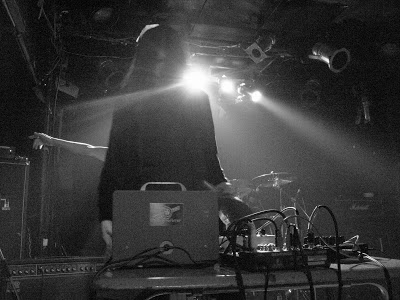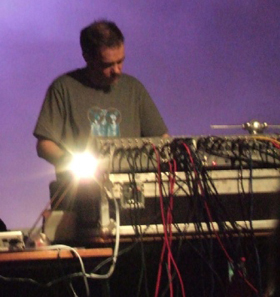
CCCC/HIJOKAIDAN Live on Italian TV (30 May 1997)

THE RITA – Live at Heaven’s Gate, Philadelphia on 17 Aug 2015

Noise Train Fukushima Festival featuring Members of Hijokaidan, Ootomo Yoshide and Junji Hirose (25 Aug 2012)

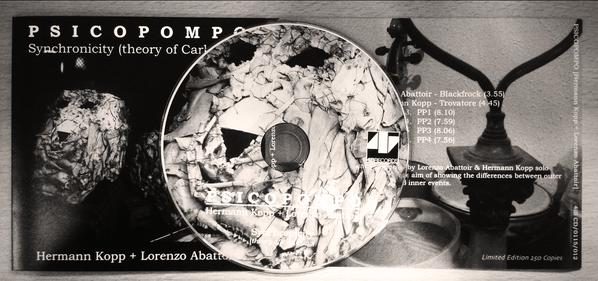
Review of PSICOPOMPO (Hermann Kopp + Lorenzo Abattoir) – Synchronicity CD (By Mäx Lachaud, Obsküre Magazine)

Lorenzo Abattoir, Nascitari, Hermann Kopp

If you love the darker and more abstract works of the German composer Hermann Kopp, this latest project is for you. The violinist, known for the legendary soundtracks for the films of Jörg Buttgereit (Nekromantik, Der Todesking) has always been attracted to the morbid and occult atmospheres. In line with Psicofonico (2007) on the EVP and recordings of voices of the dead, his last album to date on Galakthorrö label (tenebrous Zyanidanger) and the cassette Sinekdoxa published last December on Alien Passengers, this new album departs from a process of sound research and experimentation. He has worked here with Lorenzo Abattoir, a young Italian musician coming from the drone / noise scene, for a musical approach inspired by the concept of “synchronicity” of Carl Jung. This idea came to the psychiatrist when he became interested in the relationship between alchemy and christianity. The idea of simultaneous events and signifiers that can not be explained rationally. Psicopompo, the name chosen for this collaboration, is an Italian term that refers to the guide accompanying the dead in the afterlife. Of course, the concept is more complex than that and everything is explained clearly in the disc, so we shall not venture out further here. One thing is certain: the musicians have never met and have used a unique writing method, incorporating the notion of coincidence. All pieces are based on a combination of separately registered rhythms and melodies and mixed as a single sound event. The album begins with two individual tracks. The first title of Lorenzo Abattoir mixes white noise, interference and shruti box in a spirit fairly near to his work. The piece of Hermann Kopp, too, shares the idea of drones, noise and strangeness, always with these so characteristic string squeaks. But where the album gets exciting is when the two worlds mingle for the remaining half an hour. Out of it emerges a freezing, unknown music as if it came from an intangible elsewhere. Recording methods and percussion may recall the “industrial” scene if that term still means something, but the result is much less easily discernible. We are here more in occult magic, some portions even unveil a recited dimension, almost liturgical and ritual (“PP2”), which will only increase as the journey goes on. The whole is deeply frightening, disturbing, inviting to the beauty of another world (“PP4”). Weird, you said, weird?

Translation from Obsküre magazine, France. (Review by Mäx Lachaud)

More Info: http://www.4ibrecords.com

SHROUD OF VAPOUR – Suicide Forest Sessions CD Review by Musique Machine (Roger Batty)

Hiroshi Hasegawa, Rohco, L'eclipse Nue & Yoshiko Honda Suicide Forest Sessions

Shroud Of Vapour is a five piece collaborative project that brings together it’s members from the Japanese noise scene for a moody, mostly subdued and often chilling two track release on respected Singapore based noise/experimental label 4iB Records. This is the project’s first release.

The release comes in the form of a CD release, which features two tracks, each of these run between fifty & nineteen minutes a piece. And I guess it’s best to describe what we have here as a fairly loose & often woozy mix of unsettling & stripped electro ambience, subdued noisy improv/noise making, eerier vocalising, and the odd venture into more structured/noisy affair.

The release takes it’s name from Aokigahara, The Suicide Forest or Sea of Trees – a 35-square-kilometre forest situated on the northwest base of Mount Fuji in Japan. The forest is associated with demons in Japanese myth, and has been the site of many suicides (give or take around a 100 most years since the late 1980’s). Both tracks here were recorded live in the forest, using just battery powered & non electric elements.

The project brings together the following: Hiroshi Hasegawa (of C.C.C.C., Astro, and many other projects), ROHCO (also of C.C.C.C. & Astro), L’Eclipse Nue (Daniel Sine) & Yoshiko Honda.

Track one is entitled “In Memory Of” & comes in just shy of the forty nine minute mark. It languidly morphs and melts, wavering and haunting at times, almost operatic sing-song female wordless vocalising, through to stretched out & thinned noise tonal drift, onto sudden raised noise amassed textures, through to hazed & shapeless mixes of textural details, onto reduced down slightly spacey synth drift, & haunting feedback ebb ‘n’ shift. All in all the tracks are quite effective in it’s drifting, drowsy & slightly unsettling vibe, and one can almost imagine lost spirits floating & slowly shifting through the suicide forests landscape.

Track two comes in the form of “If It Pleases The Deceased”, and this track is just over nineteen minutes, which sees the five piece move towards a slightly more noise-bound feel – though it still has a haunted/loose vibe about it. The track opens with a mixture of walking or heart-beat pulse textured detail, & this is battered by on/off slams of what sounds like an organ fed through a distortion pedal – around this we get layers of ghostly moans & subdued female vocalising. As the track progresses, more wavering & sad harmonic keyboard hits can be made out, but around this you keep getting hits of textured & eerier noise matter, and retro synth flotsam & jetsam – and after a time the harmonic element departs. I guess you’d say the track falls somewhere between noised up ambience, weird séance like vocalising, and possibly a 60’s psychedelic freakout at it’s most loose and stripped down. The track is ok I guess, but I did find my attention starting to wander in places, so it certainly wasn’t as effective as the first.

So in summing up the idea of recording in the suicide forest is certainly an intriguing one, and the first track manages to capture the vibe of such a place nicely – I just felt there was a little less thought & atmosphere in the second track. So if you enjoy loose and often chilling sonics which hover somewhere between (mostly subdued) noise-making, improv and noisy ambience, you may well get something from this.

(Source: http://www.musiquemachine.com/reviews/reviews_template.php?id=5498)

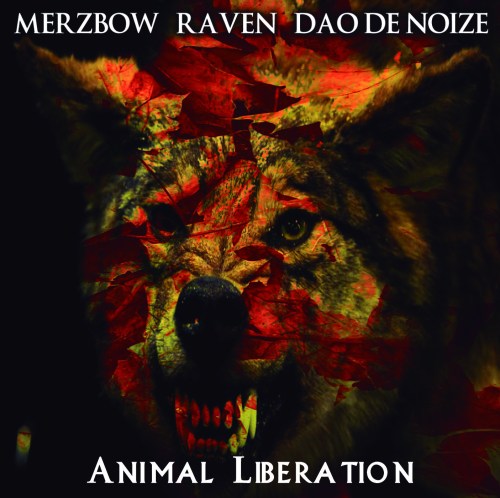
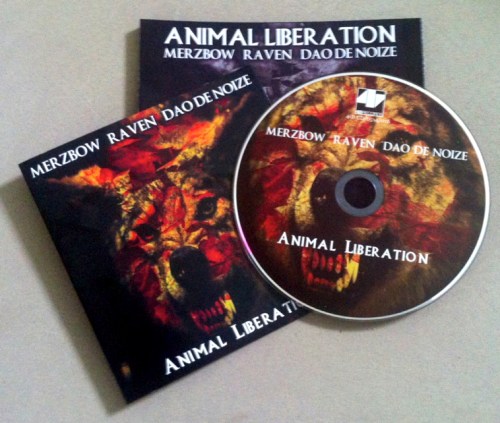
MERZBOW / RAVEN / DAO DE NOIZE – Animal Liberation CD Out Now!

Merzbow Raven Dao De Noize - Animal Liberation CD (4iB016)

Merzbow Raven Dao De Noize - Animal Liberation

MERZBOW / RAVEN / DAO DE NOIZEAnimal Liberation CD (4iB016):

TRACK LISTING
1. Merzbow – Granulation 221 (20:04)
2. Raven – Unjustified Murder (10:00)
3. Dao De Noize – Slaughterhouse Diary (19:58)

Details:
– CD in Jewel Case
– Limited Edition 200 Copies

PRICE (Includes Airmail Shipping from Singapore): USD17
To Purchase, Please Click Here:

Paypal Image Link


MERZBOW / RAVEN / DAO DE NOIZE – Animal Liberation
Animal Liberation features 3 characteristically powerful tracks of varying harshness and noise intensities with it’s theme strongly centered on animal rights and its firm stand against animal abuse.
The journey into the audio slaughterhouse begins with 2 harsh noise tracks presented by prolific Japanese noise artist Masami Akita, otherwise famously known as Merzbow and Serbia’s harsh noise artist Raven (or Djordje Miladinovic), who is highly recognisable in the harsh noise circuit as anti-war as well as a strong supporter of animal and human rights and conscious environmentalist. These two violently painful tracks are complex with a high level of hypnotic and sonic energy. The message of what these artists stand for are uniquely expressed by heavy layers of organic sounds, high frequency screeches and low level drones that almost sound like animal screams and grunts in the abattoir. This journey of butchery finally comes to an end with a closing ambient track from Ukraine’s noise/ambient artist Dao De Noize (Artem Pismenetskii). The tranquil hums overlapped by murmuring soundscapes with the background beating of hearts and animal bellows, bleats and cackles complement and complete the album. These 3 highly emotive tracks successfully propagate the intended message through a unique display of artistic sonic expression that is now one of the greatest social change movement around the world.


Please direct all enquiries to:

4iB Records
PO Box 206
Singapore 914007
email: gerald@4ibrecords.com
http://www.4ibrecords.com

> Interview with TREPANERINGSRITUALEN (Breathe, Then Die) by Stanley Stepanic (Deaf Sparrow)

MG_3567-11-1024x614

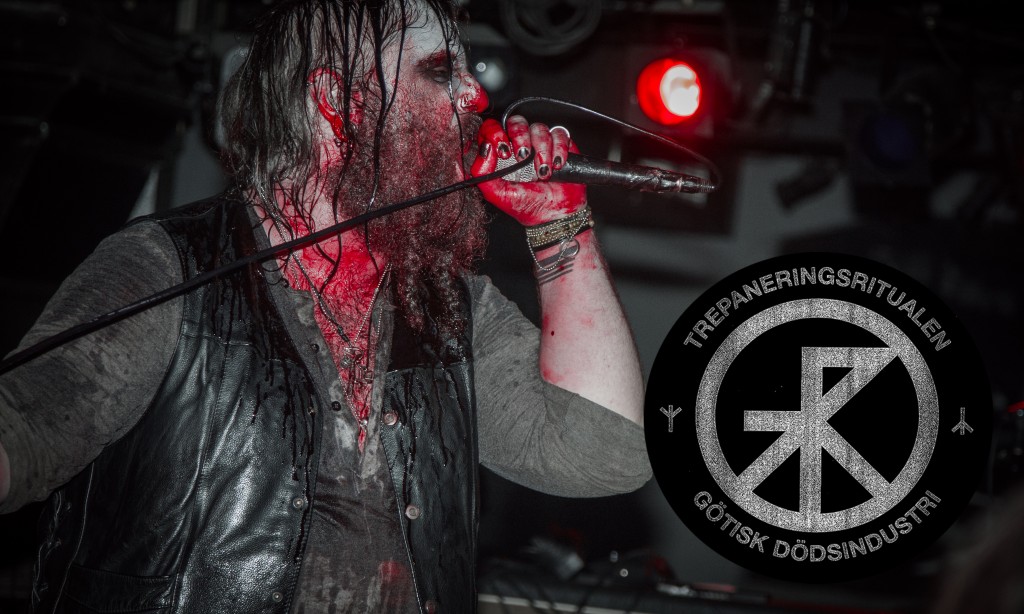
We’ve been on such a dark kick recently. We like it dark, darker than Goth, darker than black metal. So dark we tread places few will go because you’ll be tagged as ‘outsider’ by anyone. No one will accept you, everyone will fear you. One of our more recent listens involved an awesome piece submitted to us via Malignant Records, a split LP featuring Trepaneringsritualen, a Geatish death/dark industrial act from out of Sweden. After this first exposure, we took the time to listen to more of his work, and then received another release, and then eventually his most recent work from Cold Spring, who’ve we’ve been friends with for quite awhile. Not with benefits, of course, and by that we mean the benefit of a positive review. Like always, if we don’t like it, we say it, no pandering. But we like this guy here, we do, a lot. Seeing some of his live images and some videos, we figured we’d give him a quick note to see if he wouldn’t mind an interview, and here we go.

TREPANERINGSRITUALEN-HR-8365-682x1024(All sepia photos by Andrea Petrovičová.)
Deaf Sparrow – What kind of background do you have in music, if any (classical piano, earlier bands, etc.)? Seems like a lame place to start, but we’re totally lame so let’s start there.
TrepaneringsritualenMusic has always been my main focus, from when I was a kid. Tried my hands at various instruments, but I am not very good at any. I did Dead Letters Spell Out Dead Words for ten years, before retiring that moniker in 2010. Aside from T × R × P, I am currently involved in synth pop duo Soma Sema, as well as doing the odd remix, and occasionally collaborating with others in one-off projects

DS – So tell everyone a little about how TRP started and why, if you don’t mind.
TThat’s obscure even to me, it was never a conscious decision on my part. I’ve never questioned my creative impulses, and that has always served me well. T × R × P just needed to be unleashed upon the world I guess.

DS – Oh, an esoteric one, eh? We like that. Well, regardless of the why, assuming it will never be known anyway and taking it as an impulse, what was the first true TRP release?
TRitualer, Blot och Botgöring, a cassette released by Harsh Head Rituals in 2008. It has since been reissued on vinyl by Strömkarlen and Verlautbarung, and I am putting the finishing touches on a CD version on Infinite Fog.

DS – When did you start performing live? Was it an esoteric nothingness from which you sprang, much like your sudden decision to create your music?
T
In 2010. The first ritual was at the Norberg Festival in Sweden. I’ve done close to 40 since then.

DS – Wow, yeah, hahaah, that’s some serious power there man, Jesus. Considering you hit the ground running with weapons flailing left and right, it’s obvious you’d eventually get involved in releasing your material. When was the first TRP professional release? I mean, of course, some sort of separate thing on vinyl, cassette, whatever, not including compilations.
TThe first factory manufactured release was the Deathward, To The Womb 10” on Release The Bats. That was in 2011 I think. Editor’s Note: According to the Bandcamp link below it was 2012.

DS – Great stuff. Looks like that was one of the last releases they did, seems they ended the label in 2012. So, for live performances, do you tie in any visuals via video or do you perform any live rituals to go along with the sounds? Detail some of these if you don’t mind.
TI try to build as much of an atmosphere as possible, with whatever means I have at my disposal. Projections are part of it, and I work with lighting and fog when I can, as well as scent (rotten blood, mildew, and incense mostly). I believe it’s essential to attack as many senses as possible, overload the audience and disorientate them. I believe this is essential to make them more susceptible to communications from the other spheres.

DS – Awesome, yeah, I get a sense from the live footage I’ve seen that you have this excellent, modern, technological presence that assimilates actual ritual process and makes it something new. If you ever tour, you better believe I’ll be there. Some of the pictures I’ve seen look intense. Now let’s move on to your most recent work, which we just reviewed not that long ago. What was the conception behind your latest work for Cold Spring in particular, which just came out this year?
TFor once I actually did not set a specific theme or concept for the album, so thematically it’s quite wide. It deals with everything from the dual nature of divinity, betrayal and madness.

DS – I appreciate a theme, but I felt this one represented you in a more general sense, which is nice to have for a sound like this, get away from that usual consistency to something with overall variety. I see you’re also involved with some other projects. In particular I found Soma Sema very interesting, really enjoy that kind of dark, brooding electronica with pop influences. Can you tell me your involvement with Soma and DLSODW, which you talked about earlier? Really digging Soma, listening to “Artificial Heart” right now, this is something I’d even review for the site.
TSoma Sema sort of represents my pop sensibilities. Different music for different moods. Dead Letters Spell Out Dead Words was my attempt to come to terms with certain aspects of my personality. It was a very solipsistic project, very much about ME. In the end it just got too personal, I couldn’t deal with it anymore and it stopped serving its purpose. I’ve worked with so many people over the years, and I have taken something away from all of them, so it’s hard to single out anything specific. The last couple of years have been pretty hectic with my own stuff so I haven’t had all that much time to work on outside stuff. But I recently contributed vocals to a Blitzkrieg Baby song, and I am working on a few projects right now, one with Joachim Nordwall of the Skull Defekts, and one with my friend Dag Rosenqvist, who works under his own name. I will also contribute to the next Hadewych album, and I’ve been talking with Sutekh Hexen about doing a proper collaboration.

DS – Man, so many things to listen to now, thanks for that, or not, hahahaah. So wait, ahhaha, you don’t even remember how TRP actually started?
TWell, it’s more than I can’t explain the impetus. It wasn’t a conscious decision, it just happened because it had to happen. Call it fate or destiny or whatever.

DS – Back to your live presence for a bit. I’m aware of acts like Kristus Kut that get involved totally in live sex ritual performances and sexual imagery, things like that. What kind of crazy ass ritualistic death have you bled upon audiences, maybe involving literal blood?
TA T × R × P ritual typically involves loud sounds, a choking stench of rotting blood and mildew, and what ever extra-dimensional presence I manage to channel. They are rarely specific or tailored to achieve any pre-set goal. What happens, happens, and that’s the way I can keep it interesting to myself.

DS – Channeled chaos, nice, always welcome. So these visuals you’ve used, do you make them yourself or have you sourced them from obscure films and such? Any details on that?
TIt’s a mixture of found sources, and animated sequences. I try to stay away from too obvious sources, but I think any connoisseur of obscure religious films will be able to spot them. I am always looking for good source material, focusing on ritual in all its various guises. I am especially keen on getting clips of the Sanch procession, crucifixions, Day of Ashura and of course anything on Trepanning.

DS – Talk to me about Beläten, your label. I know I reviewed one of your cassettes recently, so I’d like to hear more about it. When and why did you start the label? Do you intend on cassette-only releases?
TBeläten sort of just happened to me two and a half years ago. I’ve done labels in the past, but I had been out of the game for three-or-so years when I suddenly got the urge to put out a few titles. From there it’s just rolled onward. I’m currently working on getting the first vinyl release ready for production, Veil of Light’s debut album. I expect it to hit the streets late September/early October.

DS – Awesome, glad to talk to you, it’s been a pleasure. Speaking in general, now, I’d like to give a major thanks to Thomas Ekelund for taking the time to talk to us here about his projects and work, it’s been a pleasure and truly awesome speaking to someone with such a heavy hand in dark industrial. Much appreciated!
T“oh sacred mouth!…who buried you in ashes” Here are some upcoming rituals for your readers, if interested:

September 21st, Incubate Festival, Tilburg, the Netherlands
October 17th, Endorcism, Berlin, Germany (with Wolvserpent)
November 15th, Moscow, Russia (with Brighter Death Now, Deutsch Nepal, and Raison D’etre)
December 6th, SE:UK Industrial Alliance, London, UK

And some forthcoming releases:

One Hundred Year Storm (with Sutekh Hexen) 2LP on Pesanta Urfolk
Split (with Body Cargo) Picture disc LP on Autarkeia
Ritualer, Blot & Botgöring CD on Infinite Fog
+ a few more reissues in the making

Interview Conducted by Stanley Stepanic

(Source: http://www.deafsparrow.com/2014/09/03/interview-with-trepaneringsritualen-breathe-then-die/)

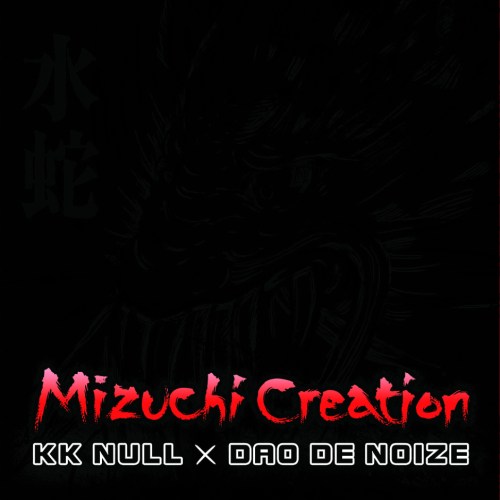
K.K. NULL x DAO DE NOIZE – Mizuchi Creation CD Out Now!

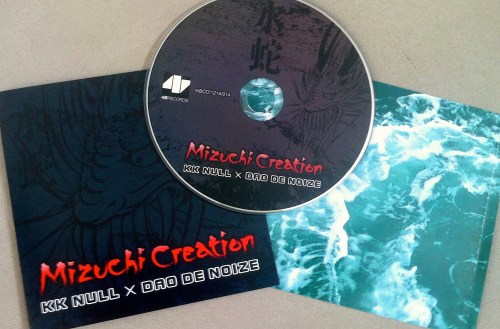
K K Null & Dao De Noize - Mizuchi Creation

KK Null x Dao De Noize - Mizuchi Creation CD

K.K. NULL x DAO DE NOIZEMizuchi Creation CD (4iB014):

TRACK LISTING
1. Mizuchi Creation (Track 1) (20:28) (sample)
2. Mizuchi Creation (Track 2) (26:40)

Details:
– CD in Jewel Case
– Limited Edition 200 Copies
– Artwork by Mikiko Ksn

PRICE (Includes Airmail Shipping from Singapore): USD16
To Purchase, Please Click Here:

Paypal Image Link


K.K. NULL x DAO DE NOIZE – Mizuchi Creation
Mizuchi or ‘Master of the Water’ is a name used to describe a well known mythical Japanese water deity resembling a serpent that lives in and around water. Titled ‘Water Snake’ in Japanese, this collaborative release showcases the sound wizardry of Japanese experimental multi-instrumentalist K.K. Null (Kazuyuki Kishino) and Ukraines’s ambient and noise artist Dao De Noize (Artem Pismenetskii). Mizuchi Creation comprises 2 tracks that flow continuously as one. Just like the impending ferocity of the serpent gliding through expanse of calm water, the album effectively maintains its sonic equilibrium of noise and soundscape through the complex balance of structured pulses, rhythmic noise, drones and hisses with the serene ambience of nature, mythology and life.


Please direct all enquiries to:

4iB Records
PO Box 206
Singapore 914007
email: gerald@4ibrecords.com
http://www.4ibrecords.com

> HIROSHI HASEGAWA (ASTRO) – Live Photos and Brief Interview (By Vicente Gutierrez & Sebastian Mayer)


The lack of posting could be a kind reflection of how hectic its been over here although, the film has pressed on and in the recent lull of posting we’ve actually been active at shows (Optrum, Hair Stylistics was properly exceptional) in addition to writing (Eye Yamataka interview in Dazed & Confused, Feb 09), research and of course, editing footage into the darker (…and then brighter) hours of the day. Two weeks ago, one of our familiar faces, Hiroshi Hasegawa aka Astro collaborated with Batur Sonmez aka Analog Suicide from Istanbul Turkey at Shinjuku Urga. It was part of Lunatic Scope Volume 12, a line up which featured Bastard NoiseDefektro and Government Alpha.

Even though our cameraman couldn’t make it at the last minute, we still followed through on Hasegawa’s invitation. Afterwards, I had a nice albeit brief chat which we continued over email and so I’ll post some words I translated from Hasegawa with some images to go along. We’ll cut part 2 of our interview with Hasegawa-san in the near future and be sure to post a clip on our Youtube and Vimeo channels. In the meantime….
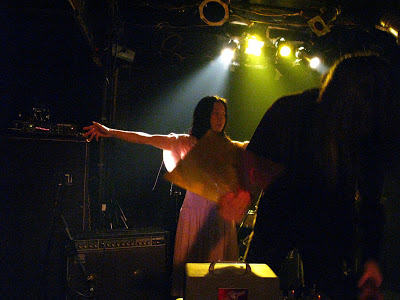

My attention was initially drawn to what seemed the latest addition to Hasegawa’s fold up table- a mysterious retro-looking box and what appeared to be gold-coated paper. Hasegawa’s set was centered around two metallic (about A4 size) sheets; shiny and paper thin. On where their role: “well, those metallic sheets, I had attached contact microphones which worked to pick up the friction and vibrations when I shook or slid the sheets against each other.” In addition to the pedal set up below his table, Hasegawa was in true analog-form running the smaller contact microphones through a high voltage, all-tube analog annihilator; essentially the ‘box’ on the table which all eyes seemed to gravitate towards at one moment or another (I have a weblink if anyone wants to know). “Since my performance is based around my [analog, ed] synthesizer and effector set up, I’m somewhat limited to what extent I can move my body so these sheets gave me some more freedom not only in terms of sound but also movement.”
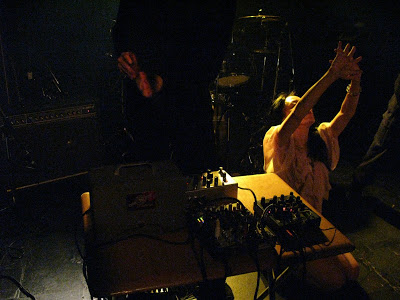

We briefly went on to discuss collaborations and how the evening went with both Sonmez and Reiko A. While Astro was enthralled with the sheets (and the occasional reattaching of the contact mics), he commented, “of course, I think its important to not only hear, but also to be conscious of your collaborator’s sounds- its very much like a regular sign that is read.” Meanwhile, Reiko A’s dance performance, punctuated with fixed stares, corpse-like poses on the floor as well as firmly locked ones via angular jukes, was familiar of the Butoh aesthetic in broader strokes. “Yeah, I’ve been playing together with Reiko for quite some time and so we I can really read her signals pretty well. From that gathered sense of communication, I’ve come to more fully realize the importance of her signs and movements. I can observe the movements Reiko makes, and while they are natural reactions, from my sounds, and she’s expressing in a physical way, its like a language that gives me a more composite idea of what is happening during the performance.”

(All photos courtesy N. Yamamoto-Masson, 2009/Posted By Vicente Gutierrez)

(Source: http://japanesenoiseproject.blogspot.sg/2009/03/hiroshi-hasegawa-astro-live-photos-and.html)

> ATRAX MORGUE – Marco Corbelli (Heathen Harvest)

In Memorium
3rd April 1970 – 6th May 2007

Marco Corbelli was the man behind the prolific noise project Atrax Morgue; he was born in 1970 and committed suicide by hanging in 2007. He was described as friendly but socially awkward and it is said that his obsessions were a very real part of who he was. Little else is known about him or his life. I have personally been interested in Corbelli since buying Atrax Morgue’s No More CD when researching an article on another artist: Premature Ejaculation. His influence can be heard in a lot of darker noise music today, I could argue his death reinforces the extremity of his musical output.

Greatly inspired by an earlier Italian Power Electronics act The Sodality, their 1987 LP Beyond Unknown Pleasures and Whitehouse’s “Dedicated to Peter Kurten”, Marco Corbelli recorded his debut cassette as Atrax Morgue at a friend’s house in summer 1992, calling it In Search of Death. The musical setup that he used for this – Keyboard, multi effect and voice – produced amazingly raw results. Corbelli didn’t use Atrax Morgue as purely a vehicle for pure noise, the sounds were purposely sick and infected as if he was using a selected palette for a purposefully murderous concept. The Atrax sound was often mentioned in regards to the Death Industrial genre rather than Power Electronics due to its consistent depravity, sickness and darkness. Although Atrax Morgue sometimes screamed and used sharp frequencies, rage was never the focus; Corbelli seemed happy to be pissed off and revel in the lower frequencies and rumblings. Friend and Deathpile noisemaker Jonathan Canady describes his sound as having taken the Whitehouse method of one synth line and one vocal and making it his own.

Corbelli immediately started running his own Slaughter Productions label in order to frequently release Atrax Morgue material, totalling around 39 Atrax Morgue recordings between 1993 and 2006. He would average 3-4 sometimes 5 Atrax Morgue releases per year on Slaughter as if he had no time to be too reliant on other labels to always release everything, so there would constantly be newer darker Atrax material released. Through Slaughterhouse, Corbelli released other artists like Con-Dom, Maurizio Bianchi, Deathpile, Progetto Morte, Taint and Richard Ramirez amongst others. Slaughter did some legendary compilations featuring the work of Corbelli and others such as the Death Odors series, Tabula of Slaughter – A Deathwish Manifest and From Sickness to Death.

Corbelli openly listed manias and obsessions as Atrax Morgue influences; Murder, Psychosis, Isolation, Pornography, Necrophilia, Pathology, Diseases, Fetishes and most importantly Death. They were often the subject matters and inspiration to Corbelli’s recordings. Atrax Morgue titles inspired by these obsessions included Woundfucker, Black Slaughter, Esthetik of a corpse, Cut My Throat, Slush of a Maniac, Exterminate, Death – Orgasm Connector, Her Guts and Cockskull Fantasy.

In 1998 Corbelli started an Atrax Morgue side project called Morder Machine which dwelled on the same sickness but with pulsating powerful slow beats to emphasize the depraved mania. Morder Machine released two cassettes on Slaughter Productions in 1998; Deathshow and Happy Birthdeath. Morder Machine also appeared on the Butchers House Productions compilation Snuff Electronics. There were several other Corbelli projects that releases on Slaughter such as; Necrofilia, Necrophonie, Pervas Nefandum and Progetto Morte.

After concerts around the world and numerous releases Corbelli’s reputation grew within the noise scene and Atrax Morgue released material on other labels including; Old Europa Café, RRR records, Bloodlust!, Murder Release, Less Than Zero and abRECt. There were 27 known other Atrax Morgue releases on other labels.

Following his death by hanging in 2007 a collaboration with an earlier Italian Power Electronics legend Maurizio Bianchi was released in 2008 called M. Plus T. This was a lot different than previous Corbelli output, a decayed gem with distorted grand synth noise and instrumentation. It served as a grand finale for Corbelli’s music and elevated him to the league of great Italian noisemakers. His name is now legendary in noise circles, a prolifically consistent artist who raised the bar within his own genre.

Written by Larsz4

Photograph: Marco Corbelli/Atrax Morgue live in London – hinoeuma the malediction/hagshadow.

Discography:

Black Slaughter  1993
In Search of Death  1993
Necrosintesi 1993
Collection in Formaldeide  1994
Necrophiliac Experience 1994
New York Ripper 1994
Woundfucker 1994
Basic Autopsy Procedure 1995
Catch My Agony 1995
Esthetik of a Corpse 1995
Exterminate 1995
Homicidal Texture 1995
Pathophysiology 1995
Untitled 1995
Autoerotic Death 1996
Cut My Throat 1996
Extended Autoerotic Death 1996
Forced Entry / N.C.W. 1996
Lesion 22 1996
Sickness Report 1996
Studio – Live Material 1996
Sweetly  1996
Aminobenzolmessias 1997
James Oliver Huberty 1997
Slush of a Maniac 1997
DeathShow 1998
Disconnected Sin Organisation 1998
Woundfucker  1998
Overcome 1999
Esthetik of a Corpse 2000
Exterminate 2000
In Search of Death 2000
Paranoia 2000
Homicidal / Mechanic Asphyxia 2001
I Vizi Morbosi Di Una Giovane Infermiera 2001
Necrophiliac Experience / Necrosintesi 2001
New York Ripper 2001
Basic Autopsy Procedure / Homicidal Texture 2002
Collection in Formaldeide 2002
La Casa Dalle Finestre Che Ridono 2002
Pathophysiology 2002
Sweetly Spatter 2002
Death – Orgasm Connector 2003
No More  2004
Her Guts  2005
No More  2005
Claustrophobic Introduction 2006
Frustration 2006
Inorganic Introduction Pt.II 2006
Negative Frequencies  2006
Pathophysiology  2006

(Source: http://heathenharvest.org/2012/10/08/october-obituaries-category-vi-atrax-morguemarco-corbelli/)

> NURSE WITH WOUND Live in Russia (10 + 12 September 2015)

SUTCLIFFE JUGEND Live in N.K. Berlin on 6 June 2015

Interview: Nurse With Wound’s Colin Potter By David Keenan (31 March 2015)

Colin Potter

The experimental musician talks about his long and winding career in the UK underground.

Colin Potter has been a central figure in the UK’s DIY and post-industrial underground since the late ‘70s. His ICR label, founded in 1981, blurred the lines between post-punk experimentation, crude pop, Krautrock-inspired drone work and contemporary electronica, with releases by everyone from DIY legends The Instant Automatons through Chris & Cosey of Throbbing Gristle, experimental composer Trevor Wishart, drone soundists Andrew Chalk and Darren Tate and Bryn Jones’s Muslimgauze. He has also been a key collaborator with both Current 93 and Nurse With Wound, working in the studio with both groups since the late ‘90s as well as serving as a member of Nurse With Wound’s current live line-up.

From the late ‘90s to the late ‘00s Potter’s IC Studio, based in a Victorian Water Tower outside Preston, was a lightning rod for musicians working beneath the radar and a focal point for the nacsent UK drone scene. Recent years have seen an upsurge in interest in Potter’s solo works, with early cassette releases being reissued on vinyl by labels like Deep Distance and Sacred Summits.

In an wide-ranging interview Potter recalls his early days as an electronics obsessed Krautrock fan as well as his founding of the IC studio and label, his adventures with Nurse With Wound and what it was like to be at the hub of the ever-evolving UK drone underground.


Space Patrol

What sparked your first interest in experimental sound, were there particular early epiphanies?
I started buying records at a very early age (around nine, ten years old), mostly instrumental and guitar groups. I remember a couple of TV shows that used primitive electronic sounds – Space Patrol and, of course, Doctor Who. I became interested in those sounds and slowly tried to find records that featured them but in the early and mid-’60s it wasn’t easy. But as the hippy/prog era developed, suddenly there was more weird music available. I had a bunch of friends who all listened to similar stuff and we’d all come up with new LPs and it was great to find so much new music. One particular favourite was Alchemy by the Third Ear Band. For some reason, we decided it would be easy and great fun to make that sort of music. So, with virtually no musical ability and only the minimum of equipment (one cheap acoustic guitar and a melodica – the rest was “percussion”) we started improvising. It was something I really enjoyed so I bought a domestic tape recorder and a cheap and nasty home organ. We never really intended our “jamming” to be taken seriously and it was around the time when we started going our separate ways – university, jobs, etc.

So when did you start working with electronics?
I ended up at York University and I was delighted to discover that there was an Electronic Arts Society and their prized possession was an EMS Synthi A briefcase synthesiser, that they had somehow managed to get a grant to buy – they were really expensive at the time. Even though I wasn’t a music student, members were allowed into the music department which was then pretty well known for experimental work. Not only did I get to see a huge number of concerts of electronic, contemporary classical and improv music, I also managed to borrow the synth for a couple of months, which taught me the basics of analogue synthesis. Around that time I also started building some simple electronic circuits for generating and morphing sounds. I dropped out of University after two years as I was wasting my time and got a job which enabled me to buy a decent tape machine and a few other bits and pieces. Over the years this kept growing and I eventually moved to a house near York where there was an outbuilding which I converted into a basic studio.

What was your first studio set-up like?
Up until then most of my equipment was pretty primitive but I decided to take the plunge and buy semi professional 4-track and 2-track tape machines, a proper mixer and some mikes. Not long after that I bought a Korg synth and sequencer. Having fairly minimal equipment and plenty of time meant that I could experiment and learn how to get the most out of what I had.


Colin Potter – The Lope I

Were your listening tastes mutating at the same time? The late ‘70s definitely seemed to witness a boom in DIY releases, especially on cassette, from musicians that were drawing on influences more further afield than the standard punk canon.
Up to then most of what I listened to was European experimental stuff, mainly German – the usual suspects – and I guess I tried to produce music that was similar. But towards the end of the 1970s I became aware of the whole punk / DIY thing and the beginning of the era when it became possible to produce and distribute cassettes and vinyl independent of the mainstream music system. I think it would be overly nostalgic to say it was a golden era because in reality not many copies were sold, certainly of the tapes (although the two compilation LPs I was involved with did reasonably well). Also, there wasn’t much exposure on the music press, other than a few little “ghetto columns” in some of the mags or papers. But what was good was that a lot of people began producing stuff with little or no regard of commercial potential or musical convention. I gradually found likeminded people through fanzines and word of mouth. There was also a great record shop in York called Red Rhino, where you could find all sorts of weird music. One of the fanzines was Mirage which mainly covered European music. I ended up writing some reviews and also sent Martin Reed some of my recordings and he put out my first release, The Ghost Office.

Was Throbbing Gristle’s vision of “Industrial Music” important to your own musical genesis?
I was never particularly happy with the term “Industrial Music” as a catch-all term, though I think TG’s use of it for what they were doing was clever. I think a lot of people were inspired by them to do things for themselves, which was also what punk did. I’d been making noises for a long time but that whole period made me think I could do something more than just messing about. Also the sense that you could make music any way you liked. I think a lot of people realised that. I’d been making noises for a long time but that whole period made me think I could do something more than just messing about.

How did you your own label ICR come about?
In 1981 I got together with a few people in the “cassette underground” to put together a jointly-financed compilation LP,We Couldn’t Agree on a Title and decided I had a label, Integrated Circuit Records – a bit of a mouthful, which was soon shortened to ICR. Not long after that I moved to a village outside York called Tollerton. The house had an old barn at the back which I proceeded to convert to a proper studio. I packed in my day job thinking I could look after my kids, run the studio and the label, which was then releasing tapes by myself and other people I liked. After a few years of doing this I realised I couldn’t keep up with everything, so I decided to put the label into hibernation and concentrate on bringing up my daughters and running the studio, evenings and weekends, as a commercial facility. I’d upgraded to 8-track just before the move and after a while I got a 16-track tape machine which seemed like heaven. The bulk of the work I did was with local musicians, some of which was pretty grim. But I learned a lot about engineering and producing (and diplomacy). I also got a lot of work producing sounds for a big local company who installed museums and exhibitions, which enabled me to compile a large sound effects library. Another sideline was cassette copying, which I originally started on a small scale for ICR. Some of the smaller tape labels found out about this and I ended up doing copies for a lot of them.

How did you first come into contact with fellow UK DIY drone experimentalists like Andrew Chalk and Darren Tate?
Andrew was one of the studio’s early customers. He lived in York and I knew him through buying ICR releases. I did quite a lot of work with him and learned a lot in terms of miking up all sorts of strange things, recording outside and playing instruments in a very unconventional way. I released a couple of his tapes and some of the other recordings made it on to various LPs. I was aware that he was also working as Ora with Darren Tate who was very reclusive. Eventually Andrew persuaded Darren to come to the studio but he was quite shy and kind of withdrawn, but after a few visits he began to relax and contribute more. At that stage I was just engineering the sessions, but I’d often suggest things – treatments, sounds, ideas – and I guess, by osmosis, became part of the project.


Current 93 – The Ballad Of Bobby Sunshine

So when did you first connect with Nurse With Wound and Current 93?
Around 1988 I was approached by David Tibet of Current 93 who wanted some tape duplication. His parents lived near York so he called in while visiting them and had a look at the studio. I think the place in London that he (and Steve Stapleton of Nurse With Wound) used had closed down and they were looking for somewhere “sympathetic” to work, so he decided to give me a try. Current 93 had released the album Swastikas for Noddy but were unhappy with it, so they decided to do a remix. David arrived with Steve and Tony Wakeford. Due to a difference in tape format, we had an additional eight tracks to use, so extra material was added, resulting in the Crooked Crosses for the Nodding God album. I guess things went well as I ended up working on more Current stuff and also Sol Invictus. Steve and David also did The Sadness of Things album at IC. If my memory is right I think the first Nurse thing I worked on was the Creakiness/Firepool LP (from 1991) then 1992’s Thunder Perfect Mind, on the release of which I was very pleased to see myself listed as a member. Out of that album came what I would say is my favourite Nurse album, 1994’s Rock ‘N’ Roll Station. It was an odd project brought about by the fact that it wasn’t exactly simple for Steve to get to the studio, as he lived in Ireland. So he asked me to treat, remix, and restructure certain sections and post them over to him. I must have done hours of stuff and he then worked on it over there and I was really blown away when I heard the finished album. A lot of the extra material later resurfaced on Second Pirate Session.

Were you aware of Nurse With Wound prior to working with Steven Stapleton?
I was aware of NWW from interviews and various tracks on compilations, but I didn’t have any albums. But when I started copying tapes, that was like total immersion as I basically was given masters of the entire United Dairies catalogue. So you could say, I got to know the music quite well. It took a while to get to know Steve. Initially I felt it was my role to just get on with the job of being the engineer. Most of the early sessions involved other people but when we started on Thunder Perfect Mind it was mostly just the two of us and I think we got to understanding each other better. Some of the ideas he had were very contrary to standard recording methods, which I normally used for my other commercial work. But neither of us gave a fuck about that and just tried all sorts of weird stuff. He’s got an incredible “ear” for what works, often in the most seemingly unlikely combinations. And humour is never very far away.

Can you tell me a little bit about the famous Water Tower that IC Studios moved to in the late 1990s?
There was a bit of a hiatus when, for reasons beyond my control, I had to move to Preston. The building was interesting in that it was a converted five-storey Victorian water tower and the studio was located on the 4th and 5th floors. It took a while to get the studio back together again. The control room was on the 5th floor with the live room underneath. It was a good place to work, there were lots of windows which was great, as my previous studio had none. I gradually improved the studio equipment and moved from digital tape-based recording to a hard disk system but eventually I realised I needed to learn how to use a computer, as there was so much potential there. I was working with local musician Paul Bradley on numerous drone-based projects, and he taught me the basics of computer, recording, processing and editing.

You reactivated ICR as a label and a distributor when you moved to the Water Tower, is that correct?
I decided to start ICR again shortly after rebuilding the studio as I realised that running a music mailorder operation using the internet was probably a good idea, so ICR distribution was re-born. I initially sold a few tapes, CDs and CD-Rs by people I knew whose music I liked and released the first ICR CD in 1999 – Sumac by Jonathan Coleclough and Andrew Chalk. I released the next one the following year, my own solo album, And Then, which was actually the first album of completely new music I had made for over ten years. The label continues today and we’re almost up to our 80th release.


Colin Potter – We Are So Glad [from We Couldn’t Agree on a Title]

What do you regard as the key ICR releases?
The key releases for me were the compilations – 1981’s We Couldn’t Agree on a Title and 1982’s Flowmotion. I like the element of cooperation in the finance and production and also the mixture of different strands of music. Later I put together a compilation tape, 1983’s Integration, again featuring a wide range of styles, which I think worked really well. Later, the CD releases of the Nurse With Wound Shipwreck Radio projects were very successful and probably introduced a lot of new people to the label.

You worked with some of the most mysterious and enigmatic artists in the UK underground, semi-legendary figures like synthist Paul Kelday, the obscure free music troupe New 7th Music and DIY legends The Instant Automatons. Can you tell us a little bit about your experiences with them?
I lost contact with Paul Kelday shortly after I put ICR into hibernation in the late ’80s. A few people have contacted me over the years asking about him, but I couldn’t help. All I know is that he’s disappeared. It’s very sad, as he made some great music, very unlike most of what was around at the time. I think this was partly due to his personality and the fact that, as far as I could gather, he used only one synthesiser, which was itself somewhat unconventional. It was a Korg MS50, an analogue modular which didn’t have a keyboard. I’ve got one myself and they are strange machines and not particularly easy to use. I’ve still got the cassette masters for all of the albums I distributed. And I’ve no idea what to do with them… Paul’s brother Phil was in New 7th Music, and was my main point of contact with them. As far as I remember they were a fairly loose organisation that met semi-regularly to jam and recorded – fairly crudely – most of what they did and released what they considered the best of. I think they played live a few times.

The Instant Automatons, well, they were extremely important in establishing the tape/DIY network. Their early compilations were a who’s-who of that scene and helped form a primitive system of what would now be called networking. They were very prolific. Maybe the quality control was a bit lax sometimes, but hey – who am I to criticise? They came over to my first studio to record their tracks for the We Couldn’t Agree… compilation LP and it was good to finally meet them. I remember afterwards we all met up in London to finish off the masters at the slightly scary Street Level studios, then taking them round to Porky’s to get them cut. Happy days.

You started playing live for the first time in 1999, what prompted that and what was the set-up you were using?
My idea was to basically try to set up a small studio on stage and remix prerecorded tracks, adding extra sounds, sampling and processing. It seemed to work OK, but it meant transporting a huge amount of equipment, including a 32-channel mixer. Once I started performing abroad, I realised I needed to streamline the set up and once I started using a computer this reduced the amount of stuff I needed to carry. Although it is still a bit of a pain in the arse to set everything up.

You’re a long-standing member of Nurse With Wound and a key part of the NWW live show; how did that come about?
My “joining” of NWW came as a surprise to me. When I received a copy of the Thunder Perfect Mind CD and saw myself credited as a member I felt honoured. It was always great fun to work with Steve. In the early 2000s I’d been playing live for a while and it was going OK. A festival in the Netherlands asked Steve if it would be possible to perform there. We spoke about how this could be done and it was decided to do a live mix of (Nurse With Wound’s 2003 album) Salt Marie Celeste. I prepared multi track tapes for a quadrophonic mix which we took over and it went really well. There followed a few other, not quite NWW, appearances around the world, but then we were persuaded to do a live version of SMC as a band, along with Diana Rogerson, Andrew Liles and Matt Waldron. Again, it went well, so despite reservations (Steve had had some bad live experiences in the 1980s) it was decided that NWW live was a viable proposition. The first “official” NWW shows were in San Francisco in 2006, followed a few months later at All Tomorrow’s Parties in the UK. We’ve done about 60 shows all over the world since then, usually with a core line up of Steve, Matt, Andrew and myself, although this fluctuates and extra performers are often drafted in. NWW is whoever Steve says it is. The live shows can be great fun (although not always). Despite the presence of guitars, basses and recorded drums, I don’t think we can be called a rock band, we’re too messy for that.

The Water Tower studio came to an end in 2009, what happened? Do you still have a studio set-up?
I stayed at the Water Tower for ten years, during which time several Nurse with Wound and Current 93 albums, as well as many others, were recorded. I worked with a lot of people who were non musicians and I always found their approach interesting in that they have no musical rules and are willing to try all sorts of unconventional ideas. In 2009 a change in family circumstances brought about a move to London. There followed a period of living in flats and most of my equipment was put into storage, although I still managed to always have a basic studio wherever I was. Fortunately at the end of 2013 my partner and I moved into a house in East London which has an outbuilding which we’ve soundproofed and I’m now almost finished fitting it out. I have a lot of equipment, some of it quite unusual, and I want to wire it all up so that it’s easy to connect and use everything. I’d also like to go back, where appropriate, to mixing in real time on the big 32 channel desk. Much as I like using a computer to record, process and mix, as it can really save a lot of time, I miss the “performance” element of hands-on mixing – moving faders, turning knobs, etc. I’m not sure how it will work out or if anyone else will be interested, but I’d like to give it a try. Back to the future, so to speak.

There has been a recent upsurge in reissues of your early release from the 1980s, has that surprised you? What else can we expect to see?
I’ve been amazed by the amount of interest there’s been in my early stuff from the 1980s, certainly more than there was at the time. Some of that music I’m still happy with, whilst some of it I find embarrassing. Why in God’s name I ever thought I could sing is beyond me. A lot of the playing is also a bit dodgy. As I’ve said before, it was a case of my ideas outstripping my abilities. But I think in some of the early stuff you can hear a connection to what I do now. Upcoming releases are a 12-inch of mainly unreleased music in May, a CD re-release of the Ora album from 2000,Amalgam, and two CDs of collaborations with Phil Mouldycliff. The rest of my early 1980s tapes are also due for re-release on vinyl this year. ICR will also be releasing an extended two and three CD version of the NWW Cabbalism project. There’s also a vinyl box set of NWW live recordings coming up. I might even squeeze in a new solo album somewhere!

(Source: http://daily.redbullmusicacademy.com/2015/03/colin-potter-interview)

MUSIC FROM A PARALLEL UNIVERSE – Faust sounds just as different today as it did 35 years ago (By Thomas Winkler)

Faust

In the 1970s, British music critics laughed off attempts by West German musicians to play rock music, dubbing it “Krautrock.” Today, the once unloved genre is the pride of German rock history.

One of the most absurd chapters in the history of pop music – and it has several such chapters to its name – began in 1973: A group from Hamburg, not particularly famous even in Germany, recorded a new album. The record opened with a 12-minute-long piece, which was given the title “Krautrock.”

The band never wanted their song to become a pop music genre. After all, in the 1970s Britons still used “Kraut” as a derogatory term for Germans. Krautrock was a sneering term from the British Isles, poking fun at German efforts to catch up with famed Anglo-American rock music.

Thirty-five years later, two marvels remain. First, the band is still together. And second, they now treat the epithet like a medal.  The group, called Faust, releases its nineth studio album, titled “C’est com… com… compliqué” at the end of February, and their record company promotes them, guns blazing, as “one of Krautrock’s foremost protagonists.”

Indeed, Krautrock has developed in an astonishing manner. Bands such as Faust, Neu!, Amon Düül, Cluster and Ash Ra Tempel were only moderately successful in Germany during the 1970s or critics even tore them to shreds. But especially in England, they gained cult-like notoriety and are now considered classic rock groups.

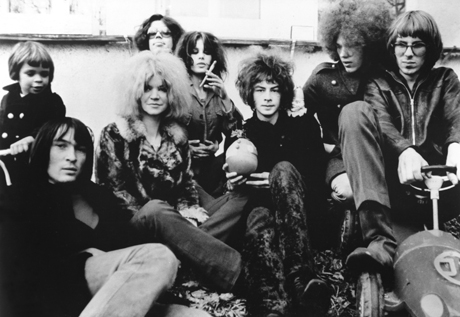
AMON-DUUL

Their music was frequently misunderstood at home – where it was seen as a mere copy of models such as Led Zeppelin or King Crimson. But only much later was the music recognized for what it really was: an avant-garde experiment, blazing a new trail for rock music that already then had become insufferably vain.

In the wake of the hippie movement, international rock bands were churning out drug-addled jam sessions, endless guitar solos and self-absorbed studio experiments. Krautrock bands, on the other hand, added progressive rhythms and influences from exotic music to the framework of rock music.

They also integrated the synthesizer for the first time and elements from modern music. Irmin Schmidt and Holger Czukay, for instance, formed the band Can, where they turned the knowledge they had acquired while studying with legendary composer Karlheinz Stockhausen into classic rock music arrangements; Tangerine Dream exclusively used the artificial sounds of the first synthesizers.

Neu!

These bands had only one thing in common. They were like nothing you had ever heard before. But still, it would have never occurred to anyone in Germany to bring together these different bands and place them under one heading. While Krautrock was music played in Germany, the British tabloid press invented the term for the genre.

The German musicians themselves did not have the feeling that they belonged to a homogenous scene – let alone that they were taking part in a national project to develop a German kind of rock music. Faust, for instance, used French lyrics – they never clearly modeled themselves on the British archetype.

In Germany, Krautrock became almost more derogatory than it was in the UK. For one simple reason: No musician likes to be pigeonholed, let alone in such a negative-sounding category.

But strangely enough, Kraut­rock’s renaissance began where the swear word originated. Germans tended to suppress memories of the ponderous and frequently drawn-out works composed by largely long-forgotten bands. Of all things, it was a few Britons who rode to the rescue of the genre.

Legendary radio DJ John Peel, generally considered a punk propagandist, played songs by German rock bands from the 1970s. That helped the music become popular abroad. The successful musician Julian Cope, mastermind of post-punk band The Teardrop Explodes, published the book “Krautrock Sampler” in 1995, which remains the definitive work on the genre to this day. Since then bands such as The Fall, Radiohead and Tortoise have cited Krautrock as one of their influences.

Looking back, Cope describes Krautrock as “a subjective British phenomenon” but it is a genre with a surprising impact on the rest of the world. Krautrock musicians, who were frequently educated at conservatories, consciously rebelled against academic institutions. Such a radical approach to rock music was a rare occurrence back then – as it is today.

“There is no group more mythical than Faust,” wrote Cope in his book, describing their music as “a style which was fuzzy, funny and extremely non-commercial, yet busted out with weird hook lines and extraordinary sounds.” The band’s first album “sounded like music from some parallel universe suspended in time and played through the oldest radio,” he added.

Listening to Faust’s music today feels the same way. On their latest album, they refuse to go with the flow – and sound just as radically different as when they were founded 35 years ago. Krautrock, once the unwanted stepson, today the pride of German rock music, is as contemporary as ever.

(Source: http://www.german-times.com/index.php?option=com_content&task=view&id=12732&Itemid=122)

Review of PSICOPOMPO (Hermann Kopp + Lorenzo Abattoir) – Synchronicity (Theory of Carl Jung) CD by The New Noise (Italian)

HERMANN KOPP LORENZO ABATTOIR PSICOPOMPO Cover

Bastava anche solo Synchronicity eh. Non c’era bisogno di complicare la vita inserendo come sottotitolo Theory Of Carl Jung (battuta). Credo nel paranormale e nelle casualità, ma di teorie di psicoanalisi non so nulla, e, anche volendo, non le capirei (comunque nel booklet è, a grandi linee, spiegata bene). Magari chi l’ha studiata parte in vantaggio e riuscirà ad apprezzare meglio il disco. Io preferisco di gran lunga scendere in cantina e rileggere i testi di aerotecnica o termodinamica, osservando saldature e tubazioni d’acciaio e ascoltando nel frattempo ogni tipologia di rumore d’impianti industriali. Semplicemente visioni o filosofie diverse, non prendetela male. L’unica maniera che rimane per analizzare il disco è quindi da ricercarsi nell’ottima sincronicitàsonora (a questo punto meglio scrivere sincronismo), derivante dall’assemblaggio di approcci, idee, stili ed epoche differenti. Psicopompo è la collaborazione fra il tedesco Hermann Kopp (veterano della NDW coi Keine Ahnung e poi in solitario facendo stridulare le corde del proprio violino) e il piemontese Lorenzo Abbatoir, che nel giro del noise italiano che conta conosciamo come Nascitari. Non vi è nulla che rimandi ad officine meccaniche, plastica e cyberpunk, state tranquilli, sarei più matto di quel che sembro se scrivessi qualcosa del genere. Ci sono però avanguardia e meditazione. Essenzialità dell’anima e purezza dei suoni. Ma anche silenzio e annullamento di ogni forma geometrica tridimensionale. È come se le necroromanticherie industrial di Kopp fossero dei multicolori colpi di pennello gettati a random su uno sfondo monocromatico, lisergico e rituale, scaturito dalle menti malate dei Mare Di Dirac (altro progetto del nostro Lorenzo Abbatoir, che personalmente adoro). Che vi devo dire, più l’ascolto e più le sensazioni di solitudine e ansia mi avvolgono, un po’ come essere immobilizzato da una camicia di forza e ingabbiato dentro un perverso labirinto senza uscita, ma questo è l’effetto Kopp.

Se esistesse un formula alchemica che permettesse di imprimere/incidere l’audio all’interno di una cornice, Synchronicity sarebbe sicuramente un quadro del pittore russo Malevič, uno di quelli più assurdi e astratti (“Paesaggio con casa gialla”, ad esempio). Candidato a disco dell’anno!

(Source: http://www.thenewnoise.it/psicopompo-synchronicity-theory-of-carl-jung/)