4iB Records | For intrinsic Beliefs
Record Label dealing in Industrial, Power Electronics, Harsh Noise, Experimental, Death Industrial, Drone, Ambient, Japanese Noise, Field Recording, Abstract, Musique Concrete and other related genres.

> P16.D4 (Ralf Wehowsky) Interview by Dan Warburton (2005)
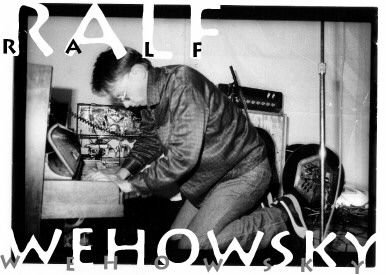
Do you come from a musical background, as such?
There wasn’t much active musicianship in my family when I was growing up. My parents didn’t play instruments. They just listened to the usual stuff on radio and records. Beethoven, Tchaikowsky, James Last.. The pop section of their LP collection consisted of one Supremes LP and the German version of the musical “Hair”. I liked the Aquarius piece a lot as a child. When I went to school at the age of 6 I had to learn one of the usual instruments – recorder or something. I refused, because I clearly disliked wasting time on stupid activities and playing an instrument seemed very stupid to me: whenever I wanted music, I could just switch on the radio. Maybe radio was my first instrument, but it would make more sense to say that my beloved Grundig cassette player was my first instrument. I got that about two years later and my interest in music really started, as I could make my own programmes. Nice mixtures of the then Top of the Pops (one of the first tapes must have included Alexandra – a German schlager-sängerin – Donovan, the great Moog exploitation..), excerpts from hörspiele and recordings of Kiki, our canary. Of course the best time for school kids to listen to the radio is after bedtime when they should be asleep, which is also when the more interesting programmes are on. That helped me find out about some sounds I wouldn’t have otherwise heard. A few years later, when I was about 11 or 12, I spent a good deal of my pocket money at the local flea market on records. Used copies of “far out” music were very cheap and quite easy to find. When I was 12 my record collection included all time greats like Can’s Monster Movie, Brötzmann’s Machine Gun, Stockhausen’s Gesang der Jünglinge, Amon Düül II’s Yeti,Xhol Caravan’s Electrip, Hans-Joachim Hespos’s Black Series LP, [“Dschen”, “Palimpsest”, “Splash”, “Kitara” published by the Hör Zu magazine] Alexander von Schlippenbach’s Globe Unity Orchestra as well as the usual children’s stuff (Pink Floyd, Yes etc.). When I was 13 I went through a very reactionary phase and decided I wanted to learn the guitar. My parents bought me one and I started taking lessons at the Conservatory (classical guitar) as well as with a private teacher, who turned out to be a big fan of Mr. Clapton and Mr. McLaughlin. Somewhere I might have some tapes of friends and me playing in 1974. Some guitars and lots of teapots etc. as percussion. Horrible stuff. (laughs) I remember it sounding vaguely like Amon Düül I without the studio. It took me a while to find out that none of these schools of playing had much to do with what I really wanted to do, and at that age there were many other things to discover, so I left the guitar in the cellar for a couple of years. Until 1979, when I saw some concerts of local “punk bands” that were so electrifying that I immediately felt the need to pick up an instrument again. Of course they didn’t use any three-chord scheme. There were hardly any chords at all. It’s a shame they were too disorganised to make any proper recordings, but listen to the 7″ Bka/Kinderfreundlich Materialschlacht made in 1979, and you’ll get an idea.
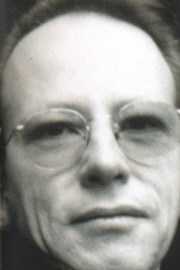
How did you hook up with the future members of P.D./P16.D4?
At one of those concerts I met Jochen Pense, who I knew as a regular visitor to many of the jazz / free jazz events I went to in those days, like the Moers festival. He was a mathematics student and guitar teacher and fully agreed with my thesis that it was the time for people like us to join the punk zoo. I went to see Joachim Stender, who had organized this particular concert, and asked him about starting a group together. It was the perfect time, as the group he’d been playing with, Messehalle, just had split. He said yes right away. We didn’t want any jazz guitar in the band, so Jochen was condemned to play bass. We bought a guitar amp and a cheap little mixing desk. A few weeks later we recorded our first record, Alltag, in my parents’ basement. The dense sound of that production really gained a lot from playing everything – two basses, guitar, and tapes – through that one amp. Another good thing about only having one amp was it was quite easy to get all the gear into one car when we gave concerts, which we did rather often back then. It was easier to take two cars, though, and one of Pense’s colleagues, another maths student called Ewald Weber, had a car and helped us out. Not for free, though: he insisted in playing drums. We were open to bribery those days… so all at once we were a quartet. But not for long – a couple of months later we swapped the drummer for a drum machine. Gerd Neumann from Messehalle had bought it and wasn’t happy with it. Messehalle never seemed to me to be a very happy crew; their drummer followed the drum machine on the way from Messehalle to P.D. soon afterwards. Since we preferred the rhythm box to his drumming, he sold all his percussion and bought a Korg MS20 synth instead. That was Achim Scepanski. So we recorded the first LP, Inweglos, with the two newly recruited members, Achim and the box. We made the mistake of borrowing two Revox machines for the proceedings, so the sound wasn’t that good as on the Alltag EP. Maybe that’s why I never was satisfied with the LP. I always preferred the recordings we’d made when Achim was auditioning, which were later released on cassette as Schwarzes Loch. Anyway, transport became a real problem now: Ewald’s car was being used by Messehalle, and Pense had gone to England for a year to study. I remember one horrible trip to Limburg by train (Joachim, Achim and me) when we almost broke down under the weight of the instruments. During our next concert in Mainz we asked the audience for promising craftsmen with their own means of transport. Among the candidates was the crew of a bass-keyboards-drum-trio, who had been playing Canterbury-influenced instrumental music for some years. Achim Scepanski and I played some sessions with them (some recordings – the Grauer Oktober Tapes [scheduled for release next year on Howard Stelzer’s Intransitive imprint] – survived), and finally Roger Schönauer (bass) and Gerd Poppe (drums) joined P.D.. We played some concerts, although Joachim Stender still didn’t want to abandon the “no more drummer” dogma. On the day we played a festival in Frankfurt in December 1980 (organized by Christoph Anders, later of Cassiber fame) with the holidaying Pense, the question was discussed intensely. As a result we offered the audience extra value for their money by playing not one concert as P.D. but two: one by The P.D. (Scepanski, Schönauer, Poppe and myself) and one by PiDi (Stender, Pense, and me). The initiated know that the first group changed its name into P16.D4, the latter into Permutative Distorsion, releasing one EP and one cassette album in 1981. P.D. was used as meta-sign. Groups ought to have a name. We didn’t want or need one, but for communicative reasons we had to define something that could be used as one without the usual implications. Therefore P.D. was not an abbreviation, but it could be used as one. Police Department, Permanent Demolition, Prävalente Dipsomanie, Permutative Distorsion, all were possible and were used. After the aforementioned split we had to change, but we wanted to keep the name. So we did both at once. It was obvious for everyone that P is the 16th and D the 4th letter of the alphabet. This year of turns and changes is documented on theeaRLy W 2 – Nur Die Tiere Blieben Übrig LP and the eaRLy W 4 – Ajatollah Carter CD.

Ajatollah Carter is one several RLW projects that have appeared on Absurd.
Yes, I’ve been in contact with [Absurd’s] Nicolas Malevitsis for over 15 years. I remember he wrote to me when he was still at school in the late 80s and asked me to send hundreds of LPs! (laughs) We stayed in touch.
When did Achim Scepanski leave the band?
In 1981. He left to finish his studies and become a techno tycoon I haven’t had much contact with him over the past 20 years, and haven’t heard from him since Force Inc’s demise. After Achim left Gerd Poppe handed his sticks to Ewald Weber, who’d fled the unhappy Messehalle crew (they were trying to get luckier under the name NTL – Non Toxique Lost – NTL – and are still around today). The remaining triumvirate (Schönauer, Weber and myself) became the core of P16.D4 until the group disbanded in the late 80s / early 90s. Though it turned out that the commitment of Messrs Schönauer and Weber was highly variable, and sometimes near zero, so I tried recruiting new personnel in 1983, which is why many pieces on the Distruct LP are co-written with people like Gerd Neumann (ex-Messehalle, too – but still with NTL), saxophonist Peter Lambert and pianist Stefan Schmidt, who became the fourth continuous P16.D4 member. He was from Hamburg and moved to Mainz after studying with Pense in England. He was a mathematician too, as well as a connoisseur of Cage and a church organist.
When did Achim Wollscheid join the Selektion crew?
1984 or 85. Achim did the cover for Distruct, and we released his first LP (S.B.O.T.H.I. – Swimming Behaviour Of The Human Infant) as Selektion’s third LP in 1985. Achim and I used to travel to an industrial disco in Wiesbaden once a week, drink heavily and rewrite the history of 20th century art and music. We also broke up lots of private parties by turning the kitchen into a seminar room and playing “our” records. It was clear that Achim wanted to stand on his own two feet and become a full time artist, so the idea like asking him to become a member of P16.D4 never arose. Instead we produced the next release, the double LP Nichts Niemand Nirgends Nie, as a collaborative effort between P16.D4 & S.B.O.T.H.I.. Today Achim is still working in the fields of sound and light installations. Selektion isn’t working as a label anymore, but we are in regular contact, and there’ll no doubt be some more collaborative projects in the future.
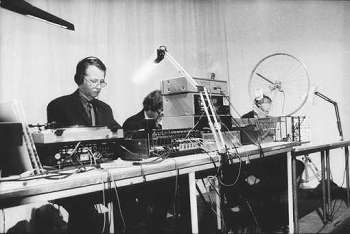
What did you think of the rock scene in Germany when you started?
German rock in 1979 and 1980 was a complete disaster. Ten years earlier there’d been lots of fascinating things going on, but after about 1973 commerce and stupidity reigned (again), as they did everywhere. The victory of unchained capitalism over taste and humanity. There were people doing uncompromising work, but there was no scene or publicity for them, nothing like the L.A.F.M.S. in Germany. The worst things were those with a ”progressive” or “electronic” etiquette. Labels like Sky released heaps of incredible tasteless crap.
What about Asmus Tietchens’ work on the label?
Asmus’s Sky LPs weren’t the worst of that bunch, but they were far from listenable. He wasn’t taken seriously, being perceived (if at all) as one of the enemies. When Steve Stapleton announced the release of a Tietchens LP on his United Dairies label everyone wondered if he’d gone mad. Fortunately Formen Letzter Hausmusik proved the sceptics wrong. It had nothing to do anymore with the “electronics lite” style of his Sky LPs. Our first collaboration followed a few years later [Captured Music, SLP 019, 1988].
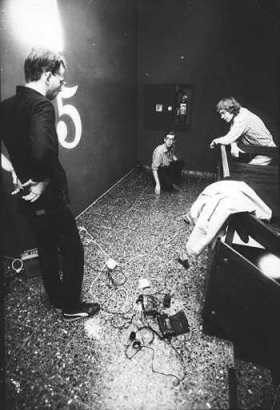
How did P.D. compare to other German punk and Industrial outfits?
When the Neue Deutsche Welle appeared about 1979 there was a big misunderstanding: many took the art school rhetoric of (some of) their English or American protagonists as if it was meant seriously: the Dada quotations, constructivist covers etc. Of course for the most of them it was just the PR hype of the day; today it’s cool to quote Schwitters, tomorrow Deleuze and then Iacocca. The good thing about it was the change in the cultural climate, which made it possible to join the public discourse from a position coming from and developing these countercultural traditions.
If I might be allowed a little diversion, I believe there is a long cultural tradition, which can be found throughout the 20th century and now continues into the new millennium, one which belongs neither to pop culture nor to “high” culture but breaks into both of those fields. The main characteristics of this tradition are being critical, i.e. not being satisfied with the world as it is (nor with culture and music as it is), and using music (or other art forms) to explore and deal with reality including the way we perceive reality. This leads to consequences which are incompatible with the central tenets of pop or “high“ culture: There is no interest in functional music/muzak: music to dance to, march to, sing along to, or go shopping to (which is the function of 99% of pop music after all), nor is there interest in respecting the conventions of musical systems that evolved to please the clergy and the aristocracy. Being able to criticise needs knowledge about the objects of criticism and about its tools, reason and language, which become objects of criticism too. A fine early example of this can be found in Dada, which didn’t just attack social and political nuisances but language itself, with lautgedichten (sound poetry) that I wouldn’t hesitate to describe as music. Another consequence is being aware of the relations between form and content and their history. There are also forms and methods that have worn out; for example, chord progressions express nothing anymore today. They’ve degenerated into clichés. Basing a track on steady 4/4 time indicates stupidity as sure as death.
Dealing with music as a means of confronting reality leads to the consequence that there can’t be one musical “style“, a linear progression or a properly defined line of ancestors. Reality and constructions of reality not only change in time; they also differ horizontally and vertically at any given time. This may be one of the reasons why this position as one approach regularly is being ignored. Of course the whole thing is not a 20th-century invention; I only think it makes sense to concentrate on such a rather short period, especially as the speed of technological and sociocultural changes is so enormous.
Standing in a tradition that has rule breaking as one of its most important rules it was clear that a new movement, which started with the rhetoric of rule breaking was a good vehicle for own operations. In other words, the main difference between us and most other groups of the Neue Deutsche Welle was that we knew what we were doing. If you listen to early NDW records like Plan’s first release, the so-called Fleisch EP, or some of the stuff on the Zickzack label, and compare it to later releases by the same artists it becomes clear how much they were just following trends. A bit of avant-garde rhetoric one day, some New Romanticism the next, and so on. For us, the Wahrnehmungen/Selektion crew, it was the perfect moment to try out in practice how to translate our ideas into our own contemporary language, insofar as the early years were a time of trying out different sorts of vocabulary and semantic models. Of course there’s never a secure model, but since, say, 1982, as documented on the “classic” P16.D4 LPs, Kühe in ½ Trauer and Distruct, there were stable reference points (others would say an unmistakable identity) to develop or diverge from. Maybe one of the reasons why the early material has a continuing fascination for me lies in seeing what other directions could have been possible. Hence the eaRLy W and P16.D4 reissues of recent years. An especially important release will be the V.O.D. (Vinyl-On-Demand) triple LP set [see review in October 2005] as it will feature six of those approaches, each taking up one LP side. In a way I took off from some of those loose ends for recent projects, especially those with Bruce Russell, Johannes Frisch, and the Views CD.
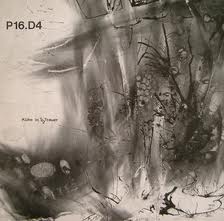
Could you describe P16.D4’s working method?
You could say we had a certain set of methods, mixed to varying degrees, and developed over the years. Some of the elements could be listed as follows:
Avoiding plunderphonics. I wouldn’t say every use of other people’s recordings is an ethically and musically weak action, but I prefer using self-created material. It opens a completely different emotional access to the material.
Improvising. Not only for the joy of the moment (the recording of such an improvisation is not primarily a document, like an Incus record, for instance) but as sound material, a source for
Transformation. No sound is only what it seems – it bears numerous possibilities in itself, which can be revealed by processes of transformation
Composition. We used classical western principles of structuring pieces a lot, which surely set us apart from other groups, but notes were never of real interest – you won’t find the structural elements in tone-related parameters (melody, harmony). We didn’t work with tones, but with slices of tape.
Reduction. Though “everything” was allowed in the stage of creating ideas, we always limited ourselves to certain sound materials and working methods for each piece. When the basic ideas and sound materials are clear, a framework of preset limits opens the freedom to work within.
Mixing became one of the most important elements in the creation of pieces – regularly three or four people were involved, using many different strategies often within the same piece.
Collaboration became a crucial part of our projects. Starting from reflections about the working process within a group of artists (as in a rock or jazz group) we practically institutionalised the idea of irregular confrontation with other artists.
The proof of the work always had to be in the hearing. If a piece had succeeded or was good enough to be released never depended on how close it came any initial conception. The point was if it was emotionally charged and fascinating to us after repeated listening.
Could you choose a representative example?
“Extase Des Sozialismus” from Kühe in ½ Trauer might be an interesting example. It’s based mainly on an three-man improvisation: Ewald playing sax and the two others manipulating the sax sounds in real time, with ring modulators, filters, distortion, and so forth (soundwise I heard something similar on a record by John Butcher and Phil Durrant not long ago). The ten-minute long recording was then edited down to five minutes, with some parts completely removed, some repeated and others sent to another place within the piece – completely restructured, in other words. This was then combined with a piano recording and a tape of looped choirs, both also edited heavily to fit the sax. The choral material, by the way, was taken from a record – so you see that none of the abovementioned principles of work were dogmatically adhered to. Of course, we made it completely our own: different excerpts of the original recording were looped, layered and mixed with changing contours over time – the composer of the “original” wouldn’t have been able to tell where the material was coming from. For the final version all parts were running through but only the sax track was constantly to be recognisable. The others were mostly below the threshold of audibility – but not the threshold of perception. If they’d been any quieter, the impression would have been completely different. It took a lot of mixing before the relations between the parts, which were changing permanently, could be “heard out” and laid down on tape.
The results of our own brand of musique concrète influenced our way of improvising very much. Whereas in the earlier days the “ideal” of “free electric improvisation” was very important (side 4 of the Zamla Mammaz Manna double LP Schlagerns Mystik is a good example), we were now heading towards something I once described as musique concrète improvisée. Examples can be found on the Nichts Niemand Nirgends Nie, Tionchor and Acrid Acme records. The piece “Half Cut Cows” was a typical live piece from mid 80s concerts. It was based on one of the sides of the Kühe In ½ Trauer LP and played by two turntablists as instrumentalists. The Kühe LP was already very complex, but the performances of “Half-Cut Cows” enhanced this complexity while combining it with spontaneous improvisation: the turntablists knew the pieces on the LP well enough to impose a rough compositional structure on the performances within which there was a lot of freedom, with parts ranging from almost indiscernible staccato attacks to loops of repeated longer segments.
These methods were developed for the SLP project, which was presented at many occasions in the late 80s / early 90s. This was based on side 4 of the Nichts Niemand Nirgends Nie dLP, which itself was a result of many processes of transformation. Side 1 of the LP was recorded by P16.D4, side 2 by S.B.O.T.H.I. (Achim Wollscheid) and both partners used each other’s materials, intermediate materials and finished pieces as material for their own pieces. Side 3 had some pieces of musique concrète improvisée by both partners, while side 4 consisted of three tracks. The first, by P16.D4, used sides 1 to 3 as source material, the 2nd, by S.B.O.T.H.I, used track one of side 4 and the third, by P16.D4, used the second and third tracks of the 4th side. For SLP, four turntablists used this LP side and the mixing was done by a computer program specially written for this purpose by Joachim Pense. There was a score for the four instrumentalists, who all used a stopwatch. The mixing program itself had precisely determined parts as well as improvised elements (determined randomness for the computer.)
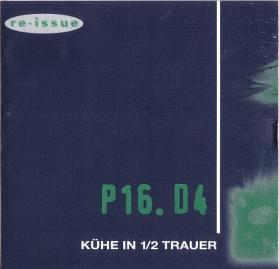
What equipment did you have at your disposal?
By 1982 we had two Revox B-77 (two track), and one Teac 4-track reel-to-reel-machines and one Teac 8-track-mixer. I usually recorded our improvisations on my B-77, listened, listened again, and again, did cut-ups and transformations with the B-77 and then did a sketch for a piece on my 4-track. During the “studio parts” of our meetings these sketches were listened to, discussed, listened to again and then worked out. For the final mix usually four mono parts came from the 4-track, 2 from one of the B-77´s, and 2 from a cassette player, all mixed down to the other B-77. The parts were often sub-mixes of more parts, mixed down at an earlier stage. All eight tracks underwent permanent change in panorama, volume and equalisation during mixdown, and as I said, this was often the crucial point in the creation of a piece, and involved the participation of several people with lots of improvisation. It was a great relief for me when it became possible to record all the above-mentioned mixing parameters (and more) with computers in the 90s!
How did you hook up with the so-called cassette underground?
It was clear to us from day one that we wanted to stand on our own feet. We released our first record, the P.D. Alltag EP by ourselves (without even thinking about another label) and offered it to everyone we thought could be interested. It worked out fine. One of the first distributors we thought of, Recommended in London, took (and paid for!) 200 of the 1000 copies pressed. The rest were sold within nine months. Even so, releasing records was rather expensive – and we were very productive – so we founded one of the first German cassette labels in mid 1980, and called it Wahrnehmungen. Tapes were copied on demand from persons and distributors of the so-called cassette underground, so editions were highly individual, and varied between 200 and 500 copies. In 1980 our contacts were mainly national, but by 1981 already I had a piece on a tape produced abroad, by the Italian mail-art project Trax. The positive side of the cassette medium – independence from economical pressure – was offset by the downside of the lack of self-restriction. There was far too much crap, and we never liked crap. We never felt completely at home in the so-called underground scene and soon moved on to concentrate on vinyl releases. We released our last cassette in early 1982 (from then on it was vinyl only, and later CDs), but we kept on receiving lots of tapes from artists all over the world.
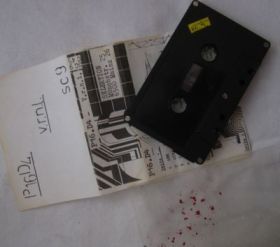
One of the contacts you made through the cassette underground was with Merzbow.
The first contact with Masami Akita dates back to the year 1982. You won’t believe it, but it was through Recommended Records’ Japanese branch, Eastern Works. They’d ordered lots of the Offene Systeme and Masse Mensch releases and I took the opportunity to ask for interesting contemporary Japanese music in exchange. I got about a dozen Merzbow tapes and immediately invited Masami to take part in the Distruct project. Which of course he did, supplying some recordings of his flute playing!
How do you see your work with relation to “classical” electronic music and musique concrète?
The dogma says that classic electronic music and classic musique concrète were at the opposite sides of the musical spectrum. There was personal confrontation and competition between Cologne and Paris as well as a fundamentally contradictory conceptual background. Electronic music was seen by many as a logical extension of serialism – insofar as musical parameters could be controlled even more precisely when the whole composition was built element by element from sine waves – whereasmusique concrète was never abstract, despite Schaeffer’s concept of a classification of sounds by purely musical parameters, independent of their social background and association. I happen to think most musique concrète composers used those associative powers quite consciously, as Walter Ruttmann did back in the 30s with his great, depressing Weekend. Of course the “classical” epoch ended for both electronic and concrète in the 1960s – and we haven’t mentioned the large number of composers working outside such conceptual boundaries outside Cologne and Paris.
As I said above, those sounds were just as much part of my childhood as schlager, rock and jazz. It was never a mystery for me that splicing tape was just another way to make music, like playing piano, guitar or whatever. Our experiments with tapes started back in 1980 (and can be heard on Alltag), and we worked over the years to integrate it fully into our sound. Coming back to your question: P16.D4 and RLW music wouldn’t sound like the way they do if electronic music and musique concrète had not existed. But they’re two influences among others. We never avoided the associative use of concrete sounds, but used them in a non-illustrative way that left room for different interpretations. The listener has enough freedom to find /construct his own meanings. Whereas in pop music you hear a bike sound in a song about bikes (the Ronettes, Steppenwolf…). How obvious! How dumb! What a waste of time!
One of the pieces on When freezing air stings like ice is entitled “Even Stockhausen knows when it’s not Cage”. Do you like Stockhausen and Cage?
I like most of Stockhausen’s 50s and 60s work and almost none of the later stuff. I like it despite its theoretical background. Basically, the idea of control is suspect to me, and the religious conversion is a pain in the ass. But even his serial pieces from the 50s simply sound great. Their crystalline clarity is so much more entertaining than any easy listening music! And Kontakte, Hymnen, the two Mikrophonie, Prozession and Aus Den Sieben Tagen are simply feasts for the ears. Interestingly enough, I often find music dedicated to the harmonies of the spheres much more relevant to this world than works explicitly intended for human beings. I guess that has to do with simply abstracting oneself from any apparent market or audience demand, and just doing the right things instead. As for Cage, don’t trust him when he speaks of indeterminacy; he deliberately chooses which elements to use and how to organize them.
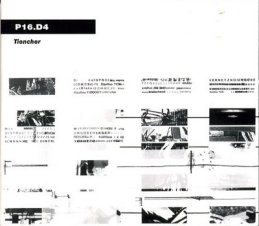
How did you hook up with Bruce Russell?
When I saw the first copies of “Logopandocy – The Journal Of Vain Erudition”, which accompanied the first Corpus Hermeticum CDs, I was completely blown away. Such a combination of intelligence, knowledge and good taste is extremely hard to find. At the same time I found out about that whole family of New Zealand abstract free improvising electric musicians who’d picked up the loose ends where others had stopped in the 1970s, coming from a completely different angle. The Kim Pieters / Peter Stapleton releases were (and still are) great. So it must have been in 1995 or 96 when I wrote to Bruce to exchange some records and ask him to take part in the (then untitled) Tulpasproject. From then on we kept in touch. In 2003 he was able to realize his plan of coming to Europe, visiting some friends and fellow-artists. When the date was set I started thinking about what we could do musically besides sitting in front of my computer, so I unpacked my old guitar, keyboard and amp and tried out a few things – something I hadn’t done in about ten years. When Bruce arrived I’d recorded about two thirds of what was to become the Views CD. when you listen to Views and Sights you’ll find that the instrumental settings are similar – though the resulting music is completely different. What was fascinating for me was that improvising together worked out as if we had been playing together that way for years – only more thrilling. It was the first time in about 15 years, since some of P16.D4´s musique concrète improvisée pieces, that I could release pieces as they were played and recorded, without significant edits.
You’ve recently released another duo project, this time with Johannes Frisch. How did that meeting come about?
I met Johannes for the first time in early 1998 when he interviewed me for a magazine he was writing for. It was just a few weeks before I moved to another city, so we lost touch soon afterwards. Five years later I met him again, by which time I’d unpacked my “conventional instruments” and was getting ready for Bruce’s visit. So the idea of asking him to play a duo was in the air – and we did it shortly after Bruce left. The first pieces were relatively close to the Sights recordings – there was little or no editing – but as the months passed I found it increasingly fascinating to use the tools I’d developed on my own in previous years, on longer stretches of the recordings, not on the milliseconds of material as I used to do in the 90s. When the time came to release the Frisch / Wehowsky duo, a lot of the earlier pieces had been put back into storage. the Tränende WürgerCD concentrates on newer or highly reworked recordings. We’ll have to see what the next steps will be.
Can you explain the album title?
It’s hard to translate: träne means tear, and würgen means strangle or throttle.. Tearful throttling?! I think it sounds better in German! (laughs) It derives from the names of the poisonous plants we chose as track titles. We liked the idea of something that was beautiful and crystalline, but also dangerous.
In 2001 Selektion released a nmperign album, and you’ve recently been working on a project with Bhob Rainey. Are there any plans for a similar collaboration with Greg Kelley?
As a devoted consumer of advanced music I got hold of nmperign’s two marvellous Twisted Village CDs soon after they were released. Achim Wollscheid met Bhob and Greg when he was touring the States in the late 90s, and they helped him set up a concert in the Boston area. So it wasn’t difficult to persuade Achim to agree to a release of an nmperign album on Selektion. I was in regular contact by mail with Greg and Bhob and the idea of a collaboration evolved very organically. I don’t know why it started with Bhob and not with Greg. Maybe because he’d already started work on the Erstwhile CD with Jason Lescalleet. Maybe a Kelley / RLW project will follow sometime in the future. The collaboration with Bhob is extremely intense: we started back in 2002 and still haven’t finished the three pieces for the planned CD yet. What normally happens is one of us works on a piece, sends it to the other who says: “Great. I was just thinking about a small change just after 17 minutes or so.” Two or three months later the new version of the piece arrives on CDR and sounds more like a new piece based on the old one than a mere variation of it. Every new version makes the CD better. You’ll appreciate the amount of work and passion we’ve put into it when you hear it. Whenever that may be.
You seem to have an enthusiastic following in the States, with Bhob, Greg and people like Jim O’Rourke, David Grubbs and Howard Stelzer. What do you think the attraction is for the Americans?
Maybe it’s the exoticism of something coming from Europe.. Perhaps it’s also because America is a big place and there are more people outside the mainstream. But a lot of my contacts date back to the 80s, long before the people you mention were active on the scene.
How did the Cases project with Kevin Drumm come about?
That started through my contact with Perdition Plastics, who released Points of Reference in 2002. I’d heard about Kevin from Jim O’Rourke.. I think at the time they were sharing a flat together or something. I knew his albums on Perdition Plastics. So we got in touch and he sent me a CDR containing about an hour of improvised material. I listened to it a lot and heard a certain structure to it, a possible connection between the different improvisations. I selected a few extracts and combined the transformed material to form 12 sections, which eventually became two complete pieces. It evolved rather slowly. I was working with computer programmes to analyse dynamics and pitch. I’m not sure what Kevin thought about the idea at the time. We still haven’t actually met.
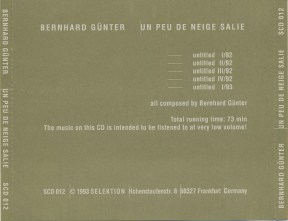
One of Selektion’s releases was Bernhard Günter’s Un Peu De Neige Salie, and you subsequently worked with Günter on Un Ocean de Certitude. How did you meet up with him in the first place?
When I moved to Koblenz in 1988 I took part in several projects by Peter Wiesenthaner, an experimental composer who lived there in a kind of loft and held concerts and lectures for small audiences every few weeks. At one of those evenings, it must have been in 1990, after presenting some of my recent work, I met this guy who’d turned up that evening for the first time. He worked in the guitar department of the local rock shop, and had sold Peter some equipment, and was interested to see what a flautist – which Peter was – would do with that gear. His name was Bernhard Günter and he’d been doing ethno-fusion-rock since some years. He lived nearby, and it was the start of an intense cooperation, which went on until I left Koblenz after 1995. Bernhard didn’t know anything about the last 10 or 15 years of experimental music – he was more into that virtuoso jazz-guitar thing, David Torn, Bill Frisell and the like – so he listened to lots of records from my collection. After a year or so had changed his way of creating music completely and we started working on some pieces together. Our first concert was held in December [18th and 19th] 1992, at the Mutter-Beethoven-Haus in Koblenz. About that time he also joined the Selektion team, but he never really agreed with Selektion’s non-profit philosophy of investing money in new projects, so he left and started his own label in 1995.
Can we speak of a P.D. / RLW greatest hit?
In terms of the largest number of copies made, that would be the Skartrack flexi (1980): 6000. As was usual with flexis back then, it came as part of a magazine, one published by a Students Union in the Freie Universität in Berlin for an election campaign, in an edition of 5000. The other 1000 were our promos and given away free. The regular releases Selektion did on vinyl and on CD were editions of 1000. To date Kühe In ½ Trauer has sold 3500, Distruct 2600, Masse Mensch 2500, Inweglos, Tionchor and P16.D4´s Music and Bruitiste sides 2000 each and the Tulpas box-set 1700. As we were always busy with new projects we never had time to take care of reissues, so they were handled by other labels. Apart from the flexi, the piece “Kühe in ½ Trauer” has had the highest circulation. It’s also appeared on two compilations; all in all 5500 copies spread around.
The idea of the remix, or the collaboration, is essential to you. Why? What do other people bring to your work?
For me music is about communication. Once it was a rather one-way communication, addressing everything to God (and waiting for a reply), today it’s more about communication with other human beings. A rock group is a typical example of a communicative system. In ideal circumstances there’s no unique authorship, no separation between composer and performer, and a constant interchange of ideas and musical material. As our material from early on consisted of tapes (mainly of our own recordings), which were handed round and worked on in various configurations, the next step, i.e. using other people’s tapes wasn’t far away. Exchanging tapes was about transforming them into new sonic entities. In the 80s we didn’t use the term remixing: we called it recycling. Thinking about what one’s doing is as much fun as doing it. The general conditions of exchange and organisation were almost as fascinating for us as the music itself, which is why major collaborative projects appeared early in our recording career (Distruct in 1982) and continue to this day. Questioning oneself and being questioned by others is a constant source of inspiration. The practice known as “remixing” these days hasn’t got much to do with such a creative process, of course. In most cases it’s just cashing in by reproducing a commercial product with slightly changed parameters. I’d even say it’s an opposite principle: not questioning a piece of work to create something new, but just repeating it without any artistic need.
We should talk a bit about Tulpas, its origins and title.. Did you start out with the idea that it would be a 5 CD set?
When I started the Tulpas project back in 1995 my motivation was rather selfish. I’d reached a point of my life when drastic change was unavoidable: becoming a father and taking up a job with more “responsibility” meant it was impossible to continue musical activities as they were before. So I thought I’d sum up some aspects of my artistic development so far. A “commemorative” CD on the other hand wouldn’t have been very interesting, from my own point of view. I wanted to take what I’d done to a new level. I thought about extending the principles of collaboration and using my own back catalogue as the common source for all participants. There was no plan of how big the project would become at the start. I simply asked everyone I was in contact with at that time and whose work I appreciated and thought could fit into the context of the project. Nor did I hesitate to contact other people whose records I’d enjoyed (even though I had never contacted them before). People like Bruce Russell, Toshiya Tsunoda, the Noise-Makers Fifes..). It fell to Bruce to give the baby a name. As I said, I loved the “Journal of Logopandocy” mags, so it was only natural to ask him for a statement to be included in the CD booklet. He surprised me by comparing the whole idea to Tibetan mysticism, and Tulpas ended up as the name of the project. In 1997, after about three years’ work, I pulled the plug on the whole thing. I had more than five hours of quality material, but I was completely exhausted, corresponding with about 50 participants as well as mixing (some participants came to my studio), editing (I edited one piece down from 20 to ten minutes) and so forth. I’ll never forget the meeting we had at the Selektion office: when I told Achim [Wollscheid] and Charly [Steiger] that the whole thing had become rather big, I could see in their eyes they were wondering: two or three CDs? When I told them it would be a 5-CD-boxset, they were shell-shocked! Anyway, Charly did an absolutely great job on designing the cover, booklet and labels and Achim surpassed himself organising the release, with some help from friends such as Gary Todd.
Selektion did a first run of 1200 copies, with 200 as promos for the participants. The rest sold out within few months, and a second run of 500 followed immediately, now all gone. The response was very good, with lots of positive reviews, good sales, and requests for interviews. A few bizarre things happened, too: one American techno-dominated mag had a story ready to print about how such a project could only be possible in the age of e-mail. when I told them I had no e-mail, and that everything had been done by letter or fax, they didn’t write back! (laughs)

Would you describe yourself as a composer, and if so, what is your definition of “composer” and “composition” today?
A composer is a human being organising sound purposefully without reproducing an existing piece of music (or significant parts of it). Of course, the definition is very basic. It includes free improvisation as well as Muzak (as long as it’s not a copy of existing Muzak). So, yes, I’m a composer, though I must say I don’t think the question has much relevance. It’s of no of interest for me if someone is a composer or not. For me the relevant question is if someone produces compositions that are of importance for me. I think there are two criteria that make compositions fascinating from an experienced listener’s perspective: the first is simply a question of organising sound in a way that the parts of a piece relate to each other and to the whole of the piece (something experienced improvisers manage, by the way). The second is about going beyond a certain simplicity. The pop “song” is a perfect realisation of criterion one, but it’s completely boring in terms of structure; no intelligent human being could stand it for very long. The stupid, by the way, often criticise improvised or other challenging music as “unstructured”. That’s nonsense. The problem lies in human memory capacity, which isn’t enough to cope with complex structures for more than a short period of time. But we live in the days of recording media, and one only has to listen often enough to be able to remember more and make out complicated and irregular structures. The pieces won’t turn out to be a song or a sonata, but will be all the better for it. A lot of my pieces only reveal themselves upon repeated listening. Insofar as listening to complex compositional structures is closer to listening to free improvisation than it is to song-structured music.
They’re complex in that the processes you use seem to be disguised or buried in a way. There’s no “easy” RLW music. Are you deliberately trying to “hide” the formal artifice, the “how it was done”, or do works just evolve that way?
I surely never tried “to hide” things. I always mistrusted artists who tried to evoke the impression of mystic inspiration or magic atmosphere (a hangover from the age of Romanticism, by the way). Au contraire, there are often texts with explanatory notes on the realization of a project/piece. That said, I would caution against going too far with that, as I would against writing too detailed on the technical, musical and philosophical contents of compositions, simply because I don’t think those aspects give a complete picture. Everyone listens with their own ears, own background of experiences and knowledge of all kinds, in which everything new will find its place. There’s certainly no intention to make things sound “not easy” or “difficult”. In most cases my pieces simply sound “right” for me in the way that Helmut Lachenmann’s opera Das Mädchen Mit Den Schwefelhölzern sounds absolutely “right” (though as a genre opera usually is a pain in the ass), whereas everything I’ve heard by someone like Madonna simply sounds “wrong”.
Regarding artifice I am regularly wondering how many artists waste their time by copying others instead of developing something on their own. Well, waste is relative. Financially, it seems to count. Remember the “pick the guitar like John Fahey” wave from a few years back? By counterfeiting and mellowing his way of playing some probably earned more than Fahey might have throughout his life. Obviously my enthusiasm for mimicry is pretty low. But no one is an island, of course.
When I hear things that impress me I try instead to avoid the techniques they use or to use them in another way, relating to my own set of methods and interests. Indeed, I’m relieved you haven’t asked why I’ve been doing the same half dozen pieces over and over again for 25 years! I think there is a certain set of dispositions and parameters, which remains relatively fixed, but within those parameters there’s a vast range of possibilities. Not to mention the simple fact of getting older while trying to bring experience and knowledge to bear on the creative process. Constant values like confrontation and discontinuous continuity will – and are ought to – lead to vastly differing sonic results. Not every time, but very often. Driving cheap everyday instruments over the edge sounds different if you use a cassette recorder or reel to-reel on one side of the spectrum, or a sampler or common consumer software on the other. Confronting oneself with changing partners in collaborations leads to different results from each collaboration, but none lack identity. They all throw light on different facets of the same identity.
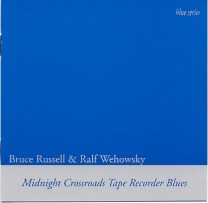
You’ve recently released a second collaboration with Bruce Russell on the A Bruit Secret label. How did Midnight Crossroads Tape Recorder Blues come about? And what’s with the blues?
I have very ambivalent feelings about “the” blues. There hasn’t been much listenable blues during the last say 40 or so years, but there have been tons of recordings, concerts and radio shows. During the time of my “musical socialisation” in the early 70s, “blues” seemed to be a synonym for the pale, lifeless, formalised reactionary stuff that went under the flag of “progressive” and “expressive“ and “authentic”. Imagine Rory Gallagher and his ilk performing authentic blue-collar tristesse for an audience of thousands of boogie-driven kids in big sports arenas. Not exactly what Robert Johnson dreamt of. Not that the black blues- and jazzmen were any easier to stand, each of them living proof of the “errors” of free-jazzers or other outcasts in the eye of the traditionalists who were in charge. Every music school offered courses on how to learn the “authentic” scheme of 8-and 12 bar blues in three months. Thousands signed up, and as the self-declared heirs of one of the greatest popular art forms of the 20th century, they were – and are – merely performing acts of necrophilia again and again. The most decent behaviour is to steer clear from the cadaverous smell. On the other hand, dancing with the dead has been a legitimate concern since the Surrealists (Ptomaine, by the way, is the title of a party Asmus Tietchens organised using 100 rotten corpses by RLW and others), and digging in the sediment that current culture is built upon is certainly a fascinating subversive activity. Maybe that’s why P16.D4 included a heavy musique concrète-type blues on the Nichts Nirgends Niemand Nie double LP, “Neger Am Laster”. The piece was based on an organ/synth improvisation by Peter Lambert and myself, transformed by Achim Wollscheid and restructured in night-long cutting-sessions by Stefan Schmidt and me.
When Bruce arrived in Eggenstein in 2003 he’d already recorded an early version of “Kate’s Blues”. We discussed what could be done with the recording – Bruce planned to try out tape work himself. I recorded some instrumental takes and sent them to New Zealand, and a year later, when he suggested we extend the project, I recorded some more improvisations, did some sound transformations of his and my recordings, and added two drafts of possible reconfigurations. I should say that all the credit for putting together the pieces as they appear on the CD has to go to Bruce. I like the disc very much and am happy to have helped out a little bit.
Is there any chance we might see you performing live again?
I haven’t played in public for about 10 years. Performing always entailed a lot of preparation, especially the visual aspect. It wasn’t just a question of turning up and playing, like jazz or free improvisation. If I played live again I’d have to think about that visual aspect again very carefully. I’ve also avoided playing because of my job, which can involve a lot of travelling at short notice. It would be difficult to plan a tour long in advance. The third reason is my family. I have to look after the wife and children too! When they’re a bit older I might consider it again.
Are you optimistic about the future for difficult new music such as ours?
I can’t speculate about what might happen. There are some very negative developments in terms of the record industry. The decline of the market, which is basically due to mistakes by the mainstream labels, has impacted negatively on distribution. Many of the distributors who carried some of the independent labels have gone under. On the other hand, there are far more releases today than there were before. Nowadays almost everyone burns their own CDRs.
Do you still manage to keep in touch with what’s going on?
Yes, I still exchange a lot of records with lots of other artists – you, for instance – and buy a lot of records. I have an hour’s commute to work and I use it to listen to music on my portable CD player. Sometimes I can listen to it at home; it mixes very well with the children’s voices.
(Source: http://www.paristransatlantic.com/magazine/interviews/wehowsky.html)
> WOMEN OF THE SS by John Zewizz (2012)
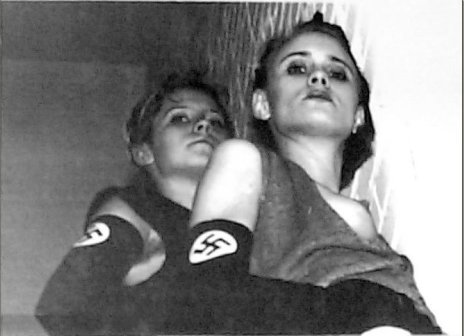
I started this project in 1984 while making background back-masking for a SLEEPCHAMBER track. After experimenting with the musick I did not feel that it had the “SC” sound or style I waz interested in. But I did like the sound piece. I waz writing very sexual in those days with “SC” lyric’s so to make another musickal project sexual waz just instinct. I referenced my current fantasies and they included Women in Uniform… Dominant Women… and a combination ov both brought me to the Image ov an SS WOMAN. Sexually in control, aggressive, and somewhat ‘Raunchy’… but.. to be in a black SS uniform waz the ticket The image ov a sexually dominant Woman-in-Uniform… with somewhat exposed nipples expressing herself with sexual dominant conquests. This waz it ! In the earlier pieces the trax had little to no verbal input. So I included a woman speaking in German and gave it a very sexual title.

The difference waz like night & day… the vocal part ov this musickal concept waz the secret… and it waz instantly obvious to me.. So I searched around the women I knew looking for a German accent. I found out how rare this waz.. The earlier trax with German voices from TV and movies waz not going to last much longer. I had female friendz with accents but not German. I started to work with girls from Hungry…girls from Poland… and finally my favorite waz a Russian Jewish girl who had no problem speaking the lines I wrote. She waz totally aware ov my concept. She knew it waz a sexual fetish and had nothing to do with HATE or anything subversive. Although she waz Russian… just like the other girls the accent waz not German, but it still worked in this fantasy fetish. For WOMEN OF THE SS to stand on its own, it had to have a strong female accent and the lyrics always sexual. I mean this iz the whole concept right ?..
In all I used 4 different girls to do the lyrics.. LARISSA waz my favorite and probally the best. She did the trax “SS ORGY”,,, ”SS BITCH”.. and many others, once you hear her Russian accent you know it iz her,, its close enough to German to work the fantasy.. Many people have a problem with the “NAZI” part ov this fetish. And trying to explain to them it iz purely sexual and haz nothing to do with jewish people or hate or NAZI politics falls on deaf ears.. WOMEN OF THE SS iz outlawed in Germany. There are admirers who live in Germany and understand the whole concept and are into the image. They admire the whole fetish aspect behind the title and the image.

There are those who will not stand for an explanation ov WOMEN OF THE SS. To them it iz offensive and perverted. Which iz their human right to express and I can understand this… I feel that we do not have to go into a History lesson to understand the image. But what even intellectuals even fail to realize iz that the more you make something a “Weapon”… the more vicious and powerful it bekums… We need no History lesson or argument on ‘where’ the swastika even originated from… (not the NAZIS).. but like I said need no History because I am only using an image to evoke the concept ov a Woman more powerful than a Man. This part ov the threatening image goes without mention, but it iz there. Being comfortable with your sexuality and understanding your sexuality are two different emotional ideals.
WOMAN OF THE SS iz a ideal fetish because it works. The musick iz always atmospheric… the female vocals always have an unfamiliar accent and are always sexually dominant and command respect at all times. Now we could go into submission or whatever here but that’s not the point. This iz not where I explain why people like to be out ov control or submissive… bondage likewise. WOMEN OF THE SS iz a purely sexual fantasy. It contains 1: A FEMALE VOICE 2: SEXUAL LYRICS 3: SEXUAL IMAGERY 4: SEXUAL SUGGESTIONS A complete sexual concept with a forbidden image… Make no mistake I deplore HATE crimes ov any kind.. this image iz for sexual fantasy and not politics or ideals ov the NAZI party.

Well… after defending myself on that front, back to the musick… There have been many WOMAN OF THE SS Releases… (cassettes, CDs, Vinyl LPs,VHS TAPES, Picture Discs. And DVDs) the popularity speaks for itself… I had no idea it would bekum az popular az it haz. But it haz. I have no plans on releasing all the early cassettes. What iz being made and what iz in layout iz a WOMEN OF THE SS- DVD That contains all the naughty material not allowed on U-Tube-(obviously).. it iz X-Rated and will be for sale to adults over the age ov 21. This DVD iz not for sale to minors-(lets make that very clear). There iz also a Vinyl 3- LP Set with gatefold cover in production (this will contain earlier material)… and there will be a re-issue ov the CD “JOHN ZEWIZZ PRESENTS HIZ INFAMOUS…WOMEN OF THE SS”. There haz been offers for me to release some 7” vinyl singles but I have not gotten the right offer. So that will sit for a bit. There iz also a “New” WOMEN OF THE SS –CD being recorded. The musick iz recorded and I am waiting for the vocals currently to finish up the trax. For you who do not know… this concept haz cost me many unwanted headaches… but it iz my expression… my fantasy… my fetish… my art… and my fucking work… so if you do not like it.. then look away… it iz not being broadcast in your face… it iz hidden on the internet and on U-Tube you have to search for it…. SO…. do not fucking tell me how it offends you-(I COULD CARE LESS)… I have explained the complete concept here. And if you can not understand it clearly… then that iz YOUR problem iz it not ?? My PROBLEMS with U-Tube and this image iz discussed in another page called “U-TUBE CENSORSHIP WITH MALICE AND NO DUE PROCESS”… (HIGHLY RECOMMENDED YOU READ) and pass on this BULLSHIT…. because if you do not give a shit about MY rights… its only a matter ov time before YOU start complaing about yours…. when it eventually affects YOU directly… AND IT WILL… Sincerely for the right to expression.
JOHN ZEWIZZ 9/23/12
> K2 (Kimihide Kusafuka)/GX (Jupitter-Larsen) – Convulsing Vestibular CD (Ltd/No’d 250 Copies) Out Now!
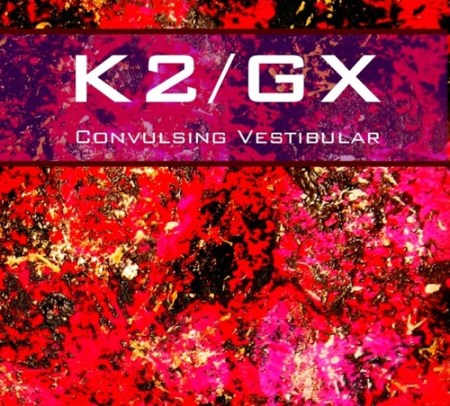
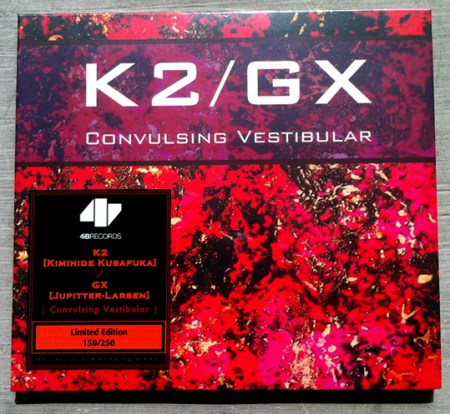
K2 (Kimihide Kusafuka)/GX (Jupitter-Larsen) – Convulsing Vestibular CD (4iB 005):
TRACK LISTING
1. K2 – Worse Than PM2.5 (10:50)
2. K2 – Racist Tango (9:22) (Sample)
3. K2 – Symphony For The Public Pollution (14:49)
4. GX Jupitter-Larsen – Bunyi Tentang Polywave (20:36) (Sample)
Details:
– Digipack CD (Paintings by GX Jupitter-Larsen)
– Individually Numbered
– Limited Edition 250 Copies
– Limited Copies Include 4.5″ x 4.5″ Embroidered Cloth Patch
PRICE (Including Airmail Shipping from Singapore): USD20/ €15 / £13
To Purchase, Please Click Here:

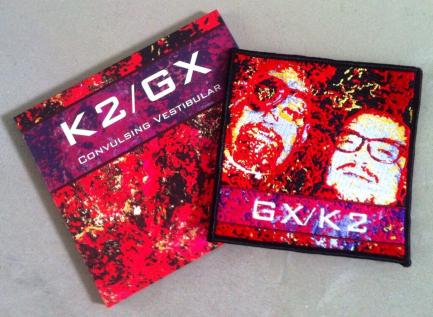
K2 (Kimihide Kusafuka)/GX (Jupitter-Larsen) – Convulsing Vestibular
30 years is a long time for 2 people from different corners of the world to come full circle and meet again. Old time buddies K2 (Kimihide Kusafuka) and GX Jupitter-Larsen (The Haters/Survival Research Laboratories) are both presented together on this split CD release after their paths first crossed in the 1980’s when they were actively involved in the underground populist artistic movement of mail art and homemade audio tape trading. In 1999, they met once again in Kyoto, Japan where they performed together on stage dressed up in Lucha Libre wrestling masks. This show also saw GX rigged-up in a championship wrestling belt that had been specially reconstructed to generate pure harsh noise through a built in microphone and distortion pedal. In many ways, this release presents a significant homecoming of sorts, where 2 old friends cross paths once more to showcase their unique styles of sonic mayhem together.
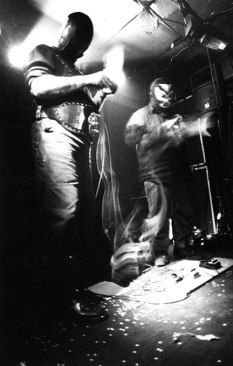
K2, also widely known in the Japanoise/Harsh Noise community as the “King of Metal Junk Noise” works with an acoustic piano, e-violin, MTR, Monotron and other analogue electronics. In the three tracks that last more than 30 minutes, K2 pushes the sound barriers through a pent-up emotional rollercoaster ride of hi-frequency screeches, jarring metallic creaks and blasting shrills that tests the limits of aural thresholds. In it’s entirety, rhythmic tempo is constantly kept high in pure sonic abstraction. The track titles reflect strongly upon the sorry state of the world we live in; one that is full of chaos and desecration brought about by mindless environmental and social contamination.
‘Sound of the Polywave‘ is the direct translation of the title ‘Bunyi Tentang Polywave‘ in the Malay language that GX uses for his 20 minute long track. The Polywave, which is a graphic synthesizer specially designed to create sounds through the drawing of waveforms on a screen has been the subject of interest of GX for some time now. The track is very much drone-like, almost sounding like the slamming of doors looped repetitively to create a hypnotic trance inducing rhythm. One can draw parallels to the live performance of The Haters, where sounds generated from the incessant grind and abrasive rubbing of amplified suitcases took centerstage during the many performances and recordings. This activity goes on and on until the suitcases finally break apart, the frictional rubs and slams soften, signifying the eventual destination of destruction.
=======================================================
Please direct all enquiries to:
4iB Records
PO Box 206
Singapore 914007
email: gerald@4ibrecords.com
www.4ibrecords.com
> GENOCIDE ORGAN – Profile by Richard Stevenson (2003/4)
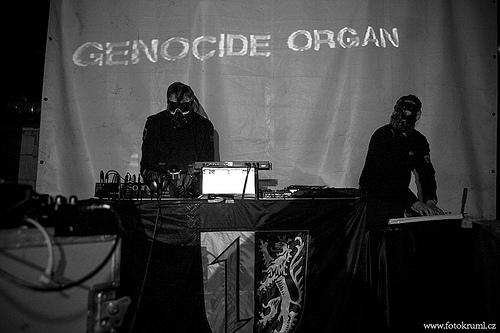
Genocide Organ have been in existence for close to 2 decades now, slowly but surely rising to a cult level within the heavy industrial/ power electronics scene. This status has been achieved through the production of an extremely physical sound approach in combination with delux packaging, to create a collectors fetishism of sorts. Yet for all their notoriety within the post-industrial scene, Genocide Organ remains relatively obscured and somewhat shrouded in mystery. This is in part to do with the group refraining from including member photos on releases, yet more specifically refusing to conduct interviews. Personally I am only aware of one interview published in 1999 in Descent Magazine Issue 5#, where the introductory blurb stated that the group had requested the interview to be removed (without success of course).
Despite the personalities behind of Genocide Organ remaining obscured for the above mentioned reasons, one fact remains certain that the group contains four key members: Wilhelm Herich, R. Freisler, D.A.X & Doc M Riot (presumably all assumed identities), with R.Freisler later leaving to be replaced by B.Moloch (of Anenzephalia infamy).

As a collective it is evident that each of the four members has specific roles within Genocide Organ, relating to studio composition, live mixing, video arts & stage performance. With reference to live actions, a direct physical approach of noisescapes with confrontational vocals is employed, along with the symbolic use of religious and political iconography via video projections and performance art. Selected examples of such visual installations have previously involved: the Mannheim/ Genocide Organ symbol being cut from a sheet of steel with a blow torch, the burning of a wooden/ chainmesh cross with a blow torch, and the display and later destruction of crosses plastered with images of political leaders. Although live performances are few and far between within Europe, or even in their native Germany, the collective have still garnered an international underground following, having been invited to give select live actions across the globe, with countries including England, Russia, America and Japan.
In order to analyze and critique Genocide Organ’s recorded output, it is evident from their lyrics, texts, images and dialogue samples that there is a clear focus on matters relating to war, the Ku Klux Klan, conspiracy theories, American imperialism, terrorism, the Third Reich, fetishism etc. Furthermore many of their releases come armed with titles such as ‘Klan Kountry’, ‘Mind Control’ and ‘The Truth Will Make You Free’. Packaging additionally utilises many images that have loaded connotations, or otherwise by virtue of their use seem to evoke an inherent symbolism (for an example refer to the face image on the cover of ‘The Truth Will Make You Free’). To put it in another context I quote Lina Baby Doll of Deutsch Nepal who has been a long standing fan and more recent comrade of the group:
“Genocide Organ, the heroes of German electronic chock-treatment are one of the most physical appearances within industrial culture. Every piece of sound they’ve released, and all live performances I ever experienced have been 100% “ultra” in all directions possible. Just to feel the weight of the heavy vinyl, study the sleeves and almost cut your hands open by the scalpels attached, among the dried bloodstains on the unpolished surface is an experience worth the long and hard search for the items. For me it’s not the extreme approach of the group that make them interesting, it’s the ability to withhold the possibility to go way to far out in the wasteland of cheap fetish commercialism, which for me is a sign of both intelligence and style. These are people who have got more to show than a poor tattoo and some piercings, this group shows you the truth whatever it might be. And the truth will make us free!”

Essentially the convergence of elements (visuals, titles, text, dialogue samples, set to extreme electronic sound and overlaid with shouted/ distorted vocal delivery), creates a sensory overload ensuring that ambivalence towards their releases is almost impossible. And within such a context Genocide Organ HAVE provoked reactions from listeners – be those extremists who perceive the group have certain sympathies that align with their own, or vocal detractors labeling the group racist, fascist, or more crudely – hate mongers. Likewise for those listeners intelligent enough (or otherwise uninterested) in making such simplistic and polarized views of Genocide Organ, merely the extremity of sound can likewise provoke reactions from revulsion through to pure pleasure (the pleasures received in pain is an amply reasonable adage here). Yet in creating a reaction and/or emotional response, can art legitimately use the interpretation of politics as the point of stimuli? I would argue that it is entirely legitimate. Granted that differing emotional responses may create a psychological barrier and therefore limiting the ability of many to fully appreciate certain kinds of musical and artistic expression. This however does in no way negate the validity of the interpretation of politics within art. Additionally if art is deemed to be the pinnacle of emotional expression, this still leaves scope for each individual to interpret each emotion intrinsically stimulated – be that positive or negative.
But what do Genocide Organ actually stand for and represent? Do they stand for something, or nothing at all? Are they a group simply taking a mirror to modern society, reflecting the squalled depths of hatred and violence that humanity is capable of sinking to? Or do they truly embrace a nihilistic worldview and only stand to accelerate the modern world’s decline? Alternately are they left wing, or right wing, religious or apolitical? Or are they simply purveyors of “ultra” dry humor and irony pushed to an absolute extreme? Put any of these assertions to the groups however, none will be forthcoming with affirming or denying such theories and/ or allegations. The virtues of silence perhaps?

Equally, are the questions raised in the listener’s mind significantly more important than any answer that the group could ever provide? Therefore with reference to modern society, are there any political or philosophical ideas that can be viewed in a simplistic black and white context? Consequently could it be said that Genocide Organ embrace the infinitesimal shades of interpretative grey in the way they choose to operate? Quoting from the aforementioned Descent interview it might just give some insight into the mindset of the group (or failing that, simply adding to the confusion): “We never say what we think, and we never believe what we say, and if we tell the truth by accident, we hide it under so many lies that it is difficult to find out” & ”Everything is as it is and nothing is as it should be”. (Descent Volume 5#: The Death Issue June 1999).
Yet with time marching incessantly on, the year is now 2004, marking the release of the new album ‘In-Konflikts’ and highlighting the 5 year gap between it and the prior ‘The Truth Will Make Your Free’ LP. In an apparent change of tactic it would seem that the group have now come the closest to revealing their core intent via the press statement accompanying the release: “Genocide Organ don’t reflect a concrete event of whatever nature, this is an abstract questioning of everything with anything, a call to action, which ends in a waste of energy …a call for a movement which is a waste of time…a nihilistic pessimistic worldview which leads somewhere…..we all fill just space and are part of IN-KONFLIKTS”. However, should this statement accepted merely on face value, or specifically questioned due to Genocide Organ’s subterfuge and deceptive double speak of years past? Particularly could this statement be just another ideological illusion, another psychological sleight of hand and yet another philosophical ‘house of smoke and mirrors’? To specifically justify such assertions a further statement included within the album’s sleeve provides ample vindication: “If you ask what this is all for, none can tell you. Never ask where this will end, you already know it anyway. What will be left behind is just a note in a history book. You might have the possibility to see but you will never know. As long as we not (sic) cross the final border all efforts will be meaningless. Don’t be amused, entertained or educated … that is not the intention”.

To conclude it is clear that that there is no single or for that matter simple interpretation that can be said to holistically represent Genocide Organ. Therefore it is useless for anyone but the group themselves to pontificate about knowing the exact answer. Thus without providing any sort of iron clad theory, could the question be posed: is confusion the real key to Genocide Organ’s intent? The final interpretation is up to you…..
(Originally written January, 2003 by Richard Stevenson and published in English in Degenerate Magazine Issue 3#, released 2003. Updated and partially rewritten in December 2004 by Richard Stevenson.)
(Source: http://spectrummagarchive.wordpress.com/articles/genocide-organ-profile-2004/)
> MONTE CAZAZZA Interview (Excerpt) by RE/Search – Industrial Culture Handbook (1983)
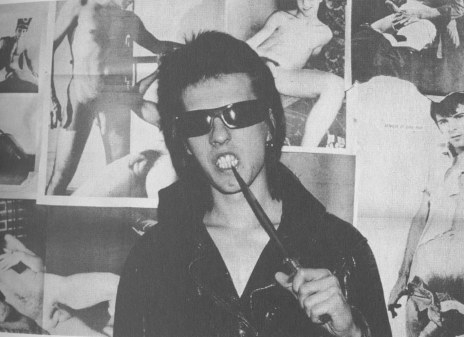
Excerpt from New Wave #13:
Monte is a necrophiliac in action. Rather than stifling his nightmares, he throws them in the face of the world. At the College of Arts and Crafts in Oakland, his first sculpture consisted of a cascade of cement that blocked the entrance of the school. He was dismissed the next day.

Passing from hospital into prison, he surfaced with pornographic collages in San Francisco. In 1971, invited to a weekend of conferences on art in the woods, he brought along an armed bodyguard and garnished the food with arsenic. At breakfast he dropped bricks painted with the word “Dada” on the feet of people convened to eat. And at the dinner table he burned the partially decomposed, worm-infested body of a cat. His bodyguard blocked the exit and several guests fell sick from teh stench.
In 1974, Genesis and Cosey were fascinated by a photo showing Monte covered with blood on the cover of Vile Magazine. Together, they fabricated the famous Gary Gilmore Memorial card, posing blindfolded on electriv chairs. It was reproduced on T-shirts. Six thousand copies were sold in Britain; it was the cover story of the Hong Kong Daily News.

In 1977 Monte entered the studios of Industrial Records to record “Plastic Surgery”, “Busted Kneecaps”, “Fistfuckers of America”, “Hate”, and “To Mom on Mother’s Day”, his first 45 (out of print). A film was made with TG where Monte and a 14-year-old boy were electrocuted. He playes also in the film Deccadance of Kerry Colonna with razor blades.
Monte seldom goes out, except on Halloween when he goes out with a cheap plastic mask, a green army bag filled with livers and hearts (like Hermann Nitsch) and the head of a body mannequinn (used by medical students to learn mouth-to-mouth resuscitation.
(Source: http://brainwashed.com/tg/monte.html)

Interview (Excerpt) by RE/Search – Industrial Culture Handbook (1983)
R/S: Tell us your earliest acts of mayhem?
Monte Cazazza: There were lots of acts of mayhem. When I first had to go to school, I didn’t like it. So I sat there for about a week and just screamed. Unbeknownst to me, if I had sat there about another week I probably never would have had to go to school, because they would have ended up giving me a tutor, or something. But I didn’t know that, and my voice gave out before they relented.
This was in Catholic school in Philadelphia. I had this nun who really hated me—she used to hit me all the time. See, I was like the example—God’s retribution.
R/S: I thought it was illegal—
MC: Not in those schools—in those schools you kneel to the boss, as Cabaret Voltaire would say. So what happened was—one time she was smacking me and finally I said I’ve had enough of this! and ripped her habit off. Of course, her hair was cropped about half an inch-all the kids thought she was totally bald—and she flipped out. Then they sent me to see the priest because they thought I was possessed… The look on her face was priceless. And she never hit me again either after that.
R/S: When did you leave home?
MC: The first time I started running away was when I was about 9 years old. I would hide in museums. I would hide in libraries. I even slept in a very expensive hotel once. But then I would get caught-about 3 days would be tops before someone, somehow, figured out that I wasn’t supposed to be where I was, and get ahold of me, and start demanding who I was and where I lived, and why wasn’t I in school etc. etc.
R/S: Tell us about your high school experiences?
MC: My parents had moved to the suburbs, which I detested immediately. I hated everyone that lived there. So in high school, literally, for one year I didn’t talk to anyone. Just went to school, sat in the very last seat in the first row, and didn’t talk to anyone because I didn’t like anyone there. No one knew anything about me, I was just this person, and mostly they left me alone. I didn’t have any friends in high school, and I didn’t want any.
The police, though, came to arrest me once. I had this business going where I would shoplift cartons of cigarettes—my whole locker was filled with cigarettes. And I was selling them to everyone very cheap. Teachers, everyone. I used to go into these 2 big supermarkets with my gym bag and I would just fill it up with cartons of cigarettes and go home. And one time I got caught shoplifting. The store people called the police and they showed up. Somehow they figured out that I must have been doing this for a long time, because of their inventory or something. I don’t know how they added 2 and 2 together, but…first they talked to me, and then they let me go home. Later on they got a warrant to search my locker. So I’m sitting in history class and these police come in and tell me I have to go with them. I wouldn’t tell them the combination of my locker so they smashed it open and found the whole thing just totally filled with cigarettes. And I thought I was in a lot of trouble then, but actually nothing else happened beyond that point. They just confiscated them all and told me I better not get caught shoplifting again…and I better not sell any more cigarettes….
I think that because all the teachers were buying cigarettes, they were all kind of implicated. They asked me what I was doing, and I said I was just trying to make money and better myself, in the American way. The best thing was that I didn’t smoke!
(Source: http://www.researchpubs.com/books/ichexc2.php)
> HIRSCHE NICHT AUFS SOFA (HNAS) Interview by Gil Gershman (2002)

Hirsche Nicht Aufs Sofa. A misunderstood proposition beginning with the name, variously translated as “No deer on the sofa” and “deer not on the sofa,” and wide open to interpretation. Is that a command? A rule of the house? An observation? Or just a kooky turn of Teutonic phrase adopted by two teens for their Surrealist rock n’ rumblings? Call it what you will, the spirit of lo-fi adventure that Christoph Heemann and Achim “Dr. P.Li Khan” Flaam invoked in their Aachen, Germany studio and dubbed HNAS has undeniably infused and influenced a worldwide network of underground artists. Willful obscurity and no small amount of infighting made the bulk of the HNAS catalog a cult curiosity, kept well within a very elitist circle of covetous collectors. Those with less disposable income had to be content with a serviceable likeness of the HNAS legend cobbled together with cuts scavenged from countless compilations. Even in the enlightened days of filesharing, one could still goggle at the princely eBay bids fetched by original copies of the obscenely limited (or so dubious rumors have it) LPs.
Apparently fed up with Heemann’s terse dismissal of HNAS in interviews, and with such collector-baiting games as expensive CD-R reissues limited to less than 100 copies, Achim has made the meat of the HNAS discography available to all who would open their ears to its many delights. No stingy art editions, these CD reissues are remastered, generously expanded, moderately priced, and seemingly here to stay (though you never know with these folks). Your reaction to such bounty may fall somewhere between “huzzah! ’bout friggin time!’ and “I should care why, now?” It’s unlikely to appeal to everyone, but the music of HNAS is fun, often fascinating, and certainly worthy of investigation.
Following dozens of self-released tapes on Dom (“the cassette label that should not have existed”), HNAS took its act even further underground – literally. 1985’s Abwassermusik LP found the duo, amalgamated with the enigmatic Mieses Gegonge, recording in an Aachen sewer main. An exercise in extreme claustrophonia, the reverb-drenched set of guitar klang and synth wibble, sparsely thumped and hammered pipes, histrionic moaning, and even the occasional ringing chord or horn honk add up to an uncommonly focused HNAS offering. Whereas Heemann’s homebrew dronology and Achim’s savant sampling would come to define the fatally split sonic personality of HNAS, here the two principals are not yet at loggerheads. On the contrary, both sound equally enthused drumming up this impressive cod-ritual racket in the dank, echoey space beneath their hometown streets. Musically, HNAS’ “waste-water music” burrows comfortably into the space carved 15 years earlier by Tangerine Dream and later shared with projects as diverse as E.A.R., Sonic Youth, and Fushitsusha. The reissue loses the gorgeous gothic woodcut that graced the LP, but gains ample bonus material salvaged from those notoriously unobtainable Dom tapes. How unobtainable? Try limited edition of one, in a clay jar.
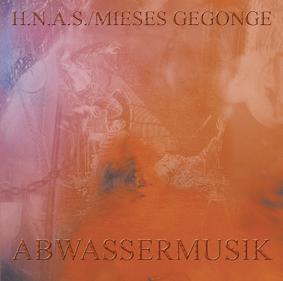
If Abwassermusik invited a contemporary comparison, it was to the cosmic mind-melt music being brewed by Nurse with Wound’s Steven Stapleton and his United Dairies label associates. So it was no surprise when HNAS’ Melchior (Aufmarsch der Schlampen) LP hit the streets in 1986 – in a preposterously large edition of 1,000! – bearing a UD catalog number. The Dom tapes and less introverted Abwassermusik moments such as “Die Gloria Hose” had featured HNAS’ experiments with record samples, pitch-spindled, folded, and mutilated in beautifully Dada-damaged fashion. In Stapleton, HNAS had both an admirer and an obvious mentor in the finer points of sonic Surrealism. A diehard devotee of Krautrock, he must have been tickled to work with such direct descendents of the discipline as Heemann and Achim. Both Stapleton and his better-half Diana Rogerson contributed to Melchior, as did Achim cohort Lorelei N. Schmidt and other members of the growing HNAS coterie (Andreas Frantek, Martin B. Klaeren). HNAS reputation is based on albums like Melchior – perhaps Melchior in particular – and with good reason. UD’s relatively broad distribution made the album semi-accessible, so it’s one of the more familiar HNAS opuses. Melchior also happens to be an extremely musical piece of work, crammed with odd instruments, ragged grooves, and endless surprises. Jags of expertly cut-and- pasted sonic strangeness disrupt kaleidoscopic raga-rock motifs. Weird, weightless drones and wind-warped chimes are sucked into a Neu!Wave hell of slowed Suicide synthpulse and exorcised in cackling bursts of technopagan revelry. An a cappella hymn from Frau Schmidt calls up a free-jazz furor of synths, sax, and slide whistles that engulfs her like glittering motes of Merlin magic. To divulge any more would chance spoiling the sense of surprise that HNAS worked so carefully to cultivate. For those seeking a crash course in Krautrock’s weirder byways, the echoes of such revered obscurities as Limbus 4, Annexus Quam, Kalacakra, Carol of Harvest, Exmagma, and Anima are all plainly audible here, as are the more familiar touchstones of Faust, Can, and Amon Düül (I and II). Reference could likewise be made to obvious kindred spirits in France, Italy, Japan, and elsewhere. Yet, like Nurse with Wound, Melchior manages to be so much more than a composite homage to very cool influences. A legitimate masterpiece of modern Surrealism, bolstered on the reissue with ten choice bonus cuts culled from the same fertile period, this is an ideal place to start exploring HNAS. Look for the telltale B&W collage of curious smiles, beaky birds, and wide, twinkling eyes.
1986 also saw the release of Küttel Im Frost, this time without Stapleton in tow. Küttel tones down the Krautrock content in favor of a twisted lo- fi pop aesthetic. Exit jazz-tinged grooves and sitar guitars – enter drum machines and goofy vocals. Don’t be misled by the humorous surfaces, though. Heemann and Achim were working some serious sound science in their adept handling and manipulation of wide-ranging musical and non-musical elements. Going by catalog numbers, Küttel postdates Melchior. On sonic evidence it’s also the more audacious of the two albums, and therefore quite a bit more uneven. Yet Küttel contains one of HNAS’ most beautiful diversions, the straight (well…) acid folk of “Grundgütiger! Der Drang Verstärkt Sich (K.I.F.).” Granted, the folk-rock movement of the ’60s and ’70s had notable impact in Germany, spawning Fairport Convention sound-alikes by the bushel. Still, it’s startling to come across such a brazen throwback to the heyday of Hölderlin and Lang Syne amidst Kuttel’s woozy mash-up of samples and song. Kuttel additionally shows the first indication of its two orchestrators’ incompatible approaches. For the time being, Achim’s flashy sample splicing and knack for Cluster-like melodies complement rather than combat Heemann’s delicate drones and decomposed sonics, especially on the dizzyingly detailed “Man Warf 2 Stunden Möbel Aus Dem Fenster.” But the cracks were beginning to show.

The rift widens with 1987’s Im Schatten der Möhre, though still not damagingly enough to send simmering tensions boiling over into conflict. New blood in the person of Heemann’s brother Andreas may have both hastened the inevitable dissolution of HNAS and held the project together for a little while longer. His fingerpicking and diplomatic chime/strum guitar stylings are a refreshing instrumental element that splits the difference between Heemann and Achim’s divergent intents. Andreas subtly fortifies Heemann’s wrought drones and weighted textural shifts against some of the more blustery tape manipulation. Cry nepotism if you must, but HNAS created some of its most enduring work with Andreas in its lineup. As mighty as Melchior is, Im Schatten der Möhre more effectively embodies all that was great about HNAS. This is sonic alchemy of a rarefied sort, encompassing the sublime “Bobbejaanland,” which abandons Alice deep within a Dada wonderland illogical enough to disorient Dali, and the Morr Music pre-image of “Poppelsdorfer Sequenzen/Lottoglück Unt With Cannons.” Even Heemann still speaks fondly of the album, and his Streamline label widely reissued Im Schatten just prior to Achim’s private Dom reissue campaign. At the risk of playing favorites, the Dom reissue is the one to seek out. Not only are the tracks indexed separately, but the seven bonus cuts are every bit up to the standard of the album. Another triumph. For some, The Book of Dingenskirchen (1986/87, released in 1988) is the HNAS masterwork. One wonders whether such high regard owes as much to the scarcity of the original LP as it does to the quality of the music contained therein. Though compellingly odd, this isn’t one of the easier HNAS albums to slap on the deck and listen to straight through. Dingenskirchen sounds like an especially uneasy compromise between Heemann’s increasing concern with sparseness and Achim’s flair for mischief. The centerpiece, 16 minutes of stark and creepy exposition that anticipate Heemann’s solo recordings, contrasts with the romping German New Wave of “Die Gretchenfrage.” Some of the juxtapositions are just plain bizarre, even within the permissive limits of Surrealism. “Gurka,” for example, plays a free-music guitar tantrum off sequenced electronics straight out of Berlin. File under: things that make you go “Huh?!” There are some real gems among the ten bonus tracks, including a WAY wiggy big-band jazz workout in the classic “Silvester-Effekte.”
And then the fighting began – over artwork, over releases, over label affiliations. Dom splintered into multiple factions, a measure that eased tensions just enough to allow Heemann and Achim to continue working together. Just barely. 1988’s Ach, Dieser Bart! LP is as bipartisan as Spacemen 3’s Recurring. Heemann and Martin filled one side with 23 minutes of lusciously imbricate synthetic and acoustic themes that spotlight Martin’s exquisite picking. On the other side, Achim and friends did their thing. The two sections have since been reissued separately, with the Heemann/Martin piece turning up on Lebenserinnerungen Eines Lepidopterologen, Robot Records’ essential 2CD retrospective of the brothers’ solo and collaborative works. Martin’s “Doppelpunkt Vor Ort” 10″ is simply fantastic, and a must-hear for any Füxa fan. Achim’s side of Ach, Dieser Bart! was ostensibly broken up and strewn across the Dom reissues. With such scant liner notes, it’s difficult to be sure. Even the most stalwart HNAS-heads have been unable to trace the sources of some of this bonus material.
Defying all odds, Heemann and Martin kept the HNAS convoy rolling throughout the next few years. Though quite patchy, and one suspects less than cooperative, the project’s final three CDs are much better than you might expect. Musik für Schuhgeschäfte may conclude with a series of irritating stereo pranks, but the digital clarity of HNAS’ first CD recording greatly enhances the Heemanns’ harmonic moire on “Zauberhaft Schöne Inseln” and adds depth of field to the disparate layers of mayhem and meditative music. There are many beautiful moments here – notably “Provinzielle Atmosphäre” – as well as one of the guiltier pleasures within the HNAS catalog, the ecstatically goofy “Das Dynamische Dreieck” (imagine the superhappyfunnest kid’s-show theme played on power tools). 1992’s Willkür Nach Noten continues the trend, with less antics, a somewhat higher dispose/treasure ratio, and an alarming array of elk imagery. Maybe this is the source of the popular mistranslation of HNAS as “Moose without a Sofa.” But then why wasn’t the project named Elch Nicht Aufs Sofa? No, “Hirsche” is definitely deer, not elk/moose. So what gives, guys? In any case, Willkür was pretty much the last gasp of HNAS. Achim’s Dom Elchklang (there’s the moose!) collected stray tracks, including the entirety of a choice 1989 LP ( Bitte Werfen Sie Ihren Müll Aus Dem Fenster) as the Gengenstände Fallen Zu Boden CD. Still worth finding, especially for Bitte… and the rapturous synthesis of Tangerine Dream atmospheres and Can lockgroove in “Welt der Getränke,” but definitely a disc that draws the curtain on HNAS with more of a whimper than the thunderous bang this unique unit deserved.
As HNAS gradually disbanded, Heemann gravitated towards collaborations, fortifying friendships with David Jackman (Organum), Jim O’Rourke, Masami Akita (Merzbow), and various members of the Nurse with Wound, Current 93, and Legendary Pink Dots camps. These alliances have paid off in recent years, with the Mirror (Heemann and Andrew Chalk) and Mimir (Heemann, LPD’s Edward Ka-Spel and Silver Man, and Jim O’Rourke) projects going especially strong. Achim recorded the bizarre solo Dropoutdrama album and kept himself busy in “avant-garde” electropop projects Anemonengurt and Rowenta/Khan. Aside from the odd Krautrock homage and the present reissue campaign, he has mainly focused on his arm of the Dom franchise, overseeing a label that went through several confusing name changes while scouring the four corners for unusual acts – like Windy City boy/girl punk poets Algebra Suicide, S&M performance artist Deborah Jaffe, and Japanese ritualist duo Jack or Jive. Meanwhile, Heemann’s Dom Bartwuchs evolved into the Streamline label, through which he has preserved such historical pieces as minimalist Ragnar Grippe’s masterful Sand and the astonishing albums of far-gone Canadians Intersystems, alongside newer works by under-appreciated German pioneers Ralf Wehowsky and Limpe Fuchs. Heemann has also built up a respectable solo catalog, with sparse ambient opuses inspired by filmmakers like Louis Malle, Andrei Tarkovsy, and Alain Resnais, as well as a pair of collaborations with Keiji Haino and Merzbow. And somehow, between activities, he still found the time in the early ‘90s to ride the rails around Germany, introducing his friends to a curious proto-glitch LP by Portugal’s Nuno Canavarro.
(Source: http://www.fakejazz.info/articles/coolerthanyou/hnas.shtml)
More Info At:
http://brainwashed.com/hnas/
http://mutant-sounds.blogspot.sg/2008/01/hirsche-nicht-aufs-sofa-hnas-willkur.html
> VAGINA DENTATA ORGAN, NEW NOVETA Live in Hong Kong on 21 July 2013

CULTURE INDUSTRIES ASSOCIATION PRESENTS LIVE ACTION!:
– VAGINA DENTATA ORGAN
– NEW NOVETA
DATE: 21 July 2013 (Sunday)
TIME: 2000hrs
VENUE: CULTURE INDUSTRIES ASSOCIATION, Unit 7, 8/F, Block B, Wah Tat Industrial Centre, 8-10 Wah Sing Street, Kwai Hing, Kowloon, HONG KONG
More Info At:
http://www.ciahk.org
https://www.facebook.com/events/297497993719949/?fref=ts
VAGINA DENTATA ORGAN
NEW NOVETA
HIROSHI HASEGAWA (C.C.C.C./Astro)/POSITIVE ADJUSTMENTS – Cryptic Void CD (Ltd/Numbered 250 Copies) Out Now!


HIROSHI HASEGAWA (C.C.C.C./Astro)/POSITIVE ADJUSTMENTS – Cryptic Void CD (4iB 004):
TRACK LISTING
1. HIROSHI HASEGAWA – Cruel Street Goddess (20:57) (Sample)
2. HIROSHI HASEGAWA – Higher Than Mountain Heaven (9:54)
3. POSITIVE ADJUSTMENTS – Changing Perspectives (7:15) (Sample)
4. POSITIVE ADJUSTMENTS – Dance The Coma (8:02)
5. POSITIVE ADJUSTMENTS – Say Goodbye To Classical Reality (7:42)

Details:
– Gatefold CD Cover
– Inner Cardboard CD Sleeve
– 12-Page Booklet (Containing Images of Hiroshi Hasegawa & Positive Adjustments)
– Individually Numbered
– Limited Edition 250 Copies (Some in Special Yellow Paper Overlay)
PRICE (Including Airmail Shipping from Singapore): USD20 / €15 / £13
To Purchase, Please Click Here:

HIROSHI HASEGAWA (C.C.C.C./Astro)/POSITIVE ADJUSTMENTS – Cryptic Void
This split release features two long time experimental noise artists: Hiroshi Hasegawa and Positive Adjustments (Krister Bergman), both whom hail from different regions of the world: Japan and Sweden and being specially curated for this album. Cryptic Void displays the unique qualities of each artist’s personal creative expressions in the field of sound manipulation. Independently, they both deliver their own trademark styles of audio mayhem that have been personally developed and reinvented over the years through active participation in the experimental noise scene.
Japanese noise legend Hiroshi Hasegawa, who is one of the country’s earliest experimental noise artists since the 1980s as the front-man of seminal ‘Japanoise’ noise band and performance art act C.C.C.C (Cosmic Coincidence Control Center) starts off with ‘Cruel Street Goddess’. It begins with a minimal and pitchy ear-piercing burst of tweaks and glitches. These bleeps and beeps pulsate progressively into an abstract yet sequential rhythm, which slowly becomes engulfed by a wall of chainsaw-sounding buzzes and swooshes. They eventually build up into a countless over-layering of abrasive noise loops and harsh drones, almost sounding like lasers cutting through metal. True to the style of Hiroshi Hasegawa, the overall ambience is one that is meditative, amid the confusion and mayhem brought upon by the overall atmosphere. It reminds one of being in a games arcade located right in the middle of an assembly line in a heavy industrialized factory.
‘Higher Than Mountain Heaven’ is a live track that sounds very much like the percussive work of American sound artist Z’ev. The hollow sounding effects of waves washing up in a wind tunnel engulfs the listener as they slowly develop into an overwhelming howling banshee-like echo. This build-up of chaotic sonic layers results in a harsh wall of noise brought about by sounds similar to the clashing of metal plates and bowls being looped repeatedly into a trance inducing soundscape.
The next 3 tracks are from Sweden’s Positive Adjustments, a solo harsh noise project headed by Krister Bergman. Moving away from his previous Power Electronics outfit Demons That Drove, he now explores deeper into the arena of sound experimentation. The tracks for this album have been especially produced, and Krister Bergman creatively demonstrates his expertise in pushing the boundaries of sound manipulation through the imaginative use of different electrical devices and water. The track ‘Changing Perspectives’ is almost entirely percussion-based presented in a random and abstract fashion. It sounds similar to the striking of metal bars on steel drums, but reworked extensively through the use of electronic effects. The ‘cling-clanging’ of metal on metal is further amplified by the persistent overlapping outbursts of tweaks, squeals and abrasive scraping comparable to power drills pressed against metal plates. Despite these chaotic noise structures, certain noisy peaks are counteracted with quiet moments of soft hums and drones, creating a state of equilibrium of loud and soft in the entire environment.
In ‘Dance The Coma’, some of the dominant sounds have a strong resemblance to the piercing shrills and amplified drones of early SPK. Distorted vocal samples are buried within indistinguishable layers of high and low frequencies. Still working within a balanced audio framework of loud and soft, he creates a tension by disrupting the noise environment with the soothing effects of pouring water, followed again by the shattering effects of grating sonic blasts.
In the concluding track ‘Say Goodbye To Classical Reality’, the peaks of noise elements have been elevated to the maximum. The noise level builds up and eventually ends on a high as the continuous chaos of squeals and scraping of metal grates barrage through the senses, resulting in a wall of cacophony.
This split release offers an interesting display of the diverse approaches to sound experimentation as presented by these two unique artists from Asia and Europe. They have carved a niche of their own in noise manipulation through their personal creative arrangements of organic and inorganic sonic elements into a collage of sound structures. The myriad of experimental styles that each individual artist presents provides the listener with a captivating insight into each of their own influences and artistic mindsets drawn from their own region of origin. As with such a genre of ‘music’, it is best played loud through the speakers or a good pair of headphones. The entire audio experience will be enhanced as every listen promises a unique experience through one being able to pick up and discern the different sound elements creatively implemented by each of these two unique veteran players of the experimental noise scene.
Writeup by Ray Cummings, The Village Voice Blogs
(http://blogs.villagevoice.com/music/2014/05/the_best_noise_music_in_may.php)
In my Ende Tymes 2014 write-up, I waxed rhapsodic about Hiroshi Hasegawa’s lunar eclipse of a set; it seemed inevitable that the prospect of experiencing the man on record would be a comparative disappointment. Sadly, I was kind of right; the first half of Cryptic Void, Hasegawa’s split release with Sweden’s Positive Adjustments, can’t measure up to the punishing waves of desolation he let loose on a rapt, (mostly) reverent crowd at the Silent Barn a few weeks back. But it comes damned close, and that has to be enough unless I can find a way to pay him to hang out in the kitchen/dining room area of my apartment, rattling the building to its foundations and boldly alienating my neighbors. The playbook for “Cruel Street Goddess” is about what you’d expect: the gingerly composed unleashing of every power electronics squirt, gush, Taze, and alarm known to humanity, with an intensity that the uninitiated will mistake for randomness. “Higher Than Mountain Heaven” opts instead for full-court-press noise saturation; you’re less likely to have an eye poked out, but the churn obliterates any and all vestiges of rational thought. Did you happen to catch Days of Future Past? Did you see the fucking Sentinels? This is the sound of dozens of them roasting you alive.
Krister Bergman, who records as Positive Adjustments, takes a more fire and brimstone approach to noise that involves demonic exclamations, the aroused corkscrewing of metallic sounds, dub-like loops you have to strain to detect, liquidy sloshes, massive, sustained fireballs, braces of broiling feedback, and unsettling stretches of quiescence; the effect is not like being teleported, with very short notice, to many different areas in a galaxy in the midst of a Big Bang.
=======================================================
Please direct all enquiries to:
4iB Records
PO Box 206
Singapore 914007
email: gerald@4ibrecords.com
www.4ibrecords.com
> SUTCLIFFE JUGEND and JUNKO (非常階段/Hijokaidan) – Sans Palatine Uvula CD (Ltd/Numbered 500 Copies) Shipping Now!
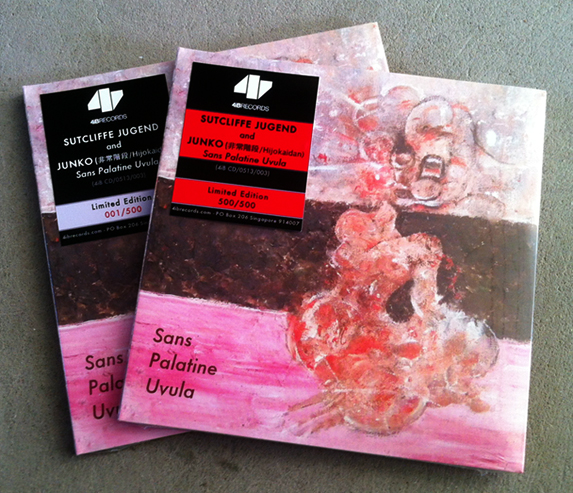
SUTCLIFFE JUGEND and JUNKO (非常階段/HIJOKAIDAN) – Sans Palatine Uvula CD (4iB 003):
TRACK LISTING
1. Mouth Ripping (Sample)
2. Throat Ripper
3. Mouth Leak
4. Mouth Slipping
5. Lip Splitter
6. Sans Larynx
7. Throat Leak
8. Throat Slipper
9. Sans Palatine (Sample)
10. Tongue Splitter
Details:
– Gatefold CD Cover (Paintings by Kevin Tomkins)
– Inner Cardboard CD Sleeve
– 8-Page Booklet (Containing Images & Japanese/English Text Translated by Yuko UNDER)
– Individually Numbered
– Limited Edition 500 Copies
PRICE (Including Airmail Shipping from Singapore): USD 20/€15
To Purchase, Please Click Here:

SUTCLIFFE JUGEND and JUNKO (非常階段/HIJOKAIDAN) – Sans Palatine Uvula
Sans Palatine Uvula showcases the amalgamation of 2 pioneering artists of their respective genres: Power Electronics and Japanoise, both whom have made their presence significantly felt (through sight and sound) ever since the early 1980s in England and Japan. Sutcliffe Jugend and Junko (from 非常階段/HIJOKAIDAN) are renowned artists in their own right, having been uniquely defined in the experimental noise scene as innovators of sound through their personal style of artistic expression that involves the churning of audio mayhem through guitars, electronics and vocals.
This album sees Sutcliffe Jugend taking a step beyond as they push the envelope of sound progression to greater heights. Junko‘s piercing screams and squeals serve as a canvas for Sutcliffe Jugend to work on and develop it further in their own innovative style. The results demonstrate a very unique reconstruction of the shriek queen’s original vocal outbursts, which see them being reworked and reinvented separately through manipulative treatments of cut-ups, distortions, samplings and introduction of other sonic elements.
This collaborative work between these two unique and respected artists of different genres from East and West encloses the listener with sonic chaos through its ten varied tracks. For some, it may seem like a difficult album to digest at the first listen. However, the tensions that have been separately produced from the harsh elements of voice and sound eventually subside as they resonate with each other, bringing forth a balanced unity of yin and yang.
Best Played Loud!
=======================================================
REVIEWS
By diefendorf (Jul 09, 2013) on Discogs:
Again a great Album by Sutcliffe Jugend on 4iB- this time with the “singer” Junko. Her voice reminds of steel crushed on steel. It actually reminds of John Zorn`s sax in bands like Painkiller. The music is great as always. The voice is disturbing. A bonus: A beautiful Sutcliffe Jugend album without the oh so horrible lyrics. A great work of music if not even art.
http://www.discogs.com/Sutcliffe-Jugend-And-Junko-Sans-Palatine-Uvula/release/4699854
==========
By Tracy (Jul 26, 2013) on Heathen Harvest:
Here we have a collaboration between Junko (vocalist for Japanese harsh noise project Hijokaidan) and English power electronics/noise duo Sutcliffe Jugend. What to expect out of this record? To be brief but not so brief; 44 minutes and 57 seconds of raw, carnal noise which audibly pierces through your ears and sharply personifies that of a torture chamber recording. Sutcliffe Jugend continue to keep the ongoing tradition of agony and malevolent musical distortion very much alive while combined with the static waves of suffering within Junko‘s high-pitched despair.
The opening of the album starts off with “Mouth Ripping” and gets right in your face with high volumes of immense energy and perpetual chaos from both collaborators. Its highly impactive force of maddening screams and deranged industrial fluctuations sound their way off through to the next few songs, each of which lasts no longer than 4 minutes as they begin to grow on the brink of abrasion, when suddenly you will find yourself halfway through this carnal creation moving onwards but falling deeper into the abyss. Track 5, “Lip Splitter,” takes a spin from the first half of the record (which did not leave as strong of an impact on me, personally) with a hint of more borderline “bubbly’” elements mixed with Junko’s loud, hellish shrieks; almost in equivalence to the sound of death itself. This is where the album begins to take a turn into more dark ambient aspects as Track 6, “Sans Larynx,” which is synonymous to that of a train ride in a dark tunnel leading into a carnival of horrors in pitch-black darkness. Upon the first listen of “Sans Larynx”, the eerie, spine-chilling ambiance did not require me to close my eyes in order to envision the my own nightmarish, demonizing agonies unfolding before me in crystal clear visions – it is malevolent in its own darkness whilst being filled with samples of industrialized echoes and raw harshness. Wails of despair soon follow throughout the latter portion of this track, which will both drag on as well as lure you in; it is both hypnotizing and haunting. At times, even Junko’s shrieks become so unbearable that it leaves me with a love-hate feeling towards the record itself… it is inescapable and so animalistic that, at times, I become so lost in her voice that it begins to morph into that of an animal or wild, carnal being.There are no watered-down elements or pleasant rhythmic melodies that will grab your attention in a manner that is comfortably centered within one’s own comfort zone on this record. Everything is harsh yet pure, in a void of hollow frequencies which bear resemblance to the creaking of a crank-wheel or tightening of ropes on torture boards. Track 9, “Sans Falatine” opens up with what sounds like an introduction into a wilderness that is vast and hidden within an underworld of darkness… the call of the beast echoes his cries throughout the song as Junko’s cries blend in together with the sounds of this primitive, masochistic hell. This record is far from any sort of condensed, upbeat/post-whatevers. Given the notoriety of Sutcliffe Jugend being one of the first few pioneers of the power electronics genre, the duo continue to deliver with this split of demented sounds, minutes of mental strain, and utter depravity. The walls of repression remain sustained as the veils of sanity inevitably crumble. Carefully tread with caution.
http://heathenharvest.org/2013/07/26/sutcliffe-jugend-junko-sans-palatine-uvula/
=======================================================
Please direct all enquiries to:
4iB Records
PO Box 206
Singapore 914007
email: gerald@4ibrecords.com
www.4ibrecords.com
> FOLKSTORM, GRUNT, ATTRITION, ANTIchildLEAGUE, IRON FIST OF THE SUN, JAAKKO VANHALA + Others – Live in Dresden, GERMANY on 28 Sept 2013
TOWER PROMOTIONS PRESENTS TOWER TRANSMISSIONS III
(A one day event of Power Electronics/Dark Ambient/Avant-Garde)
– FOLKSTORM (Sweden)
– GRUNT (Finland)
– ATTRITION (UK)
– ANTIchildLEAGUE (UK)
– IRON FIST OF THE SUN (UK)
– JAAKKO VANHALA (Finland)
+ DJ ROBOTKA (Austria) & DJ WIKTOR SKOK (Poland)
DATE: 28 September 2013 (Saturday)
TICKETING: €28 (Advance)/€32 (Normal) (Email: towerpromotions@gothic.ie)
TIME START/END: 17oo hrs – 0500hrs
VENUE: CLUB PUSCHKIN, Leipziger Str. 12, 01097 Dresden, GERMANY
More Info At:
https://www.facebook.com/events/426126930797528/?fref=ts
http://www.clubpuschkin.info/
https://www.facebook.com/events/618415421518306/
FOLKSTORM
GRUNT
ATTRITION
ANTIchildLEAGUE
IRON FIST OF THE SUN
JAAKKO VANHALA
> D.A.F. (Deutsch Amerikanische Freundschaft) + Others – Live in Estonia on 7 June 2013
BEATS FROM THE VAULT PRESENTS
15 Years of BFTV
– D.A.F. (Deutsch Amerikanische Freundschaft)
With
– 4-GOT-10
– D. DARLING
– Ivõl
– rez
– SHIFTWIND
DATE: 7 June 2013 (Friday)
TIME START: 2200 hrs
VENUE: ROCKSTAR’S, Tatari 6, Tallinn, ESTONIA (http://www.rockstars.ee/)
More Info At:
https://www.facebook.com/events/566931126662202
https://www.facebook.com/beatsfromthevault
https://www.facebook.com/pages/Rockstars/144351748936236
D.A.F.
> CUT HANDS + Others – USA, Montreal & European Tour 2013
CUT HANDS TOUR 2013
– 30 May (Thursday)
(New York: Public Assembly)
– 2 June (Sunday)
(Austin: North Door, Chaos In Tejas Festival)
– 5 June (Wednesday)
(San Diego: The Void, with Black Rain)
– 6 June (Thursday)
(San Francisco: Public Works, with Black Rain)
– 7 June (Friday)
(Seattle: Chop Suey, with Black Rain)
– 8 June (Saturday)
(Los Angeles: Complex, with Black Rain)
– 10 June (Monday)
(Montreal: Casa Del Popolo – Suoni Festival, with Sacred Paws & Howie Reeve)
– 18 June (Tuesday)
(Madrid, Spain, with Vatican Shadow)
– 23 June 2013 (Sunday)
(Lithuania – Supynes Festival)
– 29 June (Saturday)
(Toulouse, France)
– 30 June (Sunday)
(Hamburg, Germany)
– 5 July (Friday)
(Bern, Switzerland, with Phill Niblock)
– 6 July (Saturday)
(Basel, Switzerland)
– 26 July (Friday)
(Stockholm, Sweden – Norberg Festival)
– 27 July (Saturday)
(Berlin, Germany – Atonal Festival)
– 8 August (Thursday)
(Edinburgh, UK)
– 15 August (Thursday)
(London, UK)
– 31 August (Saturday)
(Cambridge, UK – Wysing Arts Festival)
– September
(Brussels, Belgium)
– September
(Odense, Denmark)
– September
(Athens, Greece)
– 19 October (Saturday)
(Moscow, Russia)
More Info At:
https://www.facebook.com/afronoise
https://www.facebook.com/events/638179039543073/?notif_t=plan_user_invited
http://williambennett.blogspot.sg/
http://afronoise.blogspot.sg/2013/04/cut-hands-updates-may-2013.html
http://djcuthands.blogspot.sg/
http://www.susanlawly.freeuk.com/
CUT HANDS
SACRED PAWS
HOWIE REEVE
VATICAN SHADOW
PHILL NIBLOCK
> BLOOD AXIS, SKULL & DAWN + Others – Live in Athens, Greece on 26 June 2013
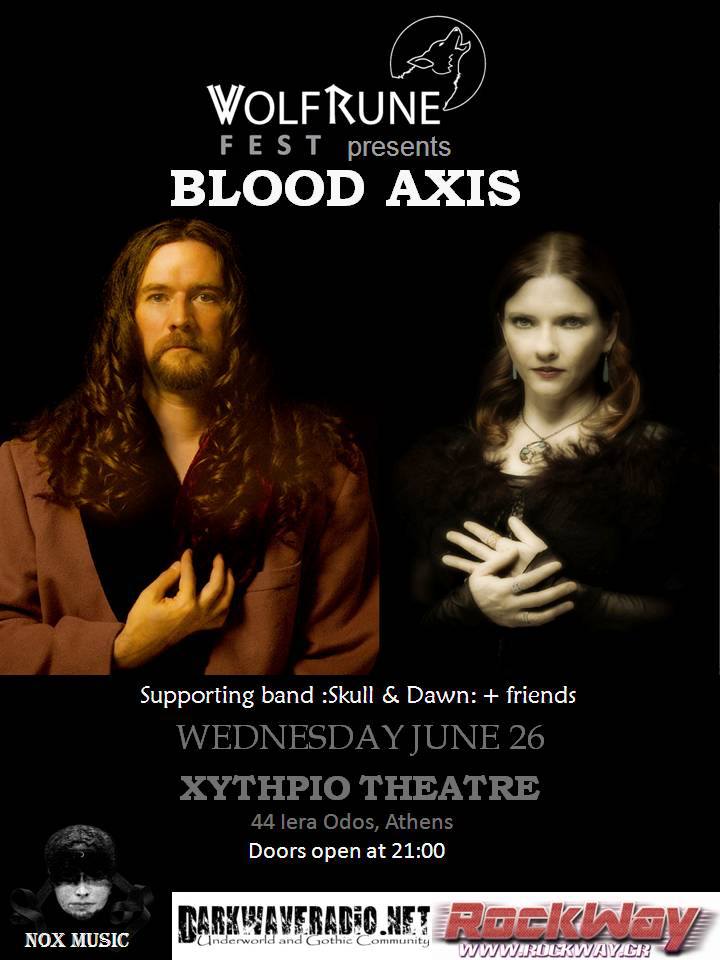
WOLFRUNE FEST PRESENTS:
– BLOOD AXIS
Supported by
– SKULL & DAWN + Friends
DATE: 26 June 2013 (Wednesday)
VENUE: XYTHPIO THEATRE, 44 Iera Odos, Athens, GREECE
DOORS OPEN: 2100 hrs
TICKETING: 25€
(Contact: wolfrunefest@yahoo.gr)
More Info At:
https://www.facebook.com/events/236032909866253/
BLOOD AXIS
SKULL & DAWN
> GEISTFORM, ÄLYMYSTÖ, LE MODERNISTE, KAIBUN, LATVIJAS GĀZE, OYAARSS, HEZZEL, MORGGROM, KONTAKT, GOLDEN SHOWER, NAV SAULES Live in Riga, Latvia on 30 Aug 2013

NAKTS MAINA III – INDUSTRIAL MUSIKFEST PRESENTS:
– GEISTFORM [es]
– ÄLYMYSTÖ [fi]
– LE MODERNISTE [be]
– KAIBUN [be]
– LATVIJAS GĀZE
– OYAARSS
– HEZZEL
– MORGGROM
– KONTAKT
– GOLDEN SHOWER
– NAV SAULES
DATE: 30 August 2013 (Friday)
VENUE: FLOATING WORKSTATION (Peldošā darbnīca) #659, Andrejostas iela 42, Rīga, LV-1045, LATVIA
http://www.peldosadarbnica.lv/
TIME: 1900hrs – 0600hrs
TICKETING: 4Lats (Pre-Sale or Before 2100hrs)/5Lats (At The Venue) or 6Lats (After 2300hrs)
(Pre-Sale Venue: TATTOO & PIERCING, Kaleju Str 6 Old Town, Riga, Latvia lv-1050)
More Info At:
http://www.sturmmandat.com/
https://www.facebook.com/events/175738585921991/
GEISTFORM
ÄLYMYSTÖ
LE MODERNISTE
KAIBUN
LATVIJAS GĀZE
OYAARSS
HEZZEL
MORGGROM
GOLDEN SHOWER
NAV SAULES
 4iB Records | For intrinsic Beliefs