4iB Records | For intrinsic Beliefs
Record Label dealing in Industrial, Power Electronics, Harsh Noise, Experimental, Death Industrial, Drone, Ambient, Japanese Noise, Field Recording, Abstract, Musique Concrete and other related genres.

> NATURE AND ORGANIZATION: Beauty Reaps the Blood of Solitude (Durtro 021CD)

- Introduction – 02:55
- Wicker Man Song – 04:33
- Blood of Solitude I – 01:18
- Bloodstreamruns – 04:38
- My Black Diary – 05:26
- Tears for an Eastern Girl – 05:42
- Beauty Destroyed – 01:34
- Skeletontonguedworld – 03:02
- Obsession Flowers as Torture – 01:51
- Blood of Solitude II – 01:52
- Bonewhiteglory – 09:47
Nature and Organisation is the project of the brilliant Michael Cashmore, a frequent contributor to Current 93’s post-80’s albums. As with his work with Current 93, the music of Nature and Organisation tends to be delicate, medieval and baroque-sounding, and almost always incredibly beautiful. At its heart, this is essentially a Current 93 album, as a good many of the major contributors to c93 appear: David Tibet, Douglas P., Steven Stapleton, and Rose McDowall all offer substantial contributions to the project. Make no mistake: this is truly wonderful music and in fact, it’s probably one of my favorite albums ever. Thankfully, the lyrics are included.
The first track, INTRODUCTION, is one of the few non-acoustic pieces; it’s mostly low grinding rumbles building up to an orchestral-sounding peak, which sets an epic and dramatic stage for the rest of the album.
Track two, WICKER MAN SONG, is a traditional song sung by Rose McDowall over quiet guitar, violin, and other acoustic instruments. Simple and beautiful.
BLOOD OF SOLITUDE I is a short classically-styled instrumental piece (acoustic guitar and strings), providing a brief intro to the next track.
BLOODSTREAMRUNS is, to me, an amazing piece of work. Carrying on with the musical theme set forth in the previous track, David Tibet’s quiet and beautiful vocals are some of the best I’ve yet heard from him; his lyrics are similarly wonderful. In fact, this entire album (for me) is a great example of Tibet’s lyrical and vocal talents.
Checking in from Death in June, Douglas P. makes his contribution with MY BLACK DIARY. Once again, the music is mostly acoustic guitar and violins, but with an edge of Douglas’ distinctive musical style. Tibet provides backing vocals.
TEARS FOR AN EASTERN GIRL has a vaguely upbeat, vaguely cheerful sound, though the lyrics (as could be expected) are dreadfully melancholy. The music comprises female backing vocals, Tibet on lead vocals, and lots of acoustic instruments.
In sharp contrast to the preceding tracks, BEAUTY DESTROYED is mostly heavily distorted guitar noise (possibly provided by Steven Stapleton and his “sheep ventilator guitar?”) and a bit of percussion. Out of the cacophony, an epic-sounding orchestra rises in the background.

Once again back in acoustic mode, SKELETONTONGUEDWORLD features more chill-inducing vocals from Tibet and sadly beautiful music from Cashmore (did I mention that the man is genius?).
OBSESSION FLOWERS AS TORTURE begins with lovely acoustic guitar, and then continues where BEAUTY DESTROYED left off, with more exquisite electric guitar noise and percussion.
BLOOD OF SOLITUDE II is another quiet musical piece in the same vein as the BLOOD OF SOLITUDE I, deeply sad and beautiful (yeah, I know I’ve been using these adjectives a lot, but they’re truly appropriate!).
And finally, we end with BONEWHITEGLORY, which is about as perfect of a song as one could hope for. Acoustic guitar, violin, and Tibet’s vocals and lyrics combine for one final exquisite slice of melancholy. The song fades out after about 5 1/2 minutes, but fades back in for a reprise of the song for the final two minutes.
No epilogue.
(Source: http://www.softblackstars.org/longshadows/beauty-reaps-the-blood-of-solitude)
[http://www.youtube.com/watch?v=Kn8He_bLnF0]
> KNIFELADDER Interview By Compulsion Online
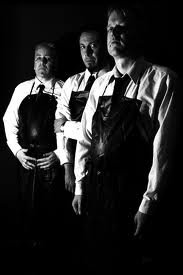
Anyone who has caught Knifeladder live can testify to their powerful performances. The trio – John Murphy, Hunter Barr, Andrew Trail – deliver a sound that is equal parts physical, visceral and spiritual.
Organic Traces is their first full-length release, following a split CD with Shining Vril, and it augments their live set-up with studio techniques and additional percussion. The core Knifeladder sound revolves around solid bass throb, industrial electronics, and an array of percussive devices and rhythms. From soft percussive flourishes to rhythmical tirades; swollen beats and rhythms are the lifeblood of Organic Traces.

‘Faultline’, ‘Scorched Earth’ and ‘The Wilderness of Mirrors’ are perhaps the most immediate tracks here as they adopt a song based structure albeit with experimental touches. Andrew Trail presents the vocals on both ‘Faultline’ and ‘Scorched Earth’. Where ‘Faultline’ features a whispered anguish over restrained percussion, ‘Scorched Earth’ builds into something more frenetic and aggressive eventually yielding to a crushing crescendo. ‘Ossirian Window’ achieves a hypnotic ethno-trance presence via wailing voices played off against an eastern flute.
A more experimental edge is achieved on ‘Feline’ where the voice of English folk-singer (and Operative labelmate) Andrew King is heavily treated and echoed amidst a jittery atmosphere and intermittent drum rolls that cease to subside for theduration of the track. Organic Traces closes with the shifting looped sounds of ‘Dervish’. The fast, frantic percussion of this ritual invocation bring to mind the ritual drums of Calanda.
There are predecessors for the output of these Antipodean industrialists – elements of Crash Worship ADRV, Test Dept, Einsturzende Neubaten, Muslimgauze and even Adam and the Ants can be detected here. However none have been able to co-opt the studio with such precision and skill. The delivery of percussion and the devices used on Organic Traces vary so widely this review can only touch upon but Organic Traces features such a spirited and dynamic delivery it really does deserve your attention.
In a remarkable career that has spanned over 20 years John Murphy has performed with some of the more illustrious groups of the post-industrial genre and more besides. An early member of Currrent 93 he performed on the terrifiying Dogs Blood Rising, a member of Graeme Revell’s industrial percussionists SPK, he performed drums on the Associates marvellously flawed classic Sulk – one of the finest albums, ever. He’s even performed with doomed rock star Michael Hutchence as part of Max Q, and took a bit part and provided soundtrack to the Australian movie Dogs from Space. Hell, in the course of this interview it transpired that he had also drummed for Shriekback, Gene Loves Jezebel and Nico. If I could be bothered to check out other releases from this period then I’m sure he’d be on them too.
Over the past few years John Murphy has become involved in the Death In June axis performing live with Death In June, collaborating with Boyd Rice and Douglas P. as Scorpion Wind, drumming for Sorrow, Ostara and occasionally Der Blutharsch. More recently he’s provided percussion for Andrew King, Naevus, and provided material for the intriguing US outift the Sword Volcano Complex.
Every time I meet John Murphy I always bend his ear about the late Billy Mackenzie of the Associates. Misguided pop star or tortured genius? He’s related to me several funny anecdotes. Tom Doyle in his compelling biography of Billy Mackenzie, The Glamour Chase, described John Murphy as mooching around in a dirty old raincoat with a Burroughs’ paperback poking out of the pocket.

John Murphy
And of his own projects; during the post-industrial scene of the early eighties and the then burgeoning cassette culture he was releasing tapes as Kraang (Tesco records released the URO: 1981-1983 Vinyl LP), Krank and Orchestra of Skin and Bone. Today he records solo with his on/off project Shining Vril, and as part of industrial power electronic outfit Knifeladder and as a member of folk-noise outfit Foresta Di Ferro, with Marco Deplano and Ostara’s Richard Leviathan.
This interview was originally intended for Richard Stevenson’s Spectrum magazine but due to the pressures of deadlines he offered it to Compulsion online, and as it coincided with the release of Knifeladder’s first full length CD, Organic Traces we revised the list of questions to keep it pertinent to John Murphy’s current projects.
There’s still many questions unasked but this should be regarded as a starter for those wishing to piece together the industrious career of John Murphy.
Our thanks go to John Murphy for taking the time to completing this while in the UK, Australia and during his travels throughout the USA with Death In June.
i) Compulsion Online (CO): First of all, when one looks at your extensive and lengthy involvement with the industrial / post-industrial genres, you have had a rather illustrious career. Could you provide a historical rundown of your involvement with industrial / post-industrial music, relating to both your own projects and collaborations with others?
John Murphy (JM): My so-called career has been shaped as much by chance as chosen design. There hasn’t ever really been any overall master plan, which may have hindered me at various points along my route to oblivion. Some people might find my tale fascinating others an abject lesson in how NOT to have a coherent career path – perhaps I am my own worst enemy in some regards.
The so-called evolution of my musical interests has taken place over many, many years. It is so convoluted even I cannot accurately remember everything. Over the years I have been involved with many different styles of music besides the whole industrial / post-industrial thing but in regards to my so called more industrial / experimental / electronic – whatever side of things – I became interested in the genesis of this sort of thing firstly in the mid 1970s, just before the advent of punk when as a teenager in Melbourne, Australia, I was first exposed to the joys of Krautrock, European prog rock, early 70s Glam rock and 60s / early 70s psychedelia. I started collecting and listening to all sorts of music at an early age and became involved in bands, properly from the age of 8 years old onwards. I could go on and on about this period and my influences and experiences for quite a while but won’t bore the pants off you. I was always an ardent Anglophile from a very early age onwards mainly through the influence of my mother and various relatives, so British music and culture was always very important to me.
I was heavily involved in the early Melbourne punk / new wave scene of the late 70s and after playing with local politically orientated punk outfits I helped form one of the southern hemisphere’s first sort of electronic acts called Whirlywirld in late 1978. This was a 5-piece outfit perhaps somewhat similar in some ways to early Clock DVA, Tuxedo Moon and Cabaret Voltaire with a dash of late 70s Low period Bowie. There was also a slight bit of a TG influence in some of the songs – though we did vary quite a bit over a 2-year period. We folded in late 1979 as we had hit a sort of artistic ceiling locally.
I ended up in London very early in 1980 basically to form another outfit with one of the other members of Whirlywirld, who is now sort of an Antipodean electronic dance music icon. Because of my percussive ability and certain contacts I became involved as a sort of permanent session drummer for the Associates. During the early 1980s I also worked as a session drummer for Shreikback, Gene Loves Jezebel, Nico (briefly) and a few others.
My European industrial / experimental experiences started towards the end of 1980 when I started working on the whole Kraang thing, purely as a bit of interest and fun for myself. At this stage it was called Krang Music and I released a cassette mid-81ish, which seemed to gather some sort of interest in certain quarters. I had always been a noise freak from an early age much to the despair, anger and head scratching of many of my teenage Melbourne peer group who just could not understand why I wouldn’t just stick to playing the drums and leave the music to the professionals. I think I may have had the last laugh, perhaps.
Through my friendship with Jim (Foetus) Thirlwell, who I had known well since 1978, I somehow met both William Bennett of Whitehouse and also Steven Stapleton of Nurse With Wound. I was asked to perform live with Whitehouse playing modular synth throughout 1982 / early 1983, as well as recording one album with them. I also did some Kraang performances in London around this time and also did some live work with a sort of improvised experimental outfit that was sort of in the style of AMM. I’m afraid I can’t remember the name.
I did quite a bit of stuff with various people during 1983-84 including tours and recording with SPK, recording for a video soundtrack released through Twin Vision, SPK’s video company, recording on one Nurse With Wound album, recording with Lustmord (the Paradise Disowned album), recording and live work with the early Current 93/Dogs Blood Order (the first few C93 albums) more Kraang material, another duo outfit called Krank which eventually had a European and North American CD release many years later in the early 1990s of material recorded in mid-1983. Some of this material was originally used for the Twin Vision video release. I also contributed tapes and primitive loops / sound samples via mail to an Australian quasi-industrial outfit called Hugo Klang, old pals of mine.
I returned to OZ after 5 years away in the mid 1980s mainly because of physical illness and general exhaustion. I got my health together and helped form an OZ based experimental, post-industrial act titled Orchestra of Skin and Bone. This outfit was in the same general area as mid-period SPK but had a darker, more ritualistic sort of tone, perhaps. Live it was a very confrontational sort of act indeed. We were quite influenced by the music of Harry Partch. We released one album in OZ in 1986, and did some soundtracks for local underground films. A CD of one of these soundtracks and a live 1985 Melbourne performance was released in Europe and USA in 1991 under the title of 1984-1986 (on Unclean Productions). As far as I know it received a good response and reviews but the band somehow or other ground to a halt during mid-1986, rather a pity as I always thought we had the potential to be a world beating act, as I knew what was going on elsewhere. Locally in OZ the general response was not good. We were basically feared by local audiences and had much trouble getting shows or local interest. An unfounded reputation of being sort of occult weirdies and on-stage bloodletting at times did not help matters. The album we released in late 1985 garnered some overseas interest, particularly in the USA, but fell into obscurity locally. The label collapsed soon after – typical of an OZ indie label of the time. I lost a lot of money, which caused me a little bit of grief.
Various members of the Orchestra of Skin and Bone including myself helped co-ordinate and record the soundtrack and incidental music for the OZ film Dogs In Space during 1986. I also worked on soundscapes for local video clips, underground films and did quite a bit of session work with various locally based acts between 1986-1990. Some of this was semi-experimental in nature but a lot was quite conventional and pretty straight. Some of the acts were The Index, Shower Scene From Psycho, GUM, Bum Steers, Box The Jesuit (well known Sydney based gothicy act), Max Q (semi-solo experimental project of Michael Hutchence of INXS), Not Drowning Waving and a lot more that I can’t and don’t want to remember. A lot of it was purely for the money.
In the late 1980s Kraang did the occasional local performance and recordings in both Melbourne and Sydney, though not to any sizable interest. Some of these performances went under the name of My Father of Serpents. In the early 1990s I did some more ritualistic, dark ambient performances using the name Ophiolatreia (its Latin for serpent worship) and had a track titled ‘Mirror to Dionysus’ on a compilation CD released by Dark Vinyl in Germany in 1992. This was just after they released the Krank material that I had originally recorded in mid-1983.
In the OZ experimental industrial area between 1986 – 91 I also worked with Ulex Zane of Zone Void, who had some recordings I participated in later released on Cthulhu Records of Germany; GUM – a local industrial duo who put out two local albums; Stress Of Terror – one cassette tape; Disciples of None – another project of Ulex’s; Sootiken Flesh – a friend’s semi solo project in the style of Whitehouse meets early Non with ritualistic drums – pretty good actually. Two tapes were released and an unreleased album for a local metal label; Browning Mummery – old OZ friend of mine doing classic style industrial sound. Two CD releases feature myself amongst others; Nada – a local Sydney based art ritualistic performance troupe; Jaundiced Eye – a Sydney based experimental / post-industrial three piece which at times included myself. The music was a mish mash of experimental techno cum ritualistic dark ambience. Unfortunately nothing has ever been properly released, only short run CD-Rs I believe.
Subcutaneous Theatre was a ritualistic sinister, industrial dark ambient duo that I was involved with that also featured Debra Petrovitch, a Romanian Australian performance and sound artist. In some ways she is like a cross between Jarboe and Diamanda Galas – a very talented intense performer. She has also appeared on some Shining Vril pieces, on the “Split” CD of Shining Vril / Knifeladder. Subcutaneous Theatre appeared at some Sydney art experimental events in the late 1980s and released one cassette on the local label Cosmic Conspiracy Productions and were planning to record a proper album in late 1990 with Andrew Trail engineering. For various non-musical reasons this never happened.
In slightly more conventional terms I also became involved with two acts from 1986-87 onwards. The first group was called The Slub something I originally put together as a sort of revenge cum musical joke in early 1986 as a one off event. I originally tried something sort of similar nearly 8-years before in Melbourne a feedback no/wave one off act called The Alan Bamford Musical Experience named after an old friend of mine. This eventually petered out in the early 1990s, quite a while after I made my escape. This was a noise guitar orientated act and could be at times alternatively brilliant and utterly appalling – often in the same show. It was sort of like a cross between a deranged Plastic Ono Band, Trout Mask Replica Beefheart, early Swans, Butthole Surfers, Whitehouse and Skullflower. Though all these comparisons do not quite do it justice. We were probably one of the most loathed acts ever in the whole southern hemisphere but even so we put out one cassette which got international interest, one locally released album titled Rootman which got rave reviews in the USA, and we released quite a few singles on the USA based label Sympathy For the Record Industry which seemed to do okay. I should also point out that I was one of the two singers in this act plus I was responsible for the majority of the noise and atonal sounds playing feedback drone, Slub guitar at intolerable volume, my trusty old EMS AKS synth and a primitive sampler/tapes. The other guitarist playing in a Beefheartian deranged style. It was through this band I originally met Andrew Trail later of Knifeladder as we once shared the bill with his act (Ministry Of Love) in Sydney. He still thinks that the Slub was one of the most “out there and plain crazy” acts he has ever seen anywhere. This group also used to make some of my more muso friends – guitarists especially virtually froth at the mouth in anger as we were so unmusical in their correct eyes. The fact that I was also much better at getting extreme guitar feedback frequencies than they were didn’t help matters at all.
The general negativity of this band left me with many bad psychological and physical scars and I eventually got out and sort of saved my tattered sanity and soul in late 1989 after leaving Melbourne for Sydney where I briefly drummed for Box The Jesuit, did the odd performance with Subcutaneous Theatre, Jaundiced Eye, My Father of Serpents, Browning Mummery, recorded with Max Q and some of the aforementioned acts and developed my friendship with Andrew Trail later of Knifeladder and lived a fairly degenerate lifestyle if the truth be known.
The second act was called Dumb And The Ugly, which released one 12-inch mini album, and one CD. We performed in Melbourne with the odd show in Sydney. This was a 3-piece outfit in which I played drums and some samples. This was formed with some very old friends from my teenage years who also played with other acts. This act was in the style of Sonic Youth meets Hendrix and Chrome/Helios Creed. Personality clashes eventually destroyed this outfit. I had had enough and couldn’t deal with music any more.
In the early part of the 1990s things were generally spiraling out of control in my tattered existence and I slowly curtailed many of my musical activities as I was not finding a great deal of personal satisfaction with any of them at all. I did some performances and recording with a Sydney based ritual, dark ambient, experimental techno hybrid sort of act, which was originally called Jaundiced Eye, but somewhere along the line the name somehow changed over to Dweller On The Threshold. We played at quite a few rave cum pagan orientated events in and around Sydney including a support slot for Meat Beat Manifesto. I also guested from time to time throughout the first part of the 90s with some other live local acts playing drums synth, samples and lo-tech electronics/tapes on both recordings and live dates. These acts included Monroe’s Fur, Psychic Date, Harpoon, Louis Tillet (OZ singer, writer) Monkey See Monkey Do, Beastianity, Extinct, Hugo Race’s True Spirit (industrial Nick Cave like blues), Blood and Iron (which also featured David Booth, who now plays live with Der Blutharsch, this act had a sound somewhat in the vein of Laibach, Autopsia and similar acts) and possibly a few others. It is actually rather hard to remember everything from this time. I also continued to do the odd bit of session work for more conventional musical acts – all OZ based so the names wouldn’t mean anything to Northern European or North American readers. It was mainly recording with the odd live show – I needed the cash! Even that didn’t always come through – such is the foibles of the music industry.
In the early 1990s I did some recording and 3 live performances in and around Sydney with an old friend of mine, Dominik Guerin who was one of the original founders of SPK. He was with them up until the time of Leichenschrei. Along with another old OZ experimental pal named Jon Evans who now lives near Berlin, we recorded and performed together under the loose name of DOM. 8-9 tracks were somehow recorded and the remastered tracks (which I did with Hunter Barr of Knifeladder at Retina studios in mid 2001) which may be at last released, sometime in the next few months or so…under the name Last Dominion Lost. The title will be The Tyranny of Distanceand the music has at times some resemblance to Leichenschrei era SPK. Others may beg to differ about this – there was certainly little local interest in what we were doing around this time..so once again things slowly petered out.
Around mid 1993 I literally by chance (fate perhaps??) bumped into Douglas P of Death In June at some sort of semi-industrial event in Sydney during one of his periodic visits to Australia. We renewed our friendship and acquaintance and later in the mid 1990s or whereabouts the Scorpion Wind album, Heaven Sent, was recorded. This also featured Boyd Rice of Non. A few months later I was asked to play live percussion on some DIJ live shows in Europe and I have been doing this ever since.
While I was in and around London in early 1997 I renewed my friendship/acquaintance with Andrew Trail whose previous outfit Autogeddon had just finished and slowly and tentatively Knifeladder was formed – even though at this stage it did not really have a name as such. We did a few live rehearsals and the hard graft of sound source and sample making at home, building prospective pieces from literally the ground upwards. Soon, Hunter Barr, an old pal of Andrew’s, joined and Knifeladder was properly formed. We played our first proper live date towards the end of 1997 at the Bull and Gate in Kentish Town. I also did a little bit of drumming recording session work with Strength Through Joy in the middle of 1997, I seem to recall.
Since 1997-98 besides live shows and tours with Death In June in many different parts of the globe I have also mainly worked on Knifeladder and to a lesser degree on my own solo ritualistic experimental soundscape project Shining Vril.
As well as this over the past few years I have done quite a bit of guest and session work (both live and recording) with various acts scattered all over the place. These have included live percussion with Der Blutharsch in 1998-99, some live percussion on a few Fire and Ice shows in late 1998, some recording and live shows with Ostara, Wertham, Andrew King, Sleeping Pictures and Foresta Di Ferro over the past few years. I have also contributed sounds and samples to album and CD releases by the Sword Volcano Complex, Genocide Organ, Brownning Mummery and Subcutaneous Theatre (both in Australia). Recently there have been a few other artists scattered in differing parts of the globe who have also asked me to possibly contribute “bits and bobs” to their forthcoming recordings and I may possibly do so – depending on time and what I can possibly come up with. I am currently trying to keep most of my ideas and sounds for Knifeladder and Shining Vril recordings. I have also recently decided to reactivate my old-school industrial noise project Kraang for a round of new recordings sometime soon.
I hope this gives something of a general idea of my personal musical history and collaborations over the years in the general industrial / post-industrial, experimental areas of music.

ii) CO: What introductory information can you provide about your solo project Shining Vril?
JM: To explain the whole concept of Shining Vril is rather difficult but I will attempt to give it a go anyway. This particular project came into being somewhat slowly towards the end of 1999. Without really attempting to give it a great deal of thought I started to record a few solo pieces that were due for various compilations around the globe. I had made quite a few potential contacts with my various live tours with Death In June and had received a few offers for contributions to various compilations and samplers on European and American labels. I had also met Stefanos of the Greek label C.A.P.P during a Greek Death In June tour in mid-1999 and somehow or other we got talking and he offered to release a “split” vinyl release of my solo recordings and some Knifeladder material on his label. This eventually turned out to be the Split CD release that came out in mid-2000 that seemed to gain a reasonable critical response in Europe and North America.
Basically Shining Vril is an ongoing solo project of mine to explore my own interests cum obsessions. It does not encompass any one particular musical style or aesthetic. Anything can or will be used in the construction of the compositions. The line-up is flexible with myself being the only constant. It can be anything I want it to be. There is also an esoteric / spiritual side to the whole thing but I am trying not to make this too obvious or self-evident. It is there for potential listeners to discover and contemplate for themselves. A form of self-initiatory gnosis perhaps using musical and other sounds in a ritualistic and a subconscious way, to aid the process of self discovery and awareness along somehow. I find all this very difficult to accurately put into words as I generally find they can be quite inadequate for the task.
I have contributed to quite a few compilations over the past few years and will continue to do so for the immediate future. Hopefully a proper full-length release will happen as well as I have quite a few unrealised ideas and plans.
iii) CO: As Shining Vril as a moniker has a rather esoteric/spiritual connotation, what led you to choose this and does the name signify a specific pursuit with the ritualistic soundscapes you produce?
JM: My reasons for using the name Shining Vril as a moniker are many and varied. Many years ago, as I said earlier, I used the moniker My Father of Serpents as a name for some solo recording and live performances in Australia, but I was never entirely happy with this. This name mutated into Ophiolatreia which basically means serpent worship in Latin but this was a bit of a mouthful and didn’t really do what I had in mind justice. I found it very difficult to actually settle on one particular name but the word Vril kept cropping up, so it was destined that somehow or other the word Vril would be used somewhere in the name for my solo material.
I have rather a deep interest in esoteric cosmology and hermetic, gnostic philosophy especially in the areas of ancient sacred sites and the still potent power associated with them, the old Mystery religions, rites and practices, the Northern Mystery tradition and what you would call “the Perrenial Philosophy” of mankind. I’m also interested in the more esoteric work of Jung, Reich, Evola, and associates; the Grail Myth and the work of Otto Rahn which encompasses a few different paths that interest me such as Catharism, the Thule Myth and also esoteric Christianity and the whole Black Sun thing. The whole Vril belief as espoused by the Luminous Lodge and the Vril Society in 1920s Germany also personally interested me. I believe there is something undeniable and powerful in all this – call it what you will and me gullible perhaps. Vril, Chi, Odic Force and a thousand different localised names in many differing cultures. This force seems to have been in existence for perhaps forever, even if a lot of the interest over the past century or so has been due to many reading the book The Coming Race written in the late 19th Century by the English occultist and novelist Edward Bulwer-Lytton which seemed to be taken rather seriously in certain parts of Northern Europe in the early 20th Century.
On a slightly different level I have also in the past 10-12 years learnt various forms of healing techniques such as Seichem, an ancient Egyptian derived healing technique supposedly and I’ve seen various forms of Taoist Asian chi energy techniques performed often in front of dozens of people. This is really what inspired the name Shining Vril as in one demonstration in Sydney in 1992 the Korean chi master produced a shining wavering sort of chi energy ball which every one in the room could see – and certainly feel. I prefer to call this sort of energy “Vril” as this may have been it’s primordial name many thousands of years ago and it was probably a lot more potent and powerful than today.
iv) CO: Split was a shared CD with Shining Vril and Knifeladder. How was this disc received by the underground?
JM: This CD release seemed to be received reasonably well and received some decent reviews in various magazines and websites around the globe. Personally I cannot actually say how the “underground” received it overall but the reaction in general seemed to be quite positive. I am still not actually sure how well it sold but apparently it was pretty widely distributed through the many distributors worldwide that Stefanos of C.A.P.P deals with. Some people found it slightly confusing as to which pieces were by Knifeladder and which pieces were actually Shining Vril. As I mentioned earlier it was originally intended to be a vinyl release with one side each for each act but it somehow ended up being a split CD. Reviews in general were quite good especially from some Northern European based magazines. I receive feedback from time to time especially from places like North America, Germany, Scandinavia and Italy but not much from Australia I’m afraid. Both acts names seem to be slowly but surely getting around in various circles. I suppose my past-reputation may have been of some help in this area. One never knows!
v) CO: In that the Shining Vril tracks on the split CD featured female vocal contributions, is this person a full time member of the project?
JM: The membership of Shining Vril is basically myself and anybody I feel can make a positive contribution at the particular time of recording or live work and who wishes to do so. I have collaborated with many others during my so called long and illustrious career. I have done a lot of recordings and work over the past 10 years under a few different names with the woman who provides the female vocal contributions. At the moment though our relationship is perhaps unclear. Her name is Debra Petrovitch and she is an Australian performance artist cum experimental musician of Romanian extraction who I have known and intensely argued with over many years. We did some work together some years back in Sydney under the name Subcutaneous Theatre. Andrew Trail of Knifeladder also knows her quite well. I would be happy to work with her once again but she can be a rather formidable and difficult personality at times. I can assure you that the Vril sessions for the Split CD became a rather an intense emotional experience for both of us. We sometimes rub one another the wrong way around literally. Both of us were also having minor emotional crises at the time, which perhaps did not generate a particularly positive atmosphere. Still some people do their best work when they are like this.
vi) CO: It would appear that you use a mélange of electronic samples, processing equipment, tape loops etc along with real instruments such as bells, chimes, singing prayer bowls, flutes etc. how do you approach a writing composition particularly as Shining Vril tracks inhabit a free-form flowing style?
JM: This is rather a difficult question for me to answer I’m afraid as I actually have no set, regular pattern in composing. This may disappoint some people out there who worry about such things but things generally come together out of their own accord. I use whatever and whoever is available: a combination of high and low tech in equipment, borrowed, found and abused. I suppose my subconscious, musical, life experience and dreams in general play a large part in my writings. I decided some time back that there would be no definite musical “style” to Shining Vril so I may “dip my wick” – to use such a charming expression – in a few different genres. I am interested in many different things and these perhaps come through in my work and compositions. Sometimes the pieces just write themselves and I perhaps am just the chosen channel. I also often work from a very gut-level feeling and often find words fairly inadequate to properly express what I am trying to put across. I also do not claim to be particularly original or indeed inspirational in my so-called compositional style. The pieces / tracks whatever just sort of evolve in the actual process of recording – make of this what you will. My only actual musical rule for myself is “try and keep it simple” which I seem to inevitably break almost everytime I am doing my own material in the studio. My complex restless mind seems at times to be my worst enemy especially when making new music.
vii) CO: You stated on the Death In June discussion list that you were not too enthusiastic about performing as Shining Vril and more specifically performing solo. Can you elaborate on this? Likewise was this aversion to performing solo the reason for recruiting live support from Marco Deplano (of Wertham and Foresta di Ferro) for the show at the Hinoeuma Club in London?
JM: I have never particularly enjoyed doing solo performances of my own work. A few fairly disastrous live performances mainly in Australia in the mid to late-eighties sort of confirmed me in this view. For some odd reason I find it far more comforting to perform in a group mode – safety in numbers perhaps? I have played thousands of live shows over the past 25-years or so in various parts of the planet but these have mostly been with some sort of band or other musicians. I have also done a lot of session work both live and recorded where I have been an anonymous backing musician. I used to take to this like a duck to water and never really felt any pressure or nerves. It only seems to be that when I do my own solo live stuff that the inner demons seem to rear up their little pointy-heads. Still this is something I am slowly getting over. Unless you have actually been a performer it can be difficult to describe the inner tension that can go on when presenting your own work by yourself to a potentially hostile and contemptuous crowd. My OZ experiences were not particularly pleasant and maybe it scarred me somewhat.
Last year Gaya (Donadio) of the Hinoeuma Club asked me to do a performance and didn’t seem to take no for an answer so I eventually relented and started to plan something without banging my head against the rehearsal room wall in frustration, something that has indeed happened more than once in the past.
I asked Marco to give me a helping hand as he is a good friend and rather supportive of most of the things I am involved with. I have also helped him with live Wertham and Foresta di Ferro shows at Hinoeuma in north London over the past 2 years or so and he was quite keen to return the favour. So yes performing with one other person on stage, for me anyway, can sort of relieve some of the internal doubts and pressure somewhat. I am rather a perfectionist unfortunately and I only want to present a Shining Vril performance that would be out of the ordinary. Ideally there would also be a visual element as well but I suppose I will have to leave this for the future – once all those performance and songwriting royalties and checks start to roll on in once again. I may be waiting a long time.
The show at Hinoeuma actually went a lot better than I expected both musically and as an actual performance. I was reasonably pleased with it for a change and as a result have considered doing some more as a few people in various parts of Europe have requested some. There may be some in the not too distant future in Italy, UK, Poland and maybe Germany/Scandinavia as well. These will probably on the same bill as Foresta di Ferro or Knifeladder. I was also asked a while back to do something in the USA but whether this ever eventuates is up to the gods. We shall see.
viii) CO: I understand that you collaborated on a musical project with members of Knifeladder in Australia prior to forming Knifeladder. Could you tell us about this? How did Knifeladder come about? What was the idea behind the project?
JM: I will have to answer sort of yes and no to this particular question. I have known Andrew Trail of Knifeladder since approximately early 1988 when I first met him in Sydney, Australia, when my act at the time titled the Slub; a noise guitar outfit sort of like a combined Skullflower meets Butthole Surfers cum Plastic Ono Band performed on the same bill as his band of the time called Ministry of Love. We sort of hit it off at the time and when I returned a few months later to Sydney – after recording with Michael Hutchence of INXS, for his experimental group project called Max Q, – we resumed our budding friendship. Over the next 2 years we saw one another pretty regularly. For a few months in 1990 I helped out on drums for some mutual pals of ours in a Sydney based gothicy orientated band called Box the Jesuit (at times slightly in the same area as the Virgin Prunes) after their drummer disappeared. Andrew also mixed Subcutaneous Theatre, an experimental, ritualistic duo I was also involved with which included the performance artist, Debra Petrovitch.
We sometimes appeared on the same bill as Andrew’s act, Ministry of Love. Andrew was also due to engineer an album for Subcutaneous Theatre towards the end of 1990. This was going to be released on the local experimental label Cosmic Conspiracy Productions(run by Alex Karinsky – who later moved to New York and promoted some Current 93 shows there in 1996-7) which had also released some Ministry of Love material. Unfortunately this never happened mainly due to financial reasons and Debra’s unforeseen pregnancy, which put a spanner in the works and pretty much curtailed everything for a while, rather unfortunately in my humble opinion, as I’m sure it would have been pretty impressive.
I saw Andrew quite regularly and he also sometimes mixed another ritualistic experimental act I was involved with at the same time containing ex-members of Box the Jesuit called Jaundiced Eye, who also played quite a few shows around Sydney, especially at 2 notorious venues called The Evil Star and a local arts centre/squat called the Gunnery. Books have been written about the Gunnery in the last few years in OZ.
Andrew formed another EBM orientated act called Psychonaut in early 1991 which played around the traps to little response and decided to head to London in mid-1991 or thereabouts. He was tired of the inevitable ceiling you reach if you are doing leftfield music in OZ and the Antipodes. Overseas is often the only option…that or slowly implode and decay. . . and recede into alcoholic, drug orientated despair and bitterness over what could have been. I meanwhile stayed in OZ and entered what I call my “dark years” which were not particularly pleasant on a personal level. I was still involved with music but was basically slowly killing myself in various ways. That is all I will say about this unfortunate period of my life but people who really know me will be well aware at what I am referring to…
Andrew and myself sort of kept in touch through various means and mutual friends. I returned to London myself in the mid 1990s for live touring purposes with Death In June. I had bumped into Douglas P. completely by chance while he was in Sydney in 1993 visiting different parts of OZ. He remembered me from the early 1980s and early Current 93 days and we renewed our acquaintanceship. Sometime later this led to him asking me if I would be interested in doing the live percussion for some European and possibly US dates and not being an idiot, of course, I said yes.
After returning to London I soon moved into a spare room in a flat in Kings Cross with both Andrew Trail and Andrew King and slowly but surely that was the genesis of the entity called Knifeladder. This was early 1997, I believe.
Some of the ideas behind Knifeladder I had sort of previously explored some years back in 2 OZ based outfits called the Orchestra of Skin and Bone and Stress of Terror which were both around in Melbourne from the mid-1980s to early 1988 – until I left that city under murky circumstances.
Andrew Trail was one of the few local OZ musicians I felt pretty much at ease with who knew of my overseas history and adventures and was eager to musically explore uncharted terrain. Unlike quite a few of my so-called “friends” back there who were not very supportive at all, and slaves to the latest trends from abroad.
When I returned to London we renewed our friendship and without really meaning to we slowly started the gradual formation of the concept of Knifeladder, by working on sounds cum samples in his home studio. I had tried doing some solo recording in OZ in the early 1990s using the name Ladder of Knives, due to a friend of mine visiting China who brought back a photo of a Taoist ladder statue of swords. These recordings were not particularly successful in concept mainly due to the rather disturbed state of mind and body I was in at the time but once I got myself reasonably well I intended to pursue the ideas I had with hopefully more suitable companions.
The general concept behind Knifeladder started to develop in London during 1997. Over a period of a few months we worked on soundsources and original made samples, often quite primitively recorded and processed cum treated from their very low-tech origins. We started to have some live rehearsals cum semi improvisation sessions and then later on with Hunter Barr – an old pal of Andrew’s at various London rehearsal rooms. An important part of the sound of Knifeladder pretty much from day one has been the live semi-improvisary trance (in it’s proper way) repetitive aspect – which to a certain degree is an integral part of every piece we record and perform live.
If there is a main concept and idea behind our sound it is that we are very much into the live performance aspect of doing so called electronic based music. Loops and various soundsamples put together in a cyclic hypnotic semi-repetative manner with organic trance wind instrument drones and exotic and heavy ritualistic percussion plus repetitive bass drones are pretty much what we are currently about.
Unlike loads of other electronic acts we tend to play our equipment and instruments “live” in the manner of a traditional 3 piece band (though we are much more flexible in instrumentation and members roles than normal rock acts) and prefer not to rely on sequences, backing CDs, DATs or everything being generated by the mixer using laptop facilities and the like. Live semi-improvisation over carefully thought-out backing is critically important to the Knifeladder sound in both live and studio work. Generally we do not play any of our tracks exactly the same way twice. There is always some sort of variation – also the live mixer is of great importance to the overall sound. We know a few really good ones fortunately. It is not that we are Luddites or anything similar it is just that most electronic orientated acts nowadays seem to hide behind their computers and the like in live performances with little thought. The best exception to this I have seen in the last few years are some Coil shows in Europe, 2nd Gen, some Ant Zen acts and possibly some of the acts on at the Hinoeuma club in north London. The audience is often an afterthought and many times you may as well stay at home and just listen to the recorded output on CD or vinyl.
Also unlike many electronic orientated outfits no matter what the style, the 3 members of Knifeladder are influenced by and enjoy many different styles of music and sounds. We have also had many years of experience in live performances and playing many differing styles of music in front of sometimes hostile audiences worldwide. I for instance have had close to 30 years experience in live work playing many different forms of music such as Jazz, Blues, orchestral, Scottish pipebands, musicals, various forms of rock, session work etc and have personally performed in front of some of the toughest and most contemptuous crowds in the world, especially in OZ where you can play like God and still be totally ignored by the local crowds who will be the first to cheer some 3rd rate over the hill act from abroad.
Hunter Barr is also classically trained in different instruments and has also a lot of experience working as a studio engineer for all sorts of differing types of acts and music over the past 5 years or so. Both he and Andrew Trail are experienced and qualified sound engineers for recording and live mixing and they have a sort of professional studio and rehearsal set-up connected with Knifeladder called Retina II. So there is quite a bit of experience and knowledge between the three of us.
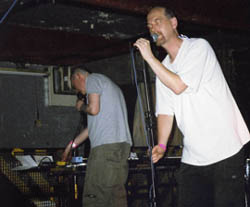
ix) CO: It’s an unusual sound comprising looped sounds, various percussive devices and solid bass throb. How do you compose / construct songs? How important is the studio to Knifeladder? What do you mean by voodoo power electronics?
JM: Knifeladder pieces cum songs are composed/constructed in a variety of ways. It is very much an organic intuitive process between the three of us. Often a piece will be built upon from an original loop or sample that the three of us have had a hand in making, often from very low tech origins and by constant rehearsal and improvisation in both the studio and rehearsal room a song somehow forms itself. Tracks have also been built…constructed…from the percussion and sampler upwards…with gradual and cyclic changing of sounds/samples etc overlaid…over time. Other tracks can be constructed differently – beginning with the bass harmonic throb or the Moroccan horn that Andrew often plays. There is no one set way of working for us. Some songs write themselves literally and we just go with the flow. A track can also end very differently from the original conception but we seem to allow room for this as construction of songs and soundscapes is a very organic process for us. There are no real definitive versions of songs in the Knifeladder side of things: pieces change and evolve constantly everytime we perform them live. The tracks ‘Dervish’ or ‘Scorched Earth’ for example have evolved of their own free will over the past three or so years and can vary quite a bit in live and recorded performance, especially in the use of rhythmic dynamics, and length. We very often use a call and response instrumental / soundscape aspect between the three members in a live performance context.
For our more soundscape and non-rhythmic orientated tracks – only some of which have been presently recorded – and haven’t really been featured on Organic Tracesdue to time restrictions. We have used different methods again in song construction, often constructing a piece from the voice used in a harmonic overtone manner or as an under lying drone or Moroccan horn with other sounds added on at will, playing off one another in a live rehearsal context, working out which sound sits best with another and constantly remembering to not be too self-indulgent and to keep things relatively simple, and to use the recording studio as an instrument in itself. Our ways of working and constructing songs are constantly evolving and changing and we have a few surprises in store for the future in this area.
The studio is critically important to us as is live rehearsal. In the construction of the whole Knifeladder sound and way of being we try and record regularly in our own studio, and as soon as we come with the basis of something new, we attempt to record the bones of it and flesh if out. Some of the material including two tunes (‘Born Under Fire’ and ‘Carousel’) due for release on 2 different Italian label compilations were completely constructed in the studio from literally nothing. This was also sort of the case with ‘Hymn’ our piece on the Operative First compilation, which was built in the Retina studio. All these tracks vary quite a bit from their studio versions when done live. We don’t really think of the studio and live aspect of Knifeladder as 2 completely different things. The studio is really another creative tool for us and unlike some other acts we tend not to be passive, overwhelmed participants when in the studio. Quite the reverse, as we often really go for it!! – ‘Dervish’ being a very good example of this in both the studio and live performance contexts. Many different ideas /sounds and overdubs are tried and perhaps used if they are deemed suitable by the three of us. If not then we often keep these for future use – for other tracks and blueprints.
I am not really sure if Voodoo Power Electronics is an entirely accurate description of our sound anymore. Perhaps we have somehow gone sort of beyond this convenient description now. The others may disagree perhaps. The sounds we use probably are quite a bit more varied than the Power Electronics description. We even attempt to use – horror!! – some melody on occasion from the keyboards, vocals and horns. We have been known to dip our wick into the ritualistic trance, industrial, dark ambient, soundscape areas at times – all these terms don’t really do justice to what I am attempting to say. We try to use many different sounds and do not limit ourselves one particular area which can cause some confusion when people try to pidgeon hole our sound. Still people love descriptions, don’t they??
In the percussive side of things there are a few different things at work besides Voudoun Drumming and rhythms. I have studied middle eastern and Indian tabla percussion, some years ago plus the master drummer aspect of different forms of African drumming which sort of rears its head in some of our work, especially in live performances. Pipehand side drumming which I did for 5 years as a teenager in OZ with a Scottish pipeband…these influences all sort of blend together in the percussive assault on stage and in the studio. Maybe we will have to think up a new more exact and detailed description of our style and sound as unlike a lot of acts around now we are not easily classifiable and cut across a few different musical boundaries and styles.
I hope this sort of answers this question for you – apologies if you all are still scratching your heads in bewilderment.
x) CO: What artists/projects currently hold your interest?
JM: I personally enjoy many different types of music and have a very diverse appreciation of many different musical styles and artists. As far as I am concerned there is only good and bad music. I try to keep an open mind about almost everything I hear and try not to fall into the all too familiar trap of musical cynicism, something I semi-regularly did when younger.
In regards to the current industrial and experimental music scene I appreciate many different artists and acts. A few examples would be the various artists sort of connected with the Hau Ruck label such as: Novy Svet, what I’ve heard of Dernière Volonté, PPF, Der Blutharsch; various Tesco acts such as Anenzephalia; Stateart releases including one from Cyclotimia; other European acts would be Deutsch Nepal, Inade, Tribe of Circle, Thorofon, Scivias, Dieter Muh, Amenti Suncrown, Nocturne, Arkkon, Cyclobe, Coil; some of the Ant-Zen acts such as Imminent; a new Antipodean dark ambient act called Isomer; anything involving Zev; the last 2 NON releases on Mute; Browning Mummery (an old Industrial act and friend from OZ – very good); 2 Polish acts: Spear and Le Plastic Mystification; Aube; various releases from Daniel Mensche, Lustmord, Nurse With Wound, Illusion of Safety and Voice of the Eye over the years; Andrew Liles, Muffpunch, Anti Valium and White Dog all based around London. These are all just examples. In the neo-folk area I think Naevus, Of the Wand and Moon, A Challenge of Honour and the work of Andrew King are the most interesting acts personally speaking. Even though it is difficult to keep up with all the new and latest releases constantly going I try somehow to do my best in these areas. Looking at it objectively I think the whole experimental / industrial / dark ambient / ritualistic whatever “scene” is probably more vibrant than ever – though a touch more originality could be added at times. Still this is something I have never particularly claimed to be.
Outside of this area I personally enjoy a lot of serious classical music (straight and avant garde), film soundtracks, all forms of 50’s/60s early 70s popular music and folk, rock and jazz. Too many composers and artists in these areas to mention and I often forget the names that go with different pieces and songs sometimes. I will always keep an open ear and mind to pretty much anything though most rave, dance and rap / hip-hop music doesn’t really thrill me or indeed attract my interest much. The culture with all this stuff sort of passes me by completely.

xi) CO: You split your time living between Australia and the UK. Why do you choose to do this?
JM: The reason I do this is because I actually can. I have never felt 100 per cent comfortable anywhere and have never really been one of the local lads, so to speak. I have always had an overwhelming urge to see the world and possibly discover myself (man) ever since I was a young sprog. I am usually in Australia for a few months each year where I tend to keep a fairly low profile doing lots of non-career related things. There is no exact reason why I divide my time between both countries it just seems for a good proportion of the last 20 or so years that most of my creativity and work happens in Europe, especially the UK. When I am back in OZ I usually do a bit of recording at a local studio near my mother’s seaside house which is probably one of the best studios I have ever worked in anywhere and for some bizarre reason is situated in the boondocks of southern Queensland, miles from any large town. Other than that, as I said before, I keep a low local profile and do not receive much Antipodean support or interest at all.
One other reason could be that I have a reasonably large support network and musical peer group in London and parts of the rest of Europe who sort of understand where I am coming from and are generally supportive. In Australia I have a network of old acquaintances who often aren’t very supportive at all. Quite the reverse, in fact: some are down right contemptuous and hostile, while others are totally bewildered by the aesthetics which seem to guide my path. The majority of the projects that I have been associated with over the years have received either little or indifferent response from Australian audiences. A lot of the people I know their have become increasingly parochial over the years which has always alienated me. I have had many discussions cum fruitless arguments with various Antipodean pals over the years about what I do etc so in general I no longer bother to keep the majority of them informed of my activities – musical or otherwise. This is just one of many reasons why I spend quite a bit of time outside of Australia. I have had many unusual experiences which would just not have been possible if I had stayed in OZ and I would be a far lesser person for it. I march to a different darker drum so to speak than the majority of Ozites who mostly consider me (if at all) a weirdy ratbag eccentric, if not worse. Why should I bother to have to put up with a local insular mindset when I know that others elsewhere will be more appreciative.
Also another reason is that I personally love being an expatriate from my homeland. This is very stimulating and intellectually satisfying. I feel somehow more alive and this in turn stimulates my thought processes, musical composing and general pursuits. I use my time in OZ as a bit of a breathing space and regeneration period before venturing out once again to parts unknown. I could say a lot, lot more on this particular subject but will shut up for now.
I should also point out that I have met other people from various parts of the globe who have similar things to say about where they came from so it’s not confined to one place.
xii) CO: You seem to be able to travel through Australia and UK/Europe on a reasonably regular basis, how are you able to manage this? I suspect that this might lead to some interesting jobs in order to finance such travels?
JM: This would be telling somewhat but let us just say that I sort of get by – not particularly well admittedly. I do lead a somewhat primitive lifestyle which certainly wouldn’t be for everybody, and I would certainly not recommend it if you want to hang on to your sanity and health. I have paid a heavy price in terms of lifestyle for the musical and artistic adventures I have had over the past 20 or so years. Quite a bit of sacrifice has gone into my endevours and international travels. I am also something of a “scammer” in regards to accommodation, musical equipment and such like, and currently at least do not really have a settled abode anywhere in the world.
Yes I have had many interesting and mundane jobs over the years in both Europe and OZ, which have helped finance things a bit. Examples include: running recording studios and rehearsal rooms in both OZ and London, lots of restaurant work in London and OZ; bar tender; theatrical hand and stage manager; new-age and alternative bookshop co-owner in Sydney some years back.; working in record stores; packing records at various distributors in UK and OZ; session musician in both UK and OZ; telesales marketer; actor in underground videos and films; soundtrack designer for similar sort of films; extra in TV commercials and mainstream films in OZ; antiquarian bookseller in Australia (briefly); assistant in jeans shop (late 1970s); and industrial cleaner at various times. These are just a few jobs I have had to do to earn a crust to continue on my merry bohemian way and enjoy what the world has to offer.
xiii) CO: I believe there is also another John Murphy operating in a similar experimental and /or soundtrack field of music. Is this the case and how much actual confusion has it created?
JM: Yes, apparently this is indeed the case, and it has caused some confusion with a few people, which I have attempted to clear up. Certain friends and acquaintances of mine have occasionally seen a documentary or something similar on Channel 4 in Britain or SBS in OZ or elsewhere which mentioned in the credits that a John Murphy was listed as responsible for the sound design and soundtrack, and that the music or whatever was in a sort of industrial / experimental mode. They just sort of assumed that it was just little me. I had to disappoint them by saying that I had no personal knowledge of the aforementioned documentary or indeed the person involved. This incidentally is an area I would like to explore and possibly get involved with as I have had a little experience in this particular neck of the woods in years past both in OZ and the UK.
There hasn’t been a great deal of confusion but this was possibly the catalyst to me to again start spelling my first name as Jonh, something I used to do many, many years ago in the days of punk in the late 1970s. Running into quite a lot of other John Murphy’s in various parts of the globe may have had something also to do with this. This in turn seems to have confused a few people out there in the international experimental / industrial music arena. Obviously I have shot myself in the foot once again by over estimating people’s general intelligence in the first name department. I will just have to persevere in that I suppose.

xiv) CO: You are involved in is the relatively new Operative Records. What comments would you like to make about the concept of this emerging label?
JM: Well for a start Operative Records as a label and so-called collective came into being towards the middle of 2001 in London. Members of Knifeladder, Naevus, Muffpunch, Rective, Andrew Liles, Ruse, Andrew King, Anti Valium, Gaya of the Hinoeuma Club and a few others got together at a series of meetings cum drinking sessions at various people’s abodes around London and slowly but surely the idea of some sort of supportive label cum collective sort of emerged out of the fog. Some of us felt that there was quite a bit of interesting and innovative stuff happening at various venues such as the Hinoeuma Club in Finsbury Park without much local interest or label support. We sort of perhaps foolishly attempted to do something about this by putting together a compilation CD titled First that sort of showcased what we all felt were the most interesting and innovative acts who hopefully would eventually release their own CDs or vinyl through or on the Operative label. This would be financed partially through the money earnt in sales of First, theoretically speaking, of course.
The basic concept of Operative is to have so called Outsider sort of acts that we all felt were being ignored locally as they didn’t conform musically or conceptually to Brit fashion dictates. It was to give these acts a sort of vehicle; a way in which to get their releases exposed, distributed and to provide a support network. I’m not actually sure if I am explaining the whole thing properly but it is slowly but surely reaching towards its goal. Besides First which has received some interesting reviews internationally, CDs have also been released by Leisurehive, Naevus, Knifeladder and a few more are being planned for the future. These include a possible split Shining Vril CD with Lloyd James of Naevus and his solo project called Retarder. An Antivalium / Andrew Liles split release, a White Dog (Gaya and Joanne of Naevus) CD. All these releases will be self financed so Operative is also an avenue for innovative acts to put out releases and gain distribution through Shellshock in the UK and abroad. That is sort of it in theory and hopefully it will eventually all work out for the best. The concept behind the label is best explained on the website at www.operative-records.co.uk
The Naevus release Behaviour and the new Knifeladder CD release Organic Tracesk have both received more than a bit of interest and appreciation internationally though this is still early days. Both of these acts have also performed outside of London at the Leipzig festival in Germany and have therefore garnered some international fans and interest, after a lot of hard slog around the local traps to little avail at times.
xv) CO: What’s next for Knifeladder / Shining Vril / Foresta Di Ferro and any other acts you’re involved in? Any closing comments?
JM: First of all I would like to say that Knifeladder is not my band!! And I am not their leader. Some people, especially in Europe, seem to have got this idea into their head, at times, so I would like to point out that I am only one of three members who are all treated on an equal basis in terms of song writing terms and in all aspects of the group. We discuss all ideas and plans fully before putting them into practice.
Over the next few months I would say that our main priority is to get Organic Traces properly distributed and sent out to all the people in various parts of the globe who seem to be interested. We also plan to perform live outside of London hopefully. We would like to take up some possible offers of shows in the north of England, and different parts of Europe mainly Italy and possibly Germany and Belgium. We also have some tracks appearing on a few European compilations and samplers. Some of which are due to be released very soon – though you can never really tell with these sort of things. Two pieces are on two different Italian based compilations: one track ‘Born under Fire’ on the Oktagon compilation Audacia Imperat and another piece titled ‘Carousel’ which is a recorded reinterpretation of an early Knifeladder live track appears on the Italian compilation Tal Mont De Lune due for release soon by Nail Records. I should also mention that Shining Vril has two tracks (‘Conquest’ and ‘A Secret God’) on these compilations as well.
We also intend to record (for an eventual second CD release plus some possible compilations) over the next few months. Some of our newer less rhythmic orientated material – which will certainly showcase other not so obvious aspects of the Knifeladder sound and maybe introduce some new unusual sounds, recording techniques and instruments. These may also feature some unexpected “guest ” vocals/voice. These are ways to widen our sound and to introduce the unexpected. We all enjoy confounding expectations and are determined not to fall into recording or live/performing clichés with all our newer material especially. We are worried about falling into a formula in our general approach.
Finally, very recently someone in Europe has just approached me and Knifeladder about something new which may open up a whole new field for us to possibly explore in the long term. I will leave this for all of you out to ponder. . .
Shining Vril will continue to appear on various European and perhaps American compilations and samplers. I have quite a few tracks appearing on various so called European based V/A tribute “compilations”: including one for Ain Soph which was supposed to be released by Oktagon; a track on a sampler being put out by Die Tat mag of Germany; the two aforementioned Italian based compilations and maybe a piece on a Scott Walker tribute that someone in Spain (I think) is putting out in early 2003. I also intend to slowly record more material and eventually release a full scale self financed CD or album, probably through Operative Records, though this will entirely depend on personal finances. One or two European based labels have also expressed some interest in releasing some Shining Vril material as a CD or similar so we will have to see. Lloyd James of Naevus and myself have occasionally talked about doing a joint Shining Vril/Retarder CD release sometime in the future. Retarder is the name of his solo project. Anyway expect some Shining Vril full length release sometime in the not too distant future and also expect some possible Shining Vril live performances – probably in London and maybe Italy, Denmark and Germany. It’ll probably be with both Knifeladder and Foresta Di Ferro or something similar.
Two other releases that include sounds cum “bits and bobs” from me are the second full length release from Sword Volcano Complex on Triumvirate Records in the USA and the debut full length CD release from Foresta Di Ferro, Marco Deplano’s project. This will be released released through Hau Ruck – Albin Julius’s label in Vienna. Both releases should be out early in 2003 or thereabouts.
There may be some new recorded KRAANG material out through Tesco from Germany some time in the not too distant future. I am due to start work on new tracks pretty soon. These will be the first new pieces recorded since the late eighties.
Tesco will also be releasing some old material recorded just over 10 years ago in Sydney, Australia, which I was involved in along with my good friend Dominic Guerin who was one of the main and original founding members of SPK back in the late 1970s and another old friend known in the experimental scene in Oz named Jon Evans. This will be released under the name of Last Dominion Lost, and the title of the CD and vinyl album will be The Tyranny of Distance. It is in parts somewhat similar in sound perhaps to Leichenschrei period SPK – make up your own mind. That seems to be about it for now I guess!!
(Addendum: after this interview was complete John Murphy reported that a Whirlywirld CD – The Complete Studio Works had been issued on CD by the Australian label Missing Link.)
(Source: http://www.compulsiononline.com/falbum7.htm)
More Info At: www.knifeladder.com
> A DOUBLE-HEADED SECRET: AN INTERVIEW WITH CYCLOBE by Russell Cuzner (2012)
Cyclobe, the ex-Coil duo of Stephen Thrower and Ossian Brown, have spent over a decade honing a beguiling blend of electro-acoustics and folk instrumentation. Ahead of their show at this year’s Meltdown festival, they speak about current projects, the occult and their friendship with Coil.
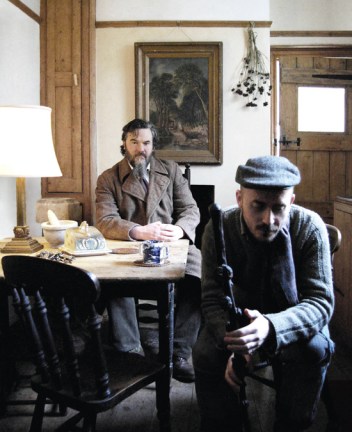
Photo by Ruth Bayer
Not to be confused with the one-eyed giant of ancient mythology, the Cyclobe is an elusive, two-headed beast formed of ex-Coil members Stephen Thrower and Ossian Brown. While a first sighting came in 1999 with the release of Luminous Darkness, there have only been a handful of other occasions since – three further albums and a single live performance – that have given the outside world a chance to witness their extraordinary anti-corporeal blend of electro-acoustics and folk instrumentation. Such a refined yet undefined sound is arguably born of a range of dualities that merge serendipitously and fork philosophically to weave a beguiling, and at times genuinely scary, set of propositions in sound.
Yesterday Cyclobe announced that their debut UK performance – their second ever – will take place at the Antony Hegarty-curated Meltdown festival at London’s Southbank Centre in August. Part of a night themed Albion – Hypnagogue – Ghost: Hallucinatory Queer British Paganism, they will perform live alongside David Tibet’s new project Myrninerest. Four films by Derek Jarman will also be shown, alongside newly composed and recorded scores by both artists.
In advance of that performance, Ossian and Stephen recently took time out to chat with The Quietus about their most recent album, 2011’s Wounded Galaxies Tap at the Window, the complex paths that led to its arrival, their friendship and collaborations with Coil’s Peter ‘Sleazy’ Christopherson and Jhon Balance, and beyond.
RC: The latest album took five years to complete, perhaps the longest gestation period of any Cyclobe album. Did you have difficulties with recording?
Ossian Brown (OB): We very rarely start a piece and keep working on it until it’s finished. After the initial sketches are laid down I find it’s good to leave it for a while, so it can germinate in the back of our minds, release spores, so ideas about where we could take it come to us organically. It’s a slow process for us. It’s almost like our recording periods operate in a different time altogether, scattered throughout a year… throughout years in some cases. It just takes time to really see clearly what path we should guide it down. It has to feel completely alive to us, to hold a magic and complexity we find compelling emotionally, so a lot gets added and then disregarded, until we find the key we need.
There were difficulties and it can be very stressful, exhausting sometimes… I can be very obsessive when we’re working, and can hang on the most minute detail. Getting it right can become a huge issue. For instance, I don’t like to think about instruments when I’m listening to our music, the experience has to be completely emotional, I don’t want to think about what model of synthesizer’s being used. The magic cracks! It’s spell-shattering. I want to make music that’s timeless, almost as if it were found growing on a rock, inside a broken piece of meteorite, in a starfish’s stomach!
I feel these days, personally, we get bombarded with just about every thought anyone ever has, every scrap of sound gets uploaded the moment it’s made, so much of it is unconsidered. There’s a storm of it all, a gigantic dirt cloud. The thought of it makes me feel claustrophobic. It seems to be the nature of things these days, and people are surprised when you don’t play that way. It’s so hard to navigate your way through it all and find really interesting work. I’m not saying music has to be complicated, or that it has to take a long time to make to be interesting, but I do think people need to take more time. The world is too ‘now’ orientated and we’re littering, smothering each others’ minds with all this uncensored mundanity.
Stephen Thrower (ST): I’m still a bit shocked that we took so long, actually. Some pieces were extremely difficult to get a handle on; they sounded almost finished for what seemed like an age, but every time we tried adding the finishing touches nothing worked… The title track actually started life during The Visitors sessions [their second album of 2001], but only came to a conclusion the year we released it. We both have a very selective attitude to what we do, and any new piece has to get past two very stroppy gatekeepers! There’s no casting vote (we’ve tried it – doesn’t work). Lots of arguing, lots of walking out in a rage, lots of banging your head against the studio wall. It’s rarely a peaceful process, but out of all the Tasmanian-Devil arguing, comes stuff we really think has its own unique identity, so I guess we have a method!
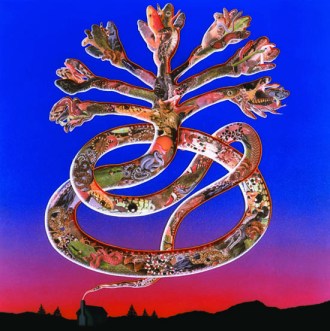
RC: The Wounded Galaxies cover created by the American artist Fred Tomaselli depicts a seven-headed serpent, a symbol that enjoys a wealth of associations across several ancient mythologies and is even the badge of the Symbionese Liberation Army (who kidnapped Patty Hearst in the Seventies). What lead to you choosing it for the album?
OB: It’s a stunning picture, astonishing, and we just felt emotionally, abstractly, it conjured so much of what we wanted to express with this collection of recordings…
Fred was so kind to let us use it. It’s a Naga, a nature spirit. In Tibetan Buddhism they’re beings, snake deities sensitive and vengeful of mankind’s disrespect and ignorance of nature, sensitive to the pain of nature’s suffering and the gradual devastation of our natural world. They’re also known in Buddhism to transmit ‘Termas’, hidden treasures of knowledge, concealed teachings in and out of the human realm. But it’s the nature spirit aspect I really responded to. The Patty Hearst connection isn’t really of interest to me.
ST: I was unaware of the SLA usage until afterwards! I know of them, naturally, but I’ve never really studied them. For me, the pleasure of the picture is twofold; it suggests some sort of slithering, airborne creativity emerging from a tiny source (which would be us, naturally), and also it responds to the title rather than illustrating it. It’s a welcome committee for those wounded galaxies! Plus, snakes are just sexy. I’d make it with a seven-headed snake. Who wouldn’t?
RC: You’re both published authors, with Stephen as a leading expert on horror/underground cinema and Ossian’s recent publication of his collection of antique Hallowe’en photographs, and you have both previously alluded to esoteric beliefs including paganism and magick. Indeed, your piece ‘The Woods are Alive with the Smell of His Coming’ (subtitled ‘A Hymn to Pan’) premiered in an exhibition at Tate St. Ives in 2009 that explicitly explored ‘Magick and Modernity in British Art’. Are you active practitioners of esoteric beliefs or do you enjoy a more scholarly or inquisitive relation to the spiritual side of things?
OB: We premiered ‘The Woods Are Alive’ alongside Mark Titchner’s excellent ‘Protection’ sculptural piece, Austin Osman Spare, work by David Noonan, and Graham Sutherland’s fantastic dark landscapes. Having our piece played in close proximity to such a great collection of work felt perfect to us. The Tate was being bombarded with coastal storms that day, with rain pounding the glass ceiling – it made quite an atmosphere when we played our piece.
I consider myself pagan – [Coil member] Jhon Balance used to call me a hedge witch. Well, that’s me alright! My beliefs feed enormously into the work I do, the art I create, of course it couldn’t be any other way. I’m not a member of any group though, I’m not interested in joining magickal organizations. I’m not following strict recipes. It’s all very instinct-based for me, intuitive and personal, it’s very nature-based. I think we become sensitive when we’re working, it can feel like we’re touching, conjoining with something magical that’s expressing itself through us, that we’re interpreters. When I work I like to think it has an effect, that it’s active, very much so with a sense of invocation. I want it to be charged, to change things, to move people, transform spaces.
ST: Ossian and I have different takes on all this. He’s intuitively in sympathy with magickal ideas. I think we create these beliefs to explain the things that we do, and then we put it out there as an external force, partially to look at it and get a grasp of it through symbolism, and partly because it gets lonely in your own head. I’m sympathetic to the idea of hermetic or communal challenges to consensus reality, the desire to carve non-rational world-views, though I’m a bit more wary of them than I used to be. I’ve become more distrustful over the last ten years. We’re heading for a second dark age with organised religion as the enemy. ‘Exterminate all rational thought’ makes a good T-shirt, but you need to give a rat’s ass about who’s going to come knocking afterwards, when you’re lying in the irrational rubble. And with the various God squads on the march around the world, I have my concerns about what the real world effect of too much repudiation of the rational might be. I reserve my interest in these things to an appreciation of the poetics.
Paganism is a bit different though – less ‘esoteric’ and ‘abstruse’. At the core is a desire to embrace and celebrate mankind’s place inside nature, rather than placing us outside it, as the sky religions try to do. I’m very much in favour of that… From the folds of the intestine to the spray of supernovae we’re as much embedded in nature as the birds and the insects and the galaxies. (I loathe that bit in the Bible where God supposedly gives man dominion over the animals, which epitomises the human race’s sense of entitlement and separation from nature.) There’s awe in the Pagan mindset, but it’s awe arising from contemplation of the majesty and beauty of nature and the universe, which works for me. And there’s still plenty of mystery at the edges of science – quantum, cosmological or psychological – to excite my imagination. As Ossian said to me recently, “Nature doesn’t end where space begins!”.
RC: While your music remains among the most elusive to describe (let alone imagine how much of it’s made), it is often described as ‘psychedelic’. How do you feel about that oft-used term and to what extent have altered states defined your sound?
OB: We were amphetamine and mushroom boys! Listening to music and recording music was a huge part of the way we experimented with psychedelics and amphetamines, although it’s not something we do any more, not for many years now. The neural pathways have been burnt in, though, they’re permanent, so the doors are always open. Perhaps we have a magnified psychedelic sensibility now, which we intuitively locate and work with.
The word psychedelic has so much baggage, a lot of tired associations that in truth for me anyway were pretty disappointing in regards to music. I never really explored Terrence McKenna’s writings or found myself drawn to Timothy Leary. When I hear a lot of psychedelic music, my mothership starts sinking in the mud! Psychedelic music should be such an enveloping unearthly experience. Kaikhosru Shapurji Sorabji, that’s psychedelic to my ears.
ST: I guess the fact that the word is still around means it’s the best we have to describe music that evokes altered states of consciousness. The best experience with music is transporting, where the limits of your room and your life and your consciousness lift away to reveal a wider vista that you have no control over, and you’ve never experienced before. Whether this chimes with your experiences with acid, or meditation, or fasting, or concussion, or hospitalization with acute schizophrenia, the point is that music can lift you out of your own head and show you other lives and other panoramas. A great piece of music can change the emotional temperature of the room in an instant (well, even a ‘bad’ piece of music can do it – it’s the most powerful medium for changing people’s moods, I think, more than any other art form, because it’s so damn quick).
I don’t take chemical ‘mood enhancers’ very much any more though. For the music that we make, I’m drawing on deeply imprinted memories and stored insight. If I try topping up the vessel these days, it leaks. One hit of a joint and I’m hopeless. The last time I took speed I ended up in agony. My balls shrank so much I thought my body was trying to eat them – try explaining that to a locum on night duty at A&E! The only things that still work as they were meant to are mind-wiping extremities like K, but I don’t go there very often.
RC: In the eighties, you both upped sticks for London within a year of each other when Stephen joined Jhon Balance and Peter ‘Sleazy’ Christopherson of Coil, as they moved away from their work in Psychic TV, with whom Ossian subsequently became involved. Yet the two of you didn’t meet until 1993 in what retrospectively could be viewed as a kind of tag-team manoeuvre: Ossian moved in with Coil at the same time as Stephen was leaving the band, meaning that the two of you were never part of Coil at the same time. Was all this simply down to serendipity?
OB: Yes, I just missed Jhon and Sleaz when I moved into Gen’s [Genesis P-Orridge of Throbbing Gristle / Psychic TV] house in London in the mid 80s. If I’d been there a couple of years earlier I’d have most probably left with them when they went their own way and formed Coil! In a way, subconsciously I was looking for them, looking for Steve, but I didn’t really know it then. I think we were all looking for each other. I’d always felt estranged, somehow, until I met Jhon, Sleazy and Steve… That was really when I found my family so to speak, my queer family.
I was only 17 when I first started working with Genesis, I’m several years younger than Steve and Jhon. I was still skipping to school when they started hanging out together, with my stick and hoop. I was just drawn to that hive of activity, the feeling of a magickal arts collective, and to the music, very much so, which was largely influenced by Sleaz’s contribution on those first two PTV albums, and the films like Sleaz’s Polarvision and Terminus. John Maybury’s hallucinatory short for ‘Unclean’ was excellent, mesmerizing, watching Leigh and Trojan, John Gosling swung upside-down naked. Derek Jarman’s involvement of course drew me as well. That’s how I first came into contact with Austin Spare’s visionary art, his magical ideas, he became a huge influence on me and I’m still an avid collector of his work.
Me and Steve met earlier than 1993, but that’s when we became partners. I first met Steve at Jhon and Sleaz’s, all of us having been up for several nights tripping on MDA. That must’ve been around 1990, just as I was about to move in, after they’d finished recording Love’s Secret Domain. On reflection it was odd, initially. Steve used to come around and work there, using Sleaz’s word processor to make his magazine, Eyeball [a journal of ‘Sex and Horror in World Cinema’], in the room next to my bedroom. We’d talk a little, but relationships were getting raw between Jhon and Steve after LSD. Everyone was burnt out after those sessions. The very first time we made contact, though, was at a Butthole Surfers show. Sleaz was doing the films for it. Steve and Jhon were hanging around with the Buttholes a lot back then, and we met each other in the audience, not knowing each other.
ST: One of the things you get involved in music for, when you’re queer and living in some small town or other, is to mix with people like yourself, who share your sensibility, and also to try and find a life partner to share it all with. Coil were my family, really, when I moved to London. They brought me and Ossian together and for that and many other things I owe them a massive debt of gratitude. It’s still hard to believe they’re both gone. It’s almost as if they’re pulling some massive headfucking prank. With Jhon there were warning signs, but Sleazy… I feel as if huge parts of my past are melting away. So many of the people who were important to me in the 1980s are gone. And to think they used to lecture me about having a death wish and taking too many drugs – well I outlived you both, you nagging bastards!
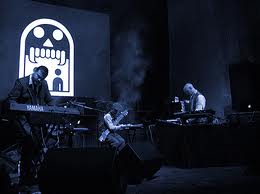
RC: Before the sad and untimely passing of Coil’s Jhon Balance at the end of 2004 and Peter Christopherson six years’ later, were there ever plans for all four of you to work together?
ST: We’d patched up our differences by about 1998 and got close again. Both Geff [Jhon] and Sleazy liked what we were doing with Cyclobe, and I was very impressed by their Moon Musick records. By 2002 we were discussing plans for a Coil/Cyclobe record called Wormsongs – but it remained more of a chance for us to swap ridiculous song titles and cover concepts, not so much a musical thing. We never got it onto the starting blocks, sadly.
RC: You’ve just announced Cyclobe’s premiere UK performance as part of this year’s Antony-curated Meltdown Festival. How did it feel to be selected for the Festival and what sort of set are you planning?
ST: To receive the invitation from Antony was such a thrill – a great artist and a beautiful human being. My first instinct was to say yes loud and clear.
OB: We were so thrilled that Antony asked us to perform at Meltdown, really flattered. There’s a very queer, very pagan current running throughout the evening, threading everything together, which is important to us and to Antony. The evening is called ALBION – HYPNAGOGUE – GHOST, and it’ll be our first ever concert here, and only our second since we formed, so it’s an important step for us creatively. We’ve been asked to play live many times over the years but it’s rarely felt right. Looking back, I think we really had to finish Wounded Galaxies first – we needed to realise those pieces before we could consider expanding into new territory.
We’ll be performing with our friends Michael J York, playing duduk and border pipes, and Cliff Stapleton with his hurdy-gurdy. We’ll be joined by Ivan Pavlov (COH) and Dave Smith (Guapo) as well, so it’s a close family supporting us… We’ll be premiering some new Cyclobe recordings, including a beautiful, mesmeric piece with a very special guest – but our lips are sealed on that one! The theme of the evening was also an integral part of Coil, so that same spirit is there. We’re drawing our water from the same well, there’s a strong feeling of shared ancestry, of our heritage. David Tibet’s close friendship with Jhon Balance is the focus of the new work he’ll be premiering with his group Myrninerest. We’ll also be screening some rarely seen films by Derek Jarman, showing four of his magical and hallucinatory short super-8 films made in the early 1970s. Hugely inspiring and evocative work. Myrninerest are recording a new soundtrack for Derek’s haunting short film A Journey to Avebury, a meditation on one of England’s most important pagan monuments – it was Jhon Balance’s favourite Jarman film.
ST: Ossian and I are writing three new scores, for [Jarman’s] Sulphur, Tarot and Garden of Luxor- Derek would just play records when screening them, so they’ve never had specially composed ‘soundtracks’ as such. We’re so happy to be working on them for this event. For me it’s the first time I’ve put sound to Derek’s images since my Coil days, working on The Angelic Conversation back in 1985. I knew Derek very well in the 1980s and spent a lot of time with him, he was one of the first people I bonded with when I started to come to London and visit Geff and Sleazy. I grew so much and so rapidly thanks to his influence. Derek had that spark about him, he was one of life’s great energisers. There was never any wasted time in his company, he was alive in the fullest sense and a massive inspiration to me.
When he contracted HIV and developed AIDS, he took the path of most resistance and really pushed himself into the public arena, at a time when hardly anyone was speaking out in a combative way against the hate and ignorance peddled by mass media and government. He could have just retired and cocooned himself, but instead he went out and fought tooth and nail. He was right in there at the birth of Queer politics, attacking conservatism and conformity in both hetero and gay culture. He had the balls to stand up against the vileness coming from the gutter press, and the eloquence to deal with ‘educated’ but unsympathetic media types whose homophobia was couched in sneering sophistry. He could take your breath away sometimes – such a strong and intelligent man.
Being able to present some of his amazing short films is very meaningful to me; Derek was one of the vital forces in my younger life, so screening these beautiful films is a way for me to reconnect with that vitality, and share it with an audience who perhaps have never seen his Super-8 work projected before.
RC: Are you perhaps now experiencing an accelerated phase of composing and recording and, if so, can we expect its results in the near future?
OB: We’re more than halfway through the next album, perhaps even three quarters done. With much the same line-up as Wounded Galaxies… and also with Dave Smith from Guapo, who’s been working on percussion for us. We’re extremely excited about some of the new pieces, they’re all just uncurling slowly, although I do think we’re working a little faster now. It is difficult though, ideally we’d like to spend more time recording, but we get distracted by other projects and necessities. We’re hoping to have it released for spring next year.
In the meanwhile this year we’re going to release an expanded version of The Eclipser on CD and vinyl. We felt we could go much further with those pieces and didn’t want them or Alex’s [Alex Rose who designed the sleeve of the original 7” release] incredible work to vanish in a limited edition. We also have recordings made to accompany my book Haunted Air, which will be played at some exhibitions I’m planning… And our soundtracks from Derek’s Sulphur, Tarot and Garden of Luxor. There’s a plan to make The Visitors available again on CD and vinyl as well. I’m hopeful we’ll find the time to do all that.
ST: I believe the new album contains some of our best ever material. I’m very excited about a couple of pieces we’re close to finishing. One track called ‘Arc’ we actually played live in Austria a few years ago. The studio version is a monster, and we’re planning on doing it live at the QEH [London’s Queen Elizabeth Hall, where much of the Meltdown Festival will be staged]. I think it will cut a few heads off when played nice and loud!
Cyclobe perform at Queen Elizabeth Hall on 4th August as part of Meltdown, alongside Myrninerest and films by Derek Jarman.
(Source: http://thequietus.com/articles/08680-cyclobe-interview-meltdown-wounded-galaxies-tap-at-the-window)
> WILLIAM BENNETT (WHITEHOUSE/CUT HANDS) Interview by The List
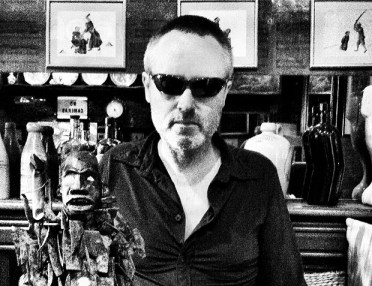
THE WHITEHOUSE FOUNDING MEMBER CHATS ABOUT GHANAIAN PERCUSSION, JAPANESE THEATRE AND A BERLIN POWER STATION
TL: You just came back from playing Berlin Atonal – how did it go?
WB: It was an unforgettable experience – the Kraftwerk venue is the disused heat power station in the East of the city and they’ve converted it into an enormous, incredible brutalist cathedral-like space with a huge laser-sharp sound system, and visuals and lights to match. It’s an absolutely fantastic place for seeing live music.
TL: What’s the plan for the Summerhall show – will there be any of the visuals from previous live shows (featuring African subtitles, voodoo and joujou inspired symbols, monochrome scribbles etc…)?
WB: Oh yes! Since that last time, lots of new stuff has been added and adapted to many of those original themes and best of all is the recent exciting transition to full colour.
TL: In your Whitehouse days, you once said you wanted to create, ‘a sound that could bludgeon an audience into submission’. When you first started Cut Hands what did you hope it would sound like?
WB: Until I began learning more about my collection of Ghanaian percussion instruments, I was never really sure how it would sound. Only that the Haitian musicians I’d seen were making some of the most mind-blowingly intense music I’d ever experienced, with almost none of the electronic technology that I felt that I’d become addicted to deploying.
TL: Last year’s Black Mamba was a very full-on, beautiful, polyrhythmic exploration of drums, ritualism, darkness and driving energy. How did it differ from your first Cut Hands record?
WB: The debut album Afro Noise I could probably be described as more eclectic in scope and certainly has more abrasive noise elements, probably because it was recorded over seven or eight years, some of which were during the Whitehouse years.
TL: What would you say were the themes influencing Black Mamba?
WB: It’s very hard to distil all those individual often complex themes, however in general terms it is to make things happen that you previously thought were impossible.
TL: Any plans for other releases coming up? As Cut Hands, or anything else?
WB: The new EP, ‘Madwoman’, on the Downwards label, just came out this week which is exciting, plus some music on new film soundtracks too including the just-released Kings Of Cannabisdocumentary.
TL: Besides your own record labels, which labels do you keep an eye on for interesting releases?
WB: It’s really a golden age in underground music at the moment. In addition to Blackest Ever Blackand Downwards, I also closely follow what comes out on Hospital Productions, Modern Love, Panand others.
TL: You seem like a tireless trawler of all kinds of musical styles to find new rhythms, artists etc – have you made any interesting discoveries lately?
WB: It’s true, I’m constantly lusting after potential new inspirations. Most of that comes from the voracious consumption of books and films however, rather than the musical domain. Currently I am wallowing in the brilliant treatises of Zeami Motokiyo, the Japanese 14th century Noh playwright. Despite never being an actor, I love finding ways to apply the principles of drama across to musical performance.
Summerhall, 8 Aug, 8pm, £8 (£7), with support from Stefan Blomeier and Claire.
More Info At: http://edinburghfestival.list.co.uk/event/355418-braw-gigs-presents-cut-hands-stefan-blomeier/
(Source: http://edinburghfestival.list.co.uk/article/53446-interview-william-bennett-aka-cut-hands/)
> AUTOGEN – Mutagen CD Review by Marc Tater (Chain D.L.K.)
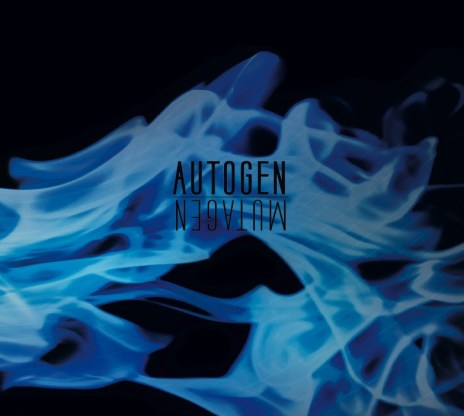
I know that I should have written this review months before, but unfortunately I lost track in between, so this one comes out late. The debut release of Autogen out of Latvia promised to be one of the outstanding releases during the last months for the Dark Electro/Post-modern Ambient/IDM genre. It is an experimental Electronica project by Kaspars Kalnins, also known under his pseudonym Kaps. He is maybe better known for his involvement in the Electro/Industrial project Rosewater or as being the founder of the Latvian cult label Sturm. Kaps is surely one of leading forces behind any activity of underground-related music in this small Eastern European country. This debut album is a collaboration release between Sturm and the new Singapore-based 4iB Records, which concentrates to present Ambient / Noise / Martial-Industrial styles. Autogen has been firstly discovered with an appearance on the latest Sturm compilation ‘Sturmer 4’ DCD set (‘Par Veelu’), ‘Mutagen’ now collects all tracks written in between 2008 – 2012.

Ever since the establishing of Autogen, this project has been often active with rude live performances and has visited numerous industrial and fetish clubs in Latvia, Finland, Belarus, Hungary, Denmark, Lithuania, Estonia and also Bangkok in March 2012. The shows of Autogen are for parental usage only, they often display cruel scenarios of blood, gore and fetishism. The musically direction of this debut tends clearly into the field of demanding Dark Electro music. Projects like The Klinik, Mortal Constraint, or Disharmony have to be named to throw in possible quells of inspiration, although this album in its presented quality would also well fitting side by side with some highly praised signed to the US-based Tympanik Audio label. And so this album explores a wide range of dark and cold sounding Electronica styles and leaves out warmer and smooth sounding ingredients. The work of Mortal Constraint or Ingo Lindmeier’s Polygon-project in its early recordings is surely witness for tracks ‘Nevajag’, ‘Trakumaa‘, or ‘Suurums‘ in its existence. Massive applause for the rather deep drowning, stone-cold Modern-Ambient-like tune ‘Vakaraa‘, one of my personal favorites. That this album is also able to scratch some inner nerves can be discovered in ‘Nederings’, the ideal and raw soundtrack for your next dentists visit. ‘Mutagen’ is a brilliant collection of tracks full of creative sound-design with matured programming skill. No pseudo-aggressive Techno kick-and-snare-bawling on here, ‘Mutagen’ is rather designed to freeze your brain. A nice, cinematic, but also ice-cold sound-trip not to be missed. Get it! (Reviewed by Marc Tater, Chain D.L.K.)
More Album Info: https://4ibrecords.com/online-store/#Autogen
(Source: http://www.chaindlk.com/reviews/?id=7720)
> BIZARRE UPROAR Interview by Purestench
BU: 2005 was changing point due the fact that I got reherseal bunker of my own. I had a possibility start to collect large metal sheets, I bought several 3m long heavy chains(heavier one was/is 15 kg).. you know things got into very physical and loud as fuck. Big amps also got into the picture. Besides environment and all junk etc. one major difference comparing to before 2005 was that I started to aim performing/recording live. earlier it was more or less “studio” tricks. BU sound at the moment is a combination of junk/chain and putrid slowly evolving electronic buzz . Rotten walls of epic filthy noise. Nasty vocals, in your face and buried. I like to mix those 2 styles. Pretty minimal approach not much going on at same time.. usually just two elements going frw molesting the listener. that’s the foundation. tracks usually 15 to 20 min. Its like a fist fuck session. starts pretty mildly to strech your arse hole. one finger, two finger .. .. whole hand. fist forth and back. it hurts at some point but in the end maximum pleasure. feeling a bit dirty afterwards hah. Have you been fist fucked Ryan?
 PURESTENCH : “Lily the Flesh” seemed to be a “turning point” for BU.The change wasn’t drastic but was very apparent. What was it about this tape that made you shift the sounds? Also, why did you choice the video Lily the Flesh out of all the XXX videos that are floating around out there?
BU:“Lily The Flesh” was aimed for VHS-filth themed compilation, its on progress and I am not sure is it ok reveal details about it. So I shut my mouth. Anyway I went to bunker w/ VHS player and TV. the actual film plus few loose ideas. result was very pleasing, dirty and eerie. It came out such a long piece that it fitted better for BU full lenght release of own instead af compilation. “Lily The Flesh” was a homevideo made by NALLE VIROLAINEN and friends early 90`s .. 1991 maybe? Sold throught XXX magazine`s personal ads. S/M, Piercing, piss/shit etc. one female involved there “IIRIS” what a character, religious person.. Her Monoloque on film is brilliant(“Thank you Jeesus”) At one scene she is on leach as a dog, outdoor at one small park in Kallio, Helsinki. She starts to eat crass. another scene she is riding on Nalle`s cock and eating raw meat.Doing some animal sounds. hah! IIRIS gave paid sessions back then I gave her a call few times but didt had guts to go see her. She seemed a bit unbalanced person. That was the main reason I decides not to go. NALLE VIROLAINEN was editor of “CHAINS” S/M zine and “LYKANTROPIA” film zine late 80s and one of maker of “ROSKAELOKUVAT” book. Throught his writings I got introduced to ILSA, Cannibal films, Nekromantik, sadism and masochism etc. everything a kid need to grow up. I was 13-14 at time I ordered his zines.
PURESTENCH : Sex and violence is an explicitly clear influence for Bizarre Uproar. What is it about sex and violence that is so intriguing to you? How does it play into your music?
BU: Sex=Violence. What else interesting there is besides Cum and bizarre activities? that’s the reason to wake up in the morning. keeps the putrid wheels rolling. Essence of everything. Those two are true ying and yang.PURESTENCH : A lot of Noise/PE artists don’t seem to be into what they write about, but from watching the videos on the IOPS dvd’s and reading the Puudeli blog it seems that you are completely into what your material is all about. What was it that drew you into humiliation, dominatrix’, filth, scat, perversions, etc?
BU: You are or you are not. I am. I have always been.
PURESTENCH : What are some books/videos/magazines that are particularly interesting to you? Snuff – do you think that snuff films exist? If so have you ever seen one?
BU: As a younger I did collect stuff a lot. Now as an older gentleman I use all my energy to get real life experienses/sessions etc.
SNUFF as a film where someone is killed for purpose to sell it for big euros. I would say I don’t think so. Killings are filmed for personal pleasure/use/trophy/ of course but not to sell. Intriquing idea. I wish someone could be degenerated enough to do it.
PURESTENCH : How long has Ms. Uproar/Fallen Angel been your dominatrix? Has any session gone too far, i.e. have you ever had to be hospitalized or hurt really bad to the point that it wasn’t arousing but just plain painful?
Eye infections and once her sharp nail teared big chunk of flesh inside my mouth, after that human toilet paper activity .. Not very wise way to take care of open wound hah!..But there is more. Everything is not what it seems like to be…

PURESTENCH : You should write a detailed book with pictures about your experiences with Fallen Angel, I bet that would sell quickly. Speaking of books, can we expect another book in the future? Or maybe some type of collection of Pasi artworks?
BU: 2012 Feb. I will be part of exhibition in Helsinki w/ SIIKALA & ASPA. There is also 3-way artbook in progress.PURESTENCH : The visuals of Bizarre Uproar and Filth & Violence are coherent and obviously very important. Are you involved with the art for every release on the label? How important is art overall to both the label and Bizarre Uproar?
BU:I use a lot of time to get dirty enough result. Yeah I am involved w/almost every release artwise. Hmm visuals have been in a big role w/ BU but like last live I played it was in complete darkness. Also upcoming LP going to be just one painting.. Important but might change from minimal to full on fireworks of filth.PURESTENCH : How do you choose what to show on the projector or what acts to perform during a live show?
BU: It changes a lot. Like said from total darkness to multi projector thing( like last year one gig w/ one own production female scatloop video and nigger gay porn) Of course there is always some red line some idea, video needs to back up the sounds and other way around.I belive upcoming live things will be without anything extra just filthy noise.
PURESTENCH : When you play live do you have a set idea of what is going to be played or is it mostly improvised?
BU: Some spine where is a some space for improvising.PURESTENCH : Your first project “Aunt Mary” was an energetic Noisecore band. What made you go from Noisecore to Power Electronics? Will we ever hear any new Aunt Mary material or is that a dead band?
BU: I have said this somewhere earlier.. to make it short. AM demised I did continue alone. Did kind of noisecore stuff. fast bursts of rough sounds. What happens when you put a lot of that kind of stuff together. lots of layers. pretty much harsh noise. I did cut up stuff at some point. idea to make structured pieces came 2005. everything has evolved slowly..
BU: Oh well I do not think a much of genres when I am releasing stuff. if its crude, nasty and original. I am interested. Connection comes from some individuals who are involved in both scenes. Typical ug metal consumer hates noise most likely. And cannot blame. There are so much utter crap around. Weak shit.

BU: They are ALL very important for me. Cannot pick any faves.PURESTENCH : What are some current projects out there that you have been listening to a lot lately? What are some of your favorite albums right now?
BU:I listen a lot of F&V stuff before they get released. Now Its been time for HALTHAN Live, GOLDEN RAIN Live, RAPE, POGROM Live plus new Full length, BIZARRE UPROAR “Viha&Kiima” LP master etc, etc.
PURESTENCH : What does Bizarre Uproar have planned for 2011? London Live first of October.
BU: “Viha&Kiima” LP hopefully end of the year. One private Helsinki bunker live. Recording sessions.
PURESTENCH : Thanks a lot for doing this interview. Final comments.
BU: Thank you.
(Source: http://purestench.blogspot.sg/2011/07/interview-bizarre-uproar.html?zx=584af03834c53fcd)
> BRIGHTER DEATH NOW, IRM, .NYCTALOPS. & Четвертое Состояние Смерти Live in Moscow on 14 Sept 2013

DATE: 14 September 2013 (Saturday)
TIME START: 1900hrs
VENUE: DOM, Moscow, B. Ovchinnikovskiy Lane, 24, Build 4, RUSSIA
More Info At:
www.dom.com.ru
https://www.facebook.com/MPECPromo
BRIGHTER DEATH NOW
IRM
NYCTALOPS.
> BLOOD AXIS Biography
Emerging officially in 1989, Blood Axis is the result of much earlier foundations. Created and directed by Michael Moynihan, it has been and remains a sincere and uncompromising expression of his often controversial thoughts and instincts.
The first recordings by Blood Axis consisted of “Lord Of Ages” and “Electricity,” two songs appearing on a German sampler CD. Thoroughly unique in their sound, the first of these tracks is a stirring orchestrated hymn to the ancient Persian sun deity Mithras, a god later adopted for a cult of subterranean worship by the legionnaires of the imperial Roman army. Although appearing on a relatively obscure release, these two initial efforts resulted in extensive radio airplay, dance club rotation, as well as mail from hundreds of enthusiastic listeners living as far away as Scandinavia, Malta, Eastern Europe and Thailand. Blood Axis had made its mark.
The band again inspired a rapturous response with the contribution of a pair of further songs to the acclaimed collection Im Blutfeuer,demonstrating more highly involved recording techniques and the ability to hypnotize listeners with subtle yet forceful atmospherics. “The Storm Before the Calm,” the second of the two tracks on this CD, utilized winding piano loops, lilting choirs and the eerie sounds of early nature recordings (a thunderstorm from 1935) along with earnest vocals and historical samples to create a sound that is more than the sum of it parts, possessing an ineffable power.
In the last days of 1995, more than six years since its formation, Blood Axis unveiled the first full-length CD, The Gospel of Inhumanity. This long-awaited album has more than fulfilled all expectations, demonstrating that Blood Axis is proudly distinct from any other modern musical groups in both sound and presentation. Sealed within a stunningly aesthetic digipak, The Gospel… is a shape-shifting soundtrack which reveals more and more depth with repeated listening. Spanning from neo-classical reveries to guitardriven aggression, the sonic incisions of Blood Axis provide a haunting backdrop for vocal elucidations from Ezra Pound, Charles Manson, as well as Moynihan’s own demanding voice. The Gospel of Inhumanity falls into no easy category, requiring a highly attuned level of intelligence and a mind free of pre-conception to appreciate its vast scope.
The Gospel of Inhumanity sold out two pressings for its initial release on German cult label Cthulhu Records, ensuring a fanatical following from Russia to Ireland, Norway to Portugal and everywhere in between. With virtually no promotion to speak of, the CD received rave reviews in Europe and America, and was even voted one of the 10 best albums of 1996 by UK extreme music glossy Terrorizer. Now powerfully remastered and re-issued on Misanthropy, the Gospel is destined to be heard by an even wider audience.
In November of 1997, Blood Axis played its first proper live show in Sweden at a special 10 year anniversary celebration for the legendary death industrial music label Cold Meat Industry. This special concert was attended by fans who came from as far away as Germany, Belgium, Austria and Latvia, and drew a rabidly enthusiastic reception from the crowd. In 1998, following the release of the planned second album, Ultimacy, the band will embark on a European tour. But until then, The Gospel of Inhumanity will continue seeping its way into the subconscious of the worldwide underground.
Blood Axis answers to nothing and no one but itself. It offers a frightening and honest expression of the souls of its creators, refusing to cater to either popular opinion or the approval of the music industry. At the same time Blood Axis continues to proudly shun popular trends and the mainstream, legions of listeners respond in growing numbers to a music presented with such undiluted care and willpower.
(Source: http://home.swipnet.se/~w-78038/blood/)
> ROBERT HAIGH: DISCIPLINE AND SPACE, An Interview by Lucas Schleicher (2010)
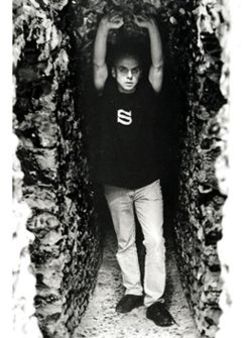
Robert Haigh’s 30 year long musical career has spawned an impressive and uncommonly diverse catalog of sounds. He has released records under his own name, as Truth Club, Sema, Fote, and as Omni Trio, collaborated with Nurse with Wound, and recorded multiple drum ‘n’ bass club anthems, some of which were inspired by Philip Glass. His work has been released by labels such as United Dairies, L.A.Y.L.A.H., Crouton, and Dom, and his music has even appeared in video games like Grand Theft Auto 3 and Midnight Club 3. He is currently completing a trilogy of solo piano records for Siren, of which Anonymous Lights is the most recent. Robert recently took the time to talk to Brainwashed about his past work, improvisation, collaborations with Nurse with Wound and Hafler Trio, the role of silence in music, and much more.
Lucas Schleicher: Who are you, where are you from, and how would you describe what you do?
Robert Haigh: My name is Robert Haigh. I was born in Yorkshire, England and I lived in London for many years. I now live in Cornwall.
Simply put, I create music. But in a way (and at the risk of sounding cheesy) it’s truer to say that I uncover music. Everything comes out of a degree of improvisation.
LS: Are you currently working on any non-musical projects?
RH: I don’t really have the time at the moment.
LS: When did you begin writing music? What was your first release and who released it?
RH: As a teenager in the mid ’70s I was is a rock group in South Yorkshire. I wrote songs, played guitar, and even sang!! We also did covers of Bowie and the Velvet Underground. My first release was as Truth Club on the Hoisting the Black Flag comp released by United Dairies.

LS: How did you meet Steven Stapleton and become associated with United Dairies?
RH: In the early ’80s I worked with Trevor Reidy (Truth Club/Fote/Monochrome Set) at Virgin Records in a basement off Oxford Street in London. It was a bit of a gathering place for post-punk/experimental musicians. Steve worked just down the road in a little artist’s studio and he used to hang out at the shop.
When the manager was out we would play all of Chance Meeting over the shop’s sound system and drive all the customers out. Steve was interested in what we were doing and asked us (Truth Club) to contribute a track for Hoisting the Black Flag.
LS: Who else showed up in that Virgin Records basement? Did any other notable projects emerge from there?
RH: Jim Thirlwell (Foetus) worked at the shop for a while. He hooked up with Steve, too. Just about anyone doing interesting stuff in London passed through that basement at some point. And a few Australians too.
LS: Tell me a little more about Truth Club. How long did it last and who was involved (besides Trevor Reidy)?
RH: Initially it was just me and Trevor, but later we invited a few others to help out. Deborah Harding did vocals and clarinet, Trefor Goronwy (later of This Heat) played bass. We stayed together for about a year and a half. We supported a few bands around London, including Cabaret Voltaire, Clock DVA, This Heat, and The Associates.
LS: And how did your Sema project begin? Who was involved with that and what was the impetus behind it? What about Fote?
RH: Sema was just me. I wanted do do something more atmospheric, more layered and textured, without the constraints of a group format.
Fote was the Truth Club without Trefor Goronwy. We made two EPs.
LS: What was it about tape collage and atmospheric sounds that appealed to you? How were you drawn away from rock ‘n’ roll?
RH: The album that introduced me, and turned me on to an alternative way of hearing music, was The Faust Tapes. In an attempt to promote the group, Virgin put the album out at 50 pence and my sister (who’s a few years older than me) went out and bought a copy.
She hated it and gave it to me. I wasn’t so sure at first (I was about 14 at the time), but I only had a couple of albums in my collection so I persevered with it. After a while I found it compelling. It opened up a whole new way of hearing and thinking about music. I was especially drawn to the juxtapositions (discordant sounds alongside melodic, etc.).
LS: Are there any plans to re-release your early records? If not, why not?
RH: Unfortunately all the master tapes for those releases are lost.
LS: In 1986 you released an album on United Dairies called Valentine Out of Season, which shares its title with a composition by John Cage from 1944. Beyond being works for solo piano, what’s the connection between them, if any?
RH: No connection apart from being a big fan. I liked the title and being a bit lazy, I ‘borrowed’ it. I think that it may have also had something to do with the fact that my previous album was called Three Seasons Only.
LS: Some of the early records you released under your own name had a “classical” flavor to them and you’ve returned to that style in the last few years. Were you trained in classical performance, or did you go to school for it?
RH: No training. I’ve always had an ear for classical piano music, especially Chopin, Satie, Debussy, Bach. And then Schoenberg, Cage, Glass, etc.
LS: But in the 19 years between A Waltz in Plain C and Written on Water you released a lot of electronic music under a few different aliases. What precipitated your move away from the piano and toward the drum ‘n’ bass sounds of Omni Trio and London Steppers?
RH: I never really moved away from the piano. All the riffs, melodies and arrangements were done at the piano and keyboard. Some of the tracks started life as extended layered piano workouts. The original sketch for “Renegade Snares” sounded a bit like Philip Glass.
You have to bear in mind that there was no such thing as drum ‘n’ bass at this point, just a load of producers playing around with keyboards, samplers and sequencers. It was very exiting and very fresh.
LS: Was PM Recordings (Parliament Music) connected to all that? Was it a label or a shop?
RH: In the ’90s I ran a record shop in Parliament Square in Hertford. We started a label to release music by a bunch of talented producers that frequented the shop.
LS: What do you think about current beat-driven electronic music like Burial or Four Tet? Is there anything out there now that you feel is as fresh and as exciting as the music from the early and mid ’90s?
RH: I’m not really following that sort of stuff at the moment. I occasionally get to hear some dubstep which can sound quite experimental.
LS: Omni Trio was an especially popular, succesful, and influential project (The Deepest Cut is counted among the earliest jungle records). Why did you end it?
RH: After Even Angels Cast Shadow and especially the minimal structures of Rogue Satellite, I felt that perhaps my work was done in this particular area.
Meanwhile I had been sifting through the piano and counterpoint pieces that I’d been composing alongside the Omni Trio stuff. There was a strong compulsion to just throw myself into developing this material.
All along the intention was to do the Omni Trio stuff alongside producing and releasing piano based material under my own name. Then the Omni thing blew up much bigger than I had anticipated. But throughout the ’90s I also kept writing piano and minimal themes. By the early 2000s the time seemed right to put the emphasis on developing this material.
LS: How do you feel about the inclusion of Omni Trio songs in video games like Grand Theft Auto? How did that happen?
RH: That’s down to my publisher. I’m very happy with it. My son loves those games.
LS: Do you think there’s a connection between your current work and what you were doing earlier in your career?
RH: I suppose the thread that runs through everything (from my ’80s and ’90s stuff to the present) is a love for the minimal or the economic use of sound materials. I like to make the most of limited elements, be that instruments, musical phrases, repetition, gradual development, or whatever else.
LS: Your return to the piano was Written on Water, which starts with a very metered, very rhythmic song reminiscent of Steve Reich and Harold Budd. “Ten Form” and “Eight Form” (from the same album) also share that quality. Do you feel a kind of kinship with either of them musically?
RH: Very much so. They are two of my favorite composers.
Ls: I sometimes think of Reich’s music as being a music of mathematics. It almost sounds geometrical, if that makes sense. What kind of advantages do you think writing in that mode has over other approaches? Do you have a method of writing you prefer?
RH: Well, I have two main approaches. One is based on shifting patterns, the other is more organic, coming straight out of improvisation. I like both approaches.
At the risk of stating it too simply, Reich works with shifting patterns, but his music is not at all dry or intellectual. For me it overflows with inspiration. He is a true creative force.
LS: What attracts you to minimal composition like that? Your recent records, like many of Reich’s and Budd’s, have a directness about them that I think more complex works either obscure or miss altogether. Why do you think that is?
RH: In some ways there is an imposed discipline which provides a certain amount of focus, which I appreciate. I suppose that composing with limited materials creates something more exposed and open-ended, stark, vital.
LS: What difficulties does working in a minimal setting present to you? How difficult is it to find and develop a unique voice when the piano is practically your only instrument?
RH: I prefer having the discipline of the minimalist. Some choices are predetermined, the rest is wide open. You can’t expect to reinvent the piano every time you write. You work with what’s there in a way that speaks to you.
I do like to bring a freshness to what I’m doing but I’m not interested in being unique or radical just for the sake of it.
LS: Your solo piano pieces are sometimes compared to those of Erik Satie and Claude Debussy. Are they conscious influences?
RH: I can’t deny the influence and my love for their music. Satie is the most criminally underrated composer in the history of classical music. The depth, subtlety and inventiveness in his music, not to mention mood and intelligence, is surpassed by few. And his music never dates.
LS: What do you think distinguishes your music from theirs?
RH: It’s not as good!
I’m not really sure. I suppose that my stuff is informed by later developments in music, like Reich, Glass, Cage, Nyman, Eno, and Budd. As I said earlier, things like Faust and the German scene were an influence, too.
LS: Notes and Crossings is a fantastic record, and one of the best records I’ve heard in the last couple of years. When did you start writing it and what was your inspiration?
RH: Thank you. It’s hard to say when I stared writing it. At any one time I have a load of half improvised material on tape/disc. I then go back into this material and see which ones I feel inspired to develop. A couple of pieces were a bit older: “Tomorrow Never Came” was written in 1989.
Initial inspiration always comes from the moment of improvisation at the piano.
LS: You’ve mentioned improvisation a couple of times now and claimed that you “uncover” music more than write it. Can you say a little bit more about that? What is it about improvised performance that is so inspiring? What does it offer you that composed or non-improvised writing doesn’t?
RH: I would think that most forms of composition start with some degree of improvisation. Just to sit down and start from nothing is itself the position of improvisation. Playing without too much thought or strategy is the key. In my case I think that it frees me from falling into obvious chord structures and harmonies. It throws up unexpected twists.
My initial work happens at the keyboard and is purely improvised… an unmediated flow. I don’t decide to start in A minor or whatever: the fingers do the work. It’s only later that I edit and impose structure, unless I leave it [as an improvised piece].

LS: Your most recent record, Anonymous Lights, sounds busier and less introspective than either Notes and Crossings orWritten on Water. In your mind, what distinguishes them?
RH: I think you are right to say that Anonymous Lights is a touch less introspective. It has a couple more pattern based contrapuntal things on it. Written on Water is even more interested in patterns and counterpoint. The material I am working on now (for a third in a series for Siren) is leaning more towards the organic and intimate.
LS: Silence frequently plays a part in your most personal recordings. Tell me more about that. Why is silence important in your music?
RH: There is a legacy in classical music that is still going strong: the veneration of the virtuosic. It’s a throwback to the past where technique and skill were considered so important. This probably one of the reasons for the snobbishness against Satie. He never played nine notes where one or two would do.
I don’t have a compulsion to fill space. A note is defined by its relation to another note and to the space around it. Giving space to notes seems to create more openness, more harmonic suggestiveness.
LS: Are there other modern composers or musicians writing in the classical genre that you admire?
RH: I like the stuff that I’ve heard from Goldmund, Hauschka, and Max Richter. They might be regarded as contemporary classical. Again, with these musicians there is no concern with virtuosity.
LS: I expected you to mention ballet a little, because ballerinas show up on at least two of your records (Valentine Out of Season and Juliet of the Spirits) and some of your songs exhibit a dance-like quality. Are you at all interested in ballet or dance?
RH: I’m not sure how that came about, I’ve never really been exposed to ballet. The lonely ballerina is a powerful almost mythic image, though.
And yes, there is a rhythm element to some of my music. I especially like the rhythmic folk influence that can be heard in the work of Ravel, Satie, Debussy, Bartok an in later things like Reich’s Tehillim.
LS: Have you ever considered moving further into the classical field by writing music for larger groups? What about writing a sonata or a concerto or working in other traditional forms?
RH: I would consider working with another instrument, possibly a cello or maybe an oboe. I think that so much could be achieved with just two distinct voices. There’s really no need for further orchestration.
I’m not too keen on the piano concerto format, though. I’ve never heard one that didn’t sound a touch overworked or contrived.
LS: I’ve seen articles online mention a collaboration you did with The Hafler Trio, but I’ve had a hard time finding any further information about it. What can you tell me about that?
RH: Ah ha, the mysterious Cold Pieces project. It was progressing as a release for Crouton, but then Crouton folded. We’ll have to wait and see what happens with those tapes. Andrew is not a man to rush!
LS: Can you tell me a little more about that? Is it focused on piano, too, or are you moving back in the direction of tape manipulation and sound collage?
RH: About three or four years ago I received an email from Andrew, he told me that he had a cassette tape of solo piano improvising from an old session at a studio with Nurse With Wound that he had attended. It was me just messing about at the piano with the tape still running. I had no recollection of this and didn’t know that it existed.
Anyway, he said that he was interested in manipulating/experimenting with this material for a release on Crouton. After a few more conversations it was decided that I would supplement that material with some fresh improvisations, so I sent him a couple more DATs of stuff. About a year or so later I received a few MP3s of Andrews productions. I was very pleased with his treatments.
Due to illness and other practical problems the project kept getting delayed. At one point I received a mock-up of the cover design and it seemed to be going ahead as a release for Crouton under the title Cold Pieces. Six months later Crouton folded. I have had no contact with Andrew since this time – I’m happy to leave it to Andrew to decide what to do with these recordings.
LS: I know you have another album coming out on Siren, but are there any other projects you’re currently working on?
RH: There are a couple of projects being discussed. One is a soundtrack to a British film, but I’ll wait to see what happens with that. Meanwhile I am happily immersed in producing that third release in the Siren trilogy of piano music.
Many thanks to Robert Haigh for his time.
> THE ANTI GROUP CONSPIRACY (TAGC) Interview By Chris Konings (2011)
THE ANTI GROUP CONSPIRACY (TAGC) (Published by Peek-a-boo Music Magazine)
Sometimes improvisational techniques result in very complete and interesting results.

The original idea for the Anti Group was devised by Adi Newton & S.J. Turner as early as 1978, with the intention of the formation of a multi-dimensional R&D project active in many related areas. Research and development of sound/film/video/performance and the documentation of each project was the fundamental “Modeus Operandi”. Like Clock DVA, inactive since 1994, the project has been brought back to life and you will have a unique chance to see TAGC live at BIMfest. We had a chat with Adi Newton, talking about the past, the present and the future of TAGC.
CK: Hi Adi, can you explain what TAGC is all about?
AN: This is a difficult question to summarise, so I am referring to a recent TAGC document as this is a more approximate summarization.
TAGC are not affiliated to any one system of philosophy or epistemological paradigm or occult fraternity but are open more to individual systems and innovative thinkers in Science, Art, Music, Sonology, Visual Arts, Literature, Research & Publication. These are its main areas of focus. Over the years ideas and occult philosophy of various individual practioners have been a focus of exploration and research within TAGC projects, but there are always connections to other areas of research within those projects. In some, our aim is to highlight and discover new connections and correspondences between systems of thought and the systems of technics similar to Bernard Stiegler’s concept of technics which has emerged recently as an important contribution to studies of the relation between technology, time and the human spirit. By exploring the possibilities of the technology of spirit, to bring forth a new “life of the mind”.
Strictly speaking TAGC are not a group, but a variable collection of individuals contributing under invitation and the directorship of Adi Newton.

CK: A lot of your albums seem have a scientific approach, for example researching how music affects the mind. Why did you stop making those experiments? Your last album is from the mid nineties.
AN: I never as such stopped, but was engaged in other areas outside of sound and music, more concerned with visual disciplines and other aspects of life and art. It was good to step outside of the arena, to research and do other things, because this gives you a wider experience and the ability to look at your work in a different way. There is a new TAGC album, the 3rd in the Meontological Research Recording series entitled Transmission from the trans-Yoggothian Broadcast Station. This has been developed over the last 3 – 4 years, this is due to the nature of the work especially the films and the techniques I use to achieve the visual depth. Also compositionally, it’s like a form of alchemy which requires a distillation of ideas, and a process of time.The Meon 3 works are concerned with deeper levels of the subconscious mind and designed as invocation keys to help and aid ingress into outer realms of transcendental consciousness and imagination.
The meon 3 comes in the form of a hard back illustrated book with DVD, artwork photographs, and contextual essays, each chapter is a text expanding and explaining each paradigm contained in the Audio Visual piece.
CK: It all seems very methodical. But improvisation also plays a very important part.
AN: I have from the earliest days in DVA’s formation employed intuitive and what the surrealists referred to as psychic automatism, to create audio and generate ideas to further enhance. Also other techniques based on aleatory and chance procedures. Sometimes improvisational techniques result in very complete and interesting results, other times suggest possibilities to develop further, I don’t have any fixed approach to creative work, but use what ever method or technique to reach a desired result.

CK: Do you agree that TAGC is similar to Throbbing Gristle in the way that they also let improvisation decide a great deal of their music?
AN: Yes I think there are similarities in our methods and conceptual approaches in the way we both explore and research and expand methods of creativity and the interests we share in certain areas but there are some big differences too. I hold TG very highly foremost as people as I have a lot of respect for them and the great work they pioneered and as a creative force which has produce some excellent works. I always felt their overall sound was limited in many ways where as TAGC was more diverse and the range in instrumentation and techniques is greater, an album like Digitaria which was recorded using full ambisonic systems for its production and realization, and Test tones, or the 3 X 12 inch releases Ha/ShT/Big Sex, explore a wider ranging audio scape in my estimation, but this is only my own personal feeling.
In any case both TG & TAGC have produced ground breaking works.
CK: The visuals are mainly images from film noir and films by Dali and Bunuel. Why those images? Doesn’t it become an art object that’s more suited for a museum?
AN: The only film piece that contain references and modified visuals from film noir and Bunuels ‘Un Chein Andalou’ was the Delivery. TAGC film work is very different. Burning Water develops new forms of visual expression. In that project which took 3 years to develop and film, specially constructed filter-lenses enabled filming through water. Inspired by the use of multiple montage techniques employed by Kenneth Anger. Each image in the film is taken from specific occult areas ,symbols and images, and up to quintuple exposures of the film i.e. five montage-levels then special computer software was used to treat the entire edited film and finally achieved the results, with a film which relates directly to the subconscious levels of the mind, a kinetic Rorschach-test, an exploration of the resurgent atavistic and sentient symbolic systems, used by Austin Osman Spare, “Burning Water” is an alchemical and technological enquiry into sub-states of being. A meontological visualisation beyond analytical analysis.
CK: On youtube I saw your performance from inside a cube, separated from the audience by projection screens all around you. Don’t you think that will create a distance from the audience, so it all becomes a passive experience?
AN: The Cell was designed to be site specific and is only possible under certain conditions. Its semi transparency allows for further montage and other visual images to occur. The audience is aware of the presence of TAGC within the cell so there is still this aspect of direct human intervention and live creativity, the idea is also to enhance the idea of the group being a creative element rather than as a focus of attention. That way the audience gets the full visualization and sound of TAGC within the live context as at points you can see inside the cell and TAGC generating creative interaction. I don’t think it separates the audience completely. I don’t think it really creates a distance and in any case it’s not something we will be doing on a regular basis. In fact as from 2012 TAGC will be concentrating on a new series of recordings and experiments and live performance will be limited to specific special events.
CK: How do you make the emotional change between TAGC and Clock DVA? Or is a change needed because at the WGT festival the visuals seemed more or less the same?
AN: For me the Leipzig performances were very special, the original plan was to do only the TAGC set in the cell as it is a TAGC set and not a DVA one, and then to reposition the screens in a more conventional position on the other stage which would have given a very different feel and presentation. But it would have resulted in a number of technical issues like the realignment of video projections and our own equipment. It would also have needed a sound check plus I was suffering from a trapped nerve in my spine which made it difficult for my mobility so it was decided to do both performances with the cell. Which I think makes the 2 performances similar in the sense of the same set up.
But you must be mixing up things a little as the DVA visual is different in concept and in images than that of TAGC Meon 3. I think it’s perhaps a little difficult to really truly appreciate the event from a filmed document, especially the hand held audience ones, no official DVA edit has been posted but I intend to upload 2 edits in the next weeks.

CK: What can we expect from TAGC at the BIM Festival?
AN: Expect the unexpected as DVA is already developing the new material and its visual representation into a more developed way, the performances this year will be unique, as next year we will take some time at the beginning of the year to work on developing the new material and visuals which will be radically different to the ones we are currently projecting, as it’s a process of development through time and there is change in the process to find a new way to express the ideas and themes that are evolving. I am also bringing in a new member of DVA whom I will work very closely with to develop new visuals, we aim to employ new techniques and technologies in our research and development which will coincide with the new audio material and its conceptual basis. So any one attending the Bimfest will see something unique that won’t be seen again.
(Interviewed By Chris KONINGS, 19/09/2011)
(Source: http://www.peek-a-boo-magazine.be/en/interviews/the-anti-group-conspiracy-tagc/)
> INTERVIEW WITH: MAURIZIO BIANCHI, AN INDEPENDENT NOISE ARTIST by Ofer Vayner (2006)

Back in 1979 noise wasn’t what it is today; there weren’t organizations (or rather pseudo-organizations) like Mothers Against Noise, or as many noise makers to provoke the all American mother, there was no Myspace, no Forums, no web-labels, and in fact no home computers with an internet connection.
Maurizio Bianchi, originating from Milan , is a pioneer in terms of noise; he started in 1979 under the alias “Sacher-Pelz”, went on to release edited speeches of Nazi leaders (for artistic use) under the name “Leibstandarte SS MB” and continued releasing albums both under those names and under his own name (or under MB) until 1984 when he became Christian.
Up until 1997 there weren’t any releases by Bianchi, but from 1998 and to this very day Bianchi is an active noise maker.
I had the rare opportunity to ask him some questions, hoping to introduce and further know his intriguing personality and music to anyone who finds it interesting.
OV: First of all, introduce yourself and your work
MB: I’m a non-musician in activity since August 1979, except a long hiatus between 1984 and 1997. I’m used to work in the experimental field because it’s the only one I can express my freedom completely in researching emotional sound sculptures.
OV: Which of your albums/projects would you recommend those who are unfamiliar with your work to start with?
MB: From the early period I recommend “Symphony for a genocide”, “Mectpyo bakterium” and “Carcinosi”; about the last, works like “Mind us trial”, “Niddah emmhna” and “The testamentary corridor” are more representative.

OV: How did you start making music?
MB: I started on August 1979 in Milan with the pseudonym of Sacher-Pelz, just using a long-playing recorder and some used long playings, manipulating them with loops, scratches, noises, crumbling them until to be unrecognizable from the originals. It was a sort of defragmentation of usual music into several atoms of unusual non-music. Later, from 1980, I introduced the synthetic sounds and a rhythms-machine, and in the end (from 1983) an echoes-machine with a microphone.
OV: What messages/feeling are you trying to provoke with your music?
MB: The uncompromising message is very clear and the inner feelings are so intense that the listener seems to make a fascinating journey in his own mind paths.
OV: How would you define the music you make?
MB: I can define it as psycho-neurotic sound.
OV: Where do you get inspiration from?
MB: I get inspiration from the concrete music of the 50’s and the German electro-acoustic/electronic music of early 70’s, but probably my main inspiration is the human alienation.
 OV: Do you have any professional musical training?
MB: Not at all! Even I don’t know how the read the seven traditional notes of the stave.
OV: You’ve collaborated with many artists – with which did you enjoy working the most? And what is the album you’re most satisfied with from those collaborations?
MB: Yes, recently I’ve collaborated with more than ten artists and groups and I’ve enjoyed with all of them! And there is not a particular album I’m more satisfied than the others. Maybe I’m a little bit diplomatic?
OV: Do you feel more comfortable working alone or collaborating with other artists?
MB: It’s a different point of view, because alone I can decide and determine by myself everything, but when we’re two or more, there is to take care of the opinions, decisions, etc. of your collaborators, and respect their decisions and their suggestions; but until now I found a very good co-operation and I take the opportunity to thank very much all of them for their precious and faithful support.
OV: What albums are you currently listening to?
MB: Currently I’m not listening any album, but only the radio programs coming from the foreign states, because I can be aware of the musical kaleidoscope is surrounding me. It’s really great!
OV: What is your opinion on the today’s music in general?
MB: Today’s music in general is very fragile and superficial. Even in the avant-gardist field, only very few people are keeping the genuine experimentation flag high.
OV: In your opinion, where do you stand as an artist? Do you see yourself as an underground artist? As an alternative to the mainstream? Where would you place yourself on a schematic sketch of the music world?
MB: I can see myself as an underground/alternative/unconformist artist, but it’s only my personal thought; probably from the outside the critics would define me in another way. Anyhow, I don’t know exactly where to place myself, maybe in another dimension?
OV: I’ve read in other interviews that you’re pretty unknown in your homeland (Italy) – are you pleased with this or would you rather it was a different way?
MB: That’s right, but I’m not worried about this, even because in my homeland there is the melodic/traditional culture and I don’t feel a need be part of this even though I’m living beside it.
OV: From digging into your biography I’ve found that you haven’t released any albums between 1992 and 1998, what are the reasons for this?
MB: To tell the truth, I remained absent from the scenes from 1984 until the 1997, and the reasons are that I had already expressed all my own creativity, and to avoid useless repetitions I preferred to stop everything with music, but not in life because on 1984 I became a true Christian and my life was lightened by the God’s eternal Word!

OV: What made you go back to composing and releasing albums?
MB: The awareness to open a new chapter in my experimental history, more intimate and careful.
OV: What made you decide to do an album like “Blut und nebel”, which consists mostly of remixes?
MB: To move against the mainstream, rediscovering hidden sounds filtered with the current spiritual maturity, and the final result is very exciting!
OV: What was the work process on it like? How did you feel about re-working on your older materials?
MB: The process was initially to create some looped effects, after re-treated and electronically filtered with Sandro Kaiser’s devices, in order to obtain a velvety effect, very suggestive. I must admit that when I re-worked with such old materials I felt certain restlessness, due probably to hidden ghosts that tried to reoccur, but now I’m feeling completely satisfied.
OV: Do you work on digital or analog equipment these days? Do you miss the times when it was completely analog?
MB: In the present I work completely with very simple and Spartan analogical equipment, and those epic times remained forever in my mind…One way or another it was a “poetic” age.
OV: What equipment are you currently working with?
MB: With a cassette-tape with microphone incorporated, a DVD-player machine with some special functions and a lot of creativity.
OV: Do you have any other interests besides music?
MB: I’m completely involved in religion, but not the traditional one, so empty and futile, and I like to do abstract photographs to use for my albums.

OV: What are your plans for the rest of 2006?
MB: There are collaborations just started with Maor Appelbaum, Matteo/ Hue Uggeri, Claudio Rocchetti, Crìa Cuervos, Saverio Evangelista of Esplendor Geometrico, Emanuela de Angelis, Land Use, Craig Hilton, etc.; concerning my solo projects, there are enough projects ready for the next autumn. So, I’m very very busy but I don’t complain because to stay active is the best thing to do against modern boredom, the dangerous root of all the misdeeds and the injustices.
OV: In your opinion, what is the most important historical event that happened during your life so far?
MB: The most historical event is very close to come… Please read the liner notes of the “603… Annus Mundi” freeload album.
OV: Do you consider yourself an artist working only for his own good or do you try to push and encourage other artists/bands/projects as well?
MB: I prefer the second option, but being so imperfect I’m not able to do it completely… sorry.
OV: Are you familiar with any Israeli noise/drone/industrial artists?
MB: I know only my friend Maor Appelbaum and the people at Tophet Prophet label. That’s all.
OV: Final words?
MB: I don’t want to become popular or acclaimed, but I’d like to awaken the sleeping consciences. Then I’ll come back to my enlightened subterraneans…
Thank you.
OV: Thank you very much for your time and effort in doing the interview.
(Interviewed by Ofer Vayner)
> SUTCLIFFE JUGEND & JUNKO (非常階段/Hijokaidan) – Sans Palatine Uvula CD Album Review by Tracy, Heathen Harvest
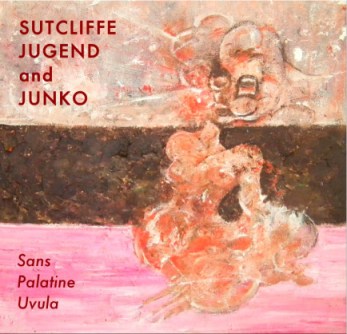
Here we have a collaboration between Junko (vocalist for Japanese harsh noise project Hijokaidan) and English power electronics/noise duo Sutcliffe Jugend. What to expect out of this record? To be brief but not so brief; 44 minutes and 57 seconds of raw, carnal noise which audibly pierces through your ears and sharply personifies that of a torture chamber recording. Sutcliffe Jugend continue to keep the ongoing tradition of agony and malevolent musical distortion very much alive while combined with the static waves of suffering within Junko‘s high-pitched despair.

The opening of the album starts off with “Mouth Ripping” and gets right in your face with high volumes of immense energy and perpetual chaos from both collaborators. Its highly impactive force of maddening screams and deranged industrial fluctuations sound their way off through to the next few songs, each of which lasts no longer than 4 minutes as they begin to grow on the brink of abrasion, when suddenly you will find yourself halfway through this carnal creation moving onwards but falling deeper into the abyss. Track 5, “Lip Splitter,” takes a spin from the first half of the record (which did not leave as strong of an impact on me, personally) with a hint of more borderline “bubbly’” elements mixed with Junko’s loud, hellish shrieks; almost in equivalence to the sound of death itself. This is where the album begins to take a turn into more dark ambient aspects as Track 6, “Sans Larynx,” which is synonymous to that of a train ride in a dark tunnel leading into a carnival of horrors in pitch-black darkness. Upon the first listen of “Sans Larynx”, the eerie, spine-chilling ambiance did not require me to close my eyes in order to envision the my own nightmarish, demonizing agonies unfolding before me in crystal clear visions – it is malevolent in its own darkness whilst being filled with samples of industrialized echoes and raw harshness. Wails of despair soon follow throughout the latter portion of this track, which will both drag on as well as lure you in; it is both hypnotizing and haunting. At times, even Junko’s shrieks become so unbearable that it leaves me with a love-hate feeling towards the record itself… it is inescapable and so animalistic that, at times, I become so lost in her voice that it begins to morph into that of an animal or wild, carnal being.
There are no watered-down elements or pleasant rhythmic melodies that will grab your attention in a manner that is comfortably centered within one’s own comfort zone on this record. Everything is harsh yet pure, in a void of hollow frequencies which bear resemblance to the creaking of a crank-wheel or tightening of ropes on torture boards. Track 9, “Sans Palatine” opens up with what sounds like an introduction into a wilderness that is vast and hidden within an underworld of darkness… the call of the beast echoes his cries throughout the song as Junko’s cries blend in together with the sounds of this primitive, masochistic hell. This record is far from any sort of condensed, upbeat/post-whatevers. Given the notoriety of Sutcliffe Jugend being one of the first few pioneers of the power electronics genre, the duo continue to deliver with this split of demented sounds, minutes of mental strain, and utter depravity. The walls of repression remain sustained as the veils of sanity inevitably crumble. Carefully tread with caution.
Track List:
01) Mouth Ripping
02) Throat Ripper
03) Mouth Leak
04) Mouth Slipping
05) Lip Splitter
06) Sans Larynx
07) Throat Leak
08) Throat Slipper
09) Sans Palatine
10) Tongue Splitter
Rating: 3.5/5
Written by: Tracy
Label: 4iB Records (Singapore) / 4iB CD/0513/003 / CD
Noise / Power Electronics
(Source: http://heathenharvest.org/2013/07/26/sutcliffe-jugend-junko-sans-palatine-uvula/)
More Info At: http://heathenharvest.org/2013/07/26/sutcliffe-jugend-junko-sans-palatine-uvula/
> VOMIR Interview By John Wisniewski (2011)
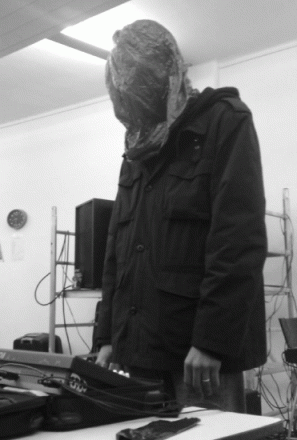
This interview is with Vomir (Romain Perrot), a French harsh noise outfit that produces dark power electronic sound pieces. There is a tribute paid to the forefathers of electronic music, with dark overtones added. Their newest release can be found at Crucial Blast Records and at those sites mentioned in Vomir’s blogspot-page. The interview discusses the band’s sound, as well as their influences and the reactions to this genre of music.
JW > What were your first recordings like? Were they experiemental in nature, sound collages?
RP > My very first recordings were early 90’s and were only harsh noise guitar impro. I did that for several years, also sometimes with an old analog guitar synth. I guess everything I make is about noise/harsh noise.
JW > Who influences you in music and art – radical movements?
RP > That’s a very tough question for me to answer. I am someone who reads and listens to a lot of different things, so consciously or unconsciously, all of that nourishes my sound & work. Basically I am/was/will be influenced by counter-culture art. From Dada to TG, from Burroughs to Debord, from Aktionism to Dennis Cooper, from The Stooges to Merzbow etc… like a lot of us : )
JW > Are you affiliated with a political party?
RP > No, I don’t have views on politics, but Crass is a mandatory reference.
JW > Why is this genre of music attractive to listeners, Crucial Blast has many titles currently of this type of music?
RP > I was surprised when Crucial Blast asked me for a release because Harsh Noise Wall do not attract many people…. It is not the same as dark ambient or doom… to be realistic, HNW concern just a few hundred people today… but what can be attractive to my work is my dedication, my determination, my perseverance to achieve a massive monolithic harsh noise, in which every listener will find something different so everyone will have his own perception of the sound.
JW > Are there any current ambient projects that you like?
RP > I do not listen to Ambient music, I really prefer drones or works on strings, the likes of Phil Niblock for example. In sound I like texture and grittiness of harsh noise.

JW > What effect does this music have when played live?
RP > Some people are relaxed, some people are bored, some people are nervous but what pleases me is when the audience is just completely focused on the noise and that nothing interferes.
JW > Could you tell us about the theme of your most recent release?
RP > My themes are always the same, just to disengage from people and society.
JW > Are you attracted to the idea of music as a changing force in society?
RP > A changing force… actually this idea can be attractive but we know from the past that music did not succeed.
JW > What lies in the future for Vomir?
RP > No change, no development, no ideas, no remorse.
RP > Thank you again !!!
(Source: http://www.damned-by-light.com/articles/046.html)
More Info At: http://vomirhnw.blogspot.sg/
> CRASH WORSHIP Interview by John Eden & Justin Mitchell (Issue 1, Ov Magazine)

Crash Worship formed in San Diego in 1985 as a studio project. Their music is a pounding, tribal, percussive affair. You can forget all about those droning backmasked ritual music CDs – THIS is what the joyful experience of ritual is all about. News has filtered down through the nett-work about ADRV’s (that’s Adoration De Rotura Violenta to you, pal.) live shows for years.
Their use of all four elements, flesh, blood and sheer unbridled ENERGY is well known in the U.S., though attempts at a European tour haven’t been too successful to date. Above all Crash Worship ADRV remind us of the participatory, magickal nature of live music, something that today’s performers have neglected completely.
John Eden and Justin Mitchell (of Cold Spring) spoke to Simon Cheffins of Crash Worship ADRV on a rare visit to the U.K.
JE/JM: So, can you tell me briefly how it all came about – how did Crash Worship start?
SC: It started as a studio project and we got through our first performances and we realised that we were onto something pretty different, at least where we were playing there was nothing going on like what we were doing. So we started to sort of scientifically look at the reactions of people to various things that we did and after a couple of years we were able to create a new system of…..
JE/JM: …..playing?
SC: No, not so much of playing, although we did that as well we created our own musical language after a couple of years. But we found ways of working with an audience and sort of manipulating their experience in a way. Just beyond standing and listening to a group or dancing.
JE/JM: How many people are involved?
SC: Right now there’s six musicians two full time drummers, one person who doubles on drums and working with the audience. We have a guitarist who, if you heard a tape or something, you wouldn’t think it was a guitar. People after our show will come up and wonder what all the sounds were if they didn’t see the guitarist. We normally have some pre-recorded sounds that we work in as well. And then there’s two guys doubling on vocals and audience manipulation. They work as a team pretty much, a two headed monster. And then often we’ll have people come with us to help out, to work with the audience. They’ll know what we’re doing – they’ll know the show.
JE/JM: OK, in what way do you “manipulate the audience”?
SC: Well, this one guy that used to come with us just used to do his own thing. He would be naked, or nearly naked, and run around coming up behind people and caressing them from behind and then disappearing hopefully without being seen. Or he would crawl around through people’s legs and try to dislodge them one way or another. Some people will grab people who are standing around the walls, around the perimeter, trying to be cool and safe and clean, and drag them into whatever’s happening in the centre.
JE/JM: So quite friendly, really.
SC: Oh yeah. We’ll bring out various gifts for the audience, like burning things or huge trays of fruit and we’ll always need help with that. Occasionally we have the to move the instruments down from the stage into the middle of the floor. We’ll bring all the drums down, like 20 drums, basically, and have a marching set up. We have everything portable – 3 drum sets we can wear and a portable guitar set up, battery operated. So we can leave the stage at any time and march down into the audience and we’ll have people come down with us, sometimes doing extra percussion, and passing out burning things and liquids.
JE:/JM: It sounds like, with a set up like that it would be quite difficult to get people to accept you, because I know you use things like fire in your set quite a bit. Certainly over here it’s very difficult to get standard rock venues to accept that kind of thing. So what kind of places do you play?
SC: Well nowadays we do the best we can to let the people know what’s going to happen, because we don’t want to go and not have the freedom to do what we do. We play warehouses if we can. Those are the best sort of spaces and often outdoors we can do what we want to. Some clubs in the States will let us do what we want to do because we make them money and so they just put up with whatever risk and mess that is left. But often if the communication breaks down before we get somewhere and they don’t know what’s going to happen and they are surprised and frightened when it does, they’ll shut us down. On our last tour we did a few colleges. At least half of them shut us down and we’re talking Fire Dept., Police Dept., coming and escorting us off campus.
JE/JM: Just in the middle of a show?
SC: Oh yeah.
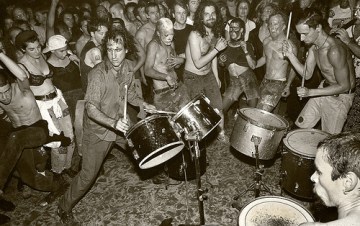
JE/JM: Blimey. Do the police give you any trouble or do they just take you away?
SC: A couple of people have run into trouble and it’s not us normally. Actually in Denver, for about two weeks preceding out show there, there was some rumour of us being involved in some sort of satanic activity, which just does not happen at all. I think some reference may have been made to paganism and these christians think “pagan = Satan”. So these cops actually created this nazi satanic task force and they turned up at our show. They knew they were going to bust us before we even got to town. Lots of people have an overactive imagination, I think, and when you give them some reason to have an overactive imagination they just go crazy. They can see us as a vent for all these fears they want to put onto something so they can be afraid of it.
JE/JM: You said you weren’t satanic, but there’s obviously a magickal input into what you do. So what’s the story, Simon? I know it’s not something that’s easy to express…..
Affiliations with organisations?
SC: No, not any more. A couple of members of the group were involved with T.O.P.Y. U.S., and of course T.O.P.Y. U.S. has been very helpful to us throughout our whole career. Our first couple of tours were set up by people involved with that network. But there’s no affiliation now with anything like that. Everyone has widely differing interests and we actually don’t talk about it that much.

JE/JM: I think that’s good because it keeps it quite pure.
SC: Right. We used to be wrapped up in a lot of that sort of imagery and a lot of phrases come along with various releases of ours that were tied up in that kind of thinking. But we decided a couple of years ago that we would stop doing that in our “public relations”, but at the same time it happened with us. I was inspired by this group I heard about. The four musicians each spoke four different languages, it was an improvisational group. In a way that’s how we’ve become. Not so much improvisational all the time musically, but as far as how we focus and direct our events and actions are all understood in terms of direct experiences as opposed to experiences that are thought of in terms of various occult schools or philosophies.
JE/JM: So it’s more from the source than being intellectualised?
SC: Exactly.
JE/JM: Tell me about when you decided to travel and study percussion in places like Nepal. How did you go about trying to learn the rudiments of traditional music in places like that and how has it been assimilated into the Crash Worship sound?
SC: Well, I think I’ve just been interested in that music, a lot of us have, and in various other musics and cultures from around the world. The music is of course so integrated into the culture anyway. I just went to see what was missing from my own experience of life, basically. And once you’re in a place like Bali, if you make an inquiry into something you’re interested in, the people really welcome you and are more than happy to show you their culture. I didn’t go there with the intention of studying music, exactly, I just went to learn and let whatever happens happen. But I found a music teacher and studied gamelan for a month or so. As far as assimilation, it’s not something that would be done intentionally, and then I will listen to something we’ve done sometime later and I’ll hear some gamelan in there or some Moroccan drumming or something like that.
JE/JM: Have you ever met someone who’s into Crash Worship and understood the sources and where you’re coming from?
SC: Yeah, I think a lot of people who are into any sort of independent or alternative music in the States, I don’t know about here, are interested in all these other things from around the world as well. Not so much “world beat”, but especially a lot of the African and Indian music.

JE/JM: What kind of people come to your shows?
SC: All sorts. It’s a pretty diverse audience, which is good because it’s hard for people to really understand where we’re coming from and we don’t come from any specific genre of independent music. So it’s all it’s people from all sorts of different types of music will come to see us. Some punks, some people who go to raves, Industrial types.
JE/JM: What kind of experience do you want them to have?
SC: Well, I just know what sort of experience I want to have and that’s what I go for. I think a lot of the time I’m very self conscious, always wondering what people are thinking. I walk on egg-shells a lot of the time and when I play at one of our shows I become the opposite of that. I feel a power that’s inherent in me, myself and everybody.
 4iB Records | For intrinsic Beliefs