4iB Records | For intrinsic Beliefs
Record Label dealing in Industrial, Power Electronics, Harsh Noise, Experimental, Death Industrial, Drone, Ambient, Japanese Noise, Field Recording, Abstract, Musique Concrete and other related genres.

> CLAIR OBSCUR – An Introduction by David Sanson (2005)
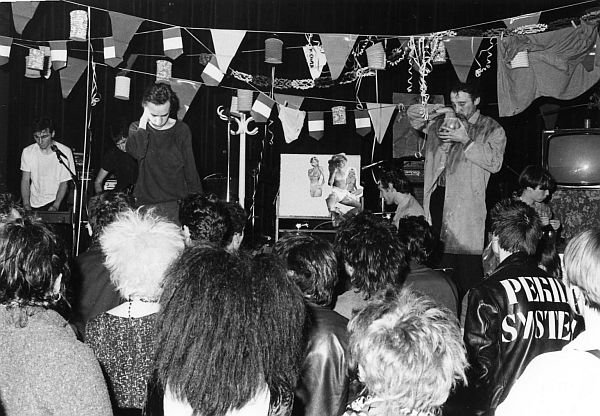
Among all groups which animated the French Cold Wave and Industrial scene of the 80s, Clair Obscur is certainly one of those which radiated furthest outside the boundaries of France. Several of their records have been published by British labels like All the Madmen (the live The Pilgrim’s Progress, 1986) or Cathexis Recordings (the 12″ single Smurf in the Gulag, the same year), and one of their act of glory is to be part of the compilation From Torture To Conscience of the mythical label N.E.R. alongside with Current 93, In The Nursery or Death In June (1984). From Killing Joke to The Nits, from Le Cirque d’Hiver de Paris (1982) to the Wiener Festwochen (1991), the bands with which they played, and the venues and places that they performed are a fantastic testimony to the richness of this group which is so difficult to classify.
Founded in Creil in 1981 by Thierry Damerval (bass guitar), Christophe (vocals) et Nicolas Demarthe (guitar), Clair Obscur drew immediately attention with a home made audio tape (re-released on the album Play), a 7″ single magnificently designed (Santa Maria) and several 12″ singles. From the most tribal cold wave to chamber music, from industrial music to dance music (unless these two are synonymous), their musical approach is eminently atmospheric and embraces a surprising variety of styles, giving birth to iconoclastic scenic transcriptions. By recreating a domestic place on stage or by organizing a fake TV game, Clair Obscur explore universes close to theatre or performance, which can be found in In Out, published in 1988 on V.I.S.A. with the help of France Culture. After the releases of the albums Sans titre, 1992, Rock (1994) and Nulle Aide… (recorded under the name CO2, for “Clair Obscur 2nd Generation”, in 1999), the end of the 90s saw the group hibernate. Christophe Demarthe mainly worked on his project Cocoon, an ambitious multimedia work released on Optical Sound. Since March 2004, Clair Obscur has been reactivated by Nicolas and Christophe Demarthe, and their albums Play and In Out (…) re-released by the label Infrastition.
(*David Sanson is a journalist and a musician. He is the editor of the French Art magazine Mouvement. The text above is an excerpt of the booklet of the compilation Echo Location, on the French scene of the 80’s, published by Optical Sound in 2005.)
INTERVIEW (By Pall ‘Nattsol’ Zarutskiy) (Grave Jibes Fanzine)
Nattsol: Tell me, how did you begin? You were ‘on the wave’, or you didn’t depend on any?
Christophe: Like any young people who like music, we had our groups. They were Joy Division, DAF, The Cure, The Talking Heads, Tuxedo Moon… At that time we lived in Creil in the north of Paris, and the music that we loved was not played on the radio (this was just before the birth of the free independent radio channels in France). So we naturally decided to write the music which we wanted to listen to. It was not our purpose to belong to a ‘wave’. Simply the bands we preferred mainly belonged to what was called new wave at that time, and which would be called cold wave today. So yes, when people asked us what kind of music we were doing, we answered ‘new wave’.
Nattsol: Could you tell about that cold wave era? Now it’s really difficult to imagine what was that. Was it organized movement?
Christophe: In France it was not organized. This must be typically French, I mean our incapacity to create real networks, unlike the British people for example who through the Cartel managed to federate the independent labels. In France everyone stupidly thinks that he is clever enough to make things by himself and better than his neighbour. This is a pity because no network really existed for this scene in the 80′s. Even if today foreign people speak about French cold wave as a movement. The only thing which existed in the early 80′s (and was partly linked to the victory of the left wing in 1981) was the creation of informal places like squatts where more post-punk bands could play and where the audience could attend concerts for little money. Of course there were also many small independent labels which were created in the early 80′s allowing such bands as Clair Obscur and others to exist, but once again the pity is that all these indie labels were never able to federate and create a genuine alternative to mass culture.
Nattsol: Your music always seemed to me more avant-garde than rock. Some of your songs like ‘Tristan Tzara’ prove my opinion. Also I can remember here that Clair Obscur was called ‘rock Artaud’. So tell me about it. What cultural movements and art actors you were influenced by?
Christophe: Truely speaking we were barbarians. Clair Obscur was called ‘rock Artaud’ by the journalist Jean-Francois Bizot but we had not even read ‘Le theatre et son double’ at that time… However we were very interested in discovering other artistic proposals in theatre, dance, cinema, visual arts, which nourished our music and our live performances. ‘Rock culture’ was too narrow-minded for us. We were not longing to belong to ‘avant-garde’. We were just interested in searching, experimenting new tracks, new fields. Also what was clear for us was that just being on stage with a guitar was not sufficient. I think that the originality of Clair Obscur in our live performances was that we were at the same time giving a live gig and questioning the conditions of this gig.
Nattsol: Another question of this type. The name of your song ‘Blume’ strongly reminds me Kurt Schwitters’s poem ‘Anna Blume’. So is that what I’m thinking about or it’s absolutely another thing?
Christophe: It is absolutely another thing. The lyrics of ‘Blume’ speak about joy and flowers, and the music is very dark. ‘Blume’ is all about this contrast. It is a good example of most of our songs where words do not say what I mean. Most of the time what I mean is to be understood not in the words but in the way I utter these words. So for the listener the exercise (quite difficult) would be to try to replace the words of the song by other words which can perhaps be guessed in the way words are expressed and also by the music. But perhaps it is rather an exercise for a psychologist more than for a music listener… And to complicate things a little more, in some songs what I say is what I mean…
Nattsol: I noticed that the music instruments in your songs are rather different. For example there’s absolutely amazing saxophone play in ‘Bad Lover’, there’re lots of wonderful bass parts in other songs. Others have only noisy ‘dirty-sounded’ guitar and so on. So it depends on line up or the songs tell what they need?
Christophe: The songs tell what they need. For our new album (to be released in early 2009), I wanted a more physical atmosphere. So we decided to use ‘rock’ instruments and analogic machines. The songs exist first. Then we invite musicians according to our needs.
Nattsol: Clair Obscur grew up not only in music but in performances too. Tell me about your performance experiments. And what are they now?
Christophe: I have answered to this above.
I cannot tell you about our next performance (in December in France near Paris (http://www. lesiteducube. com/site/breve. php?id=416) because our audience have to experience it first before we start to explain it.
Nattsol: Looking back, can you tell me what has changed in the band and what’s stayed? What makes Clair Obscur itself, of course, except the line-up.
Christophe: Our music has partly changed, because it has always been changing (right from the beginning of CO). Our shows are less spectacular (I mean there are less paraphernalia), because we have perhaps sufficiently worked with this notion of ‘spectacular’, and we are more interested today in working with the physical part of our music, which cannot be reduced. This is perhaps what makes Clair Obscur itself, the physical part of our music, whatever the music instruments which we use.
Nattsol: There was the period when Clair Obscur kept silence. What was that? Searching for new ways? And have you had any side-projects?
Christophe: Our seven years of silence were caused by a disinterest of the French music profession for our music. These years allowed me to create a solo project called Cocoon (). But because I missed the physical experience of the stage, I decided to reform Clair Obscur in 2004 and was happy to see that our music did mean something for younger people.
Nattsol: What do you think, do you have the followers in music? And what bands do you think are related to Clair Obscur?
Christophe: Oh I do not know. Perhaps you can tell me…
Nattsol: So Infrastition records re-released four your albums – ‘Play’, ‘InOut’, ‘Antigone’ and ‘Live 84/86’. Sould we wait for other re-releases?
Christophe: This is not impossible…
Nattsol: Tell me about your new album ‘We Gave a Party for the Gods and the Gods all Came’. What will it be?
Christophe: I partly answered above. Our new album will be published in January 2009 by the French label Optical Sound (http://www.optical-sound.com).
It will be rock, dark and sexy…
Nattsol: For now what do you think, is cold wave alive? Or it took it’s place in music history and cold wave bands went out of the borderlines of this style?
Christophe: Cold wave as it existed in the 80′s is dead. Young bands who write cold wave music today only make copies. It is as if they were making rockabilly music. There is no sense in only trying to approach the sound of the 80′s. What has more sense is the interest of today’s young musicians for the sounds of the 80′s when they attempt to create new sounds at the meeting point of these older sounds and the sounds which appeared more recently in the (experimental) electronic scene. Of course the interest for dark music belongs to all periods. But it is not by copying the sound of a certain period that you will express yourself in the most relevant way. Today the music of Pan Sonic for example is much more interesting and relevant than the music of many young ‘cold wave’ groups.
Nattsol: So you had many shows. Tell me, which shows and where were the most important and interesting for you. And where do you want to play else?
Christophe: My answer will not be very intellectual. I mean in our shows despite our relexion for creating the conditions of a general atmosphere and the possibility for our audience to ask themselves questions, in the end what worked or not has always been a curious alchemy between our public and us, on a special day, in a special venue. Why did it work on that particular day, in that particular venue, with that particular audience, I do not know the answer. This is perhaps a kind of luck both for the public and for the artist.
Perhaps one of the most important and interesting shows for us was when we played at Festival des Musiques Mutantes in Paris in 1986, because we had decided to take the risk to play with classical musicians in front of a rather punk audience (performing after Annie Anxiety and The Ex) and the public decided to play the game… and made an encore for us for at least ten minutes after the end of our show. This is a strong souvenir.
SOURCE: http://gravejibes.com/archives/y2008/gjf2/clair-obscur–interview-with-christophe-demarthe/
More Info At:
http://www.clairobscur.net/
https://www.facebook.com/pages/CLAIR-OBSCUR/106976802670127?fref=ts
CLAIR OBSCUR
> INCAPACITANTS (インキャパシタンツ) – Improvised Music from Japan
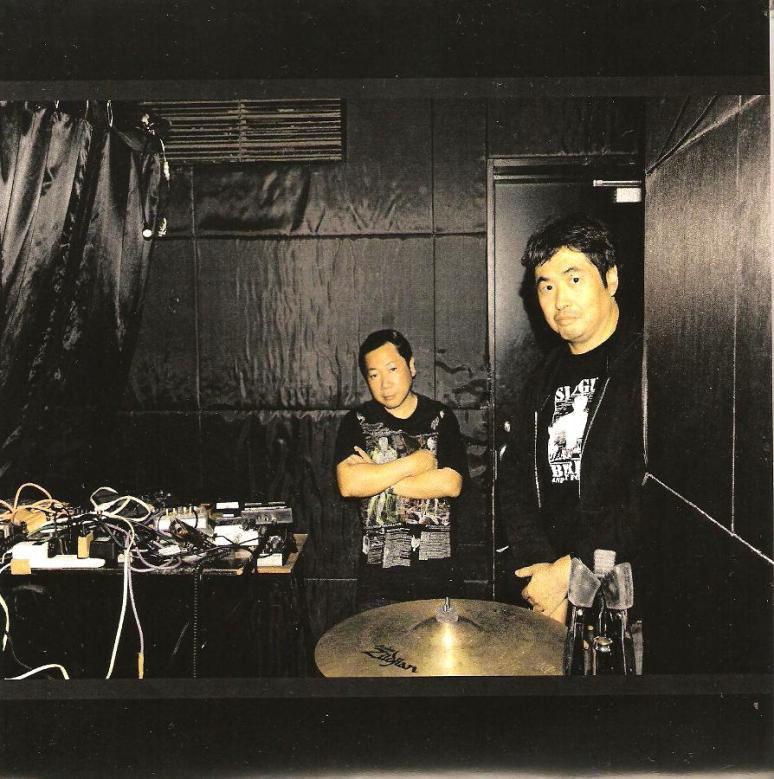
Incapacitants began in 1981 as Toshiji Mikawa’s solo project. The original base of activity was Osaka, where Mikawa collaborated with Yamatsuka Eye and others. Later, after the move to Tokyo, Fumio Kosakai became a member, to form the current duo. From the beginning, while the attempt to achieve pure noise has been the most important aspect of their sound, they have also been famous for their stage performances, which are so wild they may remind people of pro wrestling matches. This aggressive, energetic style and the beauty of their noise are unrivaled. Along with Hijo Kaidan, Merzbow, C.C.C.C., and Solmania, Incapacitants is one of the most well known of the noise bands which started out in the early ’80s. Because of the members’ other work–Mikawa is a bank employee and Kosakai works in a government office–they have rarely toured inside or outside Japan. In November 1999, they performed at the festival Music Unlimited ’99 in Wels, Austria. This was their first performance overseas.
The performances of Incapacitants–the physically incongruous combination of Hijo Kaidan member T. Mikawa and former C.C.C.C. member Fumio Kosakai–are so wide-open that they explode the usual image of noise music. The noise sound is completely integrated with the convulsive, leaping, swinging movement of the musicians’ bodies–one big, the other small. This is conveyed to listeners in such a direct way that the question “What is noise?” becomes meaningless. –Yuichi Jibiki, Eater

INTERVIEW by ANOEMA RECORDINGS
It is our great pleasure to hear some thoughts from the noisiest banker on earth, an incapacitant, sake-loving mr. Mikawa-san. To get started, could you share a few words about Gyo-Kai Elegy?
T. MIKAWA: It’s my first solo release under my own name. As you may know, early days of Incapacitants were my solo recording project and before Incapacitants, there was Contradictory Bridge. I also released a solo cassette under the name of Peguilla Kinugawa. However, Gyo-Kai Elegy is very special to me, because it’s released under my own name.
For many years (or decades, to be more precise) you have been making ear shattering noises. Any changes or progress in your approach over the years?
T. MIKAWA: I started my recording in my high school days. At first, it was guitar improvisation influenced by Derek Bailey and some other improvisers. In those days, I thought I could play that kind of improvisation, of course soon I found I was totally wrong. Then I encountered various kind of “free music” including Jean Dubuffet and L.A.F.M.S. I learned anything was OK and so continued the recording experiments. I made several cassettes under the name of Contradictory Bridge. At that time, I met Jojo Hiroshige and he invited me to join his new unit, originally named Fushoku no Marie, which later became Hijokaidan, by succeeding the original Hijokaidan’s name. So, I joined most of Hijokaidan’s recording since then (some exceptions recorded by Jojo and Junko only). Contradictory Bridge became Incapacitants, originally my solo recording project. When I moved to Tokyo from Osaka, I was asked to do live performance as Incapacitants and I asked Fumio Kosakai to join as a member. It was in early 90’s. As Incapacitants, Pariah Tapes & Repo were my solo recordings. Still, at first, I thought Incapacitants was a recording project and not suitable for live performance. But with Fumio as a permanent member, Incapacitants has changed very dramatically. The reason why I started Incapacitants as my solo recording project apart from Hijokaidan was that I wanted to concentrate on noise itself, keeping myself away from Hijokaidan’s disgusting live performance in early 80’s. However, doing live performance with Fumio, I came to feel it’s fun to me.
More generally speaking, do you feel that noise has changed significantly over the years? How do you see noise of today?
T. MIKAWA: I don’t think “noise” itself has changed so dramatically. What has changed significantly within these 30 years is the relationship between “noise” and society. In other words, the way of looking at “noise” by society changed so much that many people misunderstand “noise” is a kind of music. I think Throbbing Gristle should be held responsible for that. Of course, I don’t blame them. I would like to point out that without their concept “industrial music for industrial people”, such a situation might have been realized much later. I noticed many young talented noise guys arising almost everywhere in the world. I believe whether noise has a glorious future or not depends on if they continue to make noises. I would like to say don’t stop making noise.

Do you feel there is an insurpassable difference between noise and music? Does noise offer something that music doesn’t?
T. MIKAWA: What I would like to say is that, for example, “techno pop” is the name of a genre of music, but I can’t admit that the same thing can be said about “noise”. I believe “noise” should stand as it is and should not be taken on by “music”. “Music” always tends to take on “noise” as its part, but “noise” should not yield to that attractive temptation. Keeping away from “music”, “noise” can maintain its original power and strength. It’s quite important to me.
From a stereotypical perspective, Japanese are known for their lust for new electronic gadgets and devices. How imporant is technology for making noise?
T. MIKAWA: I think technical progress in terms of equipment makes things easy. In my case, if all the effectors can be much smaller and lighter, I feel very good to bring them into the live space with me. But that’s all. Using new equipments may kill the taste I like in my noise. So, when employing new gears, I try to be cautious.
Incapacitants are legends of intense physical live action. What is the difference between performing live and preparing music in the studio, or composition vs. imporivisation?
T. MIKAWA: As I mentioned before, I now enjoy live performance very much. Basically, live materials are the source of my composition. Of course, composition doesn’t mean making pieces using scores. I improvise.
Art is often harnessed for the extra-aesthetic purposes. In your work, what agenda should we look for?
T. MIKAWA: I don’t have any special message in my noise, but being loud.
And finally, if nobody would be listening to your noise, would you still be doing it?
T. MIKAWA: I think so, because I like to listen to my noise.
Doumo arigato Mikawa-san!
Source: http://www.anoema.com/mikawa.html
More Info At:
http://www.japanimprov.com/incapa/
INCAPACITANTS
SIX COMM, ALLERSEELEN, THE ANXIETY OF LOVE – Live in London, 2 Nov 2013

CONFESSION VII PRESENTS:
A Dark Electro Night
– SIX COMM
– ALLERSEELEN
– THE ANXIETY OF LOVE
DATE: 2 November 2013 (Saturday)
VENUE: SLIMELIGHT, 7 Torrens Street, London EC1 1NQ, UNITED KINGDOM
TIME START/END: 1930 hrs – 2400 hrs
TICKETING: £15 (Door)/£13 (Advance)/£11 (Concession)
https://www.wegottickets.com/event/220479
More Info At:
http://www.hagshadow.net/6comm/
https://www.facebook.com/confessionlondon?fref=ts
https://www.facebook.com/6comm?fref=ts
6COMM
ALLERSEELEN
THE ANXIETY OF LOVE
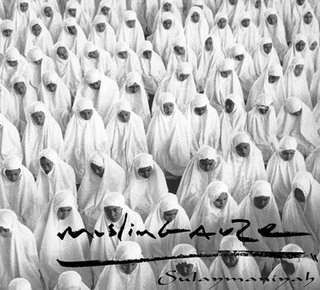
> MUSLIMGAUZE Interview by Guillaume Sorge (1998)

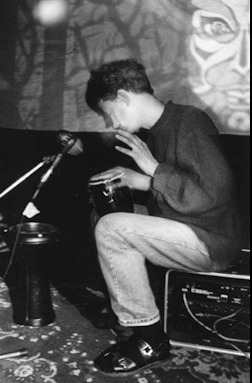
Tomorrow’s show (30/4) for NTS will be a pre-record, which was recorded and delivered early last week. In the process Paul introduced me the music of Muslimgauze, an incredibly prolific and potentially controversial artist who’s captured the rawness and electronic brutality that we often look for in head-turning music (at least in the early examples he played me). At the time of his death (aged 37) in 1999, Muslimgauze aka Bryn Jones was credited with a 96 release deep catalogue, a number that’s more than doubled since with post-humous output. Take that, hologram Tupac.
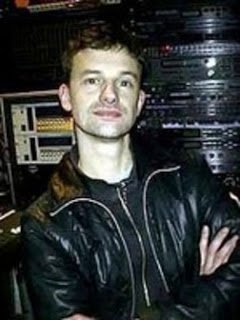
It’s difficult to talk about an artist with such a massive output, especially having only spent a week or so checking them out. Even Paul who’s got more than a handful of releases admits he’s only scratching the surface. It gets even more complicated when dealing with a western artist (born and lived in Manchester) who’s formed his music as a reaction to world politics. Specifically “every piece of music Muslimgauze releases is motivated by a political fact, mostly Palestinian, also Iran and Afghanistan are of great interest” – otherwise known as an area we really don’t want to get in to. But the bottom line is that while anyone can record an album a week, it’s near impossible to record an album a week and keep the ideas inventive and interesting, which, from my short exposure to Muslimgauze, is something that Bryn was managing to do.The short interview below was done by Guillaume Sorge on behalf of Trax 40,000September 1998.
The first music would have been English pop music, followed by German bands of the 70’s and traditional Indian music. My approach to music stems from Punk; the attitude, approach and a belief that “do what you feel”.
Electronic, it was German bands of the 70’s, searching and finding old vinyl LPs from this time, lots of bands, trying different things.
I bought a synth, experimented with it, out of this I turned into a drummer!!
Main influences are political. The human rights of Palestinians, an end to the vile regime of Israel. Anybody reading this who has any thoughts of support for Israel, should through embarrassment donate all their money to help Palestinians through aid. Muslimgauze music has a political fact at it’s heart. I have far too many ideas for my own good, but I believe in what I do. If you don’t like Muslimgauze, I don’t care.
Technology seems to have brought together more crap with idealess people. The idea of sitting in front of a computer to inflict further crap music on poor record shops, it shouldn’t happen.
No I do not, never touched a computer. I use old analogue equipment, which I abuse and force to do what I want. I hope Muslimgauze sound unique and the CDs are worthwhile.
The important thing is ideas, not technology. Which ever artistic expression is used, you need the original idea.
I translate an idea from my mind, through my hands I create this idea using old analogue equipment and percussion from various countries. Over this I place things from cassettes, which could be voices/instruments. Some tracks are left unfinished, some un-mixed, some re-mixed. It depends on the track.
No, everything has been done before. Just try and put a different slant on things.
Something is different to everybody, a million people don’t buy Muslimgauze releases, a lot of people don’t like Muslimgauze, so what’s good?
To have an ear for sound, hands to shape this into a final thing.
Things seem to be global through the Internet. A different culture has affected me, so culture is global now and in the past through pictures and sound.
I’m not too sure as to what techno culture is. The social implication of drugs is evidently around. If some drugs are legal, the case for an open house is strong.
I cannot see that far ahead, but I hope that over that time Muslimgauze will have released good quality CDs/vinyl/whatever system comes up next.
No, I have no time to play other peoples music, I have no interest in other peoples output. My time is total Muslimgauze, new tracks, new CDs, old tracks, it’s endless.

It’s about quality not quantity though, and Muslimgauze had both. Due to the volume of releases it’s hard to categorise and discuss one individual sound of the artist, only that his middle-eastern influences were always present. From crunchy raw drum ‘n’ bass created from hand drums to 50 second beatless arrangements he covered a lot of ground, and it’s worth checking out.
Strangely Bryn never had any desire to visit the Middle East, or even a deep understanding of the Islam, certainly never having converted to the religion. Despite the offer for fully paid trips, he expressed a desire to avoid visiting any occupied land.
He’s an interesting figure in music. for further reading there’s a host of interviews and articles collected over here: http://www.muslimgauze.org/articlesIndex.html
Source: http://www.awkwardmovements.com/2012/04/muslimgauze.html
MUSLIMGAUZE – State of Palestine
MUSLIMGAUZE – Sadhu
> FM EINHEIT (Einsturzende Neubauten), C.3.3. (Test Dept.), THE TUNNELS OF ĀH (Head of David) + DJ BLACKDEATH 1334 – Live in London, 15 June 2013

COLD SPRING PRESENTS:
London Under London
– FM EINHEIT (Ex-EINSTÜRZENDE NEUBAUTEN)
FM Einheit (‘Mufti’) was one of the pillars of Industrial giants Einstürzende Neubauten. His metal percussion became legendary and cemented the band’s image from the early 1980s to mid-1990s. He has also collaborated with KMFDM, Pigface and Goethes Erben. This special performance will include full metal percussion. Not to be missed!
http://www.fmeinheit.org
http://www.facebook.com/pages/FM-Einheit/15563901733
– C.3.3. (Ex-TEST DEPT.)
C.3.3. is Paul Jamrozy, founder of Industrial legends Test Dept., and Roz Corrigan. Inspired by his experience of HMP Reading, C.3.3. traces the history of the location through to the present current political and social situation, the performance invokes the harsh realities of Victorian and modern day Britain. The title C.3.3. is drawn from the cell number where Oscar Wilde was incarcerated in Reading Gaol under gross indecency charges.
http://www.satellitic.org.uk/C.3.3.html
http://www.facebook.com/pages/C33/217217731634346
– THE TUNNELS OF ĀH (Ex-HEAD OF DAVID)
The Tunnels of Āh is Stephen Āh Burroughs – Head of David. For veterans of the psychick war. Guiltless ‘industrial’ esoterica, a seance for a fading shoreline. Praise Hail! The Brickburner.
http://www.facebook.com/TheTunnelsOfAh
– DJ: Blackdeath 1334
http://www.facebook.com/DjBlackdeath1334Francesca
+ COLD SPRING RECORD STALL
DATE: 15 June 2013 (Saturday)
VENUE: The Garage, 20-22 Highbury Corner, London N5 1RD, UK
TICKETING: £13 (Advance)/£15 (At The Door)
http://www.ticketweb.co.uk/artist/fm-einheit-tickets/921395
http://www.seetickets.com/event/fm-einheit/the-garage/706805
https://www.stargreen.com/a-z/fm-einheit.html
http://www.jazzcafe.co.uk/ (In Person – No Booking Fee)
More Info At:
http://mamacolive.com/thegarage/listings/upcoming-events/13507/fm-einheit-c33-the-tunnels-of-ah/
https://www.facebook.com/events/552931294729462
FM EINHEIT
C.3.3.
THE TUNNELS OF ĀH
> BLOOD AXIS Interview By Wulfing One (EsoTerra #5, 1995)
THE CALM BEFORE THE STORM (An Interview with BLOOD AXIS by Wulfing One)

The sound of an army marching in unison fills the brooding autumn air. Distorted guitar and ambient gothic keyboards soon accompany the sound. A deep, somber voice echoes in the distance, and it is obvious that Blood Axis has taken over the airwaves.
Blood Axis is the fascistic rock machine manned by extreme leftist, Michael Moynihan. Far from being a household word, he chooses to remain deep underground in a shroud of utter darkness. But, to a select group of night time wanderers, he has quietly and persistently emerged as a unique figure in the shadow realm of extreme tendencies. As is characteristic of the investigator and experimenter, Michael has always embarked upon the path long before the mainstream herd can tread it. His arsenal is filled with many weapons, including publishing (under the banner of Storm Productions), music critic (writing for such magazines as SECONDS, The Fifth Path, and ESOTERRA, of course), and art.
Thus armed, he has blazed new trails where others dare not follow. In this comprehensive interview with ESOTERRA, Moynihan chronicles past activities, achievements, and experiences with rare humor and singular insight, as well as revealing some of the future projects and plans in his ongoing itenerary.
Could you give us a chronology of your musical involvement over the years?
In 1983, when I was fourteen years old, I started doing experiments with electronic equipment. I was fascinated with the idea of electronic instruments, and I had a small kit with which you could build oscillators and circuits that basically made white noise or frequency noise. So I started building those, and little keyboards, and manipulating reel-to-reel tape recorders at different speeds to make noise collage with tapes – that was the first music I did.
You began essentially as a musical alchemist?
Yes, but it was real primitive – I wouldn’t attach any claim of quality to it. I was sitting down in my room in the basement of my parent’s house building these things. Around that time I also picked up on the fact that there was other music out there like this, that people actually listened to.

How did you find out about these forms of music?
I simply followed trails to their logical conclusion. I’d hear about one thing and then see a reference to some other music group that would be even more extreme. Not so mush avant-garde or experimental, because I really don’t like those terms much, but music which carried certain ideas in it. Around that time I discovered Throbbing Gristle, and I tracked down all of their records. SPK as well, and these were the original industrial bands as far as I was concerned.That was before the disco/dance elements came into it. No one else I knew had any interest in this music. It was all things I found on my own. They would usually get one copy of a Throbbing Gristle LP at a local store, set it aside for me, and I’d go down and get the record. Then I discovered, while listening to the radio, a record shop in Boston, which I had never known about, that supposedly specialized in this type of music. I went over there and began getting lots of things. The owner of the store turned out to be the guy who did Sleep Chamber, and I became friends with him. Around that time I was already doing my own music under the name Coup de Grace, starting to record cassettes, and he was encouraging me to put the material out myself. At the time he was releasing tons of cassettes on his record label. By then I’d gotten a synthesizer and had some keyboards. I used to run a Casio keyboard through all these homemade effects to distort it. The original recordings I did were more musical, but they were all electronic. There was also a lot of noisy stuff, and it was pretty harsh overall in terms of content. I put out a couple of cassettes that were extremely limited, but surprisingly they got over to places like Europe, although I don’t even remember at this point how anyone found out about them. They ended up in the hands of some people called Club Moral in Belgium, who did a magazine, called Force Mental, which covered art and music. Most of the music they liked was really extreme electronic stuff along the lines of Whitehouse, and they printed a small, glowing review of the first cassette I put out. They sent a copy of a magazine, and I began corresponding with them, and at a certain point they invited me to come over there to play a festival that they’d gotten art grants for from the Belgian government. I agreed, so they set up what turned out to be this small European tour in the Netherlands and Germany, with the money from the extra concerts paying for all my expenses. It was five or six shows at different places, some of which were just factory warehouse halls: one was in an old movie theater, one was in a nightclub in Rotterdam – different underground venues. They were very, very small shows, but they went over well. That was where I first met Willi Stasch and Rose Kasseckert of Cthulhu Records, who subsequently became more important. After returning to the States I was asked to become a member of Sleep Chamber, which I did for awhile as a side project, though I was still much more interested in continuing my own activities.

Sleep Chamber originated in Boston?
The guy was from Boston who started it, John Zewizz. It began as this very weird electronic music that he did pretty much by himself, or with a few friends. At the time Sleep Chamber was a lot different from what it is now. It really had a disturbing quality to it. It was much more confrontational, and was generally hated by all of the rock crowd in Boston. Later it got more and more accessible, and he obsessed on the sex aspect, which was there when we did the stuff, but it hadn’t become the S/M fashion show it is now. At the same time I kept doing my stuff, and he was still running his record store. When the store went out of business, he had different electronic groups play there in the final few weeks he was open, so there were a couple of live shows I did there as Coup de Grace. Around that time Thomas Thorn, who does the Electric Hellfire Club, also joined Sleep Chamber. He was an old friend of mine, and came out to Boston and joined the band. For a brief period we were both in the band together, and then there was a big falling out, mainly between him and John. I followed suit and quit the band as well; Thomas and I wanted nothing further to do with it. That was the end of that. I was much more interested in going over and spending time in Belgium, as the Club Moral people invited me to come live there in the same wharehouse where they lived. I built a whole apartment in the upper floor of this empty factory, and it was totally illegal to live there, so I had to lay low. I couldn’t work there and I tried to stay out of trouble. The rent was a whopping fifteen dollars a month, which made it worth the risk.
The price was right?
Yes, but I had to do everything from installing the plumbing to wiring the room for electricity. There was no water, no power, nothing. I taught myself all of that. I lived there for a couple of years, off and on. Then, at that time, another musical event occurred. Thomas was doing his own band, Slave State, that he formed when he returned to Wisconsin after he left Sleep Chamber. It was a techno Skinhead band, for lack of a better description. He and I were still in close contact, and he came over to Belgium to visit. He stayed with me for a few weeks, and we decided that we should try to do a Slave State show over there. We did it in the basement of the factory where I lived – there was a secret room that the guy from Club Moral had discovered underneath where their garage was. It was where they parked. He was cutting a hole in the cement floor so that he could work on his car. The saw went right through the floor and he discovered a whole room under there, full of dirt and debris, mostly ancient Chianti wine bottles, thousands of them. We cleaned out this whole space and had the concert in the cellar, which turned out to be a strange event attended by about fifty people. It was extremely dangerous, totally illegal, and a death trap, to boot, with that many people in a place that had only a tiny metal ladder to get out of the hole.
Claustrophobic?
It was really claustrophobic! The concert itself was extremely noisy and fascistic. Quite a few suspicious types showed up, because the propaganda for the show looked incredibly fascist. We were both skinheads at the time. The most amazing part was that nothing bad happened as a result. Club Moral were terrified that the police were going to come and arrest us all for having some strange rally in a dangerous and completely illegal bunker. This hole in the ground. Yes. We drank lots of absinthe before we played. One guy who came from Sweden had the symbol of the band, a lightning bolt inside a triangle, carved into his arm with a carpet knife after the concert because he was so excited by the performance. There were quite a number of interesting repercussions; not long after that, in 1989, I decided that it was impossible to continue living in Belgium because of the illegality of it, and for other personal reasons.
And you began to also give up on music as a medium with any great impact?
Besides the Slave State thing, I wasn’t interested in doing music anymore. I didn’t have any musical equipment. At that point I’d gotten rid of whatever minimal stuff I had owned. I wanted to publish books. Around that time is when I started to work on the edition of The Antichrist. That came out at the end of 1988, about a hundred years after it was originally written, which was in 1888. I didn’t have the means to make music in terms of how I wanted to do it, and I thought books would have more impact at the time.
What led to your recording music again?
In 1989 after that book had come out, I was still living over in Europe, and, before I made a final move back to America, I decided to go on a trip to all these different places I hadn’t seen. I visited the people from Cthulhu Records, in the Rhineland part of Germany, and stayed with them for a few days, and we talked a lot about music. They were encouraging me to do something again. They expressed a desire to put it out and convinced me there would be a lot of people interested in it. I expained to them that I wanted to do certain things with music, but the problem was that I didn’t have the means to do it properly. They basically said: “Well, whenever you do manage it, just let us know, and we’ll release it.” They really inspired me.
And this led to the two inclusions you had on “The Lamp of the Invisible Light.”
Yes, it basically led to Blood Axis. I already had the nascent idea for it, but their enthusiasm convinced me that it was worthwhile to actually do it. Once the seed of the idea was firmly planted in my mind, I knew I would figure out a way to do it in some manner or another. After a final trip through Europe, I moved all my things back to America, and it was right around that time I got in touch with Boyd Rice. I’d known about him for years previous, since 1983 or ’84 – actually, I was in England in 1984 and bought his records in London. You couldn’t even find them anywhere in America at that point. Later on, he got an invitation to go to Japan and do NON shows there.
This was in Osaka?
Yes. This was in the spring of 1989. he had recently done a show in August of 1988, exactly when we had done the Slave State show. He’d done a show that was called 8/8/88, as it was held on the eighth of August that year. He did it with Nicholas Schreck and a bunch of other people like Zeena LaVey and Adam Parfrey.
Where was that held?
San Francisco. I started talking to him right around that time. It was just after we’d done the Slave State show. Both shows were in a sense fascistic performances. In the Slave State show we wore black uniforms, had shaved heads, and played Wagner at volume for an hour before we went on. The show they did in San Francisco had all these people involved, and they tried to make it a rally along fascistic lines. That was another thing we were talking about at the time: how to successfully incorporate those elements in a performance.
On this Japanese tour, who were some of the others involved in the show?
Initially, Boyd had been invited to go over there, and Current 93 was going to play also. The promoter wanted Boyd just to do the noise music where he goes up with a little, black box… And flips on the switches and walks off the stage. They wanted him to just make noise. He told them he wasn’t interested in doing that, and he wanted me to come with him. He asked me, and I said, “Sure, if you can arrange it.” He insisted to the promoters that I would come as part of NON. the organizers were constantly trying to get him to come only by himself and do some simple thing, because they didn’t want to pay for more, but, in the end, they did get us the tickets; and we went over there. The people from Current 93 were all there, which was at the time the people from Death in June, Sol Invictus, and Rose McDowall (ex-Strawberry Switchblade, who does records with Current 93 and Death in June). They were already there, and we had planned out what we wanted to do involving drummers – a militaristic drumming foundation for the show. I figured out the drumming parts, and we had all this regalia which I designed and made. Boyd arranged it so those people would help perform the concerts with us. It ended up being me, Boyd, Rose McDowall, Douglas P., and Tony Wakeford.

That turned into the TOTAL WAR performance?
Yes, that’s what it became. We did three shows in Japan which worked out well, especially the last one in Osaka: everything really came together there. Boyd has become something of a legend as a prankster, and I know you’re not averse to pranks.
Could you tell us about any pranks and the reactions you received over there in Japan?
Japan was sort of a wonderland for playing practical jokes, because you have this society where every single person has their place: it’s all orderly, and every thing is supposed to happen in a certain way. It makes sense to them, but not to you as an outsider! There’s nothing really out of line. People don’t expect things to be out of line, and it just does not compute when they are. They don’t really know what to do because they assume that everything is going to be orderly, and, 99% of the time, it is. Now, of course someone with a prankish nature can see the limitless possibilities this offers for creating mayhem everywhere. And that was what we set out to do because, unfortunately for them, we happened to have a lot of free time. We only played three nights, but we were there for three weeks, which left us with days where we had to amuse ourselves somehow. We did a lot of different things. In Tokyo we stayed at a large hotel, a very nice place. And there, just like all that you witnessed out-of-doors, everything was in its proper place, real neat and orderly. So we started doing things like changing signs and altering things, which is a concept they couldn’t fathom. No one would ever do that over there! It would be tantamount to some sort of insanity.
A ticket to the asylum?
Yes! They had elaborate signs in the elevators telling you where to go, what was on the different floors – all the parts of this huge hotel. So we would take these giant posters out of their holders, rearrange them, and add things into them, these absurd elements: re-draw the people in the illustrations into hideous-looking creatures, and put them back. We figured, the Japanese being so orderly, they would immediately remove them, but it was almost as if they were afraid to change anything, because it was supposed to be there for a reason.
Some higher order had placed it there?
Exactly. These absurd signs were all over, and we would burst out laughing every time we saw them. They would stay up for days, untouched. Boyd had some newspapers from St. Louis – this amazing publication called The St. Louis World Examiner, which is America’s oldest black newspaper. It pretty much catalogues crime. When you first see it, you think it’s Ku Klux Klan propaganda or something; but it’s real, and is actually published by blacks. It has regular features, like a column called “Wife Beaters and Sweetheart Mistreaters.” Most of the articles are written in this sort of rhyming, jive style, and they would have bizarre headlines like: KING COBRA SNUFFS BILLYBOY. Some weird crime had been committed, a horrible mug shot of some ghetto dweller underneath. So we replaced the signs in the hotel with the front pages of these newspapers, and those stayed up for days, the full time we were there. Nobody dared remove them.
And what was the reaction?
Who knows? We were long gone. That’s the trouble with some pranks: you often don’t get to see the punchline. We did some things in Osaka, and then we did get to see the payoff when we got back to Tokyo before we left. All the shows were over, and we were holed up in this hotel: a tiny, narrow building that had about twenty-five stories. We were way up at the top of this place, and each story had a balcony. This is where we really had a field day. We realized you could do a lot of stuff from the balconies, and we went to our rooms, which were on the twenty-fifth floor, and opened the little mini-bars which had drinks you could take. We found that there were packages of these weird, little fish crackers, nuts, and things like that. We’re bottled up in this place with nothing to do, so we went out on the balcony at nighttime, and we could see all these little Japanese people down on the street below. We had these crackers, and started tossing them down, watching what would happen. They were landing near people, and, the strange thing was, people would try to act as if they didn’t notice anything had happened. They would see this object hit the ground, but they would just ignore it because it didn’t compute. It just wasn’t supposed to be that way. We kept dropping these things, and they just were not noticing them that much, so we took this entire cannister of these nuts and crackers, half full, with the cap on tightly, and threw it down like a bomb. It landed next to a guy getting on his motorcycle and exploded. These crackers were everywhere, and he wouldn’t look up! He looked all around, to the sides, but nobody would dare look up toward where the thing had obviously fallen from! It was as if they didn’t want to believe these things were coming out of the sky, and the thing they really couldn’t believe was that someone would actually throw something purposely down from a high place. At that point we realized we could have a field day and went down to the grocery store. We started buying every slimy foodstuff we could afford. The best were eggs. We got cartons of eggs, smuggled them back into the hotel under our jackets, and proceeded to spend hours tossing eggs down at the people. Not trying to hit them, but aiming so they landed several feet in front of people. It was really like some sort of strange cross-cultural sociological experiment. There was a night construction crew working on the corner who all had their hardhats on, so we knew we wouldn’t really hurt anyone with the eggs, which made it even better. We were throwing them down, and there’s a guy going along with a wheelbarrow. Somebody threw one as he was trying to cross the street with the wheelbarrow, and the egg landed exactly in front of him and exploded! He stopped for about thirty seconds – pauses, staring at the ground – and then backs up and circumnavigates around the broken egg in front of him. He continued to his destination never even looking up at where we were! Then we started bombarding the building across the street. We hit the glass windows of this apartment, hid behind our balcony. The resident came out and actually did look around, but to no avail. But then he spent firty-five minutes scouring all the windows until they were perfectly clean, in his bathrobe, brfore going back inside. That went on all night with the eggs.
Can we expect a full CD from you in the near future?
Blood Axis is finishing the recording for the full-length release, “The Gospel of Inhumanity,” right now. We’ve signed with Cthulhu Records in Europe, and they are great to work with as they support our work very sincerely. Hopefully, by the middle of the year it will come out in Europe via Cthulhu, and then an identical version will come out via Storm in the US.
What sort of material is on the release?
About half of the CD will be proper songs that are more structured, have a melody, and more traditional song structure, and the other half will be longer, atmospheric pieces that try to cultivate a certain mood.
Could you give us some sort of preview of the type of things you’re planning on producing in the future?
I’ve basically turned Storm into a record label, and I’m looking for things to release that I feel deserve more attention. There’s a bunch of material lined up at the moment. One release is a CD of a group called Changes: it’s folk music from the end of the sixties and early seventies. I initially found out about it because it was loosely connected to the Process Church of the Final Judgment when that was prominent. Much of the music was initially performed at a Process meeting house, and Process members attended their other shows in Chicago. I got a hold of some cassette tapes, and was impressed with the sound of it. The more I listened to it, the more I felt it should be released in some form for posterity, if nothing else. A lot of the things they were talking about in the songs were still valid, similar to ideas that bands like Sol Invictus and even Blood Axis are trying to put forth. And this was stuff from twenty or more years ago! So I felt this would be an excellent thing to release, especially since the music was already done. It was a matter of collecting it all and re-mastering it to put it out in a coherent form, which is what I’m working on at the moment.

Is there au underlying philosophy or criteria for what you will be producing?
There are a couple of criteria. One of them is whether I like the stuff, and whether or not it would see the light of day otherwise. If there is a certain spark that resonates with me, then I think other people should hear it. For me, this is good enough reason for a release. Things like the Changes material no one would hear otherwise, and it would probably be consigned to obscurity. The Changes CD is called “Fire of Life,” and is a full album, sort of a best-of compilation. It ranges from tracks done in a studio to stuff recorded in a kitchen on a really primitive, mono reel-to-reel deck. In the latter case we had to re-create a stereo effect, and the original tape was actually disintegrating, falling apart during the mastering process. But, luckily, everything we wanted was saved. The Republic release will be a seven-inch with a song called “Responsibility” on the A-side. It’s centered around a speech by Harold that sounds like a cross between Hitler and John F. Kennedy. The B-side is probably going to be a collage of source recordings they did. Another seven-inch will contain the title track from the Changes CD, plus an unreleased B-side. Then the Blood Axis CD will hopefully be out in the summer. There are also plans for a CD by Peter Gilmore, who does The Black Flame…
He’s into music?
He’s a composer of electronic music, and he’s done some intros and segues for the death metal band Acheron. He’s also done the soundtrack music for the “Death Scenes” videos, and the “Burn, Baby, Burn” riot video by Nick Bougas. Peter does his own things as well: marches and more classically based works. He’s working on his “Ragnarok Symphony,” and that will be a full CD whenever he’s done with it.Another seven-inch is going to be done by David E. Williams from Philadelphia, which will be a four song EP.
What about the Manson CD?
There is a Manson CD out which is not being put out by Storm, but which I helped to coordinate; it was a thing which a few people worked on. It’s called “Commemoration,” and has been released on White Devil Records.
So you’ve become sort of a catalyst for various diverse creative forces in the underground or alternative culture?
Regardless of how well-known I am, there do seem to be a lot of people coalescing on a single thought. Like, back when we did that Slave State thing in Europe, it happened exactly when this 8/8/88 performance, utilizing some similar ideas, was occurring on another continent. There’s a more orderly, strong, and aggressive ideal coming to the forefront, instead of passivity, or wallowing in escapism. It’s opposed to so much of rock music, which degenerated into hippie pacifism.
I think you’re beginning to see a lot more music coming out that is opposed to that. What are your most current personal projects?
Besides fininshing the production of the Blood Axis album, there are lots of other plans. Storm will be relocating to Portland, Oregon in a few months. I am also making arrangements to do a true crime book called Blood and Ashes about the recent events in Norway, where a group of pagan young people committed murders and torched a startling number of Christian churches, burning most of them to the ground. I’ve been invited to write a chapter about fascist tendencies in modern music for a book called Apocalypse Rock as well. And I’m trying to arrange for the English translation of certain works by the Italian occultist and political philosopher Julius Evola. The list of projects goes on and on, and there really are too many things to even recall all of them at any given moment.
Article first published in EsoTerra #5, 1995
Source: http://www.esoterra.org/moynihan.htm
BLOOD AXIS – Song of the Comrade
> STRAFE FUR REBELLION Interview By Brian Duguid (1993/1994)
For many listeners with an interest in unusual music, Germany has been an effective shangri-la. In the 50s and 60s, Karlheinz Stockhausen’s movement from total serialism through improvisatory, process and electronic music represented the most obvious sign of German avant-gardism. In the seventies English-speaking listeners turned to Faust, Can, Tangerine Dream and Kraftwerk as the more accessible representatives of an adventurous tradition that never achieved quite the same recognition in Britain or America. In the eighties the name of Einstürzende Neubauten became best known, combining “industrial” methods of music making (found scrap materials, noise elements, dominant percussion etc) with a flair for exciting live performances. Throughout this period, the big names have tended to disguise the existence of hundreds of other innovators, so that only the afficionadoes are likely to be familiar with Gunter Schickert or Narwal. Of all the lesser knowns, I consider Strafe für Rebellion to be one of the most consistently innovative, and undervalued.
A duo of Bernd Kastner and Siegfried M. Syniuga, Strafe FR have existed since 1979. Over the course of several albums since then, they have developed a style of abstract instrumental music that owes a lot to their use of home-made instruments, found objects and field recordings, but is never subservient to them.
1989’s Vögel compilation is perhaps definitive, containing tracks from as far back as 1981. Take Boston, recorded in 1988, and utilising “a goods train passing by, birds, howling wolves, steel nails beaten inside a steel pipe, blow with a hammer on a steel case, squeaking spring on a wooden holder of a roll of toilet paper, e-guitar played with a violin bow, male voice, wrist watch, beats on a metal tube (using foam)”. None of these are gimmicks; the music that results combines brief snatches of rhythm with low animal / mineral drones and a groansome male voice to produce music of real imaginative power. Unlike other Düsseldorf groups whose music suits the city’s image perfectly or is striving to escape it, Strafe FR’s music is timeless and placeless; it may create an effective imaginative space in your head but it transcends any connection with a real place.

Strafe FR explained their musical techniques to me as follows: “As you probably know we do not use any electronic music instruments. We do not condemn electronic music instruments at all, it is just not our approach. One central aspect of our work is the use of field recordings, either wild or domesticated animals, machines and all kinds of noises that we think are peculiar in some way. We go searching for sounds during trips, we occasionally find them or we consciously go looking for special sounds (visiting a zoo, for example). When we do field recordings already some compositional elements come into being – they go beyond the pure documentary sounds and beyond the quality of our normal archive. We also use ‘normal’ music instruments and ‘prepare’ them, there are also self-made music instruments or noise machines. But we never use anyone else’s pre-recorded sounds; we have never used samplers nor rhythm machines.” They are also careful to point out that all the instruments they use and recordings they make are only tools; however peculiar they may be, Strafe do not see the use of these as an end in itself.
I don’t know if Strafe would want to identify themselves as post-Cageian, but John Cage’s ideas are clearly relevant to their music. If Luigi Russolo legitimised the use of harsh, mechanical noise as part of music, then Cage legitimised all other sounds, including the environmental recordings that feature prominently in Strafe’s music. Their use of amplification on small sounds (such as the squeaking toilet paper holder in Boston) seems reminiscent of Cage’s Cartridge Music, which amplified musicians playing directly on a record-player’s stylus with tiny brushes. Strafe’s Rising Sun makes the connection more explicit, as it employs the “grinding noise of a thin wire on the rotating turntable of a record player (amplified by a tin can)”.
Another Cage connection is Strafe’s approach to the use of conventional instruments. “We are interested in each and every ‘traditional’ (ie non-electronic) musical instrument that we come to know and that we find. No matter if it is a lute from 100BC, a Bechstein grand piano that is out-of-tune or an electric guitar. First of all we are not interested in handling those instruments in a craftsman’s way, we are ready to drape those instruments, we torment and harass them. What is decisive is the sound itself, and not the esteem in which the instrument is held. This is also valid for musical instruments or sound-producing mechanisms that we have developed and built by ourselves.”
This is one area where Strafe FR are way ahead of most of their peers; an interest in all sounds, a willingness to accept unorthodox ingredients for their musical recipe, and most important of all, an ability to create powerful, evocative music out of these unconventional sources.
Another area that makes Strafe of particular interest is their interest in extra-musical ideas, both as inspiration and information for their recordings. The “concept album” is, of course, not a new idea (nor one that it’s easy to mention nowadays without sniggering!) But Strafe are perhaps unusual in the way that non-musical concepts often dominate musical theory in the way that they think about and produce their own music.
“The main idea in our work is of course a musical one! But the starting point can well find its origin in non-musical fields. When we make music we might have in mind a concept from a research scientist or an explorer such as James Cook. We have no interest in the kind of scientist working at BASF to develop a new sort of tape material. He is a professional man and just a narrow specialist. On the other hand, there is a scientist doing research on bird language. He created a bird language machine to carry out analyses. He got over the documentary method and proceeded into the music of birds and was able to differentiate the character of each kind of birds. He composed a symphony of bird language. By doing so he left his research realm and enlarged his interest – now he was no longer a specialist, and became a searcher who we are interested in. Another example of a non-musical model could be Erasmus of Rotterdam, as he broke conventions as well. Yes, as a rule we are more closely tied to non-musical models than musical ones. A musical model might be John Tavener, John Cage, or John Lydon.
“There are historical or biological models that can inspire our music. An example is when creating a drum rhythm, not to think about the measure, but about a Roman slave galley. The musical inspiration is not Kraftwerk, but a sick lion, Faraday rather than Stockhausen, a film about animals rather than Monteverdi. The music theory is never decisive or authoritative. In this sense, we do not plan to create a mood in minor or major.”
Strafe extend their interest in non-musical factors to the way in which they affect the listener as well as the music-maker.
“Music is more than an acoustic phenomenon. The perception of music is dependent on the ability (and capacity) of the human ear – how the ear functions technically and how the brain is able to work out those informations, knit them together with the information from the other senses, your thoughts and your individual experiences.”
1991’s Lufthunger succeeded in combining several concepts into a coherent whole. Ostensibly, it is a 10-part symphony stretching from the Cambrian period of 530 million years ago through to the most recent 2 million years of the Quaternary period, describing and mirroring geological and ecological evolution. On a more musical level, it explores themes of gradual and catastrophic change, the sleeve notes pointing both to how human perception of prehistory is affected to a great extent by our negative view of catastrophes, and also to how in the much briefer history of music, sudden new developments have also been viewed negatively. Strafe FR suggest a third important influence: “Lufthunger could only be created in the year 1990. That is why it does not only deal with the pre-history! At that time the Gulf War (‘Desert Storm’) took place, which certainly influenced us emotionally and in terms of general atmosphere.”

Strafe’s next release, Öchsle, was a more lyrical project, illustrative of Strafe’s continuing interest in language. “In Öchsle we used words that we ‘translated’ from an original Hamar (Ethiopian) chant into German in an onomatopoeic way – but the choice of words was not incidental … We have also developed our own peculiar Strafe language according to our own special way of working. There is also the natural human (vocal) language and the musical language. That is why we have created several radio plays using our music as a soundtrack.” The lyrics, composed of these ‘translated’ words, are left as a chant, and form the major element in several tracks, but several others are solely instrumental, exploring Strafe’s usual wide choice of instrumentation and textures.
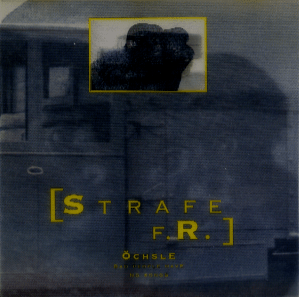
The most recent album, Moor, represents something of a surprise, as it turns its attention to the rock and pop music worlds. Of course, Strafe’s own unique use of rock sounds and patterns swiftly removes the familiar framework in favour of music that retains the energy, textures and devices without having to pay too much lip-service to the form itself. “Moor should offer different opportunities and a variety of different musical windows. Moor of course also has a lot to do with our personal interpretation, how we both perceived the music of the past three decades, which the two of us have consciously heard and listened to.”
However much the critic might want to dwell on the way Strafe FR recontextualise the familiar rock elements, the group’s own vision is much less prosaic.
“If you take Moor as a landscape, it offers a lot of possibilities; either to drown, or to get marshy, or to get bogged down, or to get blinded by beauty. You watch a rare animal or plant and the next step there is muddy soil. There is a good smell of heather, but also millions of summer-gnats and the black grouse. A moor also has its unique acoustic. In the musical Moor there are some contact mines to be found; there are sloughs, poison snakes and slow-worms to be found in the world of pop music. After a short time big parts of pop music disappear inside of mud holes where they rot and decay. Occasionally some of this rises again as a moor corpse – these revived corpses appear in pop museums but they have historical relevance only, they are spent and past. The contact mines in the pop music can cause destructive explosions which give birth to new possibilities, or just create new holes in the ground.
“You need all your senses, feelings and personal atmospheres to experience music. It is important to push away your blinkers, the way of perceiving that automatically has the tendency to fall back into its old narrow position.”

These wide open spaces have to be taken as an allegory, since as soon as you hear the galloping beats and electric noise of Moor’s opening track, Bog Bay the images that come to mind won’t be those of the quiet countryside. The instruments employed are more conventional than those that Strafe usually adopt – Schoolmaster II even consists only of piano and electric guitar – but the musical possiblities are as uninhibited as ever. On Stradivarius, which mixes distorted riffs with pounding drums, and inappropriately classical singing, it requires a quick double-take before you recognise the presence of the violin. As ever, it is the total sound that determines everything else, and Strafe’s juxtapositions of melodic and noise elements are as striking as ever. There’s even a sense of humour present, and in places it’s very obvious:
“We are neither the first to use noises in music nor have we invented a new kind of music – noises itself are not yet music but they become music if we put them in the order of a composition. We are very much interested in language … We do have a special Strafe humour. However, humour can be understood or it can be misinterpreted. We cannot prescribe humour. Humour can be a variant that stimulates every work.”
Where next? Strafe do not play live very often, and then only for special events, rather than as part of a tour, but the possibility of an appearance in Britain has been suggested, and may yet come to pass. Keep an ear out, because whatever happens, it should be good.
Source: http://media.hyperreal.org/zines/est/intervs/strafe.html
STRAFE FUR REBELLION – Hamar
> ORGANUM (DAVID JACKMAN) Interview by Paul Lemos (1988)
Unsound: What does the word ‘Organum‘ mean and how is that meaning related to the music?
David Jackman: ‘Organum‘ is a type of Christian vocal music. Historically it was the first development out of unison chanting, and being sometimes just a drone plus melody is of pleasurable interest to me. As you know, the Organum sound is very much drone-based. So that’s the somewhat loose link with the music that I make and the name doesn’t have any other significance, though it does have other dictionary meanings. Drone musics have always appealed to me, Celtic, Indian, Japanese Gagaku and so on.
Unsound: What’s the philosophical or social statement behind your work? For example, is there an element of mysticism in Organum?
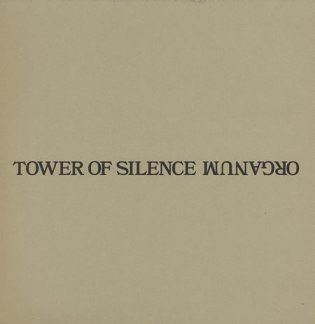
David Jackman: There’s certainly no social statement behind the work and, philosophically, there’s nothing consciously being projected into the sound. Apart from the blind desire to make sounds, the only thing that was at work in the beginning, particularly with ‘Tower of Silence‘ was the wish to make something that sounded completely new. So it was invention that was the driving force, even to the point of eccentricity in the way the sounds got made, like an alarm-clock case being scraped round a rusty bicycle-wheel rim for 20 minutes. As it happened, nothing new got made at all. Instead, Organum music came out sounding really ancient, like something from the very beginning of music-making.
Unsound: How would you define music as opposed to sound or noise? And where does Organum fit into that definition?
David Jackman: In my opinion, music is not any kind of opposition to sound or noise at all, so I don’t think it’s possible to even attempt such a definition. In any case, the work gets made in an intuitive way – which is my particular manner – so what use would definitions be? They’d just be limitations and stumbling blocks.
Unsound: How do you begin creating a work and what is the process used to develop a particular track?
David Jackman: Well, ideas just come and knock around in my head. If I want to, I can then sit down and make diagrams of the various sounds – elements that could go into the track. However, when I go into the studio I usually find that either they don’t work together or I do something completely different anyway. Intentions, which are a sort of fantasy about a track, generally go out of the window pretty fast. I find that it’s no use in my trying to force sounds to fit ideas. Sounds have a life of their own which I have to respect if I’m going to get anything done. I don’t hang on to the intentions if they’re getting in the way. As far as process goes, I only know I have something when the music coming out of the studio speakers begins to add up to more than the sum of all parts. After that the music is made fairly quickly and there’s not much fiddling around with any particular sound. But very odd things surface when a track is in progress. There’ll be strange thoughts and associations that won’t strictly make sense. This kind of non-logic is interesting, because it often leads to a finished track which you then mentally step back from and think, “where on earth did that come from?’ And you hear it as something new and unexpected.
Unsound: Do you foresee any changes in the Organum style?
David Jackman: You can view the early records as being just dense streams of sounds. But the very recent work has become simple. There’s a sort of clarity now and I find that a bit unnerving. When you have just a few naked sounds it’s either going to work really well or just sounds awful; so the music has become more difficult to do. It was comparatively easy to pile on the noise, though even then there were still all the usual problems of composition, of making something work as a texture, durations or whatever.
Unsound: A lot of people feel that the music is developed through extensive tape processing. Can you discuss the manner by which the sound is processed – or not processed?
David Jackman: The sounds on ‘Tower of Silence‘ and ‘In Extremis‘ are mostly of acoustic origin and are not heavily processed at all. But they were put through the usual things like reverb, equalization and chorus. However, that doesn’t make it electronic music. It’s only in the very recent work that I’ve begun to let the studio take over, and it’s something I don’t want to indulge in too much. I don’t want the gadget to sap the desire to originate sound; I think that can happen of you rely too much on technology.
Unsound: What was your pre-Organum work like?
David Jackman: Loops, collaged layers of tape-loop sound. In some ways it was probably more inventive that the later work. Being recorded on an ancient Revox from sound mostly stored on cassette, it was a bit rough on the technical side. I worked that way for five years.
Unsound: What are your musical influences?
David Jackman: Apart from all the drone musics, listening to the weekly AMM sessions in the early 70’s taught me most of what I wanted to know about sound-making. I really owe them a debt if gratitude – one of the world’s great bands. I think it was through them that I really began the process of learning how to listen. At about the same time, the ritual music of Tibetan Buddhism also had an impact. I liked the music because it appeared to be totally relying on texture for coherence. Note relationships didn’t seem seem to have anything to do with it. I may have misperceived it but that interpretation has guided my compositional approach a lot. But other sounds can be influences too, apart from the musical ones. For instance, the engine notes of the various motorcycles that I’ve owned. ‘Tower of Silence‘, for example has in it’s texture many sounds which can be traced back to a Kawasaki KH400 I used to ride. And the metallic scraping found in most of the Organum tracks is a direct result of hearing and liking the squealing brakes of trains at night when I was 14. I don’t think I’ve used a noise yet that doesn’t eventually turn out to have some personal meaning or historical link.

Unsound: Can you say something about the ideas and line-up of The New Blockaders? How does it differ from Organum?
David Jackman: You’d better ask them. I just liked the noise they made and they liked that Organum made, so we did some work together. Probably the major difference is that Organum has never had any strong Dadaist inclinations. But I like their music because it doesn’t really register as music at all.
Unsound: What are your feelings about American art and music as compared to Europe?
David Jackman: I wouldn’t know how to make a meaningful comparison. But the last American artworks that interest me were the works of the minimalists sculptors and, more recently the music of Glenn Branca and Rys Chatham. Some of the hardcore was good too. However, it doesn’t matter to me where art comes from. There are only three questions I ask – do I like it, do I think it’s any good, and originality; have I come across anything like this before? Art considered on a nationalistic basis doesn’t interest me.
Unsound: What are you involved in outside of music?
David Jackman: I ride motorcycles, stare outside of the window and have a nice time with my friends. And like a lot of people, I go to work in the morning. You know, just a normal life. But I don’t regard music as a separated compartment of my life at all. Listening goes on all the time.
Unsound: What’s your goal for the future of Organum?
David Jackman: Well, as I don’t work with with overt theories but with specific sounds and an internal urge there can’t really be any goal. So each track is it’s own end. Really, there’s no mystery to the music; I just make it because I want those sounds to exist. There’s no other reason.
Source: http://www.chronoglide.com/Organum_article_unsound.html
> SPK Interview in Chainsaw #11 Fanzine (February 1981)
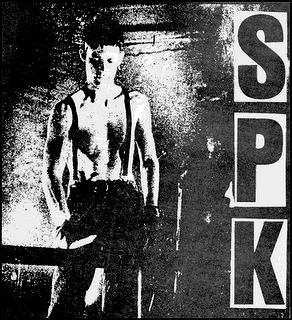
This interview took place after their set at a Final Solution gig in Heaven, Charing Cross, supporting Throbbing Gristle and A Certain Ratio.
Heaven is normally a meat-market gay disco and it must rank as the most sordid venue I have ever been to – I’ll certainly have doubts about going there again. It was unbearably hot, smoky and very dark towards the end of the evening it was literally impossible to see from one side of the hall to another. Decor (and background music) rather over-the-top disco. All in all, probably just about sordid enough for a Throbbing Gristle/SPK gig.
Incidentally a couple of years ago this. place used to be called the (Global Village and had occasional gigs then too – the last time I saw the Users was in there. My, how it’s changed.
I first became interested in Surgical Penis Klinik when their single “Meat Processing Section” came out in the summer last year (although it was recorded in their native Australia in 1979). This was in fact their second EP, the first (No More/Contact/Germanik) was released on their own label Side Effects Records early in 1979.
Tonight their set was quite an experience, to say the least. It is probably best described as an all-out attack on your senses. First, there was the sheer volume of sound – the constant low-frequency noises that were played at deafeningly loud volume. The sound itself – deliberately loud so as to cause distortion – more like the “Slogan” side of Meat Processing Section than the “Factory” side, but always with the booming low frequency noises in the background, that were missing on the records. The lights and the strobes were pointed straight at the AUDIENCE and not the group…
Current line-up:
Operator – Synth/Tapes/Rhythms
Mr Clean – Production engineer
Wilkins – Guitar/Bass
Genesis P-Orridge told me once that this group were the most deranged group that he’d ever come across. After seeing their set, and doing this interview, I almost agree…
Charlie: How long have SPK been going?
Operator: First started in January 1979 I think, but the first time we played together was June l979 and that was with me, a psychiatric nurse, a guy called Nehil who was a mental patient – schizophrenic, and two punk guys we got to help us, who left soon after to become pop stars.

Charlie: Who with?
Operator: They’ve got a group of their own in Australia called Secret Secret who are just making a lot of money in the clubs.
Charlie: Are you all Australian?
Operator: No. Wilkins is English, comes from Bristol, and Mr Clean and I don’t come from anywhere in particular. We consider ourselves stateless.
Charlie: You were born in Australia, weren’t you?
Operator: That’s not necessarily true. But don’t push it. That’s an assumption that we wish to maintain.
Charlie: How many copies did you make of your first single?
Operator: We did two EP’s in Australia – three tracks on each – and we made 500 copies of the first one and 500 of the second one, and then we had to do a re-release of 500. Then I came to England on my way to France, to live there – and Genesis of TG wrote to us and said he wanted to do a re-release in England of the second one, so we said yes. The second one has three tracks on the original – the third track was a throwaway which was fucked up after I left and re-mixed by the psycho guy, before he killed himself.

Charlie: He killed himself?
Operator: Yes… and actually recently we had another guitarist who killed himself, so that’s why the group’s so unstable all the time.
Charlie: Why did they kill themselves?
Operator: Don’t know. They didn’t tell me. They didn’t leave me anything in their wills either, which is annoying.

Charlie: Who writes the lyrics? The words of some of your songs on the first single are a bit over the top.
Operator: Those lyrics were written mainly by Nehil who was the Schizophrenic, but we were working in collaboration all the time. I handled the music, he handled the lyrics. But all the lyrics are over the top. It’s just that some of them are sung in German so they’d be over the top to a German, I suppose.
Charlie: There’s no point in going over the top in a foreign language.
Operator: Why not?
Charlie: It doesn’t seem over the top then.
Operator: But lyrics function as a dictatorial device – if you’ve got a set of lyrics, they’ll tell you what they mean. You’ve then got no choice about any particular meaning in the piece of sound. So if you write lyrics in German, bad German at that because I can’t speak any German, then the audience is free to take whatever meaning they want to from whatever the sound is.

Charlie: Your microphone was very distorted tonight. Was that intentional?
Operator: No, not particularly, but you can’t help it when you’ve got that much noise going on. You can’t get a good mix on a mike like that. Plus I’m shouting quite a lot in German because I like the language – it’s a little fetish of mine.
Charlie: When you sing in German do you understand exactly what you’re singing?
Operator: They’re translated from an English idea, but they’re usually cut up afterwards, so they probably don’t mean anything to a German person either.
Charlie: So do you ever wan to play in Germany?
Operator: I have had thoughts about going to Dusseldorf because that’s where DAF and Pyrolator are working, but I’m not sure whether I like their stuff anymore, I just don’t like England all that much.
Charlie: Then why are you here?
Operator: I don’t like places with any characteristics, I’d like a place that didn’t have any characteristics, so I wouldn’t feel oppressed by any particular culture, or anything like that. I’m not expecting to find anything, though.
Charlie: It’s probably freer here than most places, though.
Operator: It depends what you mean by free. A lot of the things we’re doing now are about information overload. For example tonight there was a tape which you probably couldn’t hear properly because of the distortion, it was a compilation of chemical warfare and side-effects of psychotropic drugs which is an indication that if we’re all excited about chemical warfare, it in effect started in mental hospitals in 1952, with people subjected to it all the time. Another case is a cut-up between several porno loops, hard core and the soft core that you get on advertisements, so we packed them all together, which is the state that you have in the so-called free society. You’re just bombarded with shit all the time. And that’s what we’re saying. We’re not trying to dictate any particular set of lyrics to anybody at all.

Charlie: So what kind of a place would you want to live in?
Operator: We’ll all end up living eventually inside the head. A head without a world. I have no material needs at all – I live on £5 a week. In London that is some achievement, so they tell me.
Charlie: Do you ever get bored?
Operator: Never. You only get bored if you’re expecting something better. And there isn’t anything better, everything’s the same.
Charlie: Isn’t that a negative attitude? I get bored sometimes.

Operator: You must be looking for something. You must have your highs. I think I’m a pluralist to the extent that as much diversity is the best thing. It’s categorisation, lines and so on that you get in the music scene in London which kill you. I can contradict myself one second after I’ve said something, because consistency is just another closed way of thinking.
Charlie: Doesn’t consistency mean that you know what you’re talking about?
Operator: Consistency generally means sticking to a set line, for example Marxist or left wing line, left wing / right wing – it’s all the same – everybody’s realising that now.
Charlie: Well I believe in some things and not in others.
Operator: Noem Chomsky, who’s a really left wing linguist just signed a manifesto of the Fascist party in France saying that they should be allowed to continue. Because he says it’s the only way it’ll be controllable – there’s no point in trying to stamp it out, that’s the way to go about things. That’s the way I think.
Charlie: Allowing any party to exist doesn’t necessarily mean that you agree with what they are saying.
Operator: Exactly. That’s why I wouldn’t follow either opinion. One day I’d say that not allowing it to happen is OK. You can’t make a decision either way. On any subject. It might help to fill in a bit of background here on why I think this way – it comes from experience in mental hospitals where no decision is ever right. For a schizophrenic person, for example, there’s nothing you can do or say to a schizophrenic person that will help them, and being silent doesn’t help them either. So what do you do ?
Charlie: What experience have you had with schizophrenic patients?
Operator: In general… I worked with a lot of alcoholics… senile dementia… manic depressive psychosis… schizophrenia… Schizophrenics are quite interesting. It’s a series of superimposed masks with no personality behind – all they can do is switch from one to the other. They’re not happy with any of them – they’re unhappy with any of them. It’s just a series of options – they don’t believe in any one of them, they don’t think any one of them is better than the other – they don’t have anything behind it to stabilize on.

Charlie: Do you identify with them in any way?
Operator: Yes. There is considerable biological evidence that there is an entire schizophrenic system in everybody which surfaces more dramatically in some than in others. Yes, I think most people are schizophrenic to a certain extent. Not the classic split personality bullshit, but in the sense that at times the overcoating devices, the rationalities just break down and they’ll go haywire – go crazy. One of our songs is called Retard, about a guy who just went crazy-killed somebody – no motive, nothing at all. He’s spent thirty-five years in a mental hospital, paying for it. They couldn’t have let him out though, he might have done it again. It’s these dilemmas, no-win situations which intrigue me. That’s what our music’s about.
Charlie: So what are you intending to do now, as a group?
Operator: We’d like to do another gig, on our own, cos we were fucked around a lot tonight. When we were playing, in what position, and all this sort of thing – in other words we were shoved to side and they forgot about us. Not that I mind – I just don’t like feeling some asshole’s pushing me around. I didn’t complain, or anything like that, but I’d rather control it myself.
Charlie: Where would you want to play?
Operator: Interesting venues, hopefully. Not the Marquee, or that sort of stuff. I’m looking into… they’ve started to rent out the old World War Two underground shelters under London. There’s a huge network of them. I’d like to play down there, and if anybody got tired they could wander off and have a look. Some are run by the GLC, some by the police. They’re useful for storage, mostly. But anywhere that comes up, I’m willing to play. I got approached by a guy tonight waning to put us on a compilation album of futurism, like Eric Random and Naked Lunch and stuff… I don’t want to be labelled as futurist, just like I don’t want to be labelled with Industrial.
Charlie: So you won’t be doing anything more with Industrial?
Operator: I don’t think so, no. It’s a mutual agreement, we don’t want to lump everything together – we want to diversify.
Charlie: Why did you release that second single on Industrial?

Operator: Publicity really. I couldn’t afford to do it . It’s not money, I think I made £15 out of the whole thing, even though they didn’t have any pressing charges. We sold quite a few but I never saw any money – but that doesn’t bother me because it was only to get a name.
Charlie: It didn’t get much publicity in the music press.
Operator: It only got mentioned in Sounds – one line, it didn’t get mentioned in the NME or Melody Maker, possibly because they had their big strike at exactly the time it was released.
Charlie: Would you have wanted more mentions?
Operator: Oh no, not really. It’s a very difficult situation where you’re trying to stay underground but still get a few people to know you. It’s a situation where you say you want exactly 5000 people, no more and no less, any more and you’re selling yourself and any less and you’re wasting your time. It’s difficult, cos you’ve got to tread that line all the time.

Charlie: So what about the future?
Operator: It depends on everybody else really. I’d like to diversify and do video, and maybe do some soundtracks for the video, I’m also writing two books, one on music, one on words – it’s a hybrid of philosophy and fiction. Just on different types of thought, rather than the narrow ones we’re restricted to at the moment. I like violent change, convulsive thought… ripping from one thing to another so nobody can tie you down and say “You are this, you are that”, so if you gave me this interview tomorrow I’d probably tell you something completely different.
I didn’t do the interview again, so I’ll never know now whether that is true. Anyway Surgical Penis Klinik gigs are very thin on the ground to say the least – this was the only one they’ve done in England so far – so the best way to find out what they’re like is to listen to their “Meat Processing Section” single which is still available on Industrial. I prefer the “Factory” side, which I still consider to be one of the best things to be released in 1980. Operator prefers the other side “Slogan” which is probably nearer the live sound.
Postscript. I went round to Operator’s place in Vauxhall a couple of weeks after the gig/interview… The group did not want pictures of them to be published, as one of their primary aims is to discourage identification with the star and other heroic images, and promotion of self-importance in individuals… They have chosen three images, one for each of them. Fourth member “Tone Generator” rejoining the group from Australia at the time of press.
Source: CHAINSAW #11
CHAINSAW #11 Rare PuNk FANZINE featuring Blurt, SPK, Plasmatics, The Dancing Did etc 1981 Garanteed 100% mint condition . Chainsaw was a punk zine edited by “Charlie Chainsaw” published in suburban Croydon in 1977 and ran to fourteen issues before ceasing publication in 1984. A hand-lettered ‘n’ became a stylised trademark in articles after the ‘n’ key broke on Charlie’s typewriter. Some 1980s issues featured cartoon strips and two innovative colour covers by Michael J. Weller. 1970s issues featured the cartoon strip ‘Hitler’s Kids’, authored by Andrew Marr using punk nom-de-plume “Willy D” at the beginning of his successful journalistic career. Charlie Chainsaw formed the band Rancid Hell Spawn when the punk zine discontinued.
(http://www.beatchapter.com/chainsaw-no-11-rare-uk-punk-fanzine-blurt-spk-plasmatics-1981-414-p.asp)
SPK
> COLD CAVE Featuring BOYD RICE (NON) – USA/Canada Tour, 14-29 June 2013

COLD CAVE FEATURING BOYD RICE (NON):
USA/CANADA TOUR
– 14 June 2013 (Friday) – LOS ANGELES
– 15 June 2013 (Saturday) – SAN FRANCISCO
– 19 June 2013 (Wednesday) – PHILADELPHIA
– 20 June 2013 (Thursday) – WASHINGTON DC
– 21 June 2013 (Friday) – PITTSBURGH
– 22 June 2013 (Saturday) – COLUMBUS
– 24 June 2013 (Monday) – CHICAGO
– 25 June 2013 (Tuesday) – DETROIT
– 26 June 2013 (Wednesday) – TORONTO
– 27 June 2013 (Thursday) – MONTREAL
– 28 June 2013 (Friday) – BOSTON
– 29 June 2013 (Saturday) – BROOKLYN
Ticketing Info: http://coldcave.net/site/future/
More Info At:
http://coldcave.net/site/
https://www.facebook.com/events/293050757495622/
COLD CAVE
BOYD RICE
> New Noises – A Conversation with LUSTMORD (Brian Williams)

Lustmord (aka Brian Williams) wields the weapon of sound unlike any other. From collaborations with the Melvins to Tool to Jarboe and Coil, Lustmord has long been the purveyor of sounds that reach into the depths of the consciousness. I had the opportunity to chat with Brian about his own passion for music as well as his news of his upcoming album.
What was the initial pull for you to create music? How did you arrive to where you are now in regards to what you create?
That’s a good question. By the way, sometimes I’ll be a little bit vague in my answers, and it’s not because I’m being deliberately vague. It’s just that I don’t have a straight answer, but that’s a good example of that kind of question. It’s a good question, but I can’t put a specific time or anything that happened that I knew kind of thing. It was more kind of an organic process, I guess. I’m formalizing my answer as I’m talking as you can probably tell [laughs]. No, but it’s kind of hard to describe. Which it shouldn’t be, because it’s not that complicated. This is basically who I am. I’ve always had my perspective on the world – the way I interact with my own world and my own life has always been the same. Kind of growing up I was, of course, aware of many things including music and, of course, when you’re in your formative years and when you become a teenager, especially in my generation, music was quite important as far as your identity and state. It’s just discovering the world in terms. I was always discovering cool things and music was a big chunk of that. It just seemed to be the kind of thing I’d be interested in doing, but I never really followed up on anything. I didn’t do anything about it.
I didn’t take music in school or anything like that, mainly because my school the choice was either music or art. You couldn’t do both. And I chose art, and I went to art school for a year or so before we mutually agreed that I should leave. I did that more as a delay in getting a real job, you know. I went to art school, didn’t like it, and left. During that time I was there it was the same time the whole punk thing was happening, the industrial thing was happening. I was really wowed by what they were doing, and I was really inspired by all that stuff and more than just musically – it was philosophically – all that stuff that was going on was really interesting. I actually got to know some of those people like Throbbing Gristle, and it’s actually them that originally asked me “Why don’t you do it?” And I thought, “Well, yeah…why don’t I do it?” [laughs] So I started kind of messing around, and I wasn’t really aware of it as such, but I started doing some sounds, and people were responding. I didn’t think about doing any albums or anything like that. I wasn’t expecting, when I started doing this stuff, that I’d be talking to somebody about it thirty-three years later. I was just doing it for my own amusement – expressing myself. It wasn’t really important. It’s still not that important to me. It’s great when people hear it or are into it, but I’m just doing it for my own amusement, really.
It’s through people like Cosey that wanted to hear it who suggested other people listen and then the next thing I know other people are hearing it, and then people are talking about releasing it. It’s not something I set out to do. When I left art school, which I was really good at fine art, but when I left art school I just didn’t do any art at all. And I haven’t done any since then apart from album covers and stuff like that. Not real art in the sense of drawing and stuff. Which never bothered me – going to art school, interestingly enough, stopped me from drawing. But what really happened, and I don’t know why I’ve been so slow in realizing this, but what happened was that I moved from drawing to doing sound instead. That’s how I express myself.
That seems like a natural progression to me.
Well me too, yeah. Well, that was why it was such a long, rambling answer [laughs]. It’s just so obvious.
With that, as far as your creative process – what’s your general approach to instrumentation and composition? From the inception to the birth of the sound itself what does that arc look like?
The reason I started doing this stuff…and it took me a couple of albums to find my own voice because I was distracted by my influences and stuff which is normal, but what I was trying to with, for example, the album Heresy – and any album before that I was starting formulate this sound, but the sounds I wanted to hear – they just didn’t exist. Like most musicians, I love music, and I have a very eclectic and large music collection and a wide taste in music as long as it’s good and original. But there were some things I really wanted to hear that didn’t exist. It was one of the “I’m going to have to do it myself kind of things, so I could hear the sounds I wanted to hear. And that still remains a big part of my motivation. Also this stuff – it’s inside me. And that part’s hard to describe, but this is why I do it. I don’t have much of a choice. This is in me, and I have to get it out. I’m not tortured by it or anything, but I’m always creating sounds. As far as the process, for me I’m very much an ideas guy. Concepts and such – I’m stimulated by so many things.
There are things that interest me, and there’s little ideas that will bombard me from somewhere, but basically I’ll have a concept, which is where I’ll start, and then I’ll formulize that concept in my head. The stimulating part, though, is the concept. It comes in bits and pieces. I hardly write anything down. It’s all ideas in my head, really. They come together, and then I have an idea of how this might work as an album. The actual recording is what I call the “grunt work.” It’s not boring as such, but it is the most boring part of the process, because it’s actually more digging a trench – you’ve got to roll up your sleeves and get on with it until it’s done. I always have a concept, and there’s always an arc – a beginning and an end. I always do albums. I don’t think of them as tracks, really. I mean, they’re separated, but generally speaking my albums are envisioned as one piece. I know exactly where it’s going to go, before I start on it.
I came to Lustmord’s music a little later in the game as I was introduced to your music by way of Tool. I kind of just worked my way backwards from there. I was honestly able to just explore Lustmord’s music thanks to the internet, and with that I’m curious as to what your perspective is on what the main obstacle is for someone who wants to create viable art in 2013?
Oh, man, that’s a good question, and I think there’s a multilayered answer to that one as well. Of course, it’s my opinion, but I think there’s two things…just talking specifically about impediment – I think the main one, the big one, is just the sheer amount of shit that’s out there. There’s nothing impeding someone from doing what you’re saying. What’s difficult is to be seen and be heard, and that’s because there’s so much shit. There’s so much stuff out there music-wise, and most of it is shit, and that’s not just my opinion. It is literally shit [laughs]. The signals to noise ratio is terrible. There’s plenty of artists doing good, it’s just how do you get it heard. I don’t necessarily think there is a straight answer to that. I think, basically, if you’re doing something good and something worthwhile, people will become aware of it eventually. There’s luck involved too. The good stuff floats to the top. They always say the shit floats to the top, but I think in this case, with music, the shit floats to the bottom.
It is possible – it’s not easy – but it’s possible. I think another impediment is that I think a lot of people just don’t have any ideas. They copy other people or rehash them, which is okay to a degree when you’re starting off. If you have a really good idea, though, you’ll persevere. You won’t necessarily be rich and famous, but you’ll find a way to make it happen, and people will be aware of it. And it’s not just music. It’s literature, film, TV – a lot of time people are creating things when they really shouldn’t be. They’re just wasting everyone’s time. It’s crap.
Absolutely. I think in regards to quality not much has changed, necessarily, it’s just that there’s so much more other shit to sift through.
There’s just so much noise, pardon the pun. There’s a few things now that’ll help you like “If you like Tool, you’ll like so and so….” It’s subjective anyway, though. Tool is a very good example, actually, going with that. Tool, of course they have a very wide audience. They have the knuckleheads and then they have the enlightened hippie-types and everything in between. If you like this it doesn’t necessarily mean you’ll like that. Tool is a good example of that, because they’re actually a little more complex than most. So, the reason why you’d might like them might be completely different from the reason someone might think you’d like them. It might because of some of the hard rock stuff they do or because of the ideas and concepts and stuff. They’re a progressive rock band with complicated rhythms, and they’re very good at what they do, but why them? It’s because they’re good. They play, people notice them, and they have a large fanbase, because they do what they do really well, and they’re original.
It’s funny, actually, because I’ve listened to heavier music almost my entire life, Brian, and thankfully I had an older brother who liked heavier music, so I simply stole his tapes.
Oh really? What was the turning point for you, then? Which one really made an impression?
[Laughs] Well, I’ll unabashedly say it was Guns n’ Roses Appetite for Destruction.
Oh god…
[Laughs] I know, I know.
I figured you’d say Black Sabbath or something like that.
I was a kid in the late 80s in the bible belt, man. Hard to climb that gigantic cultural fence we have surrounding the area down here.
[Laughs] Well that’s no excuse!
I did eventually work my way backwards to thrash and then to Sabbath and stuff like Blue Cheer and Cream, so hopefully I can redeem myself here.
Well, that’s good. People that really care about music…when you hear something really good and it’s really interesting you ask, “Well, where did that come from?”

As far as what drew you to the experimental or dark ambient side of music, what was the catalyst for you wanting to create those specific sounds?
I’m a big Dub fan. I listen to electronica. Most of my collection is things like Kraftwerk and Trip-Hop – just a whole range of beats and stuff. I don’t listen to dark music, necessarily. Some electronic stuff is, I guess, but I don’t go out of my way to listen to it. My own work, which has always been called dark, I just do whatever the fuck I do. I like my own work to speak for itself, you know. The music that I do – it’s how I express myself. Basically, the music is my expression of what it is. If people want to understand it, they should just listen to it, I guess.
People have an inherent need to compartmentalize things into specific categories, and I think that’s no more true anywhere else than in music.
I agree. People like something to have some kind of tag onto it, so they can file it. What do I file this with? It’s the way our brains work. We have these little compartments we put our stuff into. It makes it easier for us to make sense of the world.
What are you currently working on with Lustmord?
I’ve just finished a bunch of stuff, so there’s a new album coming out in June. That’s the next big thing. It’s coming out on a British label called Blackest Ever Black. It’s an album with vocals.
Any special guests on the vocals?
I’ve got my friend Ina, a Norwegian singer, she’s singing on some tracks. Jarboe is on a track. And I’ve got some guy called Maynard on a track too. Oh yeah, he’s from that band Tool you mentioned [laughs].
You know, Tool is actually one of those bands I listened to in my early youth that I still listen to now. They’re one of the few I’m not the least bit embarrassed about, which is more than I can say for some of the other crap bands I listened to at that point in my life.
They’re really great people. I really didn’t know much about them until I met them. I was kind of aware of them, because they were somewhat popular.
How did you actually come to work with the band?
Adam [Jones] actually got in touch and suggested we work together. I checked them out. He came over, and we sort of hit it off immediately. We have sort of very similar interests, and we became friends pretty much instantly. Got to meet the rest of the guys and get to know them – went to a few of their shows and rehearsals. Going to their shows, you actually realize they’re quite popular [laughs]. But yeah, Adam just got in touch and wanted to work together. It kind of happens that way a lot. You get together with a rock band, you’re not going to just discuss rock music. You’re going to talk about all kinds of music like electronica, Fever Ray, Aphex Twin – all kinds of stuff. Musicians are always interested in something else.
Speaking of Fever Ray, the new The Knife record is phenomenal.
I haven’t heard that one yet. It’s gotten some mixed reviews, hasn’t it?
I think it’s been fairly positive across the board. I think anything Dreijer-Andersson is involved with is well worth checking out.
Yeah, I love the Fever Ray album. I wish she’d do another fucking one of those.

What’s on your reading list at the moment?
Oh, Jesus Christ [laughs]. I just finished a book yesterday. I usually have about five or six books next to the bed. I actually finally got around to reading Blood Meridian in the last few weeks.
What do you think about it?
I like it. It’s not my favorite. I like his other ones more, but I like the writing more than I do the story. Then again, the story is kind of secondary anyway. Next to him, I’ve got some Chandler, James Ellroy, and a few others. Of course, I love Name of the Rose and Foucalt’s Pendulum. Early Neal Stephenson, David Mitchell, Chuck Palahniuk, and so on. I’ve got Hellboyhere and a whole bunch of other stuff – Sandman. I’ve got a whole section on psychiatry and brain control. My wife actually has an entire book collection on torture and execution, of course. I’ve got a really good history selection. A History of Camouflage. I’ve got a lot of books on camouflage [laughs] and barbed-wire. A whole bunch of stuff, really. I love conspiracy theories, too. Good ones. People have a real need to believe in something. I believe in common sense.
Thanks to Brian for his time.
Source: http://www.steelforbrains.com/post/48204167014/lustmord
Follow Steel for Brains at:
https://www.facebook.com/SteelforBrains
https://twitter.com/steelforbrains
> NAEVUS, SOL INVICTUS, THE MIGHTY SIEBEN, WHILE ANGELS WATCH + Others, Live in London, 11 May 2013

SOWILO MEDIA PRODUCTION PRESENTS APOCALYPSE STINK!:
– NAEVUS
– SOL INVICTUS
– THE MIGHTY SIEBEN
– WHILE ANGELS WATCH
+
DJ POISON CREEPER & SPECIAL GUEST: SORIAH
DATE: 11 May 2013 (Saturday)
DOORS OPEN/TIME START: 1900hrs/1915hrs
TICKETING: £11 (Advance)/£15 (At The Door)
(http://sowilomedia.net/)
VENUE: ELECTROWERKZ, 7 Torrens Street, London EC1V 1NQ ENGLAND
More Info At:
http://www.whileangelswatch.net/
https://www.facebook.com/pages/Electrowerkz/497558173609057?fref=ts
NAEVUS
SOL INVICTUS
THE MIGHTY SIEBEN
WHILE ANGELS WATCH
> DEMDIKE STARE, CUT HANDS, KEVIN DRUMM, FAILING LIGHTS, LUSSURIA, CLAY RENDERING + DJ DOMINICK FERNOW (PRURIENT, VATICAN SHADOW, COLD CAVE) Live in Italy, 10-12 May 2013
HOSPITAL PRODUCTIONS PRESENTS THREE DAYS OF STRUGGLE 6 FESTIVAL:
(Curated by Dominick Fernow and Nico Vascellari)
– FAILING LIGHTS (May 10)
– LUSSURIA (May 10)
– CUT HANDS (May 11)
– CLAY RENDERING (Live Debut) (May 11)
– DEMDIKE STARE (May 12)
– KEVIN DRUMM (May 12)
+
– DJ DOMINICK FERNOW (Every Night)
(PRURIENT, VATICAN SHADOW, COLD CAVE)
DATE: 10, 11 & 12 May 2013
TICKETING: 30€
(http://www.codalunga.org/shop.html)
VENUE: CODALUNGA, Via Martiri 16-18-20, 31029 Vittorio Veneto (TV), ITALY
More Info At:
http://hospitalproductions.net/news/
http://www.codalunga.org/
LUSSURIA
CUT HANDS
DEMDIKE STARE
KEVIN DRUMM
> ROHCO, SACHIKO, KEIKO HIGUCHI, MICHEL HENRITZI, RINJI FUKUOKA, SANJA (KAN MIKAMI, TOSHIAKI ISHIZUKA & MASAYOSHI URABE), Live in Tokyo on 25 April 2013 + MARBLE SHEEP & 魔術の庭 on 4 May 2013

SHOW 1:
– ROHCO (Electronics)
– SACHIKO (Voice, Electronics)
– KEIKO HIGUCHI (Voice, Electronics)
– MICHEL HENRITZI (Guitar Lap Steel, etc…)
– RINJI FUKUOKA (Voice, Violin, etc…)
– SANJA:
- KAN MIKAMI (Vocals, Guitar)
- TOSHIAKI ISHIZUKA (Drums)
- MASAYOSHI URABE (Alto Sax, etc…)
DATE: 25 April 2013 (Thurs)
DOORS OPEN/TIME START: 1830hrs/1900hrs
TICKETING: ¥2500 (Advance)/¥2800 (At The Door)
TICKETING INFO: ticket@showboat.co.jp
==============================================================================
SHOW 2:
– MARBLE SHEEP
– 魔術の庭 (Majutsu no Niwa)
DATE: 4 May 2013 (Sat)
DOORS OPEN/TIME START: 1830hrs/1900hrs
TICKETING: ¥2500 (Advance)/¥2800 (At The Door)
TICKETING INFO: ticket@showboat.co.jp
VENUE: SHOWBOAT, 3-17-2-B1 Koenji-Kita, Suginami, Tokyo, JAPAN
More Info At:
https://www.facebook.com/events/442597239165910/?ref=ts&fref=ts
http://showboat.co.jp/
ROHCO
MARBLE SHEEP
 4iB Records | For intrinsic Beliefs