4iB Records | For intrinsic Beliefs
Record Label dealing in Industrial, Power Electronics, Harsh Noise, Experimental, Death Industrial, Drone, Ambient, Japanese Noise, Field Recording, Abstract, Musique Concrete and other related genres.

> G.X. JUPITTER-LARSEN (The Haters/Survival Research Laboratories) – Interviewed By Miss Amy Young

In 1979 while I was locked in my room listening to Cheap Trick records and getting into Punk Rock, GX Jupitter-Larsen was taking the picture and smashing it into the ground, literally! Twenty years ago, this May, marks the first Haters’ performance. For the last twenty years Larsen has provided somewhat of a chaotic balance in the world of Noise by giving function and amplification to inanimate objects and also by providing the best soundtrack possible to the process of decay- -the actual sounds amplified, sometimes at levels that have been described as “maddening! And the incitement of madness is vital to the heartbeat, I say! He is the man behind the Survival Research Laboratories’ videos and live show sound for the last seven years and has an extensive Haters’ discography. I could go on and on, but perhaps you should just read more about someone who just may be responsible for why i don’t hear things quite the same way anymore.
Miss Amy Young: Not that your reputation doesn’t precede you, maybe you could begin by giving a little history of The Haters?
GX Jupitter Larsen: Well, it’s the 20th Anniversary of The Haters. It all started back in ’79 in New York when I got tired of getting kicked out of Punk Bands for refusing to learn how to play my instrument. People at the time talked about Punk as if it was noise, but it was never noisy enough for me. So one thing led to another and I started The Haters. At first no one could be in the group if they knew how to play their instrument. But I soon got rid of instruments altogether and just started smashing stuff on stage. Then we started to smash the stage itself. Then we’d destroy the whole club.
But after trashing venues around the world for 15 years I have to say it got a little boring. So for the past 5 years the performances have been less destructive, but a lot louder. The amplification of erosion, like sanding or grinding, is now the main force behind the releases and the live gigs.
Amy: Why erosion?
GX: I find decay gorgeous! Perhaps because the lack of it is a sure sign there’s a lack of everything else! You can’t eat anything without doing some kind of damage to your digestive system. Yet, without the decay going on in your stomach, there wouldn’t be the pleasure of another delicious meal. Outside in the world around you, the process of rot and decay is merely the natural environment digesting nourishment.

Amy: You told me of a recent performance where you premiered your Untitled Title Belt. I’ve told many people about this and you would not believe the response!
GX: The response to my noise belt has been truly amazing! The belt is designed to look just like a traditional championship wrestling belt. But this implement functions as a combination microphone, distortion-pedal, and noise generator. Damion Romero of Speculum Fight did the electronics for me.
Its great; you’d never know just by looking at it what the thing can actually do.
The belt is an acknowledgement of the aesthetic traditions that I subscribe to; my own and wrestling’s.
If I had an artistic predecessor, I’d have to say it was Gorgeous George. George was a psychiatrist turned wrestler. He single-handedly transformed Wrestling into the theatre of the absurd we know today. I would like to think I’ve transformed Noise into the same kind of spectacle George made Wrestling into.
Amy: Have you done anything with film or video lately?
GX: Recently I co-produced an episode of FUCK TV on Channel 53 here in San Francisco. In it, three young Victorian ladies were counting sand only to wind up eating the stuff. And they really did eat it! Amplified erosion was used as the soundtrack, because without erosion, there wouldn’t be any sand to count.

Amy: Are you working on any SRL (Survival Research Laboratories) projects right now?
GX: I’ve been doing the soundtracks for all the videos and live shows for Survival Research Laboratories since ’92. And during that time SRL hasn’t been allowed to perform all that often. It’s either the Fire Chief or the Police Chief coming down on Pauline for one reason or another. There’s some talk of a show in Oakland later this year, but I’ll believe it when I see it.
Amy: It seems that the Noise scene is far smaller here (NYC) than in the West and Southwest even. Do you at all agree that this can be attributed to region?
GX: From what I’ve been able to figure out over the years is that it all depends on how active the region’s central players are. The Noise scene is like a secret society; the only way you can know about it is by knowing somebody else who’s already into it. In regions where there isn’t a lot of stuff going on people will be more likely to make their own fun.
Amy: Tell us about your new collaboration CD with conceptual artist David Ireland.
GX: David was totally into doing the project. He’d never had the opportunity to do an audio release before. I wanted to work with him because I’d always had a great respect for his attitude towards what he does. The CD has three collaborations, all of which contain sound fragments taken from David’s audio archives of 500 Capp Street, and were re-edited by myself. I prefer working with people who are not into the Noise scene because I find the results more unpredictable. It’s more fun that way. My next collaboration is with Scanner. The CD should be out this summer. It doesn’t sound like anything either of us have ever done before!

Amy: Have you seen any performances lately that have blown your mind?
GX: Funny you should ask. A few weeks ago I was in L.A. and took in a performance by Fin. It was great! He made an oil-barrel into a speaker. Now I’m not saying he put a speaker inside an oil-barrel. He actually converted electrical signals into sound through the cylinder body of the barrel as if it were a speaker. The barrel itself was wired to vibrate in order to emit sound. It wasn’t that loud, but the fidelity was phenomenal. It really didn’t sound like anything you’ve ever heard before.
Amy: And lastly, do you have any big fantasy projects you would like to do?
GX: I’ve always wanted to get shot out of a cannon. Perhaps this will be the year.
You can contact GX at:
Polywave@yahoo.com
Or visit:
www.nd.org/haters
(Source: http://www.tif.org/caution/interviews/interview-haters.html)
> FLYING BIRDS FIND SOMETHING, SITTING BIRDS ONLY FIND DEATH; An Interview with Stormfågel By Raul A.
The years 2005 and 2006 will always stand out as one of the highlights in the long history of Cold Meat Industry. We saw new music from Ordo Rosarius Equilibrio, Desiderii Marginis, Atrium Carceri, Brighter Death Now, Sephiroth, Mz.412, raison d’être, the return of IRM, and live performances across the world. They also seemed to have had an increased interest in Neofolk, introducing bands such as Medusa’s Spell, Rome, and Stormfågel. At first I was a little hesitant, if I recall correctly there was a heightened interest in Neofolk at the time, and a sort of power vacuum as well. It would be about 4 years before we would see a new Death in June album, 7 years for a new Blood Axis, and a number of new bands coming out, some looking to make their mark, others retreading the same ground. With Stormfågel, I initially wondered how they would define themselves, but it didn’t take long before I picked up on the subtle, hidden references to Existential films and literature, and took them to be far more intellectual than some of the other new bands coming out.
Over time I felt some internal conflicts within myself, in that I’ve felt rooted in traditional ideals, but fully aware of my own functions and contributions to a modern world. After a closer examination, I was surprised to see Stormfågel also lamenting on these conflicts and with that I was even more excited for their new release and to interview front-man Andreas Neidhardt for Heathen Harvest. The following conversation was had over an extended period of time in early 2012 over e-mail, during which time Andreas was finalizing the new album “Dödsvals”, and towards the end of the thread actually saw its release.

Heathen Harvest: First of all, thank you for taking the time to correspond, I imagine you have a lot going on with your various projects and the upcoming Dödsvals album. Care to give us an update on Dödsvals?
Andreas Neidhardt: Well, Dödsvals have been more or less finished for quite some time now. The only thing left to do is the art work and unfortunately I’m very lazy so it will take another couple of months before it’s ready for release.
Max from Steinklang is also (or at least I hope so) working on the art. We were supposed to finished it when I was still living in Austria but I guess vodka and work came in the way…
HH: Unfortunately not many have the luxury to work on their art full-time, so that’s understandable. A few months would be in time for Wave Gotik Treffen, any plans to attend or have a release ready for the event? A mini-release might be a good idea.
AN: If WGT wants me to play I would love it! It’s a great arrangement, lovely people and wonderful concert halls. I know that CMI had some kind of contact with them but I’m not sure about Steinklang. And from what I’ve heard it’s quite meaningless to contact them yourself and beg. They are too big I guess. Besides all that, maybe they don’t want me there after last time…
Hopefully there will be some kind of mini-release or similar in time for WGT. I have some ideas I’ll talk to Max about. We’ll see. (Note: Stormfågel did not attend WGT 2012, but Dödsvals was released at about that time. More on this further in the interview.)
HH: Your last release, Eldvakt, marked a move from the Swedish Cold Meat Industry label to the Austrian Steinklang Industries. How has it been transitioning from working with a local label to a Trans-European model? I imagine the benefits must have outweighed the costs as your new album is also scheduled to be released by Steinklang.
AN: Actually there is no bigger difference at all. The only thing I can say is that Max answers mails faster then Roger…
The reason why my next album will be released on Steinklang is simply because I like working with them. To be released on CMI was a dream for me, both as a Swede and a big fan of their early releases. I don’t know what’s happening with CMI nowadays. I heard something about Tesco taking over CMIs back catalog but I haven’t heard anything. So I will stay with Steinklang, why fix something that ain’t broken?
HH: Right, I’m not sure what the current situation is with CMI but I’m glad you were able to work something out for your releases (Note: I later confirmed that Tesco only handled distribution of CMI releases, nothing more). You mentioned that Max is still working on your artwork, one of the things that I like about Steinklang releases is the importance they place on art and packaging, especially with their limited editions. Did Max come to you with the idea for a wooden box-set for Eldvakt, and do they have plans to put out a limited edition of Dödsvals?
AN: The wooden box-set was all Max’s idea and I also love that they do more than “just” releasing digipacks. I have never been a record collector or any kind of collector myself, but I appreciate the time and work Steinklang puts into their releases. I think a nice limited edition of an album you like actually can make you willing to spend some money on it and not just download the tracks.
We have spoken about a limited edition for Dödsvals but how it will look is too early to say.
HH: I noticed you’ve been active on the digital video front, putting together some promotional clips for Dödsvals, as well as editing video material for some of your past releases such as “StaloSthlms kanal” on YouTube . Do you have some prior experience in video production or editing? You have some quality material posted there.
AN: Thanks! No I have no experience at all and I think you can see that. 😉
For many years I’ve wanted to make some kind of music video or short film or something but there has never been enough time. Now I use it when I have to do something creative or have too much energy/feelings inside but have no musical ideas. I know they are very basic but I have fun making them and that’s the most important! I use writing and painting the same way. It’s an easy and harmless physical vent but it works quite well.
HH: It’s good to hear that you’re able to exercise your creative energies in various ways. I find that some people lack the imagination or ability to work out their inner demons and find themselves counter-productively lashing out.
AN: I’m not sure it’s a good idea to upload my little videos on Youtube since they are really amateurish. But then again, who gives a fuck? I have fun making them and it’s the same for my music, even if nobody listens to it I would still do it.
I also write and paint from time to time but that I’ll keep for myself! Creativity for me is just a way to keep me from exploding. If I don’t have music and writing and stuff like that I would need alcohol and drugs and if I didn’t have that either I don’t know what to do. Go postal I guess…
HH: So how do you feel about fans who post YouTube “music videos”? I use quotes because the videos often are just still images with the songs playing over them. I have to admit to seeking them out myself at times as a way to quickly listen to a song when I don’t have access to my library, or if I feel the need to share it with friends. It seems that you’ve taken a proactive approach by putting out those aforementioned higher quality videos yourself, so in a way maintaining some level of control over the your work. I personally believe more recording artists should take this approach, if time allows, of course.
AN: I love it! If someone takes the time to put together a little video for one of my songs, even if it’s just a picture, it’s a great honour! I don’t expect anyone to like my music so to see that someone actually made a video to a Stormfågel song is…wonderful.
Everything I have done under the name Stormfågel I have done just for myself. I never think in terms of “fans” or something like that. But, if someone likes what I have done, bought a record, made a Youtube video, wrote me a letter, then I’m the happiest guy alive. If I can touch someone with my music then…I mean…that’s huge!
I blush but with a big smile inside. I’m just a sucker for confirmation like everyone else.

HH: On your profile for Stormfågel it mentions that you are influenced by “the absence of God and the decline of mankind”. Do you feel that those two issues are related? Are you familiar with the works of Julius Evola, René Guénon or John Michell? Evola and Guénon would say that we are living in the Kali Yuga, the age of the demon, the materialistic final cyclic stage of the Hindu tradition. Thoughts?
AN: They are not related in the sense that the absence of God is the reason for the decline of mankind. Since I’m an atheist, the absence of God is somewhat permanent and has always been. For me it’s more of a lack of awareness and humility towards the planet and everything living on it. God is just another name for this. The decline of mankind started out when we realized, or at least thought, that we were god. And it’s escalating rapidly nowadays when it’s all about “Me”.
We’re living in the age of egoism and I hate it. We’re not solitary animals, we live in flocks or packs. We depend on each other so instead of all this talk about “Me, Me, Me” there should be only “Us”. I’m a big fan of the collective but of course there should be room for the individual as well. But we must remember that we face danger together, we fix problems together. This is not the time for everyone to be running around for themselves.
Since Kali Yuga is supposed to be the worst of the four ages I guess we’re heading towards a brighter future. I just hope that I’ll live to see it…
Unfortunately I think things will get much worse before there will be any turn for the better and I also think that humans, as a species, must disappear before there can be any permanent change. I’m not sure this is Ragnarök but at least it’s the Fimbulvinter…
HH: Very well put, and I agree on several points. I personally see a stark difference between rational self-interest and shallow, self-destructive egotism. In many ways there is a social contract that man, as a social animal, must abide by, for it’s ultimately in their individual best interest to have a safe, productive, and healthy environment. I think it’s within man’s potential to become a Nietzschean God, but very few do, and many who try end up fooling themselves and give up control of their lives to those who sell them that promise. Then there’s those who so firmly believe in a spiritual world in an afterlife that they have no interest or intention in preserving this material world. I believe collectivism could work in small, homogenous populations, like those in Scandinavia, but when you have many competing populations spread out over large territories, I’m not so sure. Maybe we’re seeing a test of that right now with the financial crisis in the European Union. I believe you are interested in history and contemporary politics, any thoughts on what’s going on with Greece, Spain, and the European Union experiment?
AN: It’s funny you mentioned that about small homogeneous populations. I recently read a very interesting book called Dawn over Kalahari: How Humans Became Humans, by Lasse Berg.
The book is about our prehistory in Africa and what made us what we are today. In the book the author refers to old interviews and studies of Khoisan, who is believed to have maintained our original way of living the longest, and in these interviews and studies we can see that a group of Khoisan rarely became over 30 individuals big (if they became too many some wandered off and started a new tribe). The reason why they, and probably our ancestors, behaved this way we don’t know. But later studies have shown that the amount of individuals that one can actually know well and care for is around 30. So perhaps it’s just simple as that; we are herd animals and in our herd we depend on each other and need to know that our neighbours got our backs. So we’re designed to live in small groups with 30 individuals. If the herd gets bigger we lose emotional connection to our neighbours and you can’t depend and trust someone you don’t know.
That is, to get back to your question, for me one big problem with EU. I know I have to care about what’s happening in Greece since it will affect my life here in Sweden, but to be honest I really don’t give a rat’s ass! I can’t really care about things/people I can’t relate to… Southern and Northern Europe are miles (and sometimes decades) apart. They should have drawn the line at the Alps. I can be very jealous of the lifestyle in the South, life seems easier there, but I do prefer the Scandinavian/German way of life.
I absolutely think there is a future for EU but then we need all of our countries to work together and let go of national pride, national stupidity and stuff like that. We need EU to be more like a nation than a union. One nation, one law under one leader.
I think this is the future but do I want it? Hell no!
HH: You’ve mentioned in interviews that you are not religious yourself but you have a yearning to be religious. Do you feel that through your art you form a sort of transcendental bond with nature that you would otherwise be lacking? For many artists, the very act of making art is a form of ritual.
AN: No, not really. Composing or creating is just something I need to do. There is so much I need to express and get out of my head so it’s more agony than ritual. It’s like I’m boiling inside and composing or painting is the only good and healthy safety valve I know. If I could choose, I would prefer some peace and quiet in my soul even if it killed my creativity.
HH: Many of your tracks reference and sample classic European films, such as the work of Ingmar Bergman. What would you say is your favorite Bergman film? “Hour of the Wolf” is personally one of my favorite films of all time. How about other favorite films or directors? Herzog?
AN: Vargtimmen is really a superb film but my favourite is Jungfrukällan. The film has, as always when it comes to Bergman, excellent acting and wonderful dialogue. There is something with the film that makes me see it again and again. There is a claustrophobic feeling in it, the agony is so intense and the fact that the beautiful Karin is raped and murdered immediately leaves me with a pleasant feeling of hopelessness.
Herzog, absolutely! Aguirre, der Zorn Gottes is a masterpiece.
But there are so many great films and directors. I love Das weisse Band but I also love Snatch. It can’t be only darkness and depression…hell, this morning I was laughing my head off to Bored to Death.
HH: Ah yes, Jungfrukällan is certainly considered Bergman’s masterpiece, and I can’t argue with that. I believe the rape and murder scenes in The Virgin Spring, which debuted in 1960, is in some ways more brutal and intense in its struggle than the desensitizing, overproduced torture-porn in today’s movies. I believe it was banned here in the United States at the time and influenced horror movies like Last House on the Left.
It’s great to have a variety in tastes, as much as “darkness” is a part of life, it’s not the totality of life. I’m sure you have musical interests beyond folk and neo-classical compositions. As much as I enjoy Post-Industrial music, I’m also fan of drone metal and some intelligent hip-hop (currently listening to Dälek). How about yourself?
AN: I remember the first time I saw Jungfrukällan. I was around 15 or something and the rape and murder scene really got a hold of me. There’s something with this pure and clean (in every sense) girl and the total darkness she’s facing that made and still makes my stomach hurt. I so want to believe in something pure and clean in this life, and not have to see it get raped and murdered.
I haven’t seen any of all these torture movies. I don’t find anxiety, pain and agony entertaining and I dream enough nightmares as it is already.
Oh, Dälek. I must listen to them, you’re not the first to mention them. For the moment I’m once again deep in The Sisters of Mercy and Depeche Mode. I’m reliving my youth or something!
There are bands I always will love and come back to once in a while, bands like Skinny Puppy, Joy Division and Kraftwerk. But of course I find new bands as well, even if I seem to be at least 3 years late all the time. I recently heard These New Puritans for the first time and fell in love with their “arty” post-punk/hip hop sound. The Streets and Crystal Castles are two bands I listen to often now a days.
Have you ever tried to read a German poem over an instrumental Wu-Tang Clan song? It kicks ass! Absolutely awesome! If only I could make music like that, and speak German…

HH: One of the first things I do when I enter someone’s home is check out their bookshelves. What have you been reading recently and do you have any recommendations for material that might give fans of Stormfågel some insight into your influences?
AN: Well, my bookshelves are pretty empty for the moment. I got some complaints that it was a total Blitzkrieg in my apartment so I had to get rid of some war books.
This last year I’ve been reading more fiction than ever. I need to keep my mind busy and occupied with something else than thinking so I’ve been reading 24/7 and there have been some really great books.
If I should give some recommendations it has to be:
- Les âmes Grises by Philippe Cladel
- The Book Thief by Markus Zusak
- City of Thieves by David Benioff
- Les Bienveillantes by Jonathan Littell (Even if I hate the meaningless incest. It nearly ruined the whole book)
- And last but not least: Kunzelmann & Kunelmann by Carl-Johan Vallgren
HH: Thank you for the recommendations, I’ll be sure to add these to my reading list, if I can find them in English! Or maybe it’s worth the challenge to learn some new languages! This might be the second time Les Bienveillantes (The Kindly Ones) has been recommended to me, I’ll move that one up to the top. It appears that David Benioff also wrote the screenplay to the Game of Thrones TV show. Have you read the Songs of Fire & Ice books or seen the show?
As for reading a German poem while listening to Wu-Tang… well I am trying to learn German so I wonder if that would help or hinder me, either way I’ll give it a try! Ah, Crystal Castles is great, would highly recommend Cold Cave, the latest Prurient, and Health as well.
AN: Oh, must check them out! Thanks.
Well, Les Bienveillantes… I actually think that the greatest benefit with that book is the tremendous work the author put into it. The story itself has nothing new to offer. An ordinary man becomes a killer for the Nazi regime but then the author gets cold feet, “An ordinary man, a man like you and me, becoming this Nazi killer? No! This can’t be! Of course he was a monster!” I get so tired of it… Adolf Hitler was a human, Josef Stalin was human, they were all humans, not monsters. By referring to them as monsters instead of humans makes it easier to just dismiss them and their atrocities. So maybe I shouldn’t recommend that book at all…
I saw first season of Game of Thrones but I didn’t like it. First of all I’m not a big fantasy fan at all. I like tales about gnomes and goblins but that’s about it. It was the blonde girl in the desert that spoiled it for me I think. Which is strange since I usually like thin blonde girls with big boobs and no brain…
There should have been more focus on the wall in the north and the scary things beyond it. Then perhaps I would have liked it.
HH: Well, some time has passed since we started our discussion and I was pleasantly surprised upon returning from WGT to see that Dödsvals is now out from Steinklang as a limited 500 digipak CD release! This has just been announced, so I’ve yet to hear it myself in its entirety. What can you tell us about what to expect from this new release? Any changes in mood or themes?
AN: Well, if you have heard any of Stormfågel’s previous releases you won’t be in for a big surprise. Dödsvals follows the same path, principles and ideas as the three albums before. Some traditional songs, some new. Some in Swedish and some in some other languages. Some electronic sounds and some acoustic.
After Eldvakt I promised myself that that was the last record sounding like that. I felt stuck in the genre and was really fed up with everything. Apparently I failed. Perhaps I can’t do anything else than this…
HH: I’m sure it’s not easy to pick favorites, but do you have any standout tracks from the new album that you’d like to call attention to?
AN: “Reach for the Sun” and “Hatesong”. They are the most personal songs I’ve ever made and I also think the music is very good. Much more Pop than the rest of the album, perhaps, but I like it.
The whole album is about fucked up relationships, as always, and the lyrics to those two songs are as close as I get to my feelings.
HH: You made mention to “what happened last time” at WGT. While I don’t want to retread topics which have already been discussed in the past, for clarification for those not familiar it seemed that there were a few extreme leftists who tried to sabotage your show and cause trouble with your fans. This was somewhat of a concern for me this year, as there was a strong Neofolk/Martial Music presence with bands like Luftwaffe and Dernière Volonté performing. Fortunately there weren’t any issues as far as I’m aware of, which gives me hope that the staff at WGT will be more open to bands such as yourself playing again. Any plans for live performances in support of the new release?
AN: Nice to hear. Maybe Antifa finally understood that you can play martial music without being a totalitarian maniac. But! I sometimes feel that some bands want that kind of reputation. You know, all publicity is good publicity.
HH: Andreas, this has been quite a pleasure, thank you for such a varied conversation! Any final remarks or announcements?
AN: Hmm, no not what I can think about right now. Thanks for interesting questions and a nice chat!
HH: Best of luck with your new release, ever forward!
AN: Thanks, and take care!
> JAPANOISE: MUSIC AT THE EDGE OF CIRCULATION By David Novak

DESCRIPTION
Noise, an underground music made through an amalgam of feedback, distortion, and electronic effects, first emerged as a genre in the 1980s, circulating on cassette tapes traded between fans in Japan, Europe, and North America. With its cultivated obscurity, ear-shattering sound, and over-the-top performances, Noise has captured the imagination of a small but passionate transnational audience.
For its scattered listeners, Noise always seems to be new and to come from somewhere else: in North America, it was called “Japanoise.” But does Noise really belong to Japan? Is it even music at all? And why has Noise become such a compelling metaphor for the complexities of globalization and participatory media at the turn of the millennium?
In Japanoise, David Novak draws on more than a decade of research in Japan and the United States to trace the “cultural feedback” that generates and sustains Noise. He provides a rich ethnographic account of live performances, the circulation of recordings, and the lives and creative practices of musicians and listeners. He explores the technologies of Noise and the productive distortions of its networks. Capturing the textures of feedback—its sonic and cultural layers and vibrations—Novak describes musical circulation through sound and listening, recording and performance, international exchange, and the social interpretations of media.
ABOUT THE AUTHOR
David Novak is Assistant Professor of Music at the University of California, Santa Barbara.
More Info At: https://www.dukeupress.edu/Japanoise/
> NAEVUS, BLACK LIGHT ASCENSION, FACTORY ACTS + Others – Live in London on 30 Nov 2013
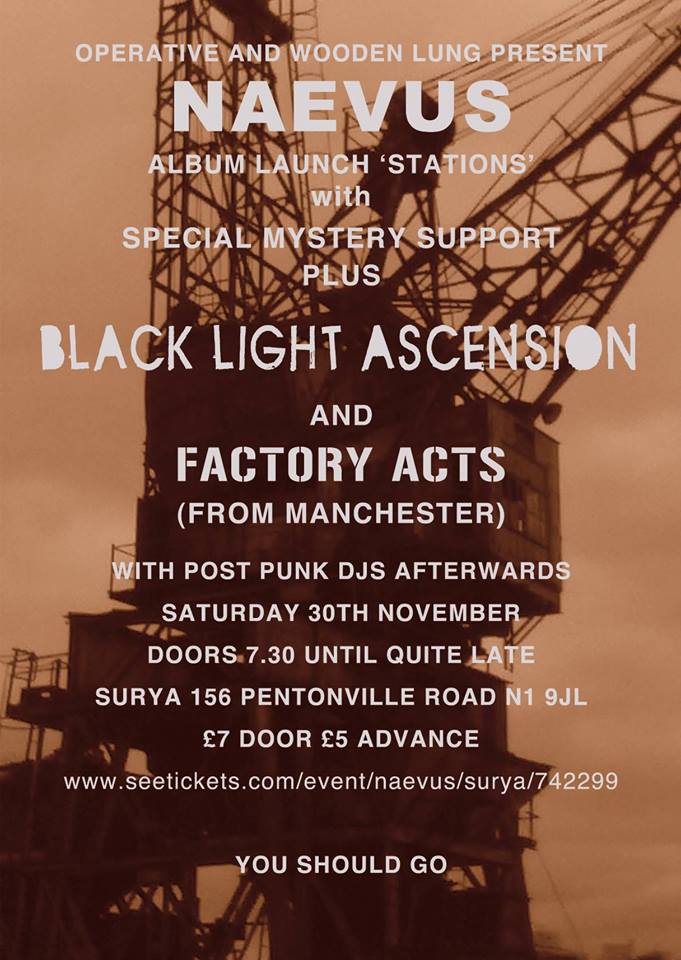
OPERATIVE AND WOODEN LUNG PRESENT
– NAEVUS (Album Launch of ‘Stations’)
– BLACK LIGHT ASCENSION
– FACTORY ACTS (Manchester)
with
– Special Mystery Support
– Post Punk DJs
DATE: 30 November 2013 (Saturday)
TIME START: 1930hrs until Late
TICKETING: £5 (Advance)/£7 (At The Door)
VENUE: SURYA, 156 Pentonville Road N1 9JL, London, UNITED KINGDOM
More Info at:
https://www.facebook.com/events/658510480866832/?previousaction=join&source=1
http://www.seetickets.com/event/naevus/surya/742299
NAEVUS
http://www.youtube.com/watch?v=pwFKm2alK-c
BLACK LIGHT ASCENSION
http://www.youtube.com/watch?v=Y4ifEjiGPd0
FACTORY ACTS
http://www.youtube.com/watch?v=lJZbybpKAPI
> SUNN O))) AND ULVER ANNOUNCE JOINT LP, TERRESTRIALS (Fact)
Stephen O’ Malley and Greg Anderson’s superior drone-metal project are back.
It’s been four long years since Sunn O)))‘s masterful Monoliths & Dimensions, although, in lieu of a new studio album, they’ve nudged out a smattering of live releases and demos in the interim. 2011 saw them collaborate on a full-length LP with spiritual forefather Nurse With Wound, and next year will, we’re told, bring another collaborative full-length – this time with Norwegian metal institution Ulver, who have been turning out experimental metal for over two decades (see 1995′s exceptional, folk-inflected debut Bergtatt).
Terrestrials will feature three long-form pieces from the two camps. Anderson’s Southern Lord label promise three “movements” of “sonically uninhibited, unpredictably cosmic” drone-rock. Ulver’s last LP was this year’s classically-inclined Messe 1.X-VI.X, and the label suggest that Terrestrials will see both parties on particularly ambitious form.
Terrestrials will touch down to earth in February 2014. That’s the cover art below.

(Source: http://www.factmag.com/2013/11/19/sunn-o-and-ulver-announce-joint-lp-terrestrials/)
> LUSTMORD: INTERVIEW By Matthew Phillips (Tiny Mix Tapes)
“I embrace the dark on a personal level, but in my work, if anything, I’m actually shining a light on it.”

Brian Lustmord is a veteran and creator of what has come to be called dark ambient music, now inspiring a new generation of followers. Although his sonic style is reliable, his newest album The Word As Power (out on Blackest Ever Black) is his first to focus on the human voice. He taps collaborators ranging from Maynard James Keenan to Jarboe to chant, call, and throat-sing atop his deep, processed samples covering the void. The ritualistic incantations on the record became a main subject of inquiry in my review, especially as I investigated the album’s cover.
The Word As Power is completely wordless, but get Lustmord talking about it and he’ll reveal a wealth of ideas buried beneath the surface. Everything about the album — from the track titles, to the album cover, to the sounds themselves — is cryptic, encoded, purposefully vague, and tantalizing, especially considering all of its references to the occult, the apocalypse, and the study of language itself. In this interview, we talk to Lustmord about some of the ideas that shaped the creation of this album and his multimedia work TRINITY, getting one step closer to unraveling the cipher.
You’ve been making albums for more than 30 years. What’s changed about your recording process for The Word As Power? You’re working with vocal collaborators here, is that any different than working with someone like Robert Rich or King Buzzo?
Not really. The way I’m working now is the way I’ve been working for at least 10, 12 years, which is all-digital. You know, before I had a shitload of rackmount gear; well, in the beginning I didn’t have anything, but I developed having a load of equipment, and then gradually it all went into the Mac and all the software. So for the last at least 10 years, 12 years it’s been all software-based. Virtual instruments (you know, I hate that term virtual) and stuff. So the actual technique is one I’ve been using for quite a few years. But as far as conceptually, how I was working with people, again, it doesn’t really change. The actual creative process (without trying to sound pretentious) is pretty much the same when you’re working with people. Of course the key is finding the right people, people who are on the same wavelength and speak the same language. You know, in that case it’s very transparent and it’s very smooth because you’re talking in the same arguments, in a sense. You know what you’re talking about. The feel, you know?
Right.
Because obviously a lot of these concepts, the kind of stuff I do, it doesn’t translate very well. It’s funny because it’s kind of abstract you know, the sounds. So when somebody understands what you’re trying to do sound-wise, or not so much sound-wise but conceptually, it’s kind of really straightforward. Of course, the problem is when you’re working with people who don’t get what the fuck you’re talking about, which is one reason you don’t work with those people. [Laughs]
Well I gather that you’re personal friends with some of your collaborators on this record, and you’ve worked with Maynard [James Keenan] on Puscifer and some of Tool’s more recent stuff. Did you have melodies set down beforehand or did the vocalists bring stuff to the table?
Well it was his idea to perform on something. Yeah I gave him the melodies pretty much and he just pretty much followed what I gave him. There’s also, well, with someone like Maynard, he’s a good example, you know, when you know somebody, it’s not tricky, but you have to be aware that you might have a relationship with these people and they’re friends and it’s all very casual and friendly, but having someone like that on your record, it’s actually worth something, you know. It has actual value. So you have to be really careful that you’re not taking advantage of that you know? Because it’s supposed to be a friendship thing and he offered to do a vocal, well if he, well, first of all, it’s my fucking album, so I’m giving him the melody [laughs], but if he did the melody then it becomes a bit more complicated as far as, you know, then it becomes more of a songwriting thing. Which is not a problem, but it’s best to keep clear of all that stuff and keep it friendly. Does that make sense?
Definitely. You’ve been playing live a little more, do you have any plans to bring vocalists to live performances?
Uh well, I’d like to, I don’t have any firm plans. I would like to, the only tricky thing, well, first of all, I wouldn’t get everybody in the same place anyway, but also I wouldn’t want to do the album live. I’d like to do a version of the album live. Because my usual show is huge screens and high-definition projection and stuff, it’d be nice to do something really intimate with no visuals, just low light and just have the voice, maybe in a church or something, somewhere with a nice vibe and nice acoustics. The only trick of doing it with a vocalist is when I do a live show I just get on a plane with a backpack and you know, turn up. When you’re bringing a vocalist, because I live in L.A. And the vocalists live in other parts of the world, now you’re talking it’s actually quite expensive to get a bunch of people flying to one place, so that makes it a little bit tricky. But it’s something we’ve been talking about and it’s possible. No firm plans, but I would like to. Like most things in life the boring details are how you find out something like that.
I sense some possible processed vocals deep in the mix. How much of this album consists in some form of vocal sound? Does the content or source of your samples play as important a role in your semantic/conceptual structure as the titles and the cover?
Well there’s a lot of electronics, actually very little electronics but I manipulate audio a lot. But a lot of the sounds you hear on the album that don’t sound like vocals are actually derived from vocals, you know, like drones and pulses and stuff. To use a technical term, I fuck around with them a whole lot. I make them sound like something else. Yes, there are actually quite a lot of vocal-derived sounds. Not all, not by a longshot, but there’s a lot of textures and hits and drones and pulses that are actually taken from some of the vocal takes or the outtakes or some vocals are done specifically with sampling in mind.
So TRINITY is this idea of, grammatically it’s not that good but, it’s an archetype of itself. It’s a thing that had never existed before. Suddenly, when Trinity was tested there was this huge mushroom cloud. Ever since then, we don’t think about it anymore, but ever since then we’ve all been living in the shadow of that cloud, because now we can destroy ourselves, and re-destroy ourselves.
I’ve read some past interviews and I’ve heard —
Must be true then! [laughs]
Well I don’t know, maybe things have changed! So I’ve heard that you’re an atheist, but it seem like you have a pretty rich metaphysics. Is spirituality important to you and your music or do you just like it for its trappings and its power?
It’s not important to me personally. I’m an atheist, a kind of hardcore atheist I guess. I mention it when people ask but I don’t preach (pardon the pun). I don’t go around telling people they should be atheists. It’s none of my business. The same way I respect other people’s religious views as long as they don’t try to impose it on me. I don’t have any need for spirituality or anything like that. I was born a skeptic and I became quite cynical later on, which is not necessarily a good trait but I’m very much a cynic and I think being cynical is a really healthy thing in life, you know?
I agree.
But as far as spirituality, a lot of things interest me, a really broad range of things interest me and spirituality is one of them. I like the why of it, why people need it and how they behave with it, and especially in the musical sense. There’s a rich history of music, early music, ritual music of different types, all the way up to Gregorian chant or Voodoo music, Tibetan stuff, Middle Eastern; I mean a lot of great music has that focus of spirituality, its focus on belief in the church or belief in gods or deep gods and demons and that’s really interesting, that focus, that energy. Which of course you don’t get with regular music. But even the blues, that’s from that spirituality.
One of the taglines on the press releases for this album is that it’s kind of ritual music but without the dogma, because I think ritual is actually a really important part of life whether we like it or not. But personally, I hate dogma. I really fucking hate dogma. I have a really sensitive bullshit detector. And also you know my “worldview,” if you wish, is more like a cosmic reality. I’m really interested in our sense of place, because the universe we live in is obviously huge. We’re incapable of comprehending the scale of things. I think that’s really interesting. And our place in this vast space, it’s pretty meaningless really, and I find that quite interesting. But you know, there’s a lot of things going on, you know, life the universe, everything, it’s quite interesting! Speaking as an atheist I don’t believe in an afterlife. Well, maybe there is an afterlife, I don’t think there is, but I don’t know and it’s kind of pointless for me to talk about it because I don’t know. Either way it’s really interesting.
Yeah, I get that sense on The Word As Power. I talked a little in the review about feeling dwarfed by the vastness of the sounds.
Ah ha, well, thank you, because one of the senses I was trying to convey in it was the scale of stuff, you know? For one person it might be a godhead or for another it might be the sheer scale in the cosmic sense. There is a central, bigger thought in my work: perspective. I think it’s really important for me personally to actually stand back and get some perspective on where we are in all this. The world doesn’t revolve around me as an individual, it doesn’t revolve around us as a race or us as a planet. It just doesn’t. You might not like that, you might want to believe it or come up with reasons why it is, but I don’t think it is. And I think that’s interesting. What’s wrong with that? Death in itself is interesting. Like the question here, sticking on a cosmic thing, is there other life in the universe? If there is, that’s amazing. If there isn’t, that’s equally amazing.
Sure, and so many are afraid to face that. I noticed that at least two of the song titles reference The Lesser Key of Solomon and a number of sacred and esoteric works show up in the cover —
You’ve been reading all the small print haven’t you! [laughs]

Yeah, that’s a pretty intricate cover illustration [artwork by Simon Fowler].
Don’t you just love some of the really small print you can’t read at all? I like that. I put so much work into the text knowing that you couldn’t read the damn thing. That’s half the fun. It’s all in there, but you might not be able to get it.
Do you have a personal connection to magic and the occult? What other books have influenced your musical work?
That’s kind of two questions there I guess. Going back to what you were saying I have a whole wide range of interests you know. Most things in life, you live life and you grow up and you’re subjected to a lot of stuff — culturally, literature, film, art, just worldviews, politics. But there’s a lot of stuff that’s hidden away. The hidden stuff is equally interesting. So yeah, I’ve read up on the occult. Crowley is pretty boring actually but there are some really interesting ideas in there. Some if it is actually nuts; though, I would say some of the Bible is nuts. That sounded wrong. There are all sorts of interpretations of things and in some of them there’s a common thread sometimes, and it just interests me to know more about different things and to come to a conclusion yourself rather than accept just one thing that’s given to you. So I have read a lot of stuff about the occult, Kenneth Grant in particular more so than anybody else, because he’s quite good at disclosing some of the secrets. On a philosophical level it’s quite interesting but on a practical level, like I said I’m an atheist and I’m a skeptic so I don’t believe any of it. But yeah, a lot of things interest me, and literature in general has been a great influence on my work (among many other things). There’s no specific author or specific books but I read a lot so obviously that’s going to filter it’s way through.
I don’t have any need for spirituality or anything like that. I was born a skeptic and I became quite cynical later on, which is not necessarily a good trait but I’m very much a cynic and I think being cynical is a really healthy thing in life, you know?
Is the last title,”Y Gair,” a reference to Byron?
Oh the last one? Oh,”Y Gair,” it’s Welsh. It means “the word.” Might as well have some Welsh in there.
Ahh. So moving forward on that cover illustration, I haven’t quite cracked it yet.
That’s good! Hopefully you never will.
That’d be more exciting for me. But I find it really interesting that it focuses so much on language in light of the album’s total absence of lyrics. Do you conceive of these wordless vocals as having a kind of language? Or are they more an attempt to exit semantics and meaning?
It’s a good question and the answer is somewhere in between. It depends on the mood and the context. In all my albums, well, in most of my albums apart from the very early ones, when I was, if you’ll pardon the pun, still trying to find a voice, what I try to do is create a place, you know, take you somewhere, and then keep you there and bring you back again. That place, for me it’s not a specific place but there are a lot of ideas in there. On this album in particular more than the others, it’s more overt. All my albums have these meaning and ideas behind them, but they’re not plastered all over the sleeve. But the idea is that the place is specific to you as a listener. Different people go to different places, and for some reason most people go to dark places. I think that reflects more on them than it does on me, to be honest with you [laughs].
But on this one I wanted it to be a vocal album but it was very deliberately with no lyrics. I thought for a while about that because I wanted to convey so many ideas in the sleeve and in the text on the sleeve but at the same time it was important to me not to give too much away. I just like to give a little cipher there or a few clues there and some people will go and figure it all out, and some people will go on a completely wrong track. It doesn’t matter, the thing is it’s a journey. So I kind of debated with myself for not including the text either, but the reason there’s no lyrics is because I didn’t want it to be tied down to specific interpretations when you’re listening to it. And I also wanted that when you listen to it, you were hearing somebody singing, and you weren’t, if you were German or Icelandic or Bengali or whatever you would hear the same thing. It would be a foreign language to everybody. There’s this whole Babel thing in it, too. So it’s a two-fold thing: not wanting to tie it down with specifics because it’s very important to me that it’s more of a trigger for your own though processes, and secondly, because I didn’t want it tied to one language.
Because another thing I tried to do, I mean I don’t always succeed but what I try to do with my albums is I try to create something that’s timeless, you know, that is not of this time. So that in 10 years, hopefully maybe in 50 years, it still sounds kind of different from anything else. And you can’t say this album is made in the year so-and-so or that decade or whatever.

It’s interesting that you mention timelessness because it seems like there’s a sort of pre-Babel, pre-confusion of tongues feeling to listening to its sort of pure vocal, and there are also a lot of references to the apocalypse too in the sleeve, so it’s sort of an Alpha and Omega.
Oh, exactly. I think Alpha and Omega are actually hidden away in there somewhere.
I’ll have to keep my eye out.
[Laughs] I’m pretty sure there is, yeah. I mean also, the running joke is my music is often referred to as dark, but for me it’s a very primal thing. It’s deliberately primal, and it comes from a very primal place. I don’t know if people associate that with darkness. I embrace the darkness, in that sense. By dark I don’t mean like negative, but the dark is traditionally a scary place to be. You have the campfire and everything else is dark and you don’t go there. You don’t go into the dark, you don’t go in the cellar, you don’t go in a cave, you don’t explore the psyche, or you don’t confront your own darker side. And I’m not talking about evil as such. But the dark is interesting.
A lot of narratives suggest that you have to go through the dark to experience ascension.
Yeah and I mean, sticking with the dark thing, I embrace the dark on a personal level, but in my work, if anything, I’m actually shining a light on it.
Can you talk a little about the TRINITY project, formerly with Biosphere, and how it relates to your conceptual framework?
The TRINITY thing is really interesting, symbolically, and what was going on. It’s two-fold how it got started. I live out here by choice because I love California and the Southwest and the desert. So me and my wife, we try to get out there into the desert as often as we can. We go and 4-wheel drive, disappear into the middle of nowhere. I’d been over in New Mexico, about 10, no maybe 15, 20 years ago, and visited Los Alamos where Trinity happened (site of the first nuclear weapons test). The first test happened in New Mexico and there were a whole bunch done in Nevada, in I think Area 53, it’s near Area 51, the whole area. Anyway, me and my wife had always wanted to go there on, you know, like a tourist trip, and it’s really hard to get there because it’s dangerous and it’s very secure.
So to cut a long story short, the subject of nuclear weapons always interested me. It’s fascinating that we did all that stuff, when you read up on the history. It’s just nuts. And my friends at Unsound, I worked quite a few times with them. They’re the ones who commissioned TRINITY . My friend Mat and Gosia, who are the main people behind Unsound, were here in the states working, and they took some time off and were driving through New Mexico. I was suggesting that they go check out Los Alamos, that whole area, because it’s a great part of the country. And I was giving them some background on Los Alamos and Trinity and all that kind of stuff and a few weeks later they call me back up after they got back home to Poland and said, “Well, actually, we have an idea.” I was obviously very knowledgeable and very interested in that subject and that would make a really good subject, and they suggested commissioning a collaboration based on that project. And then Biosphere was brought in because a lot of the funding was Norwegian so somebody had to be Norwegian [laughs]. But also, it also made sense, on paper it made perfect sense that in theory we should complement each other well. So we spent a week in Santa Fe, we actually spent a week recording there. We actually went to some of the really dangerous radioactive areas and did some on-location recordings there. From those recordings we created this 45-50 minute, it depends on the show, piece, about the whole Trinity thing.
Trinity is really interesting on many different levels. At the time, it was the most expensive project ever. In the 1940s, over a billion dollars. It was the equivalent to building the American car industry from scratch within two years.
There’s also, well, with someone like Maynard, he’s a good example… You have to be aware that you might have a relationship with these people and they’re friends and it’s all very casual and friendly, but having someone like that on your record, it’s actually worth something, you know. It has actual value. So you have to be really careful that you’re not taking advantage of that.
Wow.
In total secrecy, with nobody knowing about it. From an engineering point of view it’s amazing how the managed to do that. From a physics point of view, it was amazing what they did. They really pushed physics much further than anybody thought it could go, and that was done very quickly. There are some really interesting books about this, I mean it’s really interesting what was achieved by a few people very quickly, in secrecy on top of that. We’ve always been able to destroy ourselves to some degree with you know, dams that collapse or spreading viruses or just wars. We’ve always been capable of inflicting damage on ourselves, but that was the first time we had deliberately built something that once it was built, everything changed. Now we can just literally flip a switch. That’s kind of mind-boggling, you know?
And also, nobody wanted to make this thing, but this was the height of the second World War and they knew that once it got out (it was kept secret for quite a while) that it was in theory possible, and probably quite likely this could be done, they knew everyone was trying to do it. The Russians were trying to do it, the Japanese were trying to do it, the British were doing it and passing on all their information to America. Nobody wanted Germany to have it first because nobody knew what they would do. So nobody wanted to make this thing, because they knew everything was going to get fucked up. But they knew it was inevitable. Somebody was going to make it.
So TRINITY is this idea of, grammatically it’s not that good but, it’s an archetype of itself. It’s a thing that had never existed before. Suddenly, when Trinity was tested there was this huge mushroom cloud. Ever since then, we don’t think about it anymore, but ever since then we’ve all been living in the shadow of that cloud, because now we can destroy ourselves, and re-destroy ourselves. We’re all of the age where we grew up with this. A few decades ago people didn’t grow up with this. This was completely ridiculous. No one would think that is possible. But everything changed that day, that’s what’s so fascinating about it. We have some pointing at us right now. Baltimore [my location — MP] for sure will have some pointing at it; L.A. will have a shitload pointed at it. It’s possible, you know? So anyway, I find this really fascinating. That’s the short version, by the way.
One last question: I see your work Stalker with Robert Rich as a close parallel in your catalog to the sonics of The Word As Power. As a Tarkovsky fanatic, I have to know: if you found yourself in the Zone, would you enter the final room that grants your innermost wish? What desire would you like to see fulfilled, if any?
Well I would absolutely go in the room, but I wouldn’t tell you what I was looking for.
(Source: http://www.tinymixtapes.com/features/lustmord)
> 15 QUESTIONS TO Z’EV By Tobias Fischer (Tokafi)
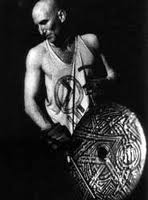
It was about time some director thought about shooting a movie on Z’EV’s life – In the 70s, he was one of the pioneers and figureheads of the Industrial movement, used advance materials (such as metals and plastics) “to produce a music based on the orchestration of Acoustic Phenomenon as opposed to conventional / traditional tuning systems” and held a job a the Society for the Preservation of Occult Consciousness. In the 80s, he was involved in the first interactive piece of art and arguably the first music video ever, started teaching Composition and Improvisation and expanded into soundtracks and painting. While the early 90s were marked by the usual energy and fervour (and by publishing a book on applying the healing power of the Qabalha to music, as well as producing some of the first Hard Core Techno tracks, which laid the basis for the movement also known as “Gabber”), personal circumstances made him withdraw from the limelight at mid-decade. A concert tour, some re-releases and fascinating collaborations have marked a much-applauded come-back – with a recent fourway split with Fear Falls Burning, John Duncan and Aidan Baker as one of many highlights. Until Hollywood calls, we can expect Z’EV to stay in the groove and finish the biggest project he has been working on up til now: [heart beating / ear drumming], a book on “Metaphors, Mythos, Metaphonics and the Trance State”, which he has been writing on for about eight years.

Hi! How are you? Where are you?
And greetings to you and my thanks for this invitation.
So I would say that gratefully my health is in good shape and I’m getting a lot of work done so the answer to that would have to be: quite good, surprisingly, considering how much general misery there is in the world presently.
And at the moment I am in London which is currently pretty much my ‘operational base’, although without yet a proper visa, which I hope to rectify in May of this year [2006], or not.
What’s on your schedule right now?
Finishing a book [heart beating / ear drumming] that I’ve been working on, on and off and on again since it’s first short version was written in 1992 for the ARCANA project commissioned by John Zorn.
SoundWorld here in the UK will be publishing it.
In between I’m supposed to be finishing off a few different recording projects, and am also slowly gearing up mentally for a series of duet shows in April with Kazuyuki Kishino [KK.NULL], and now I’m starting to try and answer an e-nterview that will do justice to the others on your site.
What or who was your biggest influence as an artist?
Do you see yourself as part of a certain tradition or as part of a movement?
Very most likely the opportunity I had to be part of the first 6 months of California Institute of the Arts at the Villa Cabrini Campus in Burbank in 1969. Maurice Tuchman who was hired [and then fired within 3 months] as the head of the Critical Studies program had the vision to bring an incredible range of peoples to California at that time; Emmett Williams, Alison Knowles, Dick Higgins, Herbert Marcuse, J.J.Hurtak, Sue Ellen Case and the list just went on and on. Nam June Paik and Serge Tschrepnin were also there.
It was a life altering experience for an 18-year-old aspirant let me tell you.
Pretty much set my vision of what Art and the Artist should be.
Which leads into your second question, and yes I do see myself as but another link in the chain from the great modernist movements; futurism, surrealism and most especially dada.
So then yes I do see myself as a ‘traditionalist’ in that basically, I see the function of the Artist as one of re-interpreting, extending and expanding the traditional knowledge and values of their Culture in a way that makes them relevant for the particular time that they are alive.

What’s your view on the music scene at present? Is there a crisis?
Well I can only speak from the very marginal strata I inhabit, but personally I’m waiting to see [although its probably up on the web somewhere] a really rigourous marxist analysis of what has to be the first TOTAL marxist revolution;
where not only the means of production, but all aspects of the distribution complex as well, fell into the hands of ‘the people‘.
As to, is this a ‘crisis‘?
Well there’s obviously been more change in the last 10 years than in the little bit over 140 years before, that’s starting with the invention of the player piano in 1863, and change is always threatening.
And if there is a ‘threat‘, it seems to me to be the general ‘post-modernist‘ infatuation with [what I can only call] the ignorance that allows them to think they are doing something/s ‘new‘.
What does the term ’new’ mean to you in connection with music?
Was that a lead-in or what?
Anyway.
I don’t know. You take someone like Harry Partch, he made new instruments, with new tunings etc etc, but for him his most important works were the large-scale pieces based on mythologies.
From my own experience, the movement based percussion I was doing from the mid-70’s to the early 80’s was definitely ‘new’, in that it had never been done before, but again, the sounds it was generating were just as definitely archaic.
Some say that it was sometime around 35 BCE that a Rav Hillel was supposed to have said “there’s nothing new under the sun”, but he was probably just repeating something he heard his great-grandmother say.
How do you see the relationship between sound and composition?
The short answer could just quote John Lennon; “it’s all in the mind, you know.”
But and so, well I write, with words, and I do see that as composing as well.
So then composition plainly exists outside of sound as well.
Now obviously very great music is/has been written by hand and only becomes sound when it is played.
So answering a question with a question, at what point when one produces sound by some activity does the production become composition?
And but so yes I do think the answer is all in the mind, and I sense another lead-in here, so I’ll just move on to the next question.
How strictly do you separate improvising and composing?
And speaking of composing, I must say I’m finding your ordering of questions quite preternatural. This is the first time in an e-nterview that this sort of phenomenon has crept in. Very impressive, to say the least.
Anyway.
So and but first I think I’d have to say that all the great improvisers, and I’m speaking of jazz here, were pretty much equally as impressive as composers, say from Scott Joplin onwards and upwards.
But and so to try to answer your question on a personal level, I’m reminded of a press conference for the Der Hang zum Gesumptkunstwerk [is that correct spelling – please correct if wrong – thanks] show in Berlin in 1982.
Robert Ashley and I were the question-ees, and that was the first time I heard him speak of his concept of ‘spontaneous composition’.
Since then I’d have to say that in the live performance context I’m definitely more of a spontaneous composer, than say an ‘improviser’.
And but so actually even though I’m probably best known as a ‘solo’ performer, my favorite musical role is as an accompanist, which can be the most rewarding of experiences given the proper context, and favorites in this regards would be;
Salome Schnebelli – dance, Doro Franck – poetry, Rudoph Grey – guitar, Simone Forti – movement, Kain – poetry, Johanna Went – performance art.
Now the reason I put ‘solo’ in quotes back there is because even in that ‘role’ I’m actually playing in a quartet made up of:
me, the particular sounds that the instruments are generating in conjunction with the unique space and time and geography of the performance and the energy generated by the audience.

What constitutes a good live performance in your opinion?
What’s your approach to performing on stage?
To the first part, I would ask that the performer/s take me somewhere or at least share with me something about what it means to be human.
And to the second, well I think the answer to that slipped in above.
A lot of people feel that some of the radical experiments of modern compositions can no longer be qualified as “music”.
Would you draw a border – and if so, where?
So since generally speaking noise is considered sound that one doesn’t like, then music would be considered sound/s that one likes.
So I would say then that as so long as there are people liking these hypothetical compositions you are referring to here, they would surely qualify as music within this context. Personally speaking I am always listening to what’s going on around me with an expectation of/for the delightful surprise. And because of my sound poetry background this also includes people/s talking.
Are “serious” and “popular” really two different types of music or just empty words without a meaning?
Well first I don’t think a word can exist separate from having meaning, or it wouldn’t be called a word.
And with regards to your example, that would be like asking if ‘ritual’ and ‘military’ musics were really two different types of music.
I think more to the point is the question of what ‘serious’ music means, and if it somehow entails an implicit elitism or say exclusionary function.
Unfortunately this does happen to be a ‘hidden’ side of Art in the broad socio-historical development of Western Culture, i.e., a vehicle for the enfranchising and maintaining of a ‘cultural elite’.
Which was just fine with Artists who were themselves using Art as a vehicle for ‘jumping’ class.
Do you feel an artist has a certain duty towards anyone but himself?
Or to put it differently: Should art have a political/social or any other
aspect apart from a personal sensation?
As per various threads above, I’d reiterate the point that the artist has a primary responsibility to their Culture, and that at this point in time this term has become, and should be construed, as quite a bit more Global in nature than for most any previous generation of Artists.
And I must say that given the heartening and unusual amount of attention your interview section pays to women Artists, I’m a bit surprised by your use of himself rather than themselves for the Artist signifier here.
And but so as to the second part of the question, well it’s obvious that many people can and do get along quite handily without encumbering themselves with any sense of a responsible political or social awareness in their personal make-up.
But this is not saying that Art has to convey some overtly polemical / pedantic ‘message’ to be political.
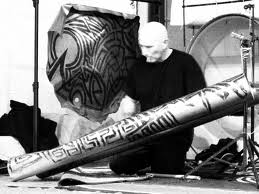
True or false: People need to be educated about music, before they can really appreciate it.
First, the older I get the less inclined I am to invest in the either/or paradigm.
I kinda like to think of myself as a both/and kind of guy.
But and so well again the semantics of ‘educated’ is the issue hear.
[am I allowed to be that punny?]
Whatever, my experience rests on just that, experience.
That is, for example, the first time most people experience any [not just] musical information from outside their general knowledge base, it comes across as ‘strange’ or whatever.
Let’s take food as a great example.
Some people enjoy expanding their culinary palate, some don’t.
And some tastes are acquired.
Does this mean some sort of hierarchy should be set up based on these differences in attitude to something so basic to survival as nourishment.
And of course, in the context of this question, this notion of nourishment can expand exponentially.
Imagine a situation in which there’d be no such thing as copyright and everybody were free to use musical material as a basis for their own compositions – would that be an improvement to the current situation?
Well I have to say that in fact I have been trying to set an example for this in my own meagre way, because for the last 10 years all [but one] of my recorded works has been released with ‘public domain’ where everyone else has their publishing company listed.
This is what attracted me to the House Music scene that I became deeply involved with in Amsterdam from the late 80’s until I left in the mid 90’s.
That you’d hear a sound or a lick on a record from Belgium and the next week it would show up recontexualized on a record from Germany and etc and etc. I loved it, and that sort of set the course I adopted from say 1992 on with regard to not registering my released recordings.
Anyway, since the advent of agriculture some 10,000 years ago, ownership [beginning with an Earth parcelled out] – with uniformity in one hand and control in the worst of its connotations in the other – is the root of all evil.
You are given the position of artistic director of a festival. What would
be on your program?
Well since this is SUCH a fantasy I might as well go all out here;
A 5 day festival featuring 2-6 hour performances.
[one group each night, listed in alphabetical order]:
Konono N°1
This 16-member group from the Democratic Republic of the Congo combines
scrap metal percussion and the heavily distorted sounds generated by DIY amplification of their instruments into their traditional trance music.
Myeong-Chang Jo,Tong-Dal with Ahn,Sook-Sun
Pansori [Korean Opera] performance by Master vocalist Jo and drummer Ahn. Note that because in Pansori audience participation is required, a core audience of app. 30 Koreans would also need to be arranged for.
Sugiura Kanze Noh Theater
A Phantasmal Noh style performance of Nonomiya [based on the Tale of Genji, the world’s first novel] hopefully by this troupe featuring Motosaburo Sugiura, a National Cultural Treasure of Japan.
Tibetan ritual musics and dance performed by 11 nuns from the Khachoe Ghakyil Ling nunnery in Nepal.
Wayang Kulit a performance of ‘Siwa Tattwa’ by the Balinese Shadow Puppeteer / dalang; I Made Sidia and 4 musicians.
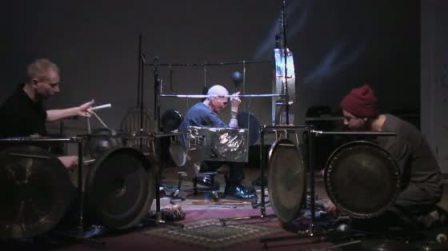
Many artists dream of a “magnum opus”.
Do you have a vision of what yours would sound like?
There are already some few of my recorded output that I do consider personal ‘masterworks’, but in terms of a ‘magnum opus’, that would have to be the heart beating / ear drumming book, in terms of a composition that I believe will resonate through the centuries.
Discography:
shake, rattle & roll (1981) fetish
Z’EV (1981) vinyl magazine
salts of heavy metals (1981) Lust/Unlust
production and decay of spatial relations (1981) backstreet backlash
auf uit b/w element L #9 (1981) remlin product
wipe out b/w element L #6 (1982) fetish
elemental music (1982) subterranean
titan nite (1985) dossier
my favorite things (1985) subterranean
schonste muziek (1986) dossier
the hottest nite (1987) decay international
the old sweat b/w the invisible man (1988) Coercion
open in obscurity (1988) Touch
bust this! \ Z’EV (1988) dossier
opus 3 (1990) helmholz theatre
direction ov travel \ ptv3 (1991) Magic Music
wheels on fire #’s 1 & 2 (1991) Temple Press
rhythmajik PRACTICAL USES OF NUMBER, RHYTHM AND SOUND (1992) temple press
thunderdome (1993) ID&T
marshmallow exteme (1993) Makkom
HYPERcussion – heads & tales v.1 #’s 1-19 (1996) avaunt/disc union
ghost stories (1998) Soleilmoon
opus 3.1 (1998) Soleilmoon
the chemical dependance (2000) Makkom
direction ov travel (2000) coldspring
face the wound – heads & tales v.2 #’s 20 – 38 (2001) Soleilmoon
3 fold ear (2002) Grannary Press
sapphire nature (2002) tzadik
live 1993 (2003) CIP
organ music for organs (2003) TOUCH
tinnitus vu (2003) TOUCH
live 03.01.86 (2004) CIP
untitled (2004) Die Stadt
headphone musics #’s 1-6 b (2004) Touch
(Source: http://www.tokafi.com/15questions/15-questions-to-z-ev/)
 4iB Records | For intrinsic Beliefs