4iB Records | For intrinsic Beliefs
Record Label dealing in Industrial, Power Electronics, Harsh Noise, Experimental, Death Industrial, Drone, Ambient, Japanese Noise, Field Recording, Abstract, Musique Concrete and other related genres.

> INTERVIEW WITH irr. app. (ext.) (MATT WALDON) by Musique Machine

When Musique Machine had the pleasure of interviewing Matt Waldon, the West Coast surrealist known as irr. app. (ext.) in the Summer of 2005 he had just been recruited to join Nurse With Wound’s new live configuration. Since then he has helped to ensure their deliriously potent live performances are a regular fixture in key cities across the globe, while maintaining a resolutely singular approach to his solo work, both audio and visual.In the last few years, this has seen him conclude his trilogy dedicated to Austrian psychoanalyst Wilhelm Reich with a fourth (!) instalment of beautifully disturbed and recycled field recordings; make wild and wonderfully blackened noise pools with Blue Sabbath Black Cheer; and, most recently, release a superb batch of three CDRs – ‘Deflating An Imaginary Spleen, Almost In Public‘, ‘Ustrojenstvozaginate‘ and ‘Tuberpendicular‘. This surge in dada-ist sonic crafting respectively reveals the evolutionary process of irr. app. (ext.)’s twentieth live performance, the compositions of confused machinery, and an album with sounds sourced from potatoes (yes, potatoes). With such an abundance of fervent finery it was high time m[m] caught up with him to discover what effect the last eight years have had on his unique and unparalleled art.
m[m]: Since you last spoke to Musique Machine I’m guessing one of the greatest changes you have experienced was moving from California to Hillsboro, Oregon in 2011. It seems to have coincided with a growth in both your solo and collaborative work. What effects do you feel the move north has had on your creative output?
MW: The move has made it much easier for me to get things done: not particularly due to the fact of being in Oregon rather than anywhere else, but because I ended up in a situation that affords me more space to work than I’ve ever had before. For the first time in my life I’ve been able to set up a proper studio and have everything I need more-or-less continually assembled and functional. 25 years’ worth of audio archives – all the way back to my earliest, crudest cassette sources — are now organised and easily accessible in digital format. I’ve never had that luxury before. I’ve always had to waste time digging through boxes and piles of stuff crammed wherever they would fit, or been forced to tear down one thing so I could set up another because there wasn’t enough space for both.
MW: It’s also helped that I moved away from most of the people I knew. There are a few lovely individuals in Portland that I am fortunate to be able to spend time with, but social activity is a far more occasional thing here than it was in California so I can spend the majority of my time on creative work. I’ve lived in this area for over 3 years now, and I still barely know anyone. I’m sure this will make me sound like a miserable old grouch, but my experience is that it’s rare to find friendships where the positive aspects balance out the negative impacts on your time. I guess I’m not a ‘people person’.
m[m]: Also, I’m guessing another major change has been your increasing involvement in Nurse With Wound (NWW). You’ve gone from ‘remixing’ the work (Chance Operation…, Angry Eelectric Finger etc.) to becoming a regular member of the band (alongside Colin Potter and Andrew Liles) performing several dates most years. How did it feel to become a member of the very thing that first influenced you to experiment with sounds? What effects has being part of NWW had on your solo work?
MW: Well, to be honest my involvement with Nurse With Wound has decreased considerably during the past several years. From 2005 to about 2009 I was participating in just about every live event that NWW was doing, but I haven’t been involved in any of the shows since early 2011. This wasn’t the result of any personal differences: I still dearly love the other Nurses and they remain amongst my closest friends. It was due to problems on the planning side of things, which have always been a complete shambles with Nurse. None of us are very business-minded (Steve least of all!) so it’s left us vulnerable to be taken advantage of by all manner of criminals and frauds. By 2011 the situation degenerated so much that it almost completely derailed NWW live activity, and it entirely sabotaged my involvement. The money that would have covered my overseas travel was being stolen by what passed for our ‘management’ at the time, and the others were told that my participation was not possible because of lack of funds. I wasn’t being told anything at all, so for a long while I had no idea what was going on. The circumstances have now been changed, and I should be on board again for the next show, which is supposed to take place in France in 2014.
MW: Leaving aside that aspect, in a personal and creative way being involved with Nurse has been a fantastic experience. To meet someone who had such an enormous influence on me, and then to become close friends with that person, and then to get to work with them as part of the project that most inspired me to begin my own audio work… it’s so unlikely that I still don’t know how to process it. In the middle of the very first performance in which I was involved (the shows at the Narrenturm in Vienna in 2005), sitting there with Steve making sounds behind me on one side and Diana Rogerson doing her vocals on the other side, I just had to stop and let the gigantic “I!! CAN’T!!! FUCKING!!! BELIEVE!!! I’M!!! HERE!!!” that had been building up in my brain have its moment so I could get on with being a functional human being. Fortunately, over the years the drooling fan-boy mentality has (mostly) been replaced by a genuine friendship and affection for a real person. In a big way it’s cured me of the whole ‘fan’ mentality for good: why do I need to waste my time with that nonsense when I can call up my favourite creative individual on the phone and have a casual chat? Developing a friendship with Andrew and Colin has been a real pleasure as well.
MW: I’ve tried to keep what I do with NWW and what I do with my own project as separate as possible, although some cross-pollination is inevitable. I suppose the biggest effect has been the technical experience that working with NWW has provided me. Between 2005 and 2009 I did almost twice as many live shows with Nurse (and in far nicer venues) as I have ever done as irr. app. (ext.). And, of course, from a business/practical standpoint, working with NWW has provided me with a wealth of knowledge about how not to do things!
MW: Strangely (or perhaps not), my years of involvement with Nurse don’t seem to have noticeably generated any additional interest in my own work. Most people (unless they already knew me personally) never seemed to notice that I was involved, and no-one seemed to notice when I stopped being involved in 2011. A number of times I’ve found that people assumed I was Andrew Liles and attributed my contributions to him. I’m not aware of Andrew ever experiencing the reverse. It doesn’t matter all that much – the opportunity to work with NWW has been its own reward – but it is a bit perplexing sometimes. There have been years where there was so much time & travel invested in Nurse that I had to completely neglect my own output, and to find a zero sum as the end result of all that effort can be a bit discouraging.
m[m]: I find that surprising as I imagine many NWW fans are more likely to be on the obsessive record collector end of the spectrum, who research the work and that of those involved (that’s certainly the route I took in discovering your solo work). Who do you think comprises your audience for your solo work?
MW: That’s a good question… and one I can’t really answer. A number of the people that buy records from me directly have been doing so since before I had any involvement in Nurse, and I imagine they all came across my stuff in different ways. Some of them knew me already or attended some of the infrequent shows that took place while I was living in California. Some of them became interested after seeing my visual work somewhere. Due to my association with Stilluppsteypa, a large quantity of my first CD ended up over in Europe, and I’m sure that had a gradual effect in creating interest over there. And, years back, I used to get occasional reviews (and the rare interview or article) in experimental/underground magazines like Bananafish and Sound Projector; there was even a brief write-up in the Wire once. College and independent radio used to play my music from time to time. Online sources like Brainwashed and Aquarius Records were very supportive as well. Except for Aquarius, who are still very good about stocking and reviewing my records, a lot of that has dried up these days: and it’s entirely my own fault. I’m extremely bad at schmoozing and maintaining casual social connections, and have become very inconsistent in regards to sending out promotional material. So, thinking about it, I probably phrased that previous answer poorly: I’m sure my participation in NWW has generated some interest in my own work, but it seems to have been balanced out by a drop-off in interest for other reasons, so the end result is not noticeably different. Also, I think a lot of people have had to abandon the ‘obsessive collector’ approach, due to both the bad economic situation and the disordered state of music distribution at the moment.
MW: In print, this might be coming across as a gripe, but it isn’t at all: the fact that anyone takes any interest in what I do is still amazing to me. I don’t try to please anyone except myself with any of my creative output, so there’s no reason for me to expect anyone else to enjoy it. I just released a record centred around the sounds of cooking potatoes! And I can still pay my bills! (Well, just barely… but barely is good enough to keep going.) And, as I said, working with NWW has been a joy, and was never done with the expectation of big material rewards.
m[m]: Another key influence expressed on two recent releases – The Other Side is Blank and Flux/Crayfish – is that of David Jackman. How did you first encounter his work and in what ways has it influenced you since?
MW: My first exposure to David Jackman was through the excellent compilation LP ‘The Fight Is On’ released in 1985. I probably came across it around 1991. I still think that is a fantastic album. I was already interested in Nurse With Wound, Coil, Current 93 and The Hafler Trio — and here they were all gathered together in one place, so I didn’t think twice about getting it. Every track on there is a gem, but the Organum tracks really stood out for me. They had a very distinctive approach that had nothing to do with musical development or any external references: it was just pure, textural sonic architecture. I immediately set about trying to find more, and fortunately at that time it was still possible (not particularly easy, but possible) to find Organum releases without having to pay a fortune to resale gougers.
MW: I can’t fully explain why David Jackman’s output appeals to me so much, but part of it is a fascination with the meticulous audio structures he creates. For me, rather than just being the realisation of someone’s compositional ideas, the tracks create the impression of being unique environments, as if I’m discovering some isolated little ecological niche within a cave or a tidal pool. One influence his music has had on me has been the desire to try to invest this quality into my own work: suggesting the existence of a particular environment within the sounds that the listener can inhabit for a while. I’ve also been influenced by the care that David Jackman takes in creating his tracks. Even the harshest, noisiest pieces have a clarity and balance that is usually neglected in harsh music.
m[m]: This year saw the final instalment in a trilogy of releases with Blue Sabbath Black Cheer, all of which were recorded back in 2009. What was it about those sessions that made them so fruitful?
MW: Well, there never actually were any sessions as such. I’m pretty sure it was Wm Rage who came up with the whole notion of the collaboration… I can’t quite remember where the germ of it came from, beyond the fact that I had long been friends with Wm and Stan (the two principal Sabbath jockeys). I thought it would be fun to see what I could wrestle out of the kind of harsh territory they generally inhabit. Wm gave me a pile of different things to work with: live BSBC recordings and individual sources from himself, Stan, and their BSBC collaborators Crystal Perez, John Lukeman and Geoff Walker. He also sent me some material from our mutual friend Mason Jones. I added some recordings I’d made of Leslie Nichols-Rage during a visit to chez Rage, and, naturally, worked in a big greasy dollop of my own sources. But none of us were ever in the same room together: it was just me splashing about with all the ingredients here in Portland and then sending the results up to Wm in Seattle. All three albums came out of the same 80-90 minute batch that I put together in late ’08 and early ’09. A slight exception is the cassette release ‘Skeletal Imposition’, which used a raw ‘demo’ version of one of tracks that I’d sent to Wm early on; he liked it and decided it would be make a good cassette release after he tweaked the tracks and added to them a bit.
MW: When everything was finished, the plan was that BSBC (under the Gnarled Forest banner) would release an LP using some of the tracks, and I would release a CD using the rest. I’ve always been rubbish at figuring out how to get anything released and I never managed to get the funds together to make the CD, but fortunately Phage Tapes was interested and took the project off my hands after I had been getting nowhere with it for a couple of years.
m[m]: Are there any plans for you to work (or maybe perform) with BSBC in future?
MW: There’s no plan for it right now, but there’s no reason not to do it again. I thought the studio collaboration had some really good results. The two actual live collaborations we’ve done so far were enjoyable, but not particularly successful – from either of our perspectives, I think it’s safe to say. But we enjoy each other’s company, so that might happen again just as a bit of fun. And I’d like to work with Crystal Perez at some point: I really like her ideas both in the context of BSBC and her solo project Pink Void.
m[m]: You have just released three new solo albums – Deflating…, Ustrojenstvozagyat and Tuberpendicular. The first, Deflating…, is your third (?) live album, this time including “the last three rehearsals” along with the final performance. How much do you rehearse prior to a solo show? In what ways does your approach to performance differ from your approach to recorded work?
MW: Each live show generally needs to be reinvented from the ground up — even if I’m repeating something I’ve done previously, I have to re-design all of the settings to work within the new sequence of the set – so I have to spend a fair bit of time ironing out the technical side at the same time as I’m rehearsing the performance aspect of it. Typically, a long period of time will have passed since the last show, and as a result I’ll have forgotten the particulars of whatever I worked out the last time. Except for some background field recordings I don’t use pre-recorded sources, so a physical layout needs to be designed so I can move between sound sources and switch between mixer & effects settings in an efficient way. After all the settings are sorted, I try to go through the final form of the set at least four or five times (or more if I keep screwing up). It’s a very poorly-organised way of working! If you listen to the actual set on ‘Deflating…’ and the three different rehearsals, it becomes clear that I never stopped screwing up that particular set; but I thought the end results were interesting enough regardless. I’ve never been able to get comfortable doing irr. performances. In contrast, performances with Nurse With Would have generally been very comfortable for me.
m[m]: Why do you think this is? Is it safety in numbers, or the pressure of having sole responsibility for your solo shows, perhaps?
MW: Both of those things, exactly. Performing with NWW, I can stop and reconsider what I’m doing and the whole performance won’t grind to a halt. I have three other people whose ideas I can respond to and build upon, rather than having to conjure everything out of thin air myself. And, of course, if it all goes wrong then Steve gets all the blame! That’s one of the real benefits of being a somewhat anonymous contributor. I’ve had some blissful experiences onstage with Nurse, where I could just relax and dissolve into the performance; when it’s me on my own, I have to spend so much time thinking about all of the technical steps that need to be done that I never get to loose myself in the moment like that. Which I think shows that I’ve been going about it the wrong way.
m[m]: Ustrojenstvozagyat combines two previous digital releases from 2011 with two additional new pieces. You occasionally go back to previous releases to redevelop them into new work – the clearest example of this is perhaps your ‘Orgonosis’ series. At what point do you deem a composition as finished, and at what point do you find yourself dipping back into it as source material for further works?
MW: The ‘Orgonosis’ series was a special case. I was prompted to revisit and rework the sources used for ‘Ozeanische Gefuhle’, and then it became a challenge to try to do it again, and then yet again, just to see how far I could go with recombining that material. How I decide that something is finished is hard to explain… that’s just a matter of my own compositional sensibilities at work, and they continue to change over time. But I never stop dipping back into source material: I’ve accumulated a sizeable archive of field recordings, shortwave recordings, studio experiments, etc, and I’ll frequently revisit certain sounds to see how they can be manipulated in a new way — and sometimes just placing them in a new context turns them into something completely different. The new tracks for the ‘Ustrojenstvozaginate’ album came about because I enjoyed those sources so much. When I was reviewing the original tracks for the physical edition, I saw there were some interesting possibilities I had overlooked and I couldn’t resist exploring that.
MW: The way I handled ‘Ustrojenstvozagyat’ and ‘Celestial Laminate’ was a mistake, but at the time I hadn’t properly thought through how to approach digital releases. When I put those first two batches of albums together, my idea was that they would only ever be in digital format; but after getting enough requests for physical versions (particularly for ‘Ustrojenstvozagyat’) it became obvious that I had been thinking about it the wrong way. Now I know to make physical versions available at the same time.
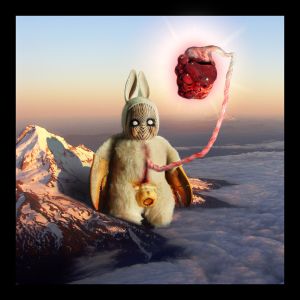
m[m]: Tuberpendicular started life as pieces you posted on the Nine Day Antler Society (NDAS), an online gallery you share with At Jennie Richie, Loving ♥ Kindness, Thomas Carnacki, R K Faulhaber, The Recordists, and Crank Sturgeon. How did this come about? As you all aspire to contribute a new work each month, has it provoked a more disciplined way of producing material?
MW: NDAS was instigated by At Jennie Richie, who invited both Eriijk Rêssler (L♥K) and myself to contribute. The original idea suggested by AJR was a full West Coast-spanning collective: AJR is based in Seattle, I’m in Oregon, and Eriijk is in San Francisco, and there was a plan to expand the roster to include someone in Alaska, British Columbia and Baja California. Not surprisingly, that idea never panned out, so it remained limited to the three of us during the first year. Back in August AJR decided to drop the West Coast concept and asked some of the bands associated with the Readymades Tapes label to join in; I suggested getting Thomas Carnacki and Richard Faulhaber on board as well.
MW: Having to come up with monthly (and, for the first year, bi-monthly) NDAS contributions has been enormously useful for me. It’s motivated me to maintain a more regular output, to work more quickly, to explore a broader variety of approaches, to interact more with other creative people – and, of course, it provides an immediate public outlet for all of it, instead of more unheard stuff being piled up in my personal archives. And it’s also created a whole resource of finished (or at least well-along-in-progress) material for me to cull from for future releases.
m[m]: Both Thomas Carnacki and Richard Faulhaber seem to consistently crop up in relation to your work as irr. app. (ext.). How did you all meet?
MW: Greg Scharpen (Carnacki) and Richard Faulhaber have both been close friends for years — long before irr. app. (ext.) was a going concern. In fact, the existence of irr. as a recording project is largely due to the assistance of Richard back in the early 90s, and the later existence of irr. as a performing entity is largely due to the assistance of Greg in the early 00s.
MW: The circumstances behind meeting Richard were a bit unusual. At the start of the 90s I was using the studio facilities at a local community college, and my instructor kept telling me “there’s a former student of mine you should meet — you have a lot in common”. At this same time a friend & co-worker at my day job was telling me “you should meet my cousin – you have a lot in common”. Another friend that I knew from high school was attending CalArts in Los Angeles, and he was telling me “you should meet my roommate down in LA – you have a lot in common”. (In fact, it was this same friend who made me aware of the existence of Nurse With Wound because this same roommate of his had an extensive NWW collection.) Of course, it turned out that all of these completely independent sources were talking about the same person.
MW: The first time we finally met (at a rare theatre screening of Eraserhead in San Jose) we didn’t get along at all, but immediately after that we became fast friends. We would get together and record spontaneous, abstract improvisations on his little cassette 4-track set-up. It was incredibly exciting and inspiring for me: I’d never met anybody who was completely open to creative ideas like that (although, he did admit to me much later that at first he thought I was completely off my rocker). Richard was always very generous in allowing me to borrow his equipment, and it was only because of this that the first five irr. records were able to happen. And, as I mentioned, it was he who indirectly introduced me to Nurse With Wound.
MW: I originally became acquainted with Greg in the early 90s as a ‘the brother of the boyfriend of a friend of a friend’, but over the years we gradually became very close. It was with Greg and his brother John that I first started to travel overseas (mainly to attend Current 93 concerts), and that led directly to my getting to know Steve later on. Like Richard, Greg was one of the very few friends I had that was open to unusual creative ideas – and, more importantly, would actually follow through with those ideas. Richard, John and Greg were all helpful in getting the first several irr. live performances going, but it was Greg most of all that would contribute useful new ideas to the process and would put a real effort into helping to make things happen. It was inevitable that he would start his own project: between Thomas Carnacki and his theatre sound design work and his radio work on KALX and his film editing work and who-knows-or-can-keep-up-with whatever else he’s doing… he’s always been a creative blur. Makes me tired just thinking about it.
m[m]: NDAS uses a combination of blog and Soundcloud to showcase its wares and you also have a Bandcamp page with a range of digital releases. Meanwhile your most recent releases have been on vinyl, cassette and CD, although you recently said you want “to get away from CDrs” – what are your preferences with regards to physical formats? And what are your feelings about digital distribution?
MW: That question opens a whole messy can of worms. I’m still not very sure about how to go about distributing my music. Early last year, I sent out a survey to the people on my mailing list to try to clarify what formats they preferred and to get an idea of how best to move forward. The response at the time was overwhelmingly against download releases, but this year that’s already changed: now I’m getting requests for more material to be also made available in that way, and for older albums to be re-released in digital versions.
MW: However, there are still plenty of people who are strictly dedicated to physical releases, and some who won’t touch anything except vinyl. I can’t afford to produce vinyl, but I recently had a couple labels offer to do it for me and so I accepted just to see how well it would work out. The good news was that I ended up with a couple really stunning vinyl releases that I could have never managed on my own. The bad news was that I didn’t make much return on them: I only received a small number of copies to sell myself (which was perfectly fair since the label paid for all of the manufacturing costs) and, since the labels could make their copies available to people much sooner than I could, most people had already bought them before I could put mine up for sale. I’d still do this again for the opportunity to get some more nice vinyl packages out there, but I’ll have to plan it around the fact that it won’t help me pay my bills. This kind of music just doesn’t sell enough for there to be anything meaningful to divide up between different parties.
MW: The cassettes I’ve been doing because there’s a label I like to work with (Readymades Tapes, run by the At Jennie Richie cartel) and they keep asking me for more releases. And it’s an opportunity to get new material released without waiting 2 or 3 years for it to happen.
MW: I’d planned to get away from CDR releases entirely, but circumstances have forced me to re-evaluate that idea. The past couple years I’ve been developing my own hand-made CD packaging, with the idea that I’d have the discs professionally replicated while avoiding the costs & restrictions of getting manufactured packaging. But, in that short space of time, new release sales dropped from 100-200 in the first month to fewer than 50. So now CDRs are the only viable option: I can create them on demand rather than paying for the full run all at once, when I probably wouldn’t be able to sell enough copies to cover those costs before the bills are due.
MW: My personal preference has been towards CDs. I used to have a big vinyl collection (of course, I started collecting music before CDs were an option) but it was such a hassle finding room for all of it, and moving it to a new house was always a nightmare! During the past 10 years I’ve purged as much of it as I could. I really never wanted to accumulate any more vinyl or cassettes, but the resurgence of both those formats has forced me to do that anyways. I’m sure I’m putting some of the people who collect my music in the same position: grudgingly buying vinyl & cassettes again because a release is only available in that format. But I’ve got to explore all the options to try to find a way through these uncertain times.
MW: I’m still not acclimated to digital releases. I grew up with stunning gatefold vinyl releases, frequently packed full of booklets and posters and stickers, so it seems very incomplete to me. Part of me can’t help but feel: where’s the rest of it? I can’t sit and study the imagery, or read the liner notes. I can’t smell the fresh ink from lovely, glossy pages – or, I can’t rub my genitals against heavy, thrillingly-textured paper. On the other hand, releasing something in digital format is fantastic. It can be made available right away, without things like lack of funds, manufacturing screw-ups or creepy label shenanigans creating a roadblock for months-to-years. No problems with finding room for unsold copies, no scrounging for packing materials or waiting in line at the post office! It seems certain that even people who prefer physical formats will start turning to digital releases if only because of the obscenely escalating cost of postage.
m[m]: Tuberpendicular is said to involve “the molecular agitation of plant-based starches” and your track titles often have a biological bent – have you a scientific background?
MW: I don’t have any kind of academic scientific background. I’m just an enthusiastic amateur, and have a profound fascination with the natural world and all its processes. And I like to explore new areas of information. Also, that description is a bit tongue-in-cheek: it’s a deliberately obscure reference to the fact that a series of recordings I’d made capturing the various sounds created by cooking potatoes were used in all of the tracks on that album (which is the reason for the ‘Tuber’ in the title). Just as the reference to “disturbances in the electromagnetic spectrum” refers to shortwave recordings, and “the inducement of resonating membranes by an unruly nervous system” refers to manipulated drum improvisations. These were the three principal sources used to make the album.
m[m]: Is imposing limitations on your sound sources, like you’ve just described, a common compositional tactic?
MW: I’ve found it very helpful to create specific parameters for just about every project. But I never consider those parameters to be inviolable: if the project doesn’t seem to be ‘finished’ or ‘successful’ (in my estimation) then I’ll bring in whatever is needed to get it there. The limitations generally offer the most help at the beginning of the process. Other times, I’ll just start doing something and see what happens.
m[m]: What’s coming up next for irr. app. (ext.)?
MW: Lots, but it’ll probably be a while before much of it comes to light. A couple more collaborations with At Jennie Richie are in the works. A collaboration with Finnish musician Pentti Dassum is almost ready to go: it’s just waiting for me to finish some artwork, and then it’ll be released on CD by a label in the Ukraine. A collaborative release with the Toronto-based project Six Heads is planned for the Readymades label for early January. Some collaborative projects with NWW are underway, and I’ve also submitted an irr. track for an expanded reissue of the ‘Sylvie & Babs’ album — possibly released next year. Liles has also contributed a track.
MW: On the pure irr. front, I’m still working through a deep-tissue scrubbing & reconstruction of the never-properly-released albums ‘Foreign Matter, Nor Frequency Carrier’, ‘Inception & Silence Undivided’ and ‘Radiant Black Future’. I’ve also been attempting to clean up the very first, never-ever-released, cassette-only irr. album made in the early 90s, but that is an almost certainly doomed effort. An album of new material finished last year is waiting to see how it can materialise, and two collections of tracks submitted for never-released compilation albums are in line after that one. A couple more pre-‘Uncertain’ archival collections are planned for digital release. But the next release will most likely be another 3” CD I’ve just completed for the Petit Mal Music label – a kind of sequel to the ‘Neognath In Machina’ EP.
MW: I’ve started doing non-performances again, but this time they’re on video. As soon as I figure out how to use my video editing software I’ll be posting those online somewhere. All the original audio non-performances have been organised, and will be released in a small edition at some point, which will be enjoyable for absolutely no one except myself.
m[m]: What are non-performances?
MW: Non-performances are little personal events I began doing during my first trip overseas, which was to Nevers, France in 1995. In part, they were inspired by two interests I had at the time: Viennese Actionism (particularly Rudolf Schwarzkogler and Gunter Brus) and in the assemblage ideas of Kurt Schwitters. The idea was to take a moment where nothing of particular interest was happening and find a way to immerse myself into it so that it became something significant and remarkable – but only for myself. I decided to call them ‘non-performances’ because, although there was some kind of performance element to it, it had nothing to do with entertaining someone else or self-consciously creating any specific end result. Whatever action was taking place was simply a way to help me focus my attention in the attempt to transform my experience of that particular moment. I would record the event as a way to mark a distinct beginning and end to the process.
MW: Throughout much of my life I’ve been tormented by boredom. Most of my memories of childhood are long, unpleasant stretches of boredom (forced to sit at an uncomfortable desk for hours at school, forced to sit on an uncomfortable pew for hours at church, forced to sit around and do nothing for hours while my mother shopped for groceries or clothes, forced to sit quietly while my parents watched ‘Lawrence Welk’ or something equally coma-inducing on the TV, etc.) punctuated by irregular, all-too-brief instances of something fun happening. Then school ended and going to a job five days a week began — and boredom REALLY kicked into high gear. It took a long time for me to realise that I had to take responsibility for my own boredom. It’s easy to just sit and be bored, but with a little bit of effort the experience can be turned into something else entirely. It’s certainly easier said than done, but non-performances were my way of practicing this.
MW: That first non-performance in France was very simple. I was out walking in a gorgeous field with John and Greg and I found a dead mole. I was feeling jet-lagged and irritable, so I decided to create a little event for myself to commemorate this tiny, decomposing French mole. I started recording the ambient birdsong on my pocket cassette player, and, using only silent gestures, I did all that I could to keep my two friends from talking for as long as possible. I managed to keep them quiet for about four minutes before they became impatient and started to talk, and then the non-event was over.
MW: I probably did about 30 non-performances between 1995 and 2004. Many of them centred around interactions with animals (all living ones, except for that mole), which worked well because the animals weren’t influenced by any awareness of a ‘performance’ taking place; the rare times I had other people knowingly participating, it always created a self-conscious atmosphere that worked contrary to the whole point of doing it. Two of the most enjoyable events in the original series involved playing a little wooden noisemaker at dusk for a raptly attentive herd of cows in Wales (this eventually also attracted a herd of horses – on the same side of the fence as I was, which made me a little uneasy), and playing a kazoo to my sister’s pet turtle when I first moved to Felton in CA. This remarkably long-lived turtle now also figures into the new video-oriented non-performance series I’ve started.
MW: I’ve been focusing more time on painting and other graphic work, so unfortunately my already slow pace with getting things released is going to slow down even more. But it’ll all come out eventually — even if everyone has lost interest by that time.
m[m]: I think a world where there’s no interest in your work would be a seriously depressing one. Thanks so much for taking the time and effort to give such considered answers our many questions.
MW: Thanks very much for your time and interest!
To keep up-to-date with all of irr. app. (ext.)’s extraordinary outputs visit: http://irrappext.com/
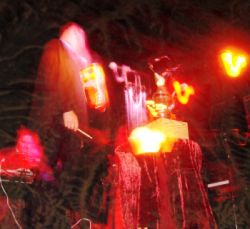
(Picture credits: Main large front page photo taken by Jim Kaiser, small front page photo taken by Jim Hayes, first in text photo by unknown, second in text picture taken from the front cover of recent irr. app. (ext.) + Blue Sabbath Black Cheer release ‘Discordant Convergence’ , and third in text picture of therecent irr. app. (ext.) release ‘Deflating An Imaginary Spleen, Almost In Public’ .)
Interviewed by Russell Cuzner
(Source: http://www.musiquemachine.com/articles/articles_template.php?id=330)
> LAIBACH Live in Hong Kong on 22 March 2014
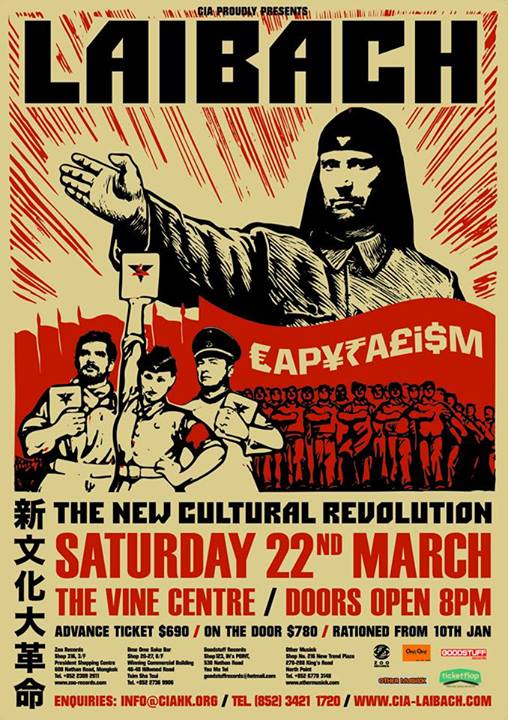
EVENT: LAIBACH (THE NEW CULTURAL REVOLUTION) LIVE IN HONG KONG
DATE: 22 March 2014 (Saturday)
TICKETING: HK$690 (Advance)/HK$780 (At The Door)
DOORS OPEN: 2000hrs
VENUE: THE VINE CENTRE, 29 Burrows Street, Wan Chai, HONG KONG
More Info At: www.cia-laibach.com
> RICHARD RAMIREZ (Black Leather Jesus, Werewolf Jerusalem) INTERVIEW By Plague Haus
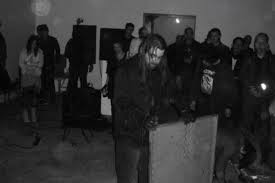
The man behind some of the longest running noise acts in the US, including Black Leather Jesus, Priest In Shit, Werewolf Jerusalem and owner of Deadline Recordings, answers a few questions for Plague Haus.
Plague Haus: Greetings, Richard. For the uninitiated, how long have you been creating noise/PE and under what project moniker did you begin releasing material under?
Richard Ramirez: I started doing my work in late 1989. I first started with a project called, Flesh Puppets. Soon after, Black Leather Jesus came. My first BLJ release came out in 1990.
PH: Is there a particular band or recording that you heard that made you say, “I want to do that”.
RR: It was artists like Nurse With Wound, NON, Merzbow, The Haters that initially got my attention. Shortly after, I heard Emil Beaulieau, Chop Shop, Hijokaidan and fell in love with their work.
PH: Was there a “scene” in Houston when you first began? I’m sure you’re one of the pioneers, but were there any other like-minded individuals when you started?
 RR: There weren’t any extreme harsh noise groups around, but there were experimental artists doing shows quite often (Pleasure Center, Turmoil In The Toybox, Ustad Oni, Jesus Penis, Rotten Piece, Infant Mortality Rate, Ure Thrall, & EL7). I think the scene was great from 1989-1994 then once again 2000-recent. There are more noise acts than before. Concrete Violin, Loudspeaker, Melanie Riehle, TEF, & ITLOA are my favorites.
PH: Are you associated with any particular network of artists? Is there any group you have an affiliation to?
RR: I am good friends with a lot of locals (including: Baptist Skin Communiti, Geoff Markoff of Loudspeaker, Concrete Violin, Rotten Piece, ITLOA, Kai/Ros, Crawling Iris, and of course my boyfriend, Jovan Hernandez of ze’r0-sum). I work on several projects with other locals like: S-21, Anatomy Of A Blackout, Are The Volcanoes Still Active?, Meat Shop Rapist, Anal Drill, Last Rape, Private Mouthpiece, and many others. I love our community of artists. For the most part, they are not snobs.
PH: You have an insane number of projects all release material and a few that are not. How do you keep them all separate in your mind or do you?
RR: I do in some cases. I just enjoy doing releases under different names. I get bored with just one or two projects. I know some hate that i do this, but i love it. I also work with so many different people and enjoy doing so. It is funny how some thought that some of the people in my releases were made up. I don’t see how i could pull something like that off. I did one project like that a long, long time ago, but that was only once. Some projects are not as harsh as my known work. I enjoy different aspects of experimental music. Not just the harsh point of view.
PH: How many are active at this moment, both your own and collaborations with others?
RR: That is impossible to say how many are active. Some projects return after many years. Last Rape for example, took several years for a new release to surface (over 10 years). Some are revived with new collaborators. There are some that will not return. There are some projects that are having their releases reissued.
PH: When you record, do you do it with a specific project in mind or do you decide which one it fits best as after?
RR: Both. Sometimes I know what project I want to do something with. Sometimes I record and later decide which project that I think it fits with. Also, the fact that I record with others makes that decision as well.
PH: Do you have a specific structured ‘song’ in mind when you record, or is most of your work improvisational?
RR: Improv is usually my way of recording. I am not too big on the idea of “structure” or reworking and reworking tracks. I do with a small percentage of projects. I love the raw sounds created in one take.
PH: I’ve witnessed you in a live setting once and have viewed several videos of your live performances. You produce a big sound with a very minimal amount of equipment. Does the same set-up apply when you record?
RR: Yes. I only own four effects pedals. That’s it!!!! It has been that way since my beginning. I am not fond of using tons of effects or the latest technology in equipment. That does not interest me at all. I try to utilize different objects for different projects. Vintage radios, turntables, sheet metal, pipes, chains, meathook, field recordings.

PH: Is there anything that influences you when laying down something new, a painting, a film, a book, etc? Where do you draw your inspiration from?
RR: I draw most inspirations from horror films (especially Asian and Italian). Also, painting gives me energy and excitement to record.
PH: Being as prolific as you are, do you keep up with all of your own releases or have some of them been lost along the way? It seems it would be easy to do.
RR: Lots have been lost along the way. I am so amazed to see some collectors with my releases from the early 90s. I don’t even have most of them. I’ve lost a lot of masters throughout the years.
PH: Have you ever considered doing a definitive Richard Ramirez box set? It would have to be huge, I’m sure.
RR: There are talks of one in the near future for both my solo work and Black Leather Jesus. There have been tape/cdr box sets, but these that are in talks are on vinyl and pro-cd format.
PH: While most PE/Noise releases usually take some kind of violent or misogynist view of women, you’ve kind of flipped that around. A lot of yours have heavy homoerotic or S&M imagery. Is there a specific reason for it and have you ever received any negative responses?
RR: I was tired of seeing so many releases based on women in submissive roles. Being gay, I decided to use men. I got a lot of negative responses in the beginning. I even got death threats and tons of hate mail. I still get some hate mail or comments. I don’t give a shit though. If they’re uncomfortable with homosexuality then they might want to question why that is such an issue for them. Most don’t care that I use those images. Some even like it. The S&M images are also a part of me. That is something that my boyfriend and I are into.
PH: Do you believe the packaging and the music go hand in hand? Yours range from the fairly extravagant to minimal. Is the artwork important to you, or is it only about what’s inside?
RR: I am more focused on the material rather than packaging. I love the whole DIY way of doing things. I’m not really into the polished look. It is nice in some cases, but I rather have a release with cheap packaging, but great noise. There are some that have both. That’s cool too. It’s a matter of opinion.
PH: Tell us a bit about the history of your label, Deadline Recordings. When did it begin and why?
RR: I started deadline recordings in 1992. Initially it was called, dead audio media. It became deadline in ’92. I wanted to release my own work since i was not being ask to really do releases for other labels at that time. I also wanted to release items for my friends and new artists that i liked. I don’t release products according to how much money i can get from them, like some other labels. I think it is sad when labels do not give new artists a chance. There are some out there that do so and I applaud them for it.
PH: Anything in the works from Deadline you’d like to comment on?
RR: I am starting a new sub-label of deadline recordings based on only pro-cd releases and maybe some vinyl later. The first release will be a Werewolf Jerusalem cd. Then, a PBK/Richard Ramirez collaboration/split cd. Later, releases with Thurston Moore, Sudden Infant, The Rita, and more.
PH: There can’t be much free time for you between the amount of projects you’re involved in and running a label. When you do find yourself with some, are there any hobbies or projects outside of music you’re into?
RR: I am also a fashion designer (under the alias, Richard Saenz). I have been doing fashion for 10 years now. That takes up a large portion of my time. I also paint when I can, but that’s rare.
PH: What’s in your own personal ‘Now Playing’ list at the moment?
RR: If you’re talking about outside of noise/experimental music that would be: The Jesus & Mary Chain “Psychocandy”, Foetus “Damp”, The Mighty Lemon Drops “World Without End”, Mono “You Are There”, Liars “Drums Not Dead”, And Les Georges Leningrad “Sangue Puro”.
As for noise, I’ve been listening to The Rita “Thousands Of Dead Gods”, Sewer Election “Sex/Death”, The Cherry Point “Black Witchery”, And Incapacitants “Pariah Tapes” box set.
PH: Are there any new special releases, tours, etc coming up that you’d like to comment on?
RR: I am doing a show in October with Sonic Youth (Marfa, Tx). Then later, I am doing a show in Atlanta, Ga. A northeast tour is being planned, possibly with Thurston Moore. In 2008, I want to do some UK shows.
PH: Thank you for taking the time to answer a few questions. The last word belongs to you.
RR: Thank you for the interview. Play safe!!!!
(Source: http://www.plaguehaus.com/home/2010/05/11/799/)
> SONIC CIRCUITS: GX JUPITTER-LARSEN KNOWS HOW TO MAKE AN AUDIENCE RIOT By Logan K. Young
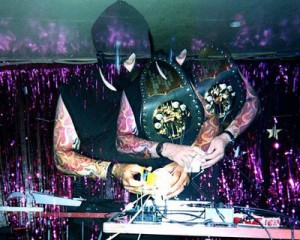
GX Jupitter-Larsen is probably one of the most infamous noise musicians in the world. A dubious distinction, yes, and if you find the term “noise musician” a bit counter-intuitive, you’d be right once again. Jupitter-Larsen has long maintained that what he makes, whatever you call it, isn’t meant to be musical. His brand of noise is more performance-art send-up than sweaty, aggro fukitol. Of course, that’s not to say it’s any less loud or any easier to comprehend. Jupitter-Larsen has led his mask-wearing troupe of noiseniks, The Haters, since 1979, but the band’s Friday Sonic Circuits concert is its first appearance in the area. And if all goes according to Jupitter-Larsen’s best laid plans, I doubt they’ll be asked back anytime soon.
Washington City Paper: Over the past 30 years, from Albuquerque to Zürich, your Haters have performed some 400 times. And yet, this is your first time going to Washington. Why so long a wait? Something Reagan said?
GX Jupitter-Larsen: Ha, don’t get me started on Reagan! But no, there is no real reason actually. My life on the road just always pointed me somewhere else. Funny that I should get to perform north of the Arctic circle in Norway before I even get to visit our nation’s capital. Such is life.
WCP: After so many years on the road, you’ve finally set up shop in Los Angeles. Given the vapidity of Hollywood, one would think the noise scene there similarly shallow. To be fair, there’s The Smell and Not Not Fun Records, but of all the places you’ve gone, I’m wondering why L.A.?
GX J-L: Forget about the silliness of Hollywood; you can’t take any of that seriously. There’s so many great and creative people in Los Angeles. Damion Romero is probably the greatest noise artist of all time, anywhere. You actually haven’t been to a noise show until you’ve seen him live. But then, there’s artists like amk, Geoffrey Brandin, John Wiese, and Joseph Hammer who all do some pretty awe-inspiring noise. Artwise, you have excellent creative spaces like Machine Project, The Museum of Jurassic Technology, and the Center for Land Use Interpretation. Groups like The Institute for Figuring will definitely make you think. For myself, personally, there’s a kind of psychical emptiness to the place. I like that. It’s easy to be left alone, easy to hear yourself think. Los Angeles is the closest thing to an urban desert you’re ever going to find.
WCP: Any parallels then with Washington, D.C. — the oft-cited “Hollywood for ugly people?” I know they’re from Miami, but To Live and Shave in L.A.’s Tom Smith was in D.C.’s Peaches of Immortality.
GX J-L: I’ve never heard that “Hollywood for ugly people” thing before. That’s pretty funny. But really, self-loathing only serves your enemies.
WCP: Tell me about the call Sonic Circuits head honcho Jeff Surak made to get you to come play the District. (Well, Silver Spring, anyways.)
GX J-L: He told me Sudden Infant was performing. And there was no way I was going to miss that!
WCP: Speaking of Surak, he just put out the fourth volume of his all-Beltway District of Noise compilation. Vol. 3, though, was a record of 100 locked grooves. As someone who’s cut more than a few locked vinyls, what is it about that medium that so entices noise’s message?
GX J-L: Noise fans love all discarded things, be it an unwanted sound, or an obsolete technology.
WCP: You’re recorded with almost every card-carrying member of the noise scene, many of whom have played the Sonic Circuits Festival prior. Live, Haters has swelled to a power-tool trio including Paul Dickerson and Bob Ferbrache. What’s the collaborative process like for the music you make?
GX J-L: I just like collaborating because it always leads me to a conclusion I doubt I would have reached on my own.
WCP: At the same time, however, there have been Haters gigs where you, yourself, didn’t even show up.
GX J-L: OK, so there’s two answers I could give: the funny one, and the serious one. Both are equally true. I guess the funny one is, in my way of thinking, just because I didn’t have the money to psychically get somewhere shouldn’t stop me from actually performing there. Just because I couldn’t get there, that shouldn’t stop me from “being” there. Something like that, anyway. Otherwise, at the time I did these so-called non-performances, I really did think of them as a means of getting to touch the substance of nothingness. This was back in the early ‘80s; I was young and quite obsessed with the idea that nothing-at-all could still be a psychical thing. Just not one which was either concrete or abstract.
WCP: Likewise, you’ve never been afraid to break the fourth wall between you and the audience.
GX J-L: The best thing about the early punk of the ‘70s was that the audience was a bigger part of the show then most of the bands were. In my own performance art, in the ‘80s and ‘90s, I tried to keep that dynamic—by using inside agitators to lead the audience to riot. That was a wild ride, let me tell you.
WCP: The Haters remain notorious for their, how shall I say, idiomatic offerings. I’m thinking of already classic pieces like the amplified-calculator-on-an-open-fan of Dirwyn. Will we witness one of these oldies, or do you have a new goodie up your tat sleeve?
GX J-L: My current performance is entitled Loud Luggage / Booming Baggage, in which an amplified suitcase gets to be the centerpiece of it all.
WCP: Alone, you’ve developed some rather complex theories of how you think noise should be experienced. Here, I’m speaking mostly about your “polywave” and “totimorphous.” Care to explain, in layman’s terms?
GX J-L: The funny answer would be to forget about metric conversion; we’re talking about GX conversion. The polywave is my own personal alternative to the inch. The serious answer is that any nation, any culture, keeps its participants in line by having them unconsciously believing in, and acting upon, certain things. The power of any culture is in its ability to automatically direct the actions of its participants, without the participants actually realizing it. Any nation, or culture, forces its participants to conform to a master narrative, as if its story was the only one worth telling. Well, I have my own story to tell. That’s where the polywave and totimorphous come in. They are the inches I use to measure my life.
WCP: You’ve stated before that you never really intended to be a noise artist; sound was merely a way to signal the beginning and end of a performance. Known primarily for your sounds now, have your intentions changed?
GX J-L: Personally, art has never been about making a statement. It’s been about going on a journey. I may have started at one location, but I’ve since moved on.
WCP: It’s no secret that your own politics swing left—hell, the entire Haters oeuvre could be described as downright anarchic—so what’s your take on the recent Republican debate? Might we hear a Red Line ode to Rep. Bachmann on Friday?
GX J-L: Republicans are the real anarchists here, with their self-fulfilling prophecy of government as the problem. Republicans have a long history of slashing taxes so the government’s ability to fund basic services is greatly curtailed. They then cynically campaign that they are the only ones that can fix the very problems they, themselves, created.
> THE RITA, VOMIR, WEREWOLF JERUSALEM & JONATHAN VALDEZ Live in Houston, TX on 7 Feb 2014

EVENT: THE RITA, VOMIR, WEREWOLF JERUSALEM & JONATHAN VALDEZ LIVE IN AMERICA
DATE: 7 February 2014 (Friday)
TIME: 2100hrs
VENUE: GALLERY HOMELAND, 2327 1/2 Commerce Street, Houston Texas, USA
More Info At:
https://www.facebook.com/events/394847347312829/
http://www.galleryhomeland.org/wordpress/
THE RITA
VOMIR
http://www.youtube.com/watch?v=KvbGwt2RCdc
WEREWOLF JERUSALEM
http://www.youtube.com/watch?v=PJWcz4Au5ew
JONATHAN VALDEZ
https://soundcloud.com/jonathan_valdez
> CYCLOBE Live in Berlin at CTM Festival on 30 Jan 2013
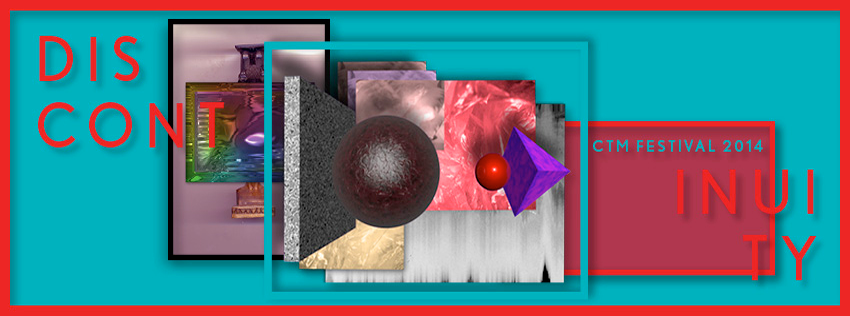
Cyclobe are delighted to have been invited by the excellent CTM Festival in Berlin to perform a concert on the 30th of January, 2014. The event is to be held at the beautiful HAU1 Theatre.
This will be Cyclobe’s 4th live appearance to date, and CTM’s 15th Anniversary edition, titled ‘Dis Continuity’.
More announcements will follow very shortly including details of the final line-up for this event,
EVENT: CTM FESTIVAL
DATE: 30th January 2014
VENUE: HAU1 Theatre, Stresemannstraße 29, 10963 Berlin-Kreuzberg, Germany
Phantomcode releases to coincide with the concert and the evening’s special guest performance.
In the mean time, please visit these links for further information regarding tickets,
times, and news concerning other artists appearing throughout the festival –
CTM Website
http://www.ctm-festival.de/festival-2014/preview/
CTM (Facebook)
https://www.facebook.com/CTMFestival
…and to join the CTM 2014 Facebook Event page please visit
https://www.facebook.com/events/314583345349557
> BABY DEE & LITTLE ANNIE PLAYING JOE’S PUB in New York on Christmas Eve (24 Dec 2013)
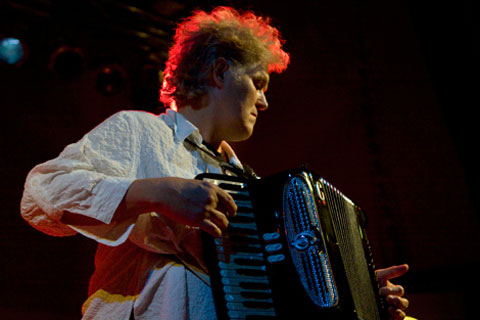
Performance artist/multi-instrumentalist/singer Baby Dee, known for collaborations with Andrew WK, Antony and others, plus another Antony collaborator who Baby Dee often shares the stage with, Little Annie, are teaming up for a Christmas Eve show at Joe’s Pub, a place they’ve played together before. It’s probably one of the only shows in NYC that night, so if “an evening of depressive snowmen, disgruntled reindeer, incontinent Santas, washed up hermaphrodites and yuletide sobstresses” sounds like your way to spend Christmas Eve, then this is not to miss. Tickets are on sale now.
EVENT: BABY DEE & LITTLE ANNIE LIVE IN NEW YORK
DATE: 24 Dec 2013
TICKETING: http://tickets.joespub.com/production/?perf=23520
VENUE: JOE’S PUB, 425 LAFAYETTE STREET, NEW YORK, NY 10003, USA
Speaking of holidays and Andrew WK, he parties it up at Irving Plaza on New Year’s Eve. Tickets for that show are still available.
Little Annie and Baby Dee released the collaborative album, State of Grace in 2012.Bonnie ‘Prince’ Billy features on the title track, and you can stream that song, along with the rest of the album, below…
—
Little Annie & Baby Dee – “State of Grace” (feat. Bonnie ‘Prince’ Billy)
(Source: http://www.brooklynvegan.com/archives/2013/12/baby_dee_little_1.html#more)
> SUNN O))) & ULVER: THE STORY OF THEIR COLLABORATION REVEALED; FIRST AUDIO SAMPLE UNVEILED
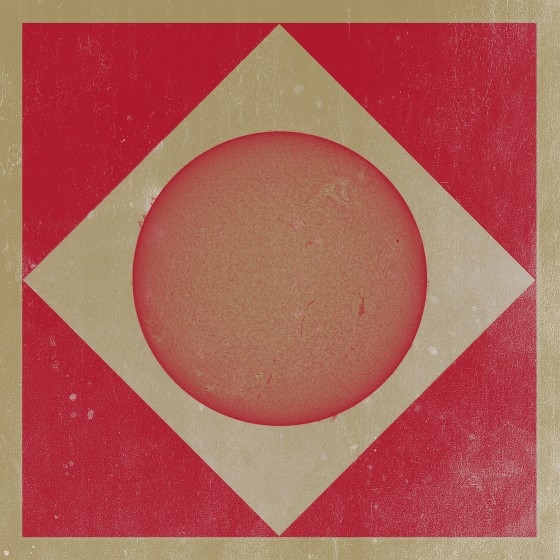
With words from the creators themselves, the story of how the impending collaborative Terrestrials LP from SUNN O))) and ULVER was conceptualized and created has been dispatched to the public, in addition to the first auditory indication of the material the album presents.Oslo, Norway, August 10th, 2008. Following their 200th gig, playing before 2000 people at the Øya festival, SUNN O))) teamed up with Norwegian legends ULVER at their Oslo studio, Crystal Canyon. They recorded three “live in improvisation” pieces, starting that evening and ending at dawn, as Northern sunlight seeped in through the windows.“We were sitting in the console room, early in the morning, listening to the takes. Someone said, ‘ah, sunrise over Crystal Canyon,’ as if the night had been a dark one. We all laughed and Greg proposed it as a title. In that setting it sounded perfect. The boys had mentioned wanting the music to orient towards the light, like some lost pilgrim stretching before the sun. We kept that mental picture for the processing.” – Kristoffer Rygg
That take became the album’s opening piece, “Let There Be Light,” which builds up from silence and darkness and proceeds – ceremoniously, coruscating – O’Malley and O’Sullivan creating the backdrop for Rygg’s Basso Profondo chants. The music unfolds over eight minutes before reaching a crescendo of bass and brass, introducing both Anderson and ULVER as we know them. The Sunn has risen.
“Western Horn” accelerates on a single and austere note of sustained bass and low end, evolving gradually into a haunted soundscape. Crying violins, clusters of Fender Rhodes, guitar pickups, and metal plate drones are gradually layered beneath Anderson’s augmented bass feedback.
“Eternal Return” introduces Rygg singing a lyric evoking ancient Greece, Egypt and the Biblical lands. The song is palindromic, echoing the lyric, beginning and ending with the same bass line and musical pattern, though the guitars are ultimately reversed as the song implodes upon itself.
After the session, ULVER spent a fortnight enhancing the dynamics of the original recordings, adding their own distinctive sheen to the mix, while never losing sight of the SUNN O))) gestaltqualität and remaining careful not to become caught up in studio stratagems.
O’Malley would join ULVER once in a blue moon to develop and sculpt the production more closely with Rygg — overseeing additional recordings of trumpet, viola and violin and attempting to illuminate, and preserve, the unique atmosphere of the collaboration. Over the course of several of these short visits, now some years since the original recording session took place, things slowly and steadily grew to become Terrestrials.
“I remember the vibe in the room back then was more rāga than it was rock. And despite the fact that the walls were literally shaking from volume, it was actually quite a blissed out, psychedelic session. I wanted to preserve that vibe in the final mix.” – Stephen O’Malley
And while Pandit Shankar (may he rest in peace) was not physically present, his spirit loomed large, perhaps together with a few nameless Persian ghosts attracted by the boys’ mutual appreciation for composers like Conrad, Riley, Glass, Alice Coltrane and Shivkumar Sharma.
“You know that opening sequence of Koyaanisqatsi, where the desolate desert landscapes, waves and cloud formations roll over the screen accompanied by deep male chanting and organ ostinatos. That’s where we were.” – Daniel O’Sullivan
So: serene, vociferous, and visually charged stuff. Supreme sounds of synergy from two seminal forces – and friends. Remember to play loud.
In advance of Terrestrials’ street date, now confirmed as February 4th, 2014 in North America, an excerpt of Terrestrials’ immense third composition, “Eternal Return,” is now playing AT THIS LOCATION.
Terrestrials Track Listing:
1. Let There Be Light
2. Western Horn
3. Eternal Return
Additional information and samples from the Terrestrials experiment will be available in the coming weeks prior to the album’s release.
http://sunn.southernlord.com
http://www.jester-records.com/ulver
http://www.southernlord.com
http://www.ideologic.org
> THEATRICAL ASPECTS OF NOISE – THE NEW BLOCKADERS (Glissando #21)

The following is an excerpt from an article about the theatrical aspects of Noise which appeared in Glissando # 21 (2013) entitled, ‘Even the electricity being cut and the venue collapsing (which is a quote from the article itself):
Do TNB use elements of theatre like movement, gestures, or dance and, if so, is it planned or spontaneous?
There is movement, but purely in a functional sense. Terms like ‘theatre’ or ‘gesture’ imply something false or contrived or (worse still) something ‘artistic’ which we reject completely. There’s a misconception in certain quarters that the black suits and masks are worn as a pantomime costume or are designed to intimidate which is not the case. It’s strictly an exercise in anonymity and to remove the idea of a personality, and consequently expectation, from the event.
Everything you see and hear is directed and completely spontaneous. This may sound like a contradiction, but both states can exist simultaneously and cancel one another, neither composed or improvised, both of which are largely musical or artistic constructs which we have no interest in. Time passes, events occur.
To what extent, if any, does the environment / venue dictate a performance? What are its limitations? Do you ever feel tempted to go outside that territory?
This is a difficult question as TNB largely shaped what is considered ‘noise music’ today while not actually sounding anything like the scene it helped to spawn. Most Noise musicians (Noisicians) now are just that; musicians – using the same old hackneyed cliches of volume, dramatic preconceived performance moves and professionalism for career advancement that have been around since the dawn of Rock & Roll (and before, no doubt.)
TNB operate completely in the area of non-music; there is no pretence or allusion to music or art at any stage, all of this is rejected. In this way there is no territory and consequently, no limitations.
Obviously most established music venues are laid out in a similar fashion with a stage area where the performers are kept visibly or physically separate from the audience. TNB generally have no interest in observing this distinction as it’s how traditional ‘music’ or ‘theatre’ is demarcated; clearly anything which is a throwback to these situations is not of any interest. Therefore, TNB regard all areas of the room and indeed the fabric of the building itself as fair game; the floor, the walls, the structural supports, found objects and so forth can (and generally are) incorporated into the proceedings. No limitations. In the past, found items have included garbage-container lids, washing machine parts, knitting needles, newspapers, Pop music cassettes, broken amplifiers, air-raid early warning system parts, cutlery, broken furniture, glass and on one occasion a plaster statue of a famous Classical music composer who watched over the proceedings.
It would therefore be fairly impossible to go outside of this territory as it has no real definition to start with once the old music hall rules have been dispensed with. Even the electricity being cut and the venue collapsing would mean we could carry on acoustically using the rubble as a sound source.

What is the role of the audience at a show? Does the presence of an audience influence the performance?
TNB ‘performances’ happen despite the audience, rather than being influenced by them. Stages have been invaded by audience members getting carried away by the proceedings, venue sound personnel have cut power to PA systems, equipment forcibly unplugged and so on; the proceedings carry on regardless as volume is not always the end-game. Silence is often far more interesting.
TNB ‘performances’ have also happened without any audience whatsoever, in private, or publicly cancelled only to go ahead anyway. There’s a rejection of anything that could be perceived as an ‘art event’ or ‘Rock & Roll show’ which most audiences are still looking for despite their declarations of being ‘avant garde’ and so forth. TNB offer no ‘polished’ performances, no personality, no content, no bravado, no beginning, no end.
> 1913 – 2013 THE ART OF NOISES (Featuring Strange Attractor, Vomir & Others) on 13 Dec 2013
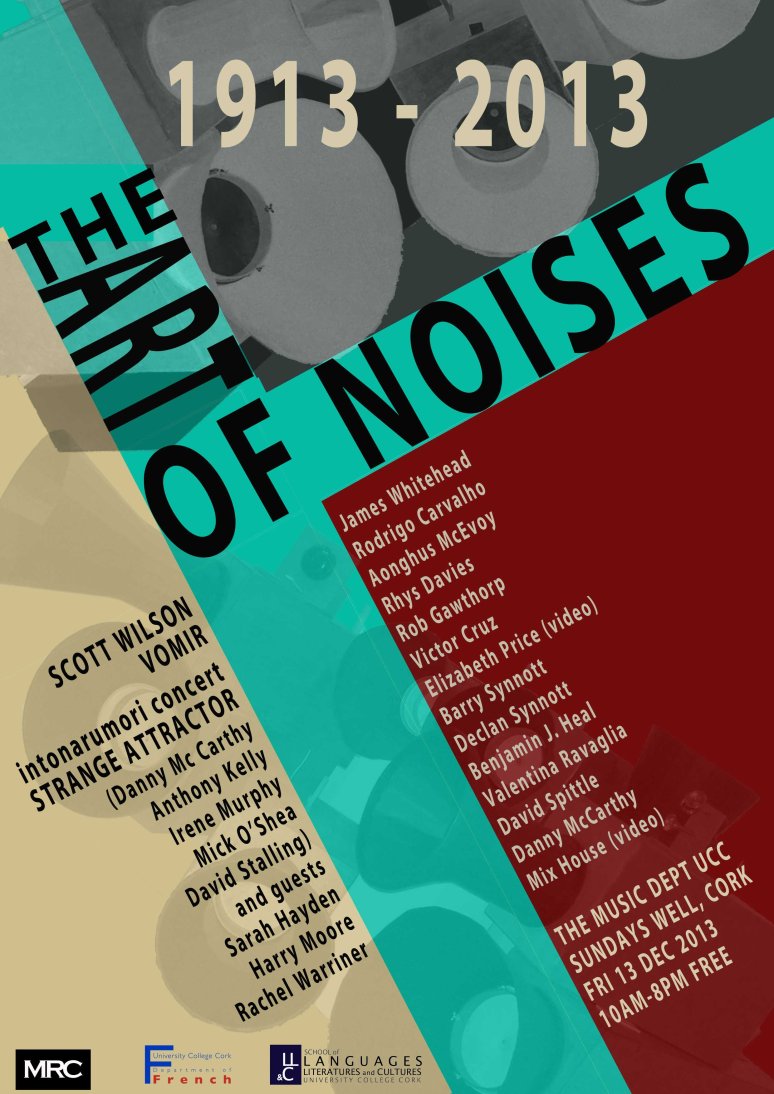
DATE: 13 December 2013
VENUE: University College Cork, School of Music, Sundays Well Road
LOCATION: ALOYS FLEISCHMANN ROOM
Time: 10.00am – 11.15am
- James Whitehead, Noise is Stupid – Flat Ontologies, Reality and Noise
- Rodrigo Carvalho, The Metaphor of Noise in early 20th Century Avant-Garde Music: Busoni, Russolo and Schaeffer
- Aonghus McEvoy, Russolo – Mapping Auditory Experience in Belfast City; noise and meaning in urban space
[short break]
Time: 11.30am -12.45pm
- Rhys Davies, Why Sound Art Became the Unloved Bastard Child of Music
- Rob Gawthorp, Not Seeing What is Heard | Not Hearing What is Seen
- Victor Cruz, Crisis Music: Futurism, Jazz and the Historiography of Aesthetic Avant-Gardes
Time: 2.15pm – 2.45pm
- Paul Hegarty, Elizabeth Price, The Woolworths Choir of 1979
LOCATION: Ó RIADA HALL
Time: 2.45pm – 3.15pm (Analogue Electronics)
- Barry Synnott, Modular Synthesiser Live Improvisation
- Declan Synnott, Amplified Static
Time: 3.15pm – 4.15pm
- Benjamin J. Heal, Weaponizing Noise: William S. Burroughs’ Sound & Music Experiments
- Valentina Ravaglia, ‘The Vibrations Between Two Objects in Relation to each Other Offer the Pleasure of Magical Thinking’: Aural and Visual Noise in the Work of Mike Kelley
[short break]
Time: 4.30pm – 5.30pm
- David Spittle, The Lyricism of Noise in John Ashberry’s Flow Chart
- Danny McCarthy, Luigi Russolo Met John Cage on the Corner of Castle Street
Time: 5.45pm – 6.45pm
- Scott Wilson (with Edia Connole), The Eroticism of Silence
Time: 7.00pm
- Strange Attractor and Guests present intonarumori concert
- Vomir
More Info At: http://modernismsresearchcentreucc.wordpress.com/2013/12/
(Source: http://modernismsresearchcentreucc.wordpress.com/2013/12/)
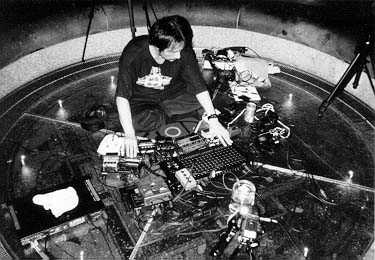
> AUBE INTERVIEW FROM QVADRIVIVM #4 (2001) (A Tribute)
In the Head the Aural Is Born

(Source: http://qvadrivivm.blogspot.sg/2011/03/aube-interview-from-qvadrivivm-4-2001.html)
 4iB Records | For intrinsic Beliefs