4iB Records | For intrinsic Beliefs
Record Label dealing in Industrial, Power Electronics, Harsh Noise, Experimental, Death Industrial, Drone, Ambient, Japanese Noise, Field Recording, Abstract, Musique Concrete and other related genres.

> NIGEL AYERS: VIRAL EMISSIONS by Justin Patrick (Brainwashed)

Nigel Ayers has long been an agent provocateur in the realm of experimental music. In the late 1970s he formed a group called The Pump with his brother Daniel Ayers and the late Caroline K. After a string of cassette releases a new project was formed by Nigel. Since 1981 Nocturnal Emissions has been releasing a steady stream of deconstructed music. The broad range of styles he has delved into can be bewildering. There are those made from abrasive noise, to an album made up of entirely remixed bagpipes, to another utilizing recordings made with vocal sounds from children under the age of 18 months, to another that samples cell phone conversations picked up on a police scanner, and a whole slew of titles which could be considered drone music before that kind of thing was as popular. He has also delved into electro and teeth-gnashing techno, and recently a dub album. And those are just the musical expressions of his curiosity. Nigel is a writer, poet, creator of viral art and digital ritual. He was kind enough to take the time and do an email interview with me to talk about his various explorations.
Justin Patrick: The phrases “Duty Experiment,” “Guerilla Ontology,” “Boycott Consensus Reality,” and “Neo-Tantric” turn up frequently in association with your artistic work. What do these tag lines mean to you and how do they relate to what you do as an artist?
Nigel: For quite a few years, although I had a degree in visual art, I tried to avoid calling myself an artist. That’s because I found the term to be very politically loaded, as the development of the idea of the artist had implications that were central to a class-based society. For a few years I preferred to call myself something like a “cultural worker.” I felt I always benefited from my fine art background as the British art schools were, at the time I went through them in the mid-’70s, very good at sharpening your critical perception, especially self-criticism which can for some be creatively crippling. They made you creative, very tolerant of uncertainty, and very flexible. I think that nowadays they retain many of these qualities, but since the “Brit Art” phenomenon of the ’90s, art has become more of a “career option” when you have aspirations of being a Damien Hirst, and a head full of corporate X-Factor bullshit.
Anyway, I think actually it was before the rise of Hirst, I thought it might be an idea to reclaim the craft of “the artist.” And anyway I don’t think what I do is anything else. And there are positive sides to the idea of being an artist, it’s a small piece of freedom in a repressive culture. So as an artist, I feel that I am working with the field of information. About how we see and experience our exterior and interior “realities.” I have a tendency to seeing art more as a hammer-like more than a mirror-like tool, that is in using art, you are changing reality ..and society.. just a little bit.

Using memorable bite-sized phrases, slogans and tag lines in my work is a form of poetry I’ve explored. As an artist you create the frame around your work and this includes the labels that might be stuck on the wall around it. Critical writing, interviews, and other published texts are opportunities for word play, in creating personas, they are part of the work and help create its social meaning. I use a variant form of “Guerrilla Ontology” which is “Guerrilla Sign Ontology.” Cryptic crossword lovers will notice this phrase contains the words “Sign- On,” which is what you have to do to get Unemployment Benefit in the UK. Developing my art in Thatcher’s Britain, Unemployment Benefit was very very useful. “Duty Experiment” is a phrase borrowed from a bundle of photocopied documents I salvaged from the skip/dumpster when I worked as a cleaner in the India High Commission. (I could say it was something I found when I worked in India, as India House, being the embassy, is legally part of India although it’s in London).
This was a piece of “outsider art” sent in by an apparently psychotic member of the public. I recycled parts of the text in early NE work “Tissue of Lies,” as well as in The Pump project. “Boycott Consensus Reality” is an appropriate, precise, and polite response to the colonization of our everyday dream worlds by totalitarian corporations and their pernicious advertising. “Neo-tantric,” that’s one I’ve sort of dropped a bit, because it got taken up by a well-known religious cult. What I was looking at was integrating rational humanism within animism, the idea is an ecological thing developed from surrealism, and nothing whatever to do with how Sting has sex.
JP: You are perhaps best known for your musical activities under the moniker of Nocturnal Emissions, yet you continue to remain active in other media. Your “War Criminal” images of Tony Blair and George W. Bush have spread around the globe. You have released a book of spam poetry, The Control You Gain, The Power You Use, and a book documenting your psychogeographic explorations of the Bodmin Moor in your home of Cornwall, along with a few other books. You work with video, put together installations, and have been making electronic gadgets. How do all of these different modes of operation relate to each other?
Nigel: I think they all address the idea of being a multi-dimensional person, and that multi-dimensional personality being shaped by social forces, as well as helping to shape those forces back, as a tool-maker. I like to get away from the bourgeois idea of being an author, and become more of a medium for exploring, focusing and sharing existing memes. Maybe I can put a new twist on them or distort and degrade and mutate information, and subject it to critical inspection but the pleasure is in bouncing that material back and forth into the world. It’s a kind of information-dance.
JP: Is there an area of focus you’d like to spend more time exploring?
Nigel: I prefer to be a non-specialist.
JP: You’ve made a number of books available through Print-On-Demand services. One is a roundup of the Network News, featuring many authors, which you distributed between 1990 and 1999. Another that you edited is A Dictionary of Space Cornish. This came out in conjunction with the Cornwall Community Space Program to document the language for space that they developed. How did you become involved in this project that took the Cornish language and adjusted it to make it more suitable for space travel?
Nigel: A Dictionary of Space Cornish came about through my involvement with the Association of Autonomous Astronauts, which was an international network of activists committed to resisting gravity, and evolved from group discussions.

JP: Much of your work has been inspired by the landscapes of your home in Cornwall. You’ve created a body of work that I see as being a reciprocal feedback loop with the environment. Now you are colonizing Google maps by embedding your videos and music into the application. Science fiction author Rudy Rucker has been using the street view on Google maps as a way to go to a place without actually visiting it, so he can then write about that location. Do you have any other creative uses for Google maps or similar programs planned? What can you envisage other artists using these interactive map spaces for in the future?
Nigel: That thing about feedback loops is interesting on my mind. I think our memories are shaped by media systems, it’s the way we share our inner landscape. I think it’s important to tap into these global systems, which somehow form our collective memory. It seems, from what I’ve read about mnemonics, that location-based systems are particularly memorable.
Also, apparently a larger percentage of people believe in astrology than any of the major world religions. I’m not sure that my art practice colonizes these mnemonic spaces, rather that it takes up a kind of viral residence in shared public space. My art practice has something to do with recapturing the imagination. I think the imagination is colonized by meanings attached to flags and logos. Mass murder isn’t mass murder if it’s wrapped in a flag–if we don’t take charge of symbols, then symbols and the emotions attached to them will take charge of us. By the way, if anyone is colonizing public space, it’s not me, it’s Google. Google extends private property into public space, each screen shot has this corporate image encoded within in. I’m trying to do something very personal and basic, reclaim my own personal space. But also I’m encoding in the videos a scrambling of memory–modern urban planners are latter-day druids, reshaping the landscape in the shape of their own gods and goddesses. I think these kind of viral art campaigns are a way of reclaiming space for the imagination, and to restore a bit of sanity and sense of community. I think there is a basic anger in my work, an anger at the human race and the natural world being plundered by corporate greed. You have to wonder what the concept of “freedom” means, is it the psychotic response of the supporters of huge armies in the world, protecting the interests of the super-rich against the super-poor. One thing I’ve been very interested in is the retelling of recent myths and using magical practice similar to that used by alchemists like Marcel Duchamp and Andy Warhol, turning worthless trash into valuable cash. Except that I’m not impressed by the way they were such suckers for class-based society, and the way they re-inforced the status quo.
I think that Google’s street view is a wonderful technology and one that is too good to be left in the hands of a capitalist corporation. I’d like to see the evolution of open source, Wiki-versions of street view. There is the Open Street Map project, I met a couple of the people who got that going and that’s where I first got the idea of using GPS in a magical ritual. I find Google Street view fascinating, I like the bits that don’t join together properly, the shifts in time between when different parts of a street have been scanned.
When I was walking the lines I plotted on the Bodmin Moor Zodiac, I used large scale (UK military Government) Ordnance Survey Maps as well as photos taken from airplanes and satellites from Microsoft’s mapping project. The Google views weren’t detailed enough for my use in 2006. There are many discrepancies between official maps and the publicly available aerial photos, which is odd because the OS maps were partly based on aerial photos, and there is a small airport actually within the zodiac. While I was walking the Bodmin Moor zodiac there were major road works underway in the southern section, where the Virgo image lies. I have photos of the surveying equipment used to mark out the road when they were building it, painted wooden artifacts not dissimilar to items used in ritual magic by the OTO. What I found later was that rather than breaking up the landscape giant overlay, the new road builders had in fact made new marks where marks weren’t so visible previously. I can’t say I’ve read much Rudy Rucker, but yes, Google Maps is good a way of viewing places for research purposes if you want to hack out a novel. I used Street View when I made My Own Stonehenge, to correct some the inaccuracies of the plastic model kit it was based on. But street view isn’t all that accurate either, I had to use some archeological plans that I found elsewhere. There is a time element in Google maps, and overlaying the Google views on other mapping systems, say Microsoft’ views, gets interesting. Also integrating this into a form of magical realism.
JP: I have heard from a reputable source that one of your favorite writers is the Irish novelist Flann O’Brien. What is it that attracts you to his work? Have his writings influenced your own work? If so, in what ways?
Nigel: I like Flann O’Brien a lot. (which reminds me, the guy I lent At Swim to didn’t like it and hasn’t returned it, I’ll have to buy myself another copy!). He was writing in Ireland in the 1930s. It’s the deep absurdity in the way he mashes up the tropes of various genres with shaggy dog stories and unreliable narrators. He deconstructs the novel in the way a postmodern writer is supposed to—you’ve got Joyce and Beckett in there—and Flann is a lot funnier. Yes Flann O’Brien has definitely influenced my work, especially books like the Bodmin Moor Zodiac, and the fictional sections of Network News.
JP: You recently told me that a local radio station contacted you about a motor accident on the highway near the Virgins Nipple in Cornwall. On your blog you wrote that “The Virgin’s Nipple is a ritual motor vehicle trackway designed to stimulate an erogenous zone within the Giant Effigy of Virgo in the Bodmin Moor Terrestrial Zodiac.” Did they ask you to comment on the event? Do you feel there is a corresponding connection between events in the area, your ritual walks and your other artistic engagements with the landscape?
Nigel: The reporter is coming round to see me tomorrow, I’ll let you know. [Link to audio file of Nigel speaking on the radio show can be found here]. I think our understanding of landscape is a bunch of (often media-fueled) ideas about place, private and public property and belonging-to-a-place, from which we get the construction of personal identity. Locality, ethnicity, nationality, family, tribe, gender, age, subculture, and species are all negotiable when you get into the zeroes and ones of informational-based systems. Reality is, in this sense, a social construction and informational based artworks are part of that construction. Human consciousness doesn’t stand aside and look at reality, it is part of reality. There is no such thing as art, apart from within a negotiated social construction. And one of the things I like to use art to do, is to make it not look like art a lot of the time, so that you are forced to think about it a bit more. Although it’s nice to imagine that my ritual walks have activated some sort of magical current in the landscape, I am perhaps too rationally-minded to be totally convinced. I’m more closely inclined to Dawkins’ theory of the spread of memes. That is, the information generated mutates as it gets into the public domain, attaching itself to various hosts. My artworks have now been in the public domain for an amount of time sufficient for them to start to interfere with the social construction of place, in that they are beginning to be used by public services like traffic services, in this example.
The Twelve Woods roundabout would otherwise be a particularly meaningless public space, the highways agencies have resisted attempts by the local community to give it visual meaning with Christmas trees. It was ripe for eroticizing with multiple levels of meaning, if only via virtual and digital media. The new cheeky name for the roundabout seems to have done the trick.
JP: On one of your websites you have a page devoted to “Desiring Machines” you have built. They are very beautiful pieces of psychotronic craftsmanship. Can you tell me about your intentions behind building them, their use in your installations, and what recordings, if any, they turn up on?
Nigel: They are healing machines for hands-on use. They are based on some of the principles of radionics, except where radionic devices tend to use pseudo-electronics, I have used real electronics. They are packed with sensors, and because my approach to electronic engineering is improvisatory and intuitive, they tend to be short-circuited, over-sensitive and chaotic to the extent that that they respond to to the extra sensory perception of their users. I haven’t as yet used them on any of my recordings.
JP: You often use the language of magick to describe what you’re doing and yet you are a skeptic of magick. How do you view such belief systems and how do you play with belief systems—your own and other peoples?
Nigel: Yes. This may have derived from my attempts to talk about art to art teachers. I remain even more profoundly skeptical of artspeak! Zappa said something like writing about music is like dancing about architecture. I guess that in using the snake oil terminologies of magick, I’m using a language which is partially understood by a lot of people who might partially understand the language of art, but respond better to subcultural references. Modernist art (including post-modern art) is a project of developing new languages, to describe new experiences, and is very much built on misunderstanding, and re-interpreting the past. Traditional societies don’t need traditional art being explained to them. And to paraphrase Cage, you don’t have to call it art if the term bothers you.
So, although I am hyper rational in my daily life, and really have to say I don’t share the superstitions that the industrial music world is riddled with (which I put down to its prime movers attending English private schools that were a bit like Hogwarts). What I’m doing in my practice is exploring dream worlds, which could be the positive side of voluntarily induced psychosis, while keeping both feet firmly in the clouds. Where what I’m working with is a magical reality, the one which the mass media and politicians mess with in their satanic way. Having said that, I think my hyper rationality is close to animism where everything is holy and close to paganism, because it’s to do with a reverence and integration with the natural world—though I do use soap and genetically modified ingredients. Philosophically, this may be close to existentialism but different from individualistic magic.
JP: “Nocturnal Emissions” is a provocative name for you music project. How did you decide on it?
Nigel: It just came to me one night 😉
JP: Have any of your works been inspired by dreams?
Nigel: Yes, quite a few of them. Mostly they are inspired by bees in my bonnet.
JP: What are your thoughts on Beuys and Duchamp?
Nigel: So when I mentioned using dreams, Freud claimed that dreams were to do with the subconscious urges that were unacceptable and otherwise inaccessible to the conscious mind and that these unfulfilled wishes were expressed symbolically in a personal language that was meaningless to anyone but a trained psychoanalyst. My own tendency is towards a more Cognitive explanation of dreams, which is less mysterious and suggest that dreams are the brain’s way of processing and filing data, imposing some sort of order on the chaos of cognitive stimuli experienced during the day, preparing it for storage in long-term memory systems. That is, dreams are very much to do with the dreamer’s current conscious needs and preoccupations. They are not considered to be mysterious or secret symbols from a hidden impulse-driven and inaccessible realm. Some therapists argue that when a waking person relates the content of a dream he or she will necessarily impose a structure onto the dream that will include the same cognitive distortions that he or she may use to interpret other aspects of experience. So this can be a way of understanding in greater depth the cognitive distortions a client experiences. So in the respect that I’m using my music and art as a “righter of wrongs,” I’m not dealing with mysterious realms, I’m using dreams as raw material to process the very real cognitive distortions of the real world.
On to Duchamp and Beuys—apart from their life work in creating a personal mythology and celebrity for themselves, one of the things they did was point out, in Duchamp’s case—that art was anything that art professionals said was art and in Beuys’ case that everyone is an artist. That is, artists don’t necessarily have to be professionals and that other social interactions can be seen as art. This poses the question of not whether something is art or not, but whether what the art produced is good or bad, in a social sense.
I got into a debate recently with a record distributor, who I know has progressive attitudes in his personal life, but who chooses to distribute records by various “mysterious” pro-fascist bands on the goth scene. The argument he gave me was “freedom of speech,” also he wasn’t convinced that the bands in question were pro-fascist even though what they produced looked and sounded like fascist propaganda and had members who had actively raised funds for at least one racist organization, etc etc. Now, as I understand it the argument for “freedom of speech” is that you allow others to speak, not that you actively encourage them and spread their poison. And that you oppose their arguments with better ones. (I understand that pro-democratic publishers in the 1930 and ’40s published Hitler’sMein Kampf in English, with a view to exposing it to ridicule and criticism). This doesn’t seem to be what is happening in this case. So, despite this distributor’s “liberal” attitudes, what this guy is doing is exploitative, and he is contributing to a particular social problem by circulating fascist propaganda. He is happy to cash in on the fools who buy this material and this argument makes sense in free market capitalism, where if you weren’t selling hi-tech weapons and instruments of torture to certain tin pot dictators, someone else would.
Incidentally, when I mentioned psychosis before, I was referring to psychosis as a metaphor, rather than extolling the “raw primitive urges of the psycho-killer,” which I think was, and continues to be, a problem with much of the Industrial scene. The author Colin Wilson–especially in his take on Freudian psychology and Nietzsche—is one of the worst culprits in creating this mythology of the “outsider” figure being somehow purer in his “extremism” than an ordinary person. Of course this kind of serial killer nonsense was taken up by P-Orridge and those silly power electronics and England’s Secret Reverse people, which produced various hyper-conformist cults of fan-boys in awe of their wonderful role models, who in turn showered them with overpriced, samey, shoddily produced, ill-thought out, crap. P-Orridge was lucky in finding a collaborator like “Sleazy” Christopherson who was skilled in creating cultish prog rock packaging, and a few decent collaborators, but Throbbing Gristle and PTV didn’t half release some crap. Hours and hours of tedious rubbish. I think there is the same problem with Merzbow, obviously as an artist (in the abstract expressionist tradition) he has to produce an amount of material to create a market, which will sustain him professionally. But the product is, at best, not very good, at worst, exploitative crap. It only makes sense if you see Merzbow as a celebrity and buy into the micro-celebrity culture that these guys depend upon.
JP: How do you feel about having been frequently lumped in (perhaps through associations from your early label Sterile Records and some of Nocturnal Emissions earliest releases) to the milieu surrounding what is sometimes called Industrial? I don’t think of your music as Industrial at all, but rather partaking of the multiple avenues available in the vast landscape that pertains to recorded electronic music.
Nigel: I don’t really like it, so thanks for not thinking that way!
JP: I’ve never felt you were someone who was trying to pass themselves off as a micro-celebrity, only as someone who is doing interesting and important work. So how do you personally sustain yourself in this late-capitalist, or as some would say too-late capitalist market?
Nigel: At the moment I have another job that allows me flexible time and doesn’t drain my brain too much. The work I’m producing, which I publish myself, is closer to my intentions.
JP: From your perspective, what strategies exist for those who wish to make a living from their music, art, writings etc. without compromising their values, or a political stance that is at odds with the free market?
Nigel: I’ve found that when you’re making a living from music, art, writings there’s always an element of compromise and you’re always operating with one eye on the market. I’ve found that not being dependent on my music, art etc for an income helps.
JP: Earlier when we were talking about magick, you mentioned that you are “even more profoundly skeptical about art speak.” What is it about the language employed by artists, art teachers, and critics that arouses your already healthy skepticism?
Nigel: To clarify, it’s necessary to use a certain amount of technical language to talk about the craft side of art, movement in art and art history. But I’ve found a lot of the “theory” attached to art is only used because it sounds “cool” and educated. When a lot of the time, to be fair, it’s people who have a high visual awareness who are incapable of using written language. But also within art education there is a tendency to impose an agenda of class-divisions within the appreciation of visual and other culture. That is middle class standards are operating as a sub-text..and deference to celebrity culture.The value of an arts education is in sharpening up critical thinking..
JP: So Nigel, are there any new releases, performances, from you people should be looking out for or any other activities people should be aware of?
Nigel: There’s the band camp releases & re-issue of The Quickening CD out now.
ciao
> OSTARA INTERVIEW; IMMORTALLY WOUNDED by Malahki Thorn (Heathen Harvest)
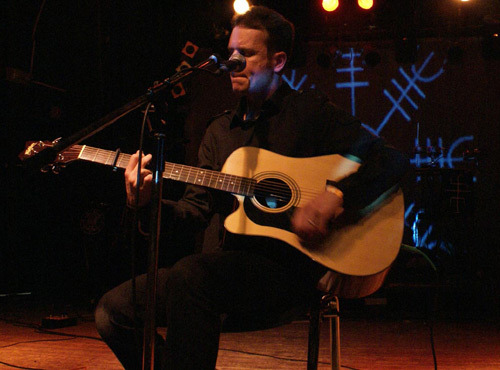
Richard Leviathan | Photo by Kai-Uve Altermann
Written by: Malahki Thorn
(Originally Published, Thursday, April 15 2004 @ 12:09 PM PDT)
Heathen Harvest: Please brief our audience on how Ostara started and who the founding members were.
Richard Leviathan: Ostara began in the Spring of 1999. It consisted then of myself (Richard Leviathan) and Timothy Jenn who left Ostara in 2001. He has been replaced by guitarist and composer, Stu Mason and we also work with drummer Tim Desmond and occasionally with Kartsy Hatakka from Finnish band Waltari who plays keyboards on some of the compositions.
HH: What were the founding members musical experiences before forming Ostara?
RL: Timothy Jenn and I founded in Strength Through Joy in 1991 after we met at university in Adelaide, Australia. I had absolutely no previous musical experience but Timothy was a bassist in a Goth group in Ireland. The two STJ albums, ‘The Force of Truth and Lies‘ and ‘Salute to Light‘ were produced by Douglas Pearce of Death in June between 1994-5. We subsequently moved to Europe and toured with DiJ and NON/Boyd Rice during 1996-7. We also recorded two collaborative albums with Douglas and Boyd, KAPO! and Scorpion Wind respectively.
HH: Can you explain the ideals and ideas that formed the band’s conceptual foundations?
RL: Ostara is the ancient name for Easter and I have always been interested in the esoteric dimensions of this association both from a pagan and mystical perspective. This includes an orientation towards a spiritual and metaphysical path that incorporates a number of traditions but within a modern or post-modern context. I am especially interested in the disjuncture between faith and atheism, meaning and nihilism, God and the Void, that seems to characterize the contemporary period.
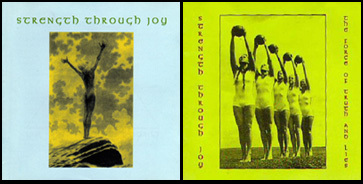 Salute to Light + The Force of Truth and Lies
HH: What was the connection between Ostara’s beginning and the ending of the previous musical project Strength Through Joy?
RL: Basically, Timothy Jenn no longer wanted to use the name Strength Through Joy as he was moving to Germany so we agreed to change it to Ostara (‘out of the frying pan and into the fire’ as someone once said!). But this complemented the musical development towards a more subtle and original sound and so the two events were well timed. Timothy then became increasingly distant from the song writing and performance and so we parted company after seven years of collaboration. Stu Mason and I are now in full control of the project.
HH: Ostara has consistently been described in the musical press as a neo-folk / pop music hybrid. Is the band comfortable with being described as pop music?
RL: Yes. I like some pop music but I still enjoy being part of the Neofolk scene as I have learnt a lot from the alternatives it offers in terms of imagery and ideas. To bring powerful lyrics to a melodic sound is something that has preoccupied me for a few years now and I am pleased to be able to pursue a hybrid style without losing the essence of what Ostara is primarily, having emerged from this very unique and specific genre.
HH: Has the band intentionally striven to create music that embraces pop sensibilities?
RL: Yes but only out of an organic evolution as opposed to a deliberate effort to create pop per se. It has become a part of the general framework of the song writing and performance. However, there is a diversity of styles within Ostara and the ‘pop‘ element is just one intrinsic aspect of this.
HH: Ostara’s founding members look to be in their 30′s. This would make Ostara part of the second generation of neo-folk / post-industrial artists. Can you tell us what music and bands have left an impression on Ostara or contributed to the members desire to work in the neo-folk post-industrial music scene?
RL: Oh, and there I was thinking that I still looked 25!! Yes, I have just turned the magic 33 and Stu will soon be 29. Obviously, Death in June and early Current 93 were a big influence although I would also add Boyd Rice, Laibach, The Doors, Leonard Cohen, Kate Bush, Love, Nick Cave, Depeche Mode, Swans and Nine Inch Nails among my favourites. Of the newer generation, I like Forseti, Foresta di Ferro, the revived Changes, some Blood Axis, Ain Soph and Nový Svět.
HH: The neo-folk scene is defined by song writing and musical compositions that tend to lean heavily towards traditional folk arrangements with only slight rock influences if any. Ostara has changed this landscape even further by now adding a new member to the band who plays electric guitar. Can you explain the evolution of Ostara and how the band came to include its new members?
RL: After Timothy left, I decided to alter the sound and find someone who could bring a new dimension to Ostara. Electric guitar and electronics seemed to be the logical choice and Stu Mason specialised in both of these things. He got in contact after I advertised for musicians on the Internet and I liked him the moment I met him. I was also listening to harsher music at that stage (NIN, Marilyn Manson, Ramstein) so this also influenced the change.
HH: Can you tell us about any new band members and their previous musical endeavours?
RL: Stu still works with an American electro-punk band called Skamper. Kartsy is the front man of the popular group Waltari and Tim Desmond also plays drums for Skamper and a number of minor groups in the UK.
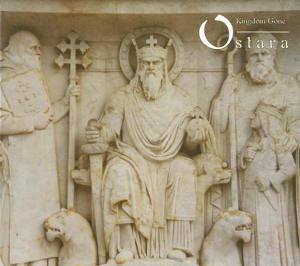 Kingdom Gone
HH: On the last two albums Secret Homeland and Kingdom Gone Ostara was comprised of Richard Leviathan and Timothy Jenn. Timothy is missing completely on the bands newest album Ultima Thule. What has become of Timothy? Has he left the band?
RL: I have no idea. He withdrew from music in 2002 and no one has heard anything since. Perhaps he decided it was not for him anymore.
HH: If Timothy has left the band, can you please explain the circumstances around his leaving or else explain his absence?
RL: I became increasingly focused on developing Ostara and Timothy started to lose momentum. There were personal reasons behind this but, in the end, if a group can’t function effectively it will perish, so something or someone has to give way. I wanted Ostara to continue and prosper whereas Timothy was putting a brake on our progress. The rest, as they say, is history.
HH: The music of Ostara has always excelled when it comes to lyricism. Can you tell us how you go about song writing? Who participates when the music and songs are being composed?
RL: I write all the lyrics and usually create a melody around them or compose words to a tune from guitar, piano or a capella. Sometimes the melody comes out of a walk in the woods or even in the supermarket, little whispers to the soul you could say! I enjoy writing lyrics and see this as the main ingredient in the formation of any song.
HH: The lyrics of Ostara have always focused on esoteric themes. These themes remain distinctly open to interpretation and are noticeably devoid of deity references. Can you explain the motivation behind writing songs and lyrics that address esoteric and spiritual matters?
RL: It is just innate and intuitive. I always look for ways to transcend the personal, even if I am writing about something close to my heart. Of course, I do read a lot of related books on history, mythology and the occult but I try not to make too many direct references to these areas. I prefer to engage with the mystery directly, which often means obscurely!
HH: The music of Ostara seems intertwined with the history of Europe. How has the Europe’s past and future influenced the music of Ostara?
RL: I was drawn to Occidental history from an early age and, despite a non-religious childhood, I became very interested in religious and spiritual themes, including paganism and Christianity. The crisis of the modern world and the catastrophic events of both the past and present are unavoidable facts that are hard to ignore and so they recur in a lot of the Ostara lyrics. Europe is an ancient land with a rich but troubled past and this ambivalence is intrinsic to our identity and experience of the new Europe.
HH: Many songs also express references to exile and redemption. Can you explore these recurring themes?
RL: Exile of course is a major preoccupation of the ancient and modern Jews and, being Jewish, I am influenced by that tradition. I do, however, see a positive side to this theme and I like the image of the Wanderer which has echoes of both Odin and Ahasuerus. It is also so central to the image of the outsider as explored and experienced in the modern age. Almost every modern writer and artist has sensed this as a primordial characteristic of our existence, a sense of personal or even metaphysical exile that can lead to a heightened awareness of reality but always at a price. Redemption and Loss are just two sides of the same coin.
HH: The album titles of Ostara’s albums also shed light on the bands creative vision. With album titles such as Secret Homeland, Kingdom Gone and Ultima Thule there seems to be a recurring theme of searching for a lost paradise or a remembrance of a way of life that has been sacrificed. Can you explain for us this exploration of homeland, conquest, fallen kingdoms?
RL: Yes, the idea of paradise lost or of a forgotten kingdom is a perennial theme and one which becomes especially strong in an age of skepticism and materialism. There is something nostalgic and even romantic in this sentiment but the main thing for me is the feeling that the kingdom is gone forever and will never return. It is something that we can strive towards but the mission is quixotic and the most we can achieve is some kind of elevation of the self beyond the purely mundane and everyday world. All the kingdoms of history are subject to decay, even the kingdom of heaven as represented by religions.
But, there may still be a hidden residue, the original Platonic Idea of the transcendent realm through which the human comes into contact with something extra-human or divine. This is always somewhere between the spaces, among the ruins of the ideals that once drove (and still drive) some people towards self-sacrifice and even martyrdom.
HH: References to the Nordic runes and Northern lands of Europe are found throughout Ostara’s music. Does this reflect the personal spiritual identification of the band? What is the bands connection to the Northern lands and myths?
RL: I do have a special affinity for the North and its associations in mythology and history. This is not an exclusive orientation as I am just as interested in the other sacred regions of the world. But the Northern polarity is something that once obsessed the whole of the Occident. The Greeks believed that they originated from Hyperborea and the Romans pursued the land of Ultima Thule in their expeditions. The Norse myths are a very powerful element of our cultural history and filtered into Christianity to frame the medieval world-view. In the 20th Century, the destructive and horrific aspects of this obsession with the Northern homeland remain a dark but addictive influence on our reckoning with the modern age. We currently live in the UK which still retains some of its Nordic heritage, although Siegfried is now incarnated as David Beckham!
HH: The bands name “Ostara” is as far as I understand a pagan name for Easter. Easter of course is a Christian ritual that was used to smother out the older Pagan traditions that it came to replace in Western culture. Other Pagan or traditional references appear in Ostara’s music as well. Is the music intended to carry a spiritual message?
RL: Yes, but nothing in a New Age sense. I prefer to embrace old myths in the same way that a modern poet might seek an identity with the tangled thread of the past. There are many layers of tradition buried one over the other and the task of acquiring knowledge is to follow the deep grain of the ages and sometimes also to go against it. I am not self-consciously spiritual. It is something that, on the contrary, emerges from an immanent or intuitive urge.
HH: Ostara’s songs often ask the listener open ended questions. In my own listening experience, this philosophical and spiritual probing has inspired a lot of personal thinking. Is Ostara aiming to ignite the fires of imagination and thought in their listeners or is this consequential?
RL: This tends to happen also in the process of writing. I may intend to write one thing and something different comes out forcing me to change direction and alter the meaning of the text. To think is automatically to question and when put into an artistic medium, it can provoke something both in my own mind and potentially in the mind of the listener. So, the monologue becomes a dialogue, a correspondence between the self and the other.
HH: Being a non-deity identified Pagan I have personally found excessive references to deities to be cumbersome and proselytizing in some music in the neo-folk genre. Ostara has cultured a vary unique form of neo-folk that embraces nature based Paganism and Northern European spiritual references while refraining from coming across as proselytizing. What is the secret to your successful approach to integrating music, spirituality, philosophy and history?
RL: Again, I try to be true to my instincts and accept the fact that, while I am drawn to many traditions, I cannot truly belong to any of them in a formal sense. I need the freedom to move in and out of different modes of thought and meaning, like reading between the lines or finding meaning in the irruption of the chaotic and unexpected nature of life rather than in fixed concepts of truth. I like the idea of the hidden god or the gods of dark places. This is something you find in the esoteric traditions and in the mystical side of religions. Meister Eckhart‘s sermons, Zen Buddhism and the Rosicrucians come to mind here.
HH: In all three of Ostara’s albums a good number of love songs filled with romance and passion can be found. These songs are often filled with longing, love, and all of its trials. Does Ostara draw from personal feelings and experiences when writing and creating these romantic songs?
RL: Yes. Love is perhaps the most powerful and intimate of experiences because it breaks down the isolation of the self in the presence of another. The distances that separate individuals suddenly collapse into a reeling abyss of powerful emotions. Love liberates and ensnares at the same time and thus brings both intense joy and deep suffering. Most love songs are about the joy of being in love but many of the greatest are concerned with its tribulations.
HH: Both Kingdom Gone and Ultima Thule end with songs that have references to the fall of Western culture. Both songs also refer to the September 11 bombings of the World Trade Center Towers. This particular bombing event sent shock waves around the world. Ostara has chosen to sing about the event. Can you explain your feelings concerning the bombings?
RL: It was both spectacular and horrific. Not even Hollywood could have dreamt up such a spectacle and the fact that it was a media event was highly significant. The plotters knew that it would be captured on film and that the image would be repeated again and again forever. It happened right from the very beginning. CNN even played a pop song about New York combined with the footage of the planes crashing into the towers as a soundtrack to one of their ‘breaks‘ in transmission!
9/11 was both a symbolic and an actual incident – it hit the psyche as hard as it smashed those buildings. I certainly did not sympathise with the terrorists but I couldn’t help being impressed and shocked at the same time. The West had been struck right at the heart by an extreme faction of an ancient faith that was enacting its own nihilistic self-dissolution. This was indeed an event that represented more than just the struggle between East and West. It was an apocalyptic rupture at the core of globalisation, reminding us that the world is still a very violent, unstable and divided place.
HH: Can explain the thoughts that led to you covering these events in your art and music?
RL: I just remember being compelled about 24 hours after the event to write something. The increase in the number of suicide bombings in the Middle East was already on my mind but this massive attack simply could not be ignored. I was also aware of certain positive reactions to 9/11 (both from the East and the West) that disturbed me and I needed to get to the bottom of what it meant in the wider scheme of things.
HH: In many ways, the conflict currently existing between the East and West can be seen as modernized Christian civilization and Muslim traditional non-industrialized society clashing. Your music references these politics. Can you elaborate on your feelings about this conflict?
RL: I think that the conflict demonstrates the limits of Western power and values in the world at large and shows the absurdity of the concept of the ‘end of history’ and the triumph of liberal democracy. Liberalism is the privilege of the affluent nations and serves their interests better than it does the rest of the world. It also conceals the conservative and reactionary elements that have prevailed in America and other Western countries since the Kennedy bbbbbb. Furthermore, there is a historical and cultural conflict that does not permit the full integration of other nations and peoples into the Western fold, no matter how close the relationships on a political and economic level.
HH: Can you tell us what brought you to music as a means of personal creation and expression?
RL: I fell into it by accident at the relatively late age of 21. I was more used to writing verse and prose but this translated well into lyrics and so my musical career was born and evolved slowly but surely after that.
HH: You previously worked with Douglas Pearce of Death In June on a musical project called Kapo. It is well known that Douglas P. and his musical project Death In June have faced harsh accusations and censorship based on political extremist’s interpretation of his music. Has Ostara ever experienced similar threats of censorship or accusations of Nazism etc.?
RL: Yes. We were banned twice in Europe, once in Nurnberg and also in the Netherlands (of all places!). The assumption of guilt is usually made from the beginning by people who have no interest or intention of understanding the music or its content. They react upon rumours and provocations alone. But anyone who knows me would realise that I have no political agenda and that making music for me has nothing to do with ideologies of any kind, even if the lyrics and imager veers towards a vaguely political direction in some instances.
HH: Fairly recently Kirlian Camera has been fighting off similar accusations and has even had venues shut down to them. All of this attack and censorship is based on a minority’s interpretation of valid artistic expression. These extremists seem to be attacking almost everyone in the neo-folk / post-industrial music scene. What are your thoughts on these censors and their tactics?
RL: It is pointless and counterproductive. There are extremists living in Europe who want to blow up trains and kill as many innocent people as possible. The threat posed by a music group with no apparent political motivations pales into insignificance. Even if a band is political, no one has the right to stop them from playing. Criticism is always a better way of dealing with controversy than censorship.
HH: Richard Leviathan recently showed up in a new band called Foresta Di Ferro. Can you tell us about the band and Richard’s involvement with the band?
RL: This is the project of Italian industrial artist Marco Deplano who has ventured into Neofolk territory with FDF. I collaborated on several songs for the album ‘Bury Me Standing‘ which was released by Hau Ruck! this year. It is a powerful work with a mixture of styles but held together by the general theme of fanaticism as suggested by the title. We will be performing together at the Hau Ruck! festival in Vienna this May.
HH: Is the new album Ultima Thule being supported by a tour in Europe or North America?
RL: Yes. We just did three dates in Europe (Germany, Italy, Spain) and there are more to come. A few US dates are planned for June.
HH: As Ostara fans are feasting on the new offering Ultima Thule, is there any new music in the works by Ostara or its members that we should be anticipating?
RL: We are working on a new album which will be called ‘Immaculate Destruction‘. I won’t say anything more at this stage!
HH: Do you have any comments?
RL: Thanks for a very interesting and thorough interview. Hope it makes very un-pleasant reading!
(Source: http://heathenharvest.org/2014/03/08/ostara-interview-immortally-wounded/)
THE NEW BLOCKADERS & CREATION THROUGH DESTRUCTION – Negative Mass 12″ (Ltd & No’d 250 Copies) Out Now!
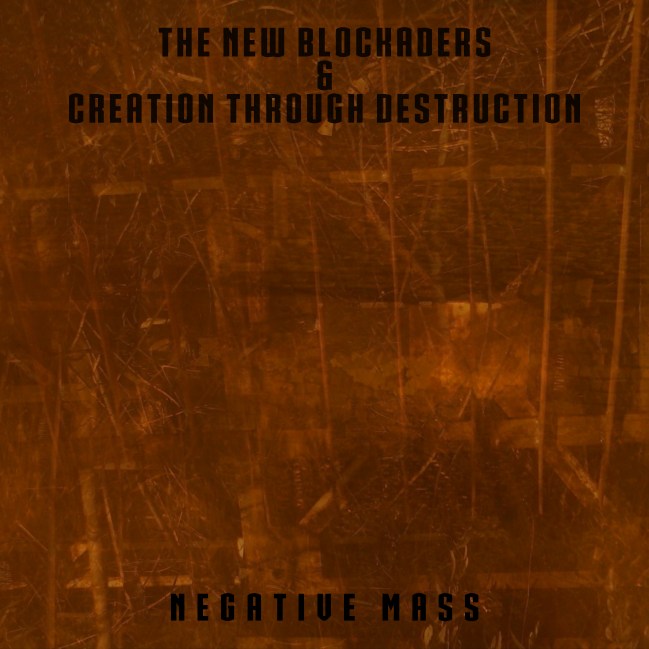
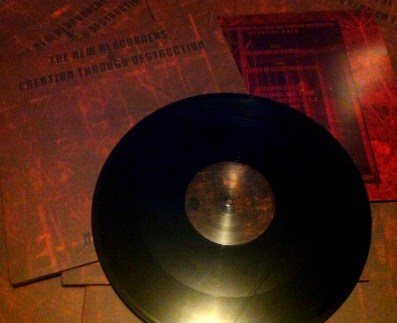
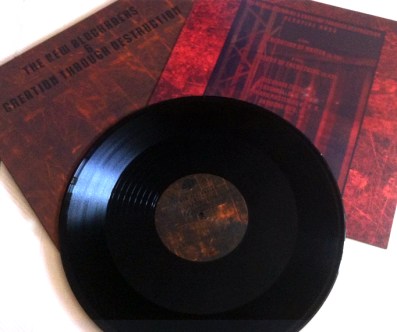
THE NEW BLOCKADERS & CREATION THROUGH DESTRUCTION – Negative Mass 12″:
– Thick Cardboard Sleeve
– Direct Metal Mastering (Extra Loud Cut)
– 12″ x 12″ Insert
– Limited Edition of 250 Copies
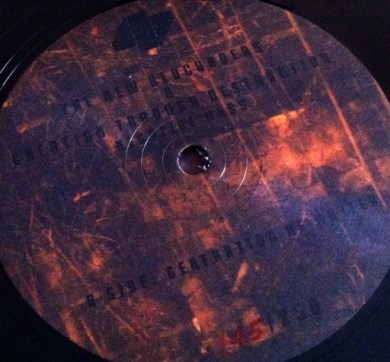
– Individually Numbered (Cover Sticker, Main Sleeve & Vinyl)
TRACK LISTING:
Side A
1) Generation of Matter
Side B
1) Theory of Everything (Sample)
PRICE (Including Shipping from Singapore): USD33.99 / €25 / £20
To Purchase, Please Click Here:

THE NEW BLOCKADERS & CREATION THROUGH DESTRUCTION – Negative Mass
Here is a 2-track 12″ release that presents 2 prolific (and masked) noise making entities partnering together with the intent of inducing a breakdown of the senses through their own distinctive identity of generating relentless noise assault. This collaboration of UK noise terrorists and harsh noise pioneers THE NEW BLOCKADERS with Serbian’s harsh/static noise/wall act CREATION THROUGH DESTRUCTION (DEAD BODY COLLECTION) sees the merger of two noise genres with unique creative sound methodologies being amplified and redefined to an even greater level of sonic brutality.
The 2 tracks: Generation of Matter and Theory of Everything epitomize THE NEW BLOCKADERS philosophy of sonic nihilism through anti-art and anti-music as well as the dark and sadistic psyche of CREATION THROUGH DESTRUCTION’s Dr Alex. This is a full on display of explosive sonic violence, anguished background screams drowned further by a wall of weaving noise. This incessant ear battering of tonal destruction sustained through the complicated textured layers of brutal grating pandemonium is what nightmares are made of, and made even more disturbing by the masked anonymity of madmen.
Best Blasted Loud!
=======================================================
Please direct all enquiries to:
4iB Records
PO Box 206
Singapore 914007
email: gerald@4ibrecords.com
www.4ibrecords.com
> THE VOMIT ARSONIST Interview by TheIcarusDescent (Chain D.L.K.)

I recently took some time to speak with Andy Grant, who may be better known as The Vomit Arsonist; one of the best power electronics/death industrial/noise artists in New England, if not in the country. His dark, desperate sounds just bleed raw emotion, making the listener all but sick upon listen, but in that way that makes you want for more and more.
Chain D.L.K.: First and foremost, I’ve got to ask: is there a story or meaning behind the name The Vomit Arsonist?
The Vomit Arsonist: I have a feeling this will eternally be the first question in every interview I do, haha.. But no, there’s no real meaning. It was a stupid name I came up with 10 or so years ago, when the project was supposed to be nothing more than the most unlistenable garbage I could come up with. I did just that, and people liked it, which confused me, but I ran with it. I started taking the project more seriously, and now it’s what it is today.
Chain D.L.K.: Your new full length ‘Go Without’ has finally been released. I understand there were some issues and delays involving the Chinese government? Can you elaborate a bit on that?
The Vomit Arsonist: I’m not 100% sure on the details, but apparently there was some kind of copyright crackdown on all the CD and vinyl pressing plants in the Hong Kong area. I think they were making sure nothing was being manufactured illegally, counterfeit releases and stuff like that. I’m pretty sure that forced all the plants to stop pressing until they were done. I really don’t know much more than that.
Chain D.L.K.: ‘Go Without’ is quite an impressive listen. It’s going in a slightly different direction than many of your past releases, with a bit more of the Death Industrial influence. What took you this route this time around?
The Vomit Arsonist: Thanks, I’m glad you like it. Simply put, the reason it sounds more death industrial than previous releases is because I was listening to that stuff a lot while I was writing it. Brighter Death Now, IRM, Atrax Morgue, MZ.412, Institut, stuff like that. I’ve always been a huge fan of Cold Meat Industry and acts that have that really heavy, dreadful sound, and I wanted to do something like it. To me, the tracks on “Go Without” are pretty repetitive and monotonous, but that was intentional. I wanted to pay homage to my various influences, as well as match the music with the lyrical content of the album.

Chain D.L.K.: How different was the writing/thought process on ‘Go Without.’
The Vomit Arsonist: It was a long process. I mean, “Wretch” was a really long process too, but on that disc, the music just kinda flowed out of me. I really had to pull at myself to get some good sounds down for this one. I spent months re-working the album; each time I said it was finished, I’d listen to it and say “ahhh this needs to change, this part sucks, I don’t like the way this sounds…” So I’d go back and make all these small changes that no one but me would probably ever notice. As far as the lyrical content and thought process is concerned, that also took a lot of time. It took a lot out of me personally and emotionally, but that’s what I’m about. “Wretch” was an album about a specific incidents that spanned a few years time– It was a story. “Go Without,” however, is more like me looking in a mirror and letting myself know the honest truth. I was thinking and reading a lot about suicide, nihilism, and what the point to life itself actually is. I tried my best to reflect these topics in the lyrics. As it is with all of my material, I did this album for me and me alone. It’s a way to try and exorcise certain demons. The fact that other people want to hear it is just an added bonus.
Chain D.L.K.: While your releases are always a little different each time, they always retain that bleak, depressed, desperate sense of chaos and destruction that is a solid backbone of TVA. How do you keep things so different yet so unmistakably TVA every time around? Is it a conscious effort, or is that just how your thought/writing process tends to go?
The Vomit Arsonist: It’s good to know that what I’m trying to put across is actually coming through! Honestly, I don’t think it’s really a conscious effort, I just do what I do. I like to think that after all the years I’ve been doing this, I’ve finally found “my sound,” so to speak. And a lot of it is just who I am. The “bleak, depressed, desperate” sound is what comes most naturally to me when writing music, so I suppose that’s why my releases, while different, have that blanket sound that makes it mine. I’ve got a lot of shit in my head, and this is the best way for me to get it all out. It’s the only way, really.
Chain D.L.K.: How have things changed from ‘Loose Girls Make the Best Wives’ to ‘Go Without?’ [And this is a very open-ended question, interpret as you wish. Equipment… Production… Writing… Thoughts… Mental Status… Gear… whatever you’d like to mention.]
The Vomit Arsonist: Man, it’s been a total transformation from “Loose Girls…” up to now. I mean, pretty much everything has changed. Almost none of my equipment is the same; I started out with a radio, a microphone, and a couple of pedals. All the beat oriented stuff was programmed on my PC, which is actually something I still do, but I attack it from a totally different angle now. The early material had almost no structure… I mean, yeah, a lot of it was straight harsh noise, and unstructured tracks aren’t out of the ordinary in that genre, but now I sit down and try to write actual songs. Even the noise parts I do now are more structured. My mental status has never been very good, really, so I guess that’s about the only thing that’s stayed the same. I’ve always had a compulsive urge to do this, and I honestly don’t see that changing any time soon.
Chain D.L.K.: I know you use both analogue and digital processes, i.e. live improvisation/feedback/in the moment noise vs. more thought out and constructed work. Which (if either) do you prefer to work in, and how do the thought processes differ for these two styles of creation?
The Vomit Arsonist: Whatever happens happens. That’s usually how I work. Sometimes I’ll sit down and start programming stuff, start writing synth lines, shit like that. Other times I just plug-in everything and go for it. It doesn’t really matter to me, as long as I get whatever sound I need.
Chain D.L.K.: How do your gear setups differ from live performances to in studio? Also do they evolve a lot from performance to performance or do you tend to have a ‘go-to’ setup that you use as a staple and work from there? If you don’t mind, talk about some of your favorite pieces of equipment and/or software.
The Vomit Arsonist: The live setup is really simple: a sampler, a few pedals, a mic, some junk metal, and, more recently, a Walkman with some kind of backing track. That’s usually it. In studio, it’s a whole different beast. I’m obviously not going to bring every piece of gear I own to a show, but I have access to everything I need in the studio.
Chain D.L.K.: Speaking of live performance, there are a plethora of noise acts out there that while are very listenable, tend to repeat themselves a lot, especially live. Sometimes its hard to tell artist from artist, let alone performance to performance. How do you keep your live shows fresh and different each time?
The Vomit Arsonist: Over the past couple years, I’ve tried to have a new set for every performance. There are exceptions to this of course; if I’m doing a bunch of shows in a row on tour or something, I’m not gonna have something new every day. But since I usually only perform live once every couple of months, it’s easier. I can take my time writing new stuff. Sometimes I’ll write material intended for a release and I’ll perform it live, sometimes it’s the other way around. That’s happened a lot, actually; performing something for the first time in a live setting, recording it, and taking bits and pieces (or the entire thing, if it isn’t total shit) and throwing it on an album.

Chain D.L.K.: Do you ever perform pieces from your catalogue or do you strictly do improvised sets? If you DO play existing songs, how much and how often do they vary from the originals?
The Vomit Arsonist: When I first started playing live, about 8 years ago, my sets were almost completely improvised. Once I started writing material for “Wretch” around 2008, my live show became much more structured. I realized that I was writing actual songs, they had messages and meaning and importance, and I wanted that to come through. I didn’t want to phone it in live. That said, what you hear on an album versus what you hear live won’t be the same. They’re the same song, same lyrics, same general idea, but I always leave room for improvisation in a live setting.
Chain D.L.K.: Do live improvised works ever inspire you to work them into those more constructed studio works?
The Vomit Arsonist: Absolutely. I try and record every show I play, even if it’s just so I can critique my own work. A lot of songs I’ve done live have appeared on releases unaltered, other times I’ll take clips from a performance and build something new around it.
Chain D.L.K.: You are a part of an almost endless number of other projects both musically and otherwise. How do you manage to contribute/perform with all of these other projects and still manage to release your own material and run a label?
The Vomit Arsonist: I have no idea. I’m balancing several different bands, most of which are different styles of music, and all of which I have a different role in… it’s tough sometimes. There’s been a few times where I’ve double booked myself, where I’ve gotta be at this venue by this time to play with this band, then I have to leave immediately so I can make it to this other venue across town to play at this time… But I like it. I like being busy to the point of stress. I’d be bored if I didn’t try and run myself ragged. The label, Danvers State Recordings, isn’t all that hard to manage. I do almost everything for the label in house, short of printing. It’s actually a good way to relax, I just throw on a movie and dub a bunch of tapes. I like it.
Chain D.L.K.: What is (are) your favorite project(s) outside of TVA to work with/be a part of?
The Vomit Arsonist: That’s a good question. I really don’t know. BEREFT is fun for me to do, because although it’s in the same vein as my solo work, I get to focus more on the music and production, rather than being front and center. It’s good to have another person’s input, too. WHITE LOAD is always a good time; we really just get drunk and play fast, sloppy hardcore while assaulting the audience. I play some bluesy rock type stuff with a band called THE WOLFBANE BLUES, I play bass in that one. I love playing with that band because the other two guys are super relaxed about everything, they don’t want to tour or anything stressful like that. We’ll record a disc in the drummers garage and hand them out in bars and stuff. We don’t even really play live all that often, we just get together every week or so and play whatever we feel like. It’s a good time.
Chain D.L.K.: Talk a bit about your influences. What artists/bands are responsible for you giving birth to TVA?
The Vomit Arsonist: I was 16 when I attended my first noise show, and I was blown away by it. I didn’t know this stuff existed. I got into PINE TREE STATE MIND CONTROL, IMMACULATE:GROTESQUE and some other local acts… then I saw EMIL BEAULIEAU play live. He’s the fucking master. Through EMIL I obviously discovered RRRecords, and I’ve been into noise ever since. PRURIENT is one of my biggest influences, although that may not be readily apparent when listening to my material. I saw him play live in Providence, RI after he’d moved to Brooklyn, I think it was his first show in the area since he’d left. It was right around the time “Pleasure Ground” came out, which I hadn’t heard at the time. But man, he played two songs off that record and I was fucking floored. That’s when I got into the really synth-heavy PE stuff. And although I was familiar with the style before, that was the time when I got into all the European PE and Cold Meat industrial stuff. That’s what I like the best, and it’s what I want to create. To create a list of my actual influences would take a lifetime…
Chain D.L.K.: What can we expect from The Vomit Arsonist in the next 6 months to a year?
The Vomit Arsonist: I’m working on a few releases for various labels; Hate Mail is putting out a split 7″ between me and THE BLACK SCORPIO UNDERGROUND. I’m doing split 7″ with REGOSPHERE, which doesn’t have a label yet, I don’t think. Currently, I’m collaborating with THEOLOGIAN for a pro CD-R release called “Nature is Satan’s Church” (available March 20th 2013), based on the ideas and themes in Lars Von Trier’s film “Antichrist” … Oppressive Resistance is putting that one out, and it should be done by the end of the year, I think. I’m really excited about that one. Beyond that, I hope to tour the US again sometime soon, but that’s always tough with work and real life getting in the way. By this time next year, I may be touring abroad… But I won’t say where or with whom, because it’s just an idea right now, and no real details have been discussed. But it’d be fucking incredible if it works out.
Chain D.L.K.: Anything you’d like to say? Shoutouts? Random thoughts? Etc?
The Vomit Arsonist: Thanks for taking the time to send these questions, I appreciate it. Obligatory self promotion: Contact me for booking/releases/info/death threats at thevomitarsonist at gmail.com, or go to http://thevomitarsonist.wordpress.com. TVA is on Facebook too…. http://www.facebook.com/thevomitarsonist. Check out Danvers State Recordings at danversstaterecordings.blogspot.com … Oh, and listen to any and every industrial/pe/noise act you can possibly find from the midwest. CUSTODIAN, GNAWED, DETERGE, HATE BASEMENT, MACHISMO, GRAIN BELT, THE THIN WHITE PUKE, BLESSED SACRIFIST, NYODENE D, WINCE — all of those acts are fucking intense. Easily some of the best noise and PE currently operating in America come from the no-coast scene. Do yourself a favor and check them out.
Check out the artist online at: thevomitarsonist.wordpress.com
(Source: http://www.chaindlk.com/interviews/the-vomit-arsonist/)
> QUACKADOODLEDOO; A DAVID E. WILLIAMS INTERVIEW by Nathan Leonard

Several Years back there was a small business in my neighborhood called Germ Books and Gallery. As the name suggests, it was a bookshop and art gallery. It was located just a few blocks from my house, and I, being a bookshop enthusiast, soon became a regular customer. The store was small and deliberately discriminating in the materials it sold. I would describe the store as a purveyor of unusual, contrarian, and sometimes dangerous ideas. The largest section was devoted to science (or speculative) fiction. There was, of course, a non-SF fiction section, usually containing the works of notable experimental and/or transgressive authors. And there were also sections dedicated to “fringe topics” such as UFOs, conspiracy theories, the occult, as well as various viewpoints criticizing contemporary politics and civilization from all manner of perspectives. These were the types of books that you might not find in your average bookshop, and there was a whole store filled with them! I was enchanted by the place.
But Germ was not merely a store. It also served as a community forum that hosted musical events, conferences, readings, art shows, and it served as a place to meet different types of people with a tremendous range of ideologies. As I became a regular presence there I got to know the owner, David E. Williams, who had taken up the mantle after Germ’s founder, Jennifer Bates, died in 2007. I’m sorry to say that I never knew Bates personally. From what I’ve heard about her, she sounds like a true visionary.
I was somewhat surprised to learn that David E. Williams is a musical artist of international renown who has been practicing his art for decades. He was gracious enough to give me some of his CDs and I have been a fan ever since. He is a man with a piano and a unique vocal style. His lyrics are dark, humorous, passionate, and enlightening all at once.
Sadly, in 2011, Germ closed its doors due to a number of reasons. The whole story of Germ is one that is worth telling, but it is not my story to tell. However, I can verify that its brief existence had a profound impact on a number of people, myself included. I continue to maintain regular contact with David E. Williams, and that is who I want to talk about today. Recently Mr. Williams released his first full length album in four years entitled Trust No Scaffold Built of this Bone. When I heard that he was planning to release something new, I mentioned that I’d like to review it, or better yet, interview him. He seemed receptive to the idea.
After the album came out I spent several months listening to it, and we finally got around to conducting the interview over a series of emails. What follows is our dialogue.
___________________________
HH: Given that some of our readers may be unfamiliar with your work, how would you describe what you do in your own words? I mean, do you classify yourself under a particular genre or scene or tradition of music?
DEW. A lot of the genres with which I’m associated did not even exist when I first started writing and recording my own songs. Even goth wasn’t a term that was bandied about in the late 80′s. People would say “postpunk.” The first review of my first EP in 1987 compared me to Syd Barrett and Warren Zevon, which are almost unimaginable comparisons today.
I think of myself in the troubadour model, basically, singing my songs and playing my instrument. I think of myself much more as a songwriter than as a musician, although it’s fun to act like a musician on other people’s projects.
An early reviewer called me “Barry Manilow’s evil twin.” That’s obviously someone trying to be funny, but it’s more accurate than a comparison to Death in June or something like that. Maybe I’m closer to aBilly Joel than Barry Manilow. Cue the sound of a million pages of your blog clicking off now!
HH: I can see arguments for either side of the Barry-Billy question… So you have released a new CD, Trust No Scaffold Built of this Bone, which came out last May. Are you taking any new approaches in terms of style or songwriting?
DEW: The new CD is a further walk down a theme in the form of a question. Can David E. Williams write and sing a good David E. Williams song that is not about leukemia or stealing medicine from an epileptic? Can I, in fact, find the essential truth in almost any subject, like William Carlos Williams with his wheelbarrows and plums. Peanuts, candy, a dog and a bird. Those are all really good things. “Quackadoodledoo” is a funny onomotopoeia for us humans, but it’s really the language of life. For many humans, in fact, it is the very sound of the food we eat. And it’s important to remember that food consists mainly of the same elements that appear in bodily waste. That’s so simple and so obvious, but so ignored. And why?

Every Missing Duck is a Duck Missed
After my grieving survivor album, Every Missing Duck is a Duck Missed, I wasn’t quite sure what there was left to write about. A customer at Germ told me that puns were the language of alchemy and then I thought a little bit about puns that are two, three, four and five times removed from their original source — puns on puns on puns on puns, with the first couple of puns missing. It may sound stupid, but, you know, there are still some literature professors out there who are probably trying to defend Burroughs and his cutup nonsense.
As for the music on this record, it is probably worth noting that most of these songs were written on piano, but a very conscious effort was made to not have them recorded as “piano songs with a dude singing.” There is some of that, but in most instances, they are reconfigured into synth pop, polka, the rest of it.
HH: That’s interesting, in particular the idea of puns on puns on puns. Some of your lyrics have the feeling that some kind of inside joke is involved. When I think of your recent work there seems to be a more personal quality, as opposed to your earlier CDs in which a lot of the songs tell fictional stories (assuming that stealing medicine from an epileptic is fictional). Compare, for instance the difference between Hope Springs a Turtle and Every Missing Duck is a Duck Missed. ”Trust No Scaffold” also seems very personal. As such, I think your songwriting tends to be more contemplative and less cynical. Would you agree with this?
DEW. Well, a story song is only less personal in the manner that a short story might seem intrinsically less personal than a poem. Some people enjoy the naughty story part of my catalog to the point of using them as pornography. On the other hand, it is probably difficulty to find a song anywhere that is as naked and confessional as “Here Comes the Cold Narrator.” I think I can say that objectively; I’m not bragging, because perhaps naked confessionalism is not the be all/ end all that doctrinaire naked confessionalists seem to think it is.

Hope Springs a Turtle
HH: Being sort of a full-time naked confessionalist myself I can understand the temptation to elevate that particular form of expression. Maybe it was an underlying motivation to do so in my last question. What about domesticity? On ”Trust No Scaffold” there is a song about picnics, there’s “Closet” which is sort of a Williams Carlos Williams-esque pastiche of scenes in a house, and there’s the line from “Peanuts, Candy, a Dog and a Bird” that goes, “Tables ain’t no places for a couch-fighting man” (one of my favorites), all of which point to domestic life, in my opinion. Is this a new theme?
DEW. Look, I’m as dug into naked confessionalism as the next guy, obviously — Plath, Joy Division, me, on and on and on. But there is also the great T.S. Eliot quote about poetry being an escape from emotion rather than an expression of emotion. And confessionalism done poorly comes dangerously close to “identity” art — the worst of the worst!
As for domesticity, those images were not consciously implanted, but hey, you certainly found them. Perhaps it’s further worth noticing domesticity depicted as terrorist and jailer, with for instance, “Turn Off All the Very Hot Things.”
Finally, I like that image of the “couch-fighting man,” I always see it in my head, some Don Quixote with a sword fighting a couch that ever eludes him. That’s the sort of thing that’s funny to me.
HH: Huh. I had a very different interpretation of “couch-fighting man.” I was imagining The Couch as an arena in which the fight occurs. Yours is funnier. I’m glad you brought up “Turn Off All the Very Hot Things.” After first listening to the new CD it stood out to me the most. It’s the last song on the album and makes for a powerful conclusion as the music cuts out but President Nixon continues speaking and concludes his point about never giving up. At the beginning of the song, your lyrics are about fearing technology. Do you see Nixon and the song’s narrator as holding rival opinions?
DEW: I also like “Turn Off All the Very Hot Things.” Almost to the point where I dare not dissect the gossamer that binds the heat fear part with the Nixon part. As they said on Seinfeld, one doesn’t dissect gossamer! Civilians and outsiders could probably draw some comparisons between the singer’s neuroses and those that civilians and outsiders usually attribute to Nixon. That is absolutely not a connection that I was trying to create. Whatever you think of his politics, Nixon’s speech here is fabulous, with a transcendent humanity unthinkable in the cardboard cutouts that have come after him.
HH: Changing gears here, you have two prominent guest vocalists Lloyd James from Naevus and Andrew King, a former member of Sol Invictus who released an incredible solo album last year. How did you come to work with them, and what was it like?
DEW: I’ve known both of them since Lloyd invited me to play at a small club with Naevus and Andrew King in London in 2002. We’ve done all kinds of things together over the years– they were both on the DEW tribute album, I’ve played on two or three Naevus songs (live and on CD); Andrew even had a live a cappella performance and art show at Germ in 2005, when it was on Girard Avenue. We made it part of the Fringe Festival that year.
HH: I hadn’t found my way to Germ yet in 2005. Andrew King is really a fantastic singer. I’d love to see him live. “Trust No Scaffold“ was released by Old Europa Cafe, an Italian record label that has put out a couple of other CDs by you. I understand you have a following in Europe. Do you have a sense of how your European fan base compares with its American counterpart?
DEW: The fan base in Europe is small, but not as small as in the US, where it is smaller. Subtract Philadelphia and we’re talking even smaller.
HH: We are the few, the proud, and the privileged. Speaking of privileged, I’d like to thank you so much, David, for agreeing to this interview.
Trust No Scaffold Built of this Bone is available for purchase from Mr. Williams’ web site, along with a number of other David E. Williams releases.
Interview Conducted by Nathan Leonard
(Source: http://heathenharvest.org/2014/04/01/quackadoodledoo-a-david-e-williams-interview/)
> STEPHEN THROWER, LITTLE ANNIE & DANNY HYDE on LOVE’S SECRET DOMAIN by Jon Whitney
Unfortunately the core duo of Coil can no longer reply to us but we are happy to feature three people who were present at the time. Attempts were made to contact other people involved: guests and collaborators, but responses were and are still waiting to be received. If more responses come in, this article will be appended.
 Stephen Thrower: Coil member
JW: What was the first direction Coil were heading in following Horse Rotorvator and can you remember how things evolved.
ST: Recording sessions continued almost unbroken after Horse Rotorvator, without an immediate sense of where they were going. Just “the next album”. The title first floated, I think, was The Sound of Music, after which The Dark Age of Love was front-runner for a while. The songs were still quite similar in construction to Horse Rotorvator and the more evolved parts of Scatology, so if Dark Age of Love had actually materialized it would have sounded a lot more like the first two albums.
JW: Can you tell me some of the external influences that had either some major or minor impacts on the composition of the material?
ST: It’s often said that two things push music forward – new technology and new drugs. Completely true in Coil’s case! By the time we were into the LSD sessions, the club scene was intensifying; ‘E’ and acid-house were more and more prevalent in the gay scene. The background thump was moving from House to acid and then techno. There was some overlap between the sounds being used in this new music and the bleepy synth/bludgeoning rhythm side of TG, so I think Geff and especially Sleazy were intrigued by the way wider pop culture was beginning to sound indebted to TG’s sound.
JW: Can you explain your roles in the process? What kinds of materials (sound or compositionally) did you bring into the mix?
ST: I could play a little on a lot of different instruments. I was okay on drums, okay on bass or guitar as far as the noisier stuff was concerned, I could do good things on brass or woodwind, and I generally waded in with whatever synths were lying around. I knew nothing about programming or sampling back then, that was entirely Sleazy’s domain, and please god don’t point a vocal mike at me! I had the ear, and the arrogance, to make suggestions based on what I thought a song was currently lacking. Geff and Sleazy generated the majority of the ideas but I was always able to push for sounds I thought we should add.
Compositionally, there were two ways of getting involved. One was to be present at the demo stage when early song structures were being put together (which happened with me on the previous albums), but in the case of LSD most of the backing tracks were made by Sleazy in advance. The other way was to make suggestions about how to ‘guide the ship’ once it was moving. That was more my involvement on LSD. What is this thing? How can we mutate it? How can we give it new shapes and contours? Does it need a drunk Mexican prostitute rapping on it?
JW: The album took years to assemble and arrange so there must be some reasons how and why?
ST: There were many long sessions, many nights, most of which were supported with whatever chemicals were at hand. We were locked into a reckless combination of work and play that sometimes brought out marvels and other times just wasted the money being spent. During “Dark River” we spent literally as much time rolling around on the floor under the desk as we did hovering over the controls. We had to mix it in real time because the desk automation was faulty, so that one was a bloody nightmare – it probably took about forty passes, each time requiring all four of us (me, Sleazy, Geff and Danny Hyde) tweaking and panning and fading things in and out; after each effort me and Geff would collapse to the studio carpet and go and live with the fluff babies for a while.
JW: Can you recall parts of the album you’re pleased with and parts you would do over again?
ST: I pretty much like it all, with the exception of “Things Happen,” which sounds a bit half-baked, and “The Snow,” which sounds bland to me and always did. Knowing what I know now, I would love to get my teeth into “Further Back and Faster” and have a stab at a new version – even though it’s one of the highlights I still think it could go ‘further’!
JW: Was the LP version the canonical version? I ask this because I received an early promo of it on cassette back in 1990 from WaxTrax! and by the time the CD came out in July it seemed like lots of elements were “added” (additional mixes of Teenage Lightning, “tags” on the end of Windowpane and The Snow).
ST: Both are ‘canonical’ really. The LP version was planned and timed and laid out ahead of the CD version, but the longer running time of the CD meant we could add more playful elements, with reprises, false fades etc. One’s the ‘Standard’ edition and one’s the ‘Deluxe’, I guess.
JW: Can you take a peek at the song list and provide any insight on things that may have never been covered?
ST:“Disco Hospital”
Disco Hospital I adored, I thought it set just the right tone. It’s absurd and shonky and bizarre, as it’s been tripping for an hour already! It’s all Sleazy’s work as far as I can recall. The chopped-up tape stuff is him, and he did that obscenely chirpy keyboard line as well.
“Teenage Lightning 1”/”Teenage Lightning 2”
A huge buzz to work on, a really pleasurable part of the album. Being an early Roxy Music obsessive, I always wanted us to get the VCS3 out of the cupboard if possible: Jhon and I did two takes of guitar through the VCS3 synthesizer; on one take I played guitar and he twiddled the synth, and on the other take vice-versa. I think the basis for the track came out of discussions we had about the limitations of what people were starting to call ‘dance music’, and how we wanted to involve Latin rhythms, not just a boom-boom-boom-boom four-four beat.
“Things Happen”
The guests are good, Annie Anxiety and Charles Hayward were both vital to it. Annie came through Geff and Sleazy, I’m not sure how they first met but they knew each other already. She asked for a bottle of Tequila, and that’s how she worked her way into the role she plays on the piece. All gone by lunch-time! I suggested we approach Charles. I think Geff and Sleazy were a bit wary of him because he was regarded as a bit of a ‘lefty’ but I pushed for him because I thought This Heat were so incredible. Geff loved some This Heat too, especially things like “24-Track Loop,” and we would both listen to the Health & Efficiency 12” at maximum volume round at Beverly Road. Sleazy wasn’t so sure. Then Charles came in, marched into the drum booth, set up, and started pounding and racing around the kit, at which point Sleazy was beaming. He started sampling him on the fly, which is where the drum loops for ‘Scope’ (from the Shock Records 7”) came from.
“The Snow”
I was a bit of a curmudgeon about it. A session guy from the studio next door came through while we were mixing it and said, being very friendly, wow this is cool, would you like a little keyboard soloing on it? Geff and Sleazy were on ‘E’, I think he may have been smoking. So they said yes and he did this very accomplished sort of jazz-fusion keyboard solo that fitted perfectly. Nothing against the guy, but I wasn’t in that space really, that sort of ‘hey, we’re all on drugs guys, this sounds mellow, how about if I jam with you?’ vibe. I thought the session players next door ought to have been closing their doors to blot us out! I was gunning for speed a lot more than ‘E’ and of course it’s a very different head space. I think his is the best bit, these days.
“Where Even the Darkness is Something to See”
One of Sleazy’s sly surprises… he just pulled this alternate take out of the air, using what was then brand new time-stretching software to create that ‘wading through heavy atoms’ feel at the end.
“Windowpane”
My windows are too smeary…
“Further Back and Faster”
This was both a huge pleasure and a huge pain to mix. Lots of arguing and ‘debate’. The whole ‘Love/Hate’ thing was analyzed to the point of absurdity. Some of what we were arguing about really advanced the thing, the rest was just stupid drug rapping that wasted time and money. There were a few Spinal Tap moments, probably! Musically, we were getting inside the mix and shaping it from within, rather than standing back and listening more objectively. We looked upon it as probably the cornerstone of the album, we knew it was working really well as a piece that would immerse and entrance people who may be listening on acid, and we wanted to sculpt and weave the shapes as deliriously as possible. It was just a bit mad trying to do it against the clock in an expensive studio whilst everyone present was off their tits…
“Chaostrophy”
Sleazy started acting strangely towards the end of the LSD sessions. He concentrated on an amazingly luscious orchestral arrangement that Billy McGee had provided, based on a melody of Sleazy’s. He took over the mixing desk and exuded some kind of weird energy that pushed me and Geff out of the room. We were left to peer in through the control room window as he turned this stately, complex string piece into what became “Chaostrophy.” He mixed it all night at ear-splitting volume. It makes my head clench even now to remember the atmosphere in that room. I think it’s Sleazy’s most personal expression on the album.
JW: Can you comment more on music trends: you mentioned the shift from house to techno but Coil was never “accepted” into those circles – at least I don’t remember ever hearing Coil in any dance club other than an “industrial/goth” kinda night. Coil music wasn’t pure enough for the trendster purists. Do you think that this possible impurity of genre / purity of thought contributes to making the music less dated?
ST: There were DJs on the London gay scene who liked Coil and played “Anal Staircase,” “Windowpane,” and “The Snow” at big venues like Heaven, Limelight, various of the heavier SM clubs, none of which were ‘industrial’ except for maybe playing the odd Nitzer Ebb record. But yes, as you say, the longevity of Coil music is very much allied to its impurities, the fact that although there’s a lot of dabbling with this or that, Jhon and Sleazy never allowed themselves to become entirely swallowed up by surrounding musical trends. I did worry about that happening myself, back in the early 1990s, but as it turned out Coil’s flirtation with dance floor was short-lived.
 Little Annie: guest vocalist on “Things Happen” and sampled for “The Snow.”
I met Sleazy while he was still in Throbbing Gristle. I was meeting Gen for coffee or something one afternoon and he took me to where Sleazy worked. I don’t remember why but we stopped in, but I have such a vivid picture of the room and the weather and being struck instantly what a gentleman he was. We met again a few years later along with John Balance via David Tibet. They were both instant ‘likes’ and then easy to love.
For the recording of “Things Happen,” Coil just asked me to come to the studio (again I have a strong memory of the walk over, the weather, a gorgeous summer dusk (as it was London that was rare!) I hadn’t heard the track and there was no concept, that is till after they played the track to me. Then it was true concept. They gave me a background scenario, being a hooker in somewhere like El Salvador as all hell was about to break loose. Then we just did it. I ran with that image. It was one take. Very fast, very easy going.
My times with them were all just really warm & easy. We didn’t see each other that often but when we did it was lovely. John and I became sorta kindred spirits as the years went on. We’d check in with one another and shared some of the same ghosts, nothing that we ever spoke of. He was very caring and protective, they both were. It was like having two very sweet brothers that lived overseas.
I loved what they did with “Things Happen,” though like all my work, I listen once and then need to give a number of years in order to be able to hear it objectively. I guess I was surprised how wide reaching Love’s Secret Domain was. England being and island doesn’t give you an accurate picture of things (the same with Manhattan) but mainly what I think about is two men who I love dearly, and I like to think of them as being together in heaven now, that having been said, wish they were here, but will see them again.
 Danny Hyde: producer, engineer, and programmer
I first worked with Coil in 1985, probably Hellraiser time, I then worked with them on Horse Rotovator, by the time LSD started being created I was programming with them.
The first recording session was in Paradise studio Chiswick London, a fully computerized studio, Coil only needed to bring themselves. The first thing I noticed early on was how away from the mainstream was their attitude. The extent of guest musicians was more grand than anything before (or after) and songs seemed to materialize from no other explanation than the studio.
With Coil until release there was never a running order, things morphed and morphed until being forced by time restraints. They would change things right up to release including names, many times. We had to mix within a week we took too many uppers and stayed awake too many hours to function in any sane way. We all agreed afterwards we would never work that way again and we never did.
Reflections on particular songs:
“Disco Hospital”
Recorded at Point Studio, Victoria. Pete throws lots of ¼” tape into the air and randomly edits it together. We then created a loop from it feeding MPC 60 through Boss twah pedal.
“Teenage Lightning”
Starts with our first ever experiment with time stretching an acc gtr right out into space
Based on a rhythm that Pete was playing from his newly acquired Casio bip/bop machine.
“Things Happen”
One of the many jams beats we had from Point Studio sessions; Annie just came in and rambled to the track which we then arranged.
‘The Snow’
Geff decided he wanted to try some type of acid tune, so we knocked it up in minutes using Akai MPC 60 and a King Singers sample.
The jazz solo was a musician I had worked with before who happened to be in the studio next door, he popped into our drug addled spaced out session and had some indulgence, he returned 40 minutes later and insisted on jamming the solo, of course we allowed it to happen.
“Dark River”
Pete’s experiment from Point Studio with his newly acquired digital performer software
“Where Even the Darkness is Something to See”
Cyrung jamming to tape and we ran basic beat against it
“Further Back and Faster”
I will remember to the day I die the convoluted hilarious back and forth dialogue between Geff and Steve both fuelled by drugs and lack of sleep discussing over and over whether it should be the left or right hand that “loved hate” and the political implications to that meaning, me and Peter almost collapsed in pain from laughing.
> CARSTEN NICOLAI & BLIXA BARGELD INTERVIEW by Rob Young

R: How did your aabb collaboration start?
BB: Carsten contacted me one day, we met a couple of times without playing anything together, just purely on a social level – I also know his brother. At some point we started facing the idea of collaborating on some music together. On my side I was not familiar with alva noto or Raster-Noton were doing. I think for a long time I lost my interest in other music, and I had to catch up with things. I know more now about my contemporary musicians.
R: In the 90s I met plenty of German electronic musicians who seemed fairly distanced from Enstürzende Neubauten…
C: For me it wasn’t true. Enstürzende Neubauten were really influential. Maybe it’s an East thing? Because Neubauten were, in the East, really big for us. Not in terms of the music, but it was more a way of living, this anarchic idea…
BB: Of course it’s also a generational thing. I think people come from that field; they come from various different directions. Maybe there are a couple of common denominators… I don’t think any serious musician would say Kraftwerk wasn’t an influence…
C- No – for me Enstürzende Neubauten was even more important than Kraftwerk.
BB: Depeche Mode…?
C: And then I found out, talking with Blixa, they used the same sampler. But I never connected those kinds of bands.
BB: We were in the same studio and had the same producer.
C: But for me Depeche was pop music and EN …
R: In this collaboration, is it a process of exploring common ground or pushing into terra incognita?
BB: I’m not much interested in doing something I already know. I need to have a challenge, and to explore something in a field where I’m not sure of the outcome. For me it’s a process of finding ways I can enrich this, and especially work with voice and lyrics in this context. Obviously I cannot just take my EN way of writing and singing and just put it there on a different project. That’s not my interest. So it is research, and it is finding common ground. But I guess its also finding terra incognita – something that we had not explored before. It would be too simple if Carsten did his normal bleeps and I did my normal screams over the top of it.
R: Tell me more about the track “Ret Marut Handshake”…
BB: You know who Ret Marut is? I think I etched the word Ret Marut in my table at my Gymnasium at school. I just had a fascination with that name, as well as the story – it has a mantra like quality… He was here in [London]. Not under the name Ret Marut – but as Torsten Torwalds – and then he made it on a half wrecked ship to America, and wrote a novel about that. And the funny thing is the meeting with John Huston, and John Huston making Treasure of the Sierra Madre and this guy coming out of the jungle and claiming that he is B Traven’s agent – when obviously he was B Traven…
R: Do you identify with the enigmatic character of B Traven?
BB: It’s a mantra-like quality, the story behind it, the association. I think for this project I do Google-supported writing. There’s another track, “Mimicry”, and I think about that, I Google every thing I can find, start putting the associations together, and out of that the language level of the track should form itself.
R: When you’re working together, is it a process of ‘just doing it’?
BB: It was Cosey that said that [at a talk the previous night]. That wouldn’t really be my words in describing it – Carsten has a very unique and personal methodology in doing these things – mainly everything is done by editing. There are no sources. There are no samplers – it’s created purely electronically, and most of it is done with editing, and there’s a very strong aspect of psychoacoustic phenomena in it. And my methodology is I’m trying to narrow down and pin to this particular project, to come to somewhere… but it’s not just doing it, it’s method, strategy. The method may be different.
R: On that track, it sounds freer than Carsten’s usual solo stuff – electronics off the grid.
C: I think this is what the whole collaboration is all about. This track came quite late. When we started we tested a lot of things. We had a little show at a disco, four days in a studio.
B: We went through all these numbered ideas, from AB01 to AB46 or something. He played me all different Alva Blixa sketches, and I listed and figured out what they were and gave them nicknames and then we narrowed it down to a couple here and a couple there. It became evident that the playing live, the show, the arch-problem of electronica – the playing live – it’s the arch problem from high electronic compositions from the 50s onto now, and it is also in the popular genre, the arch problem is the playing live. And it became evident that if it’s worth going anywhere, the live playing factor is going to become the key element. So the shows are constructed like trees – there is the possibility of going either this way or that way at any moment. So that you are actually constructing the whole thing – not that you build in errors or the possibility of errors, they are there anyway, but they are gonna have a treelike structure. That means I have particular things where Carsten gives me something I have never heard ever before, and so I will be forced to develop something… And he is giving me treatments on the voice, while outside Boris Wilstoff the engineer is doing treatments and different things, so the turnout will be different every evening, and there will always be new pieces created spontaneously following a set of ideas, which we can build on, refine…
[page break]
C: In the recording studio, what we are doing is playing live and recording it. This is very new to me, for instance, as an electronic musician is really like a studio musician, sitting there, touching this track, move this here and loops this here. But we are not doing this – we say let’s play a song, maybe we take this version or another, but we’re always recording one thing in one place. I would normally have 50 tracks in the end, but we sometimes only have 2 or 3.
BB: There is an example of what we did – we did a cover version of Harry Nilsson’s “One”. Carsten knows even less about music than I do, so I had to not just give him the chords, but I had to tell him which notes are in these chords. He looked them up on the internet to find out which frequencies these notes are. And then he built each chord from the sine notes up. So then a simple sine notes, shifts as forming the chords, and then they are purely edited… Purely sine notes, and the original has this one note – ding-ding-ding, which you can wonderfully do with a beat. So we have a very recognisable version of Nilsson’s “one”, absolutely musical, and I’m, singing it exactly, but it’s purely made from sine notes.
I have another cover version which we haven’t recorded – Hendrix’s “Will I Live Tomorrow”. It has this feedback note which always fascinated me in the original, because sometimes Hendrix did such strange and unpopular things very often. I think this could be very nicely translated into electronica.
C: Not electronica, electronic.
BB: Electronica – is that lounge music?
C: It sounds like a sweets or something…
BB: I always feel funny when people call it Industrial – what is that, Nine Inch Nails? The terminology is not a nice thing.
R: Another way I was thinking about your work converging was with your Rede [Speech] performances…
BB: That certainly finds some of its way into that too. This is certainly an element that is a common point. In another interview Carsten explained that he was always trying to break out of the reference system because art is always self-referential to other art, and…
C: A lot of things referring to natural science rather than to art history.
BB: From day one, when I started recording music to now, I do that very often – 30 per cent of pieces I have written for Enstürzende Neubauten, are references to natural sciences, astronomy, biology and physics. And as you know, when I do Rede, I do build scenes based around pseudo-scientific experiments. I say Google-supported writing – it’s the same approach – a bit to do more with research. I would love to make a record where every piece is like an essay. But it doesn’t follow the classical way of just writing an essay, but you actually make a musical essay. That means you research about everything it is, you make a statement, and at the end there are four minutes of music that go in all sorts of directions, but it is about something that cannot be said in any other way. But the difference is, you have to do research. You don’t normally have to do research to write a song.
C: One thing that was important for me with Enstürzende Neubauten was the texts. I really can understand the lyrics, and I like poetry, I read poems… So, when you talk the lyrics without the music, they stand on their own. I was always fascinated by the pure lyrics.
BB: Thank you, but I know this is not very understandable to the non-German speaker.
R: A lot of your art and music have the quality of an essay – the elegant expression of a mathematical truth…
C: This makes the collaboration interesting to me – I’ve never really been about narrative. And Blixa is very narrative, so it’s a total opposite way. There are things I can‘t do at all. I would never imagine including voice in one of my tracks – it’s so far away from me [laughs]. But Blixa is perfect, my first choice.
BB: It first became clear to me that this was going to work out, because it had the qualities of both electronic music and what is good about rock music – there was definitely a live and physical dimension of the whole thing, and it had the elegance and cleanliness of electronics. The duo voice and electronics is almost an extended form since the 1980s.
C: It’s quite classical, the keyboard and the singer. Only the drummer is missing. Like a mini-band. We like to travel with the laptops. Now you can even travel without anything.
BB: Yeah, I want to be an iPhone artist now.
[talks about displaying the screen during live performance, dispelling secrecy]
C: The iPad artist!
R: Are you excited by the music scene in Beijing?…
BB: It’s amazing that Beijing is a youth place. 15 million [people]or something, and still you have a scene there, in a sense which is as big as the underground scene in West Berlin was. Which was totally appealing to me when we first moved there. I felt I could be in West Berlin, except that they were all Chinese. Walking down somewhere to a supermarket to buy some booze to sell behind the bar, and you have these musicians without any chance to become pop stars – not this attitude, and you don’t sell records in China anyway. You make a record with the state record company, they press 400,000 and they’re sold the next day. After that, that’s it – it replicates itself. So you get a one-off payment. For a while we were thinking about starting a record company in China…
C: I played in a club in Beijing named after a Neubauten track [laughs], Yu Gung.
Totally packed…
BB: Beijing is the new Berlin.
If you go for the glitzy magazines they always talk about Shanghai. But Beijing – that’s the difference like Munich and Berlin.
[page break]
R: Is there any critique of society going on??
BB: It’s not up to me to say anything about that.
C: As I talked to them, I really felt like back to the East. Can we do this? And I smiled during the interview, but…
BB: There is an underground and they let you have an underground.
R: You were associated with the culture of Berlin…
BB: I was born and raised in W Berlin, and I live now in a much more normal city nowadays. I don’t want the Wall back – but it’s definitely a different city.
Have you ever taken a private plane? The weirdest thing is, on these private planes, they have Playboy and Penthouse as the magazines. And they put an extra cover on the outside.
I went in an aeroplane once and it was really disturbing – there was a guy reading Walter Benjamin, but while he was reading he was always trying to touch the tip of his nose with his tongue. I have a whole folder on my computer that just tells air stories. I could write a whole novel…
R: We should mention the voiceover you did recently on adverts for the German DIY retailer Hornbach.
BB: I got the Golden Lion at the Advertising FM festival. Reading the exact text of a German DIY store chain, while you sit at the Mediterranean sea on a table, and this expressionless poetry about drilling machines and cement. I loved doing it, and was proud when I got the glove. And then all these Technical DJs came and wanted to make a record of that stuff. It was awful.
C: I’m sure colleague Unruh is doing all his shopping there…
BB: Colleague Unruh is still doing his shopping at night… But nowadays I’ve got three pieces hanging at Annecy, they did the art and the Building Site… And they wanted to rent a coupe of the instruments because they wanted to put them into an exhibition of ‘the artist and the machine’. Once you do a spectacular thing you always have to live up to the spectacularity of that.
R [turning to Carsten] Maybe we should talk about your stuff. Where you are now, have you moved on from your solo exhibition at Frankfurt’s Schirn Kunsthalle back in 2005?
C: That was really important for me, like a retrospective. There is a certain continuity in this, of course, and pieces that are… it’s difficult to say. But I did a lot of installations, and recently I am thinking very sculptural at the moment. I’m not so afraid of stepping into more traditional forms. Before I tried not to even mention the word, so I’m not afraid of this classical classification.
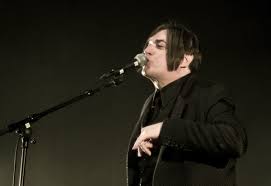
R: People often miss the Romanticism in your work, part of a longer Germanic tradition, typified by someone like Goethe, in which Romanticism and science were closely linked.
C: I totally related to the Romantic movement Most of the time the problem is the name itself. But actually it’s a total construction. It’s not so much about Romance, it’s very scientific, it’s really interesting.
BB: Did you read that new monograph about Romantik? It’s one of the continuums in my life…
C: It’s really important when you’re from Germany, because it’s a source. Even if you don’t know you have a relationship, you have a relationship. Like Caspar David Friedrich, it’s a totally construction.
BB; He went round with friends doing drawings of this tree, etc, and then he went home and constructed this thing.
C: These landscapes don’t exist – they are virtual reality you could say.
R: In Britain the landscape is generally more associated with a sense of nostalgia for pre-Industrial paradise, conservation, and so on.
C: Not for us [Germans] – it’s scientific. Maybe for the Italians, Renaissance is the big moment when things converged…
So… natural sciences are a very big source. For the Germans the more younger art situation is more Romantic. Look at Runge, making the shadows coming out of plants on black paper. It’s not only wonderful; it’s a very contemporary way of doing art. And the other end there’s this more scientific ideal of research, morphology… Plants, shape… And it’s true as well, many people say my installations are very clean and cold, but I don’t feel that – actually I think they have a very lyric aspect too, in a way a Romantic aspect.
I’m really interested and not afraid of beauty, for instance. Beauty for a long time, especially for German art, when you look at expressionism when people try to break any rule of beauty, and continues until the 80s, I would say, and people like Kippenberger, being the opposite. But I’m a little bit… I’m not afraid of it. OK, I can create something, and I can touch the term ‘beauty’, but only because I have this differential system, because beauty in mathematics or physics, is really very beautiful defined, it’s basically a beautiful formula, and it expressed something complex in a really simple way. And if it’s more and more simple, then it’s beautiful. And I it looks really simple – only a few elements – then they say, wow, that’s beauty. So I like to work with these topics.
I was a gardener before I started landscape architecture. This was actually strange for me, because I’m a city boy. So working with landscape was forcing myself into something where I had no relation in the beginning. I was, as a boy, interested in this, but not really sticking out.
R: In the past you have cited an academic research article from 1996, “Active Mutations Of Self-Reproducing Networks, Machines And Tapes” by Takashi Ikegama and Takashi Hashimoto, as a huge influence on your artistic development. Could you talk a bit more about that?
C: I don’t understand the paper fully. But I was reading it as a poem almost. What do I take out of it? And what I found fascinating was the fact that somebody loops into a machine, what obviously is made to repeat or execute algorithms, and what they did was just repeated this execution, so much and so quick as the machine can do it, and waited for something like an error.
And this was a really fantastic moment; we grow up in the situation we are supposed to do no mistake, right? And it’s defined as something negative. But then you see people doing research and finding intelligence in the moment of mistakes happening, and then you understand, OK, evolution is connected always to errors, mistakes, unusual moments. It’s not gonna change so it’s gonna adapt. So error, the mistake, is really important for us to move on, for developing. So I saw the error as something really positive. OK maybe you have to pause the situation. And like Blixa was saying, I like to make it difficult. Maybe you force it to collapse or maybe something interesting will happen.
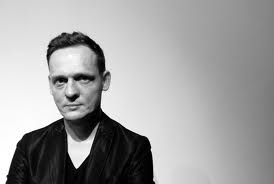
R: What would be a concrete example of that?
C: Badly programmed software for instance really good example -buggy software. I had a bunch of musicians who always have this great story of a broken synthesizer finally producing something that they’d never heard before, and then they recorded it. Or the elph project, the ghost in the machine. We all know that. And in the beginning, in terms of music, I was forcing software, it was very easy 5 or 6 years ago, I was forcing software to crash. There was a moment there, when software was better than machines. Now it’s the opposite – machines are better than the software. Which means it’s not so easy to force the application to break down. Before the G3, it was very easy to collapse something, and make the software not do the things it was supposed to do.
For example, for the collaboration with Ryoji Ikeda we used the idea of changing file formats. And through changing the file formats, you produce overtones, and other strange things happen. We all know what happens with a rough MP3 – it adds this real thing. In a way we used this thing. And later I used this in the Xerrox project – you copy the copy the copy, then you get it more rough, like an old copy machine. The new ones are really good again; it’s not as successful any more. But I bought an old copy machine to make these movies about copying onto black paper. And it’s interesting how it graduates from a white piece of paper into a black piece of paper. I was interested in the process of forcing things into a process. And many of my installations are involving these mechanisms of… When I’m inventing a principle, there is one little sculpture I did; I bought 300 table tennis balls, and a balloon. And I put all these balls in the balloon, and you have this strange balloon with hundreds of table tennis balls, and then I just pushed one side and they shaped differently. And I gave it to a company that does bronze casts, and cast them in a chrome steel. And then I got the model back, pushed it again, and got them to make it again. It was more the principle I was interested in. And you can produce hundreds and hundreds of different shapes. This principle is really… I like this idea of finding more principles rather than final results.
[page break]
R: Do you spend a lot of time playing around with physical materials?
C: Actually I have a lot of knowledge about materials, maybe because I studied architecture, but I was also playing about… I do research about materials always. But most of the projects happen in my head. And I’m thinking about it, and say, this has to work like this. And then of course you’re testing things. Just now I’m building three new installations for New York in May. And the idea is how to construct moirés. It’s a phenomenon that you can produce, but you need to know how the principle’s working – from a specific angle they appear, but from another angle they disappear. So I read all these books, and we are going to publish a book about how to produce a moiré… I’m constructing these installations, and we never tested them, but I know it’s going to work. I’m making the drawings… I have a little workshop, and people are helping me, assistants…
C: Sure, that’s one of the main reasons I moved and became so interested in sound – music came much later – it was basically that I wanted to have a material that incorporates time. I was always fascinated, and it was always the dream of the artists of the 20s, let’s change time. Let’s make a piece where we can shape time differently. There are a lot of movies as well about perception of time. And we can change our perception easy, but what is time, and how can we deal with this, it’s great. And at the same time I experimented with sound, and I realised, wow, it’s a sculptural material actually. And it has this immateriality, which I like, it’s numeric, and it sound can only exist if there is space and time. These two elements need to be to there otherwise sound disappears. So sound is a sculptural material. There’s one installation, it’s very simple, it builds this invisible membrane in the middle of the room, just having two speakers facing each other, and actually it’s the same sound, but playing a noise, white noise, out of this other file, the sound file is phase embroixered[?]. So if there’s a perfect absorption, this kind of theoretical moment is not a space, it’s a membrane. So you go from, when you stand between the speakers you go from one side to the other, and it’s like someone turns your head, or you are moving form one room into another room. I love this piece, it’s very simple, and I love building this kind of sculptures with sound.
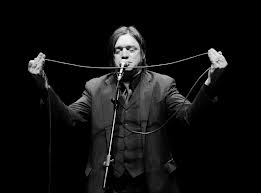
R: Could you talk about operating, as you do, across the very different economies of art and independent music?
C: It’s totally different of course. In the art world you are selling one piece, in the music world you are selling as many pieces as possible, to match your price. What I like on one side, is that you are producing a piece that only one time exists, and this singularity and solitude is the whole story of being an artist. I like this, because I have these moments when I really want to be in this space. But I like the other part too, that you can distribute ideas, and that’s what I say – we are not distributing CDs, we are distributing ideas. And we all know that to sell a CD is a strange situation, we don’t know what will happen – maybe it will disappear, maybe it will recover, be rediscovered. And I always thought it is really great to distribute ideas – and whether the internet of peer to peer, it doesn’t matter to me. It has a great democratic level that everyone can really share. At the moment the art market is really in focus for some reason. It’s not really true, because art happens outside the art market. The market is only where the economics is happening. Small independent spaces, they still exist and they are doing great jobs, and this is the place where things are happening. It’s only press attention on big auctions at the moment.
R: Is there a particular focus in your research at the moment?
C: Right now there are two projects. I just finished the moiré. And, maybe you know, I did a book on grid systems, with a publisher of design books. And it was a really successful book, sold 10,000 copies. Now second printing. And the same style, I publish a book about moiré. And there is a third book coming, finally we made it with Ryoji, the Cyclo, and we are producing a ‘Cyclopedia’ in a way, about phase correlation, sound in imagery, about what sound can create what image. It will be a dictionary about a sound and what image a sound will produce. So, we’re producing these thousands of images at the moment.
Oscilloscope is the waveform, but we are also measuring how they are out of phase. It’s the device you usually use for mastering, to avoid strong phasing problems for cutting vinyl, for instance. And we are using this device as a creative tool. Recreating what a mastering engineer would say, ‘fucking hell, how can I avoid that?’ And this is a project we started ten yeas ago, and finally we will publish the book at the end of the year.
C: It’s very interesting. In the beginning, I was more struck by this visual phenomenon. But then actually doing this research, I realised that the superimposition of line and dot colours and similarities to optical magnification and transformations. They work almost as a lens. And I found this really interesting because it shows one thing is, you have superimposition of 2D producing a 3D effect. When you move them, you see 3D. It’s only 2D information, making us think it’s 3D, so it’s adding one more dimension.
And the really interesting thing is, that what makes it 3D is obviously our perception, and then how is our perception working, and why do we perceive it as this? But at some point, there’s this big question – is it our perception or is it reality? And this is really a good question, I’m really interested in this. Do we see it magnified, or is it only constructed, we are building it in our brains.
I am really in this maelstrom of quantum physics at the moment – it’s breaking down a whole way of how you see the world. It’s so different.
BB: Read Arthur Tsaying – The Entwined History of Light And Mind.
C: I think there are a lot of things especially when you are an artist, you know it exists, but… you have this beautiful world of ether… what is it? And quantum physics would actually explain that!
BB: There’s this concept of Phlogiston – some matter that has been constructed to explain physical phenomena that were not explainable. [Consulting iPhone] “Phlogiston posits the existence of a fire like element released during combustion. To explain rusting, burning; a substance that burns.”
C: I’m in a deep-shit place. On the one hand I’m really into physics, but I also love thinking about philosophical questions, like what is the world about, what surrounds us? Those are the main questions.
R: Do you ever find these thoughts drawing you towards mysticism?
C: Quantum physics would even explain this! And it’s probably the most revolutionary discovery, but we are having a theory in front of us that can maybe revolutionise our understanding of the world, but we cannot understand it. And then you come to this great sentence from Wittgenstein, from one of my favourite books, when he is saying; only what you can think of exists.
BB: “Welt ist was der Fall ist”.
C: … “The world is what is the case.”
(Source: http://www.thewire.co.uk/in-writing/interviews/carsten-nicolai-unedited)
> INTERVIEW WITH JUNTARO YAMANOUCHI (THE GEROGERIGEGEGE) (1992)
Note: From RRR’s RRReport magazine and compact disc (NOISE & JUNK OMNIBUS (RRR CD03) featuring The Gerogerigegege “Violence Onanie”), 1992.
 From Tokyo with Love – The Gerogerigegege
Replies by Juntaro Yamanouchi, Head of the Gerogerigegege
[note- the questions weren’t printed in the issue]
I organize a rock band called the Gerogerigegege and perform noise. The one who has stripped himself naked is Gero 30, 51 years old. He has been a member of our band since we a organized a band and likes to show his naked body in public. We are not afraid of the police, and hurting the others doesn’t bother us too much.
We could make love on stage at any time if we want to. But we are not interested in doing it. We prefer to experience something more exciting and thrilling feeling like we feel when we are doing masturbation.
A part of Shinjuku area in Tokyo become a popular street for gays since 1960s. There are more than gay bar in this area. The Gerogerigegege was organized for the show at the membership SM Club. We are for homosexual love but not willing to get involved with any activities.
We have the O.C.C.U.R., the association for gays in Japan (this is not a musical band). But gays here in Japan seem to have no guts to parade like gays do in the U.S.A. I think that you will see more progressive attitude in
the Gerogerigegege show.
First of all, gay people are not frank in nature. If they try to hide who they are and to avoid associating with straight people, it is kind of natural that they are discriminated and looked down. I am always in a woman’s dress but nobody can tell I am gay. Because I have been very open about it and living as a woman without any problem.
I have known nobody who died of AIDS among friends of mine. Beside, talking about AIDS is already out.
Some journalist accused me for producing a record that was influenced by leftism. But I never intended producing such a kind of record nor expressing an idea of it in that record.
There was no problem at all. We Like the Ramones a lot. You Will see if you listening our CD “Tokyo Anal Dynamite”.
I believe that we have the best sales of records / CD and the greatest popularity in Japanese noise / industrial music. It’s because that the Gerogerigegege perform a variety of music and appears on musical magazines ad TV programs. I also work as a composer and get royalty from record company. We made 3,000 copies of “Tokyo Anal Dynamite” last year (1990) and have sold more than 2,800 copies up to now here in Japan. The rest of market for our music are RRR and Holland. Our first two LP “Senzuri Champion” (1987) and “Showa” (1989) had a price of 20,000 Yen ($142) at the used record store. And I have heard that it was already sold.
We organized our band in 1985. The first show we had outside of SM Club was October 1986. It was one of activities for student involvement by Japanese university Waseda. We performed the auditorium of Waseda University with the member of me, Gero 30, two men from Grim (ex White Hospital), and Mr. Elle from C.P. Formal member of the Gerogerigegege are me and Gero 30, but more than 30 people have helped and supported us to have a show up to now. We have a show at club (not SM Club) about two times a month.
No comment.
On June 1988, we announced on some musical magazine to have a show in Enoshima Beach for celebrating the first come out of flexi disk. And we poured gasoline and burned 2,000 copies of flexi disk in front of the audience. It was used for the cover of some music magazine.
Since we produced our first LP, “Senzuri Champion”, we have been able to get
into the field of rent CDs since last year (1990). And everything seems to be on the way.
Vis a Vis Audio Arts is a legal establishment approved by the Japanese constitution. The Gerogerigegege earns 90% of total sales. In another word, I make my living letting Gero 30 do masturbation on the show at show.
(Source: http://www.artnotart.com/gero/info-int.rrr.html)
K2/GX – Convulsing Vestibular Album Review By Julien Héraud (improv sphere)
30 ans après leur première collaboration, les deux artistes très noise K2 (Kimihide Kusafuka) et GX Jupitter-Larsen reviennent avec un excellent split sur CD, publié par la label singapourien 4iB Records. 30 ans après, ça ne rigole toujours pas, et ce disque n’est toujours pas à mettre entre n’importe quelle main.
K2 ouvre le disque avec trois pièces dignes de la réputation de la japanoise. Kusafuka utilise pour ces pièces un piano, un violon électrique, une table de mixage en larsen, un monotron, une boîte à rythme analogique, et un MTR. Je ne connais pas trop le travail de ce dernier, mais à l’écouter, on dirait une rencontre furieuse entre Merzbow, Masonna, Incapacitants et Gerogerigegege. Du pur harsh noise tout ce qu’il y a de plus sauvage : larsen, clusters, ruptures constantes, une boîte à rythme gabber, dissonances, saturation maximale, intensité et densité toujours plus forte et large. K2 propose trois pièces d’une violence inouïe, trois assaults sonores d’environ dix minutes chacun mais qui ne se différencient quasiment pas. Il s’agit de pure musique bruitiste et japanoise, dans la grande tradition des années 80 et 90 : on prend quelques instruments, on les trafique, on les amplifie, et on joue le plus fort et le plus rapidement possible. En tout cas, dans le genre, c’est vraiment réussi : on est au bord du supportable, mais on ne s’ennuie pas. Très bon.
Quant à GX Jupitter-Larsen, il ne propose qu’une longue pièce d’environ vingt minutes. Une très belle composition qui commence avec une boucle tribale et hypnothique de 10 minutes. Ca ressemble à une espèce de drone dégeulasse fait à artir d’une cassette mis en boucle. Une sorte de rythme tribale qui peut en fait être fait avec n’importe quoi, un rythme lancinant, constant, immuable, sale, non agressif, avec quelques fréquences fantomatiques dans le fond. Puis la seconde moitié du morceau est constituée d’un long drone avec une fréquence grave unique. Juste une sorte d’oscillateur, avec une fréquence carrée ou rectangle, presque sans enveloppe, sans filtre, une fréquence simple, épurée, monotone, continue, et toujours aussi hypnothique. Jupitter-Larsen continue de travailler sur la constance, le minimalisme, les blocs de son, l’épuration et la simplicité, pour accéder à des états de conscience uniques. Et c’est pour ça qu’on l’aime. Excellent.
(Source: http://improv-sphere.blogspot.sg/2014/03/k2gx-convulsing-vestibular.html)
> MAURIZIO BIANCHI MEETS ROADSIDE PICNIC Album Review by Mark Barton (The Sunday Experience)

Strictly limited to just 250 stickered copies – ours being #154 – via the Singapore based imprint 4iB Records, the latest release bearing the ominous aural autograph of Justin Wiggan finds his explorative sound art alter ego Roadside Picnic paired up with the Italian godfather of industrial and out there technological sound advancement Maurizio Bianchi for what is, even by Roadside Picnic and Dreams of Tall Buildings standards, a colossal sonic immersion into sounds un-chartered inner space.
Comprised of two lengthy and starkly contrasting suites this face off charters the disquieting voids of dark ambience. For those with meeker palettes the atmospherically chilled 24 minute ’dictatorship of dead labour’ might prove the preferred listening option. Graced with a disquieting chill that doefully permeates throughout. What first appears to sound like the equivalent of the lost sea scrolls transcribed into binary signatures and locked in a time capsule hurled forth through the endless cosmic seas from a long since dead star quadrant situated far beyond the reaches of mans eye soon translates to something akin to walking through some sand storm blizzard only to happen upon a calmed place wherein before you the hallowed ruins of a once mighty civilisation now reduced to deathly decay. Haunting and uneasy in terms of listening appreciation it evokes images of spirits trapped and damned, cursed forevermore to relive their worst days until salvation shows mercy. Here a strangely tranquil spiritual calm weaves through the grooves with the appearance through the sun bleached haze of whispering vestiges of lost archaic Tibetan ceremonial folk tongues buried deep in wells of hiss, and though we are prone mention noise manipulations, frequency adjustments and sonic skree clouds, its not your occasionally expected sonic brutality that emerges here, instead something far more disconcerting that connects with your primal instincts more so an ingrained ancestral flashback to our past or indeed as the case might be a future vision of ourselves in a future to come, whatever the case there’s no denying the haunting dread impression it leaves in its wake. Of course should sonic terrorism be your bag and chosen listening poison then ’the clearing’ might well prove a testing examination of your tolerances.
At 40 minutes in length ‘the clearing’ appears to be sub divided into several distinct movements – from the of it falsely lures you deep into its lair by way of its opening greeting of chilling atmospherics, leviathan like textures and bleak ambient curvatures and from therein everything is sombrely serene until that is without warning tripping the 4 minute your suddenly buried deep an under siege by a white hot caustic cauldron of harsh noise whose only remit one assumes is to fry the contents of your headspace whilst clearly melting your ears as it seeks to enter the power electronics sanctum of Merzbow. Afforded no hiding place the intensity is pitched at levels where animals cry and speakers literally splinter, both crude and unforgiving its noise at its purest undiluted form. Once satisfied that your listening tolerances have been bleached into submission everything abruptly halts and at the 13 minute the ambient folds which greeted us upon our entrance re-forge though this time graced in reality fracturing psychotropic dream states before again terra-forming at the 24 minute point to emerge into something truly tranquil and meditative and seductively framed in all manner of gaseous shimmers and cosmic tides whose elegantly stilled neo classical appreciation admirers of both old school Tangerine Dream and new school Hibernate recording subscribers might find a common head nodding ground.
(Source: http://marklosingtoday.wordpress.com/2014/03/22/maurizio-bianchi-meets-roadside-picnic/)
> STEPHEN O’MALLEY Interview By Jonathan Keane

Meanwhile, Sunn O))) are never ones to rest with their own work, with a new EP entitled ‘La Reh 012’ just out.
Sunn O)))’s Stephen O’Malley tells Jonathan Keane how the drone stalwarts came to work with Ulver and what he’s currently working on for the new Sunn O))) full-length.
***
‘Terrestrials’ has been in gestation for some time. You even made mention of the collaboration in interviews about two years ago. How did you and Ulver come together for this record?
I’ve been friends with Kris from Ulver for many years actually, since the early to mid ‘90s and we worked on a few things together over the years.
I interviewed him back in the ‘90s for magazines and [Ulver] produced a track for us in 2003 around the ‘White1’ session and we also played in another group together called Æthenor through the mid-2000s.
So, over a period of that time Ulver changed immensely, many times of course. Sunn O))) began and we continued on our arc as well but we always kept in touch, Kris and I.
So anyway there’s a moment where Sunn O))) was invited up to Norway to play a festival in Oslo called the Øya festival, which takes place each summer in this big park next to a fjord.
We accepted that offer to go up there and Kris got in touch and suggested that we spend a few more days in Oslo, work in their studio and try and make something together. That was the genesis of this project.
It’s pretty simple actually [laughs] but also a good opportunity to try and do something cool and creative together. Ulver have a pretty nice studio called Crystal Canyon and the timing was right.
[Sunn O)))] were just doing the one concert, one-off event, so we had time around it.
The mood was right, we got together and worked on some foundations for a bunch of tracks and then went our separate ways.
Eventually the Ulver guys worked on some preliminary arrangements and mixes using the tracking. We tried to get together to work on the production.
That took a while because we don’t live in the same country and everyone’s just really busy.
I got to be honest, for a while it wasn’t a priority. It was something we were doing because we enjoyed each other’s company [laughs] and we enjoyed the music but it wasn’t like the new album of either band.

It didn’t have that urgency to it. Also, I think the music, the pacing and the feeling of the music itself kind of suggests that too.
It’s not an urgency is what I mean, it’s something you can let yourself sink into and focus. So over a couple of years I had several opportunities to go to Norway and each summer I went to Oslo.
Given that you were living in different countries, did this separation and distance affect the end product at all in your view? Was there ever a risk of the record becoming disjointed because of gaps between sessions?
No, I wouldn’t use the word disjointed at all.
It takes time but a lot of records take time too. Opposed to the idea of it being disjointed or separated, we were actually taking the time so we could work on it together rather than work on it apart from each other because we could have easily have done it in our own studios and sent each other mixes and worked on it independently but we wanted to be in the same place where it’s really important with the production.
That’s vital for making music. It’s only actual when you’re in the space together. We took the time to make sure we were together when we were working on it. Over time of course your perspective changes, your taste grows, your interests move around so it brought a lot of ideas to the table too.
The album is largely instrumental save for moments like ‘Eternal Return’ where we hear Kris’ distinct vocals. What can you tell us about the lyrics and, broadly speaking, the themes behind ‘Terrestrials’?
I’m not one to talk about the lyrics, they’re sort of the realms of Kris and Jørn form Ulver. It seems to be missed by everyone but there are vocals on the first track as well, ‘Let There Be Light’.
Kris is doing a sort of low mantra. It’s kind of working with the idea of spectralism, which is an area that Sunn O))) is interested in with ‘Monoliths & Dimensions’.
It’s also an area I’m personally interested in in a lot of my music. The lyrics that Kris is pronouncing on ‘Eternal Return’ are far palindromic and a sort of biblical theme. I’m sure I’m reducing it somehow [laughs] by misinterpreting it. Kris and Jørn are really poets.
Do you have any aspirations to get together to play material from ‘Terrestrials’ live?
Well, congratulations. You’re asking the question that every interviewer has asked [laughs].
We’d be remiss not to ask.
Which is very nice. It shows that the music is compelling. To answer you quite frankly, I don’t know.
It would obviously be a big production to put together and a challenge logistically but it’s possible, we’ve done bigger things, more complicated things before. But I don’t know, we don’t have a plan yet.
I suppose if there’s an opportunity [that] arose to help us do that, we would definitely consider it.
Outside of ‘Terrestrials’, what can you tell us about the status of Sunn O))) right now and possibly a new album?
Sunn O)))’s actually working on another record right now and we did a big tracking session in January in London, focusing just on guitars at that time. There’s actually a session going on right now.
I’m not at it. That’s going to be announced later this year, that’s going to be pretty amazing.
It’s going to be an amazing record. I can’t really talk about what it is yet but it’s a major project for us. [It’s] something we’re really enthusiastic about but I don’t want to spill the beans before it’s ready [laughs].
Even bigger than ‘Monoliths & Dimensions’? That was a pretty monumental record for you guys.
That was a monumental record for us. I don’t really want to compare records like that, it’s too complicated to do.
I can just say that this next record is extremely important for us. The people we’re working with are really on an incredible level and it’s going to be something very different too.
I think people will be excited, especially if they like the progression we’ve gone through over the years.

You have a UK solo tour coming up in April, though no Irish dates. It’s been a while since you’ve been here, whether by yourself or with Sunn O))).
I was actually trying to get some shows going in Ireland on that tour but it didn’t work for some reason.
I’m doing some solo concerts over the years, it’s really minimalist guitar stuff, it’s really loud, sort of structural drone guitar music. It would be nice to do that trip. We’re travelling together with a really great French band called Aluk Todolo, who are also instrumental but they’re a three-piece, drums, bass and guitar, and their music’s awesome.
It’s kind of black metal but it’s pretty informed by bands like Neu! or Faust, this Cologne ‘70s scene.
We’ve done a bunch of shows together over the years, in France mainly. It’s going to be a fun tour, most of the venues are definitely smaller than where Sunn O))) would play but that’s not an issue at all.
We’ve actually done shows in France in castles, caves or these kind of weird bunkers and stuff like, more obscure locations than rock venues. We’re playing in a church in London. That should be pretty cool.
I’ve actually done a couple of tours over the years where we tried to get some Irish shows.
It doesn’t come together for some reason. It’s too bad. Like playing Dublin, Sunn O))) has played over there and we’ve even played in Cork and stuff like that and Galway and that was 2004 or 5.
[That] was the last time we went over there. I played at this festival in Dublin called DEAF [Dublin Electronic Arts Festival], a sort of electronics festival.
I was playing with Nurse With Wound on the same bill. That was the last time I’ve been over there, hopefully sometime in the next couple of years [we get back].
– Interview by Jonathan Keane ::: 20/02/14
(Source: http://www.metalireland.com/2014/02/21/stephen-omalley-sunn-0-interview/)
 4iB Records | For intrinsic Beliefs
